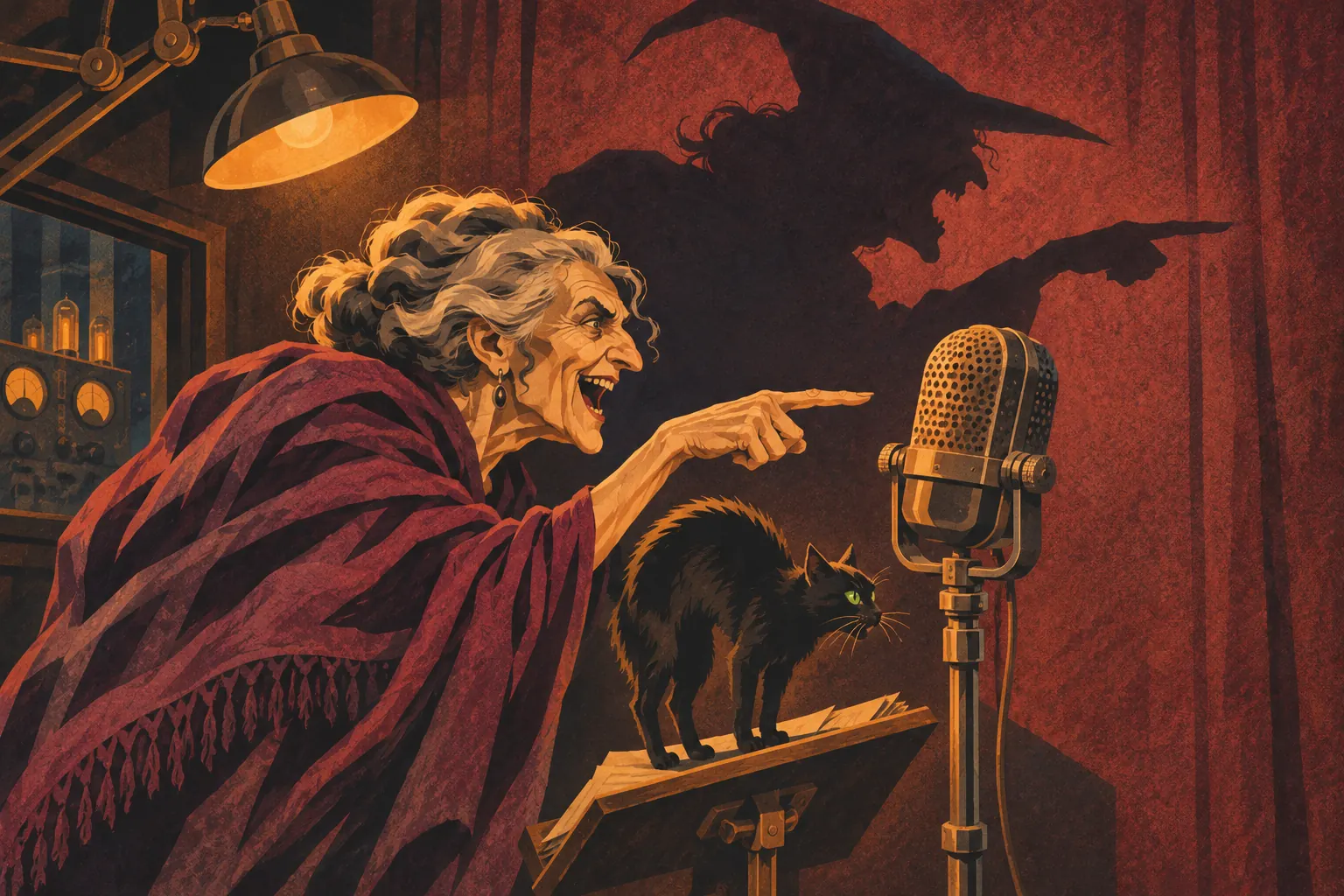
In June 1931 Dorothy Kardel, radio columnist of the New York Daily News, heard an old witch called Nancy tell her tale over WOR for the third time, and admitted it had “succeeded in working me into a sweat”.1 Almost nothing she heard can be played today.
A witch for the late hours
The man behind the witch was Alonzo Deen Cole, born in St Paul, Minnesota, in 1897. He won a statewide schoolchildren’s competition at eleven and a first prize at the Minnesota State Fair for the scenario of a military pageant, finished school at sixteen and went on the stage with stock companies, before serving as a medic in the First World War and ending up in the army’s entertainment section in France.2 Back in New York he worked in vaudeville and the theatre with his wife, the actress Marie O’Flynn, and the couple played a daytime serial on WOR called Darling and Dearie, which ran for a little over a year.2
Cole’s next idea was a harder sell. Rival stations filled the late evening with music, and he proposed that WOR counter them with something nobody else was offering, a weekly drama of the supernatural.23 WOR, the New York station that would later serve as the flagship of the Mutual network, agreed, and The Witch’s Tale went on the air in the spring of 1931.4
Exactly when is less certain than it ought to be. Wikipedia, and a Radio Spirits biography of Cole reposted on the blog In Search of Alonzo Deen Cole, give the first broadcast as 21 May 1931.25 A 1999 review in the trade paper Radio World, the oldradio.org history site and the writer Joe Pavlansky all give 28 May.146 Kardel’s column of 12 June offers a clue.
If the programme went out once a week from the start, a third broadcast on Thursday 11 June fits a first night of 28 May, and one surviving list of recordings does include a story dated 11 June 1931.17 That is an inference from the calendar rather than a record, and only a contemporary WOR listing will settle it. In the same column, according to the Radio Spirits biography, Kardel told thrill-seekers that they were missing plenty if they failed to tune in.2
What listeners heard first was the witch herself. Each week an announcer handed over to Old Nancy, the Witch of Salem, who cackled, gossiped with her black cat Satan and then introduced the evening’s story.5 Her standard greeting announced her age, “A hundred and 17 year old I be today”, and it followed an orchestral recording of a piece called Orgy of the Spirits, whose composer is named as Leginski on one fan site and as Alexander Ilyinski by Pavlansky.13
An early script placed Nancy Holcomb in Salem, Massachusetts, where a young man called Tom came to visit her, and that frame, a visit to an ancient woman with a long memory, carried every story that followed.3 Burgan’s 1999 review reprinted part of the opening from 8 February 1932, in which Nancy, cackling, begins by ordering a candle to be put out.6
Salem in a New York studio
The Witch’s Tale was made by a small company that Cole ran almost single-handed. He created the series, wrote it, directed it and played the male leads, and he also supplied the yowls and purrs of Satan.35 O’Flynn took the leading female roles, and the regular supporting players were Mark Smith and Alan Devitte.5 Miriam Wolfe, who joined later, remembered Smith as an enormous man, six feet eight and 280 pounds, and recalled Devitte’s false teeth threatening to fall out while he acted.3
Every broadcast was live, and Cole’s scripts were not always the right length. When an episode overran he wrote extensions on the spot, and he sometimes rewrote the second half of a story at home between broadcasts.3 The actor Jack Beck recalled Cole handing out script changes in the middle of a broadcast.3 Some stories were split across two or three parts, and many were repeated with small changes.1 The dates attached to surviving recordings suggest that the programme moved from Thursday to Monday nights during its first summer, with stories dated to Thursdays in June and early July 1931 and to Mondays from August onwards.7
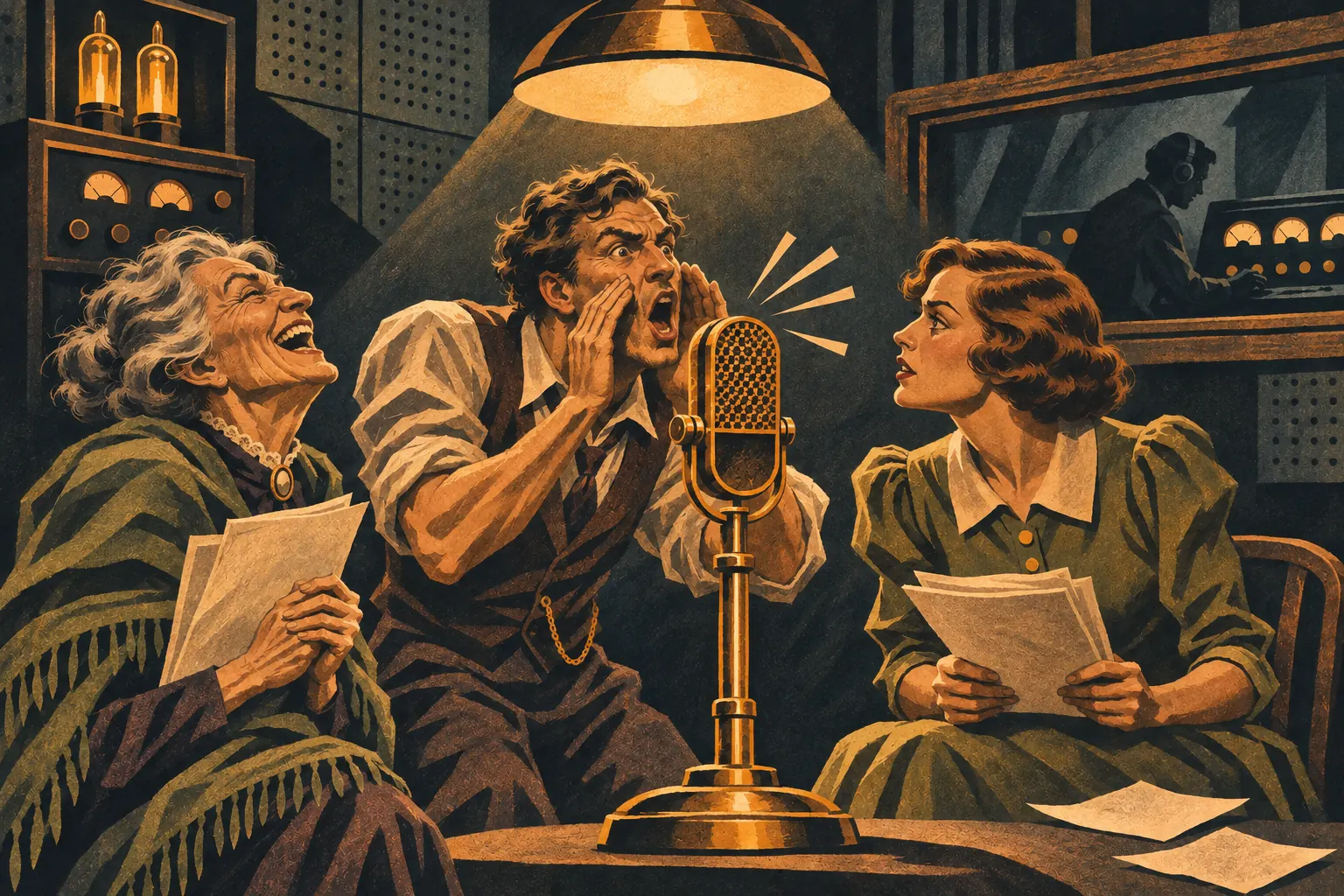
Over seven years Cole wrote 332 scripts, kept bound copies of them all and copyrighted the stories, which may have made him the first radio writer to do so.3
Most of the scripts were his own inventions, but he also adapted literature. The surviving lists include Prosper Mérimée’s story as “The Bronze Venus” in 1931, Robert Louis Stevenson’s “The Bottle Imp” as “The Wonderful Bottle” in 1934, a version of “The Flying Dutchman” and an adaptation of Frankenstein.5 According to Pavlansky, Frankenstein was first broadcast on 3 August 1931 and repeated on 7 March 1932 and 17 July 1935.1 The dates of other adaptations are disputed. Wikipedia puts “The Flying Dutchman” in 1934, but an Internet Archive collection of recordings dates a performance to 1 February 1932.57
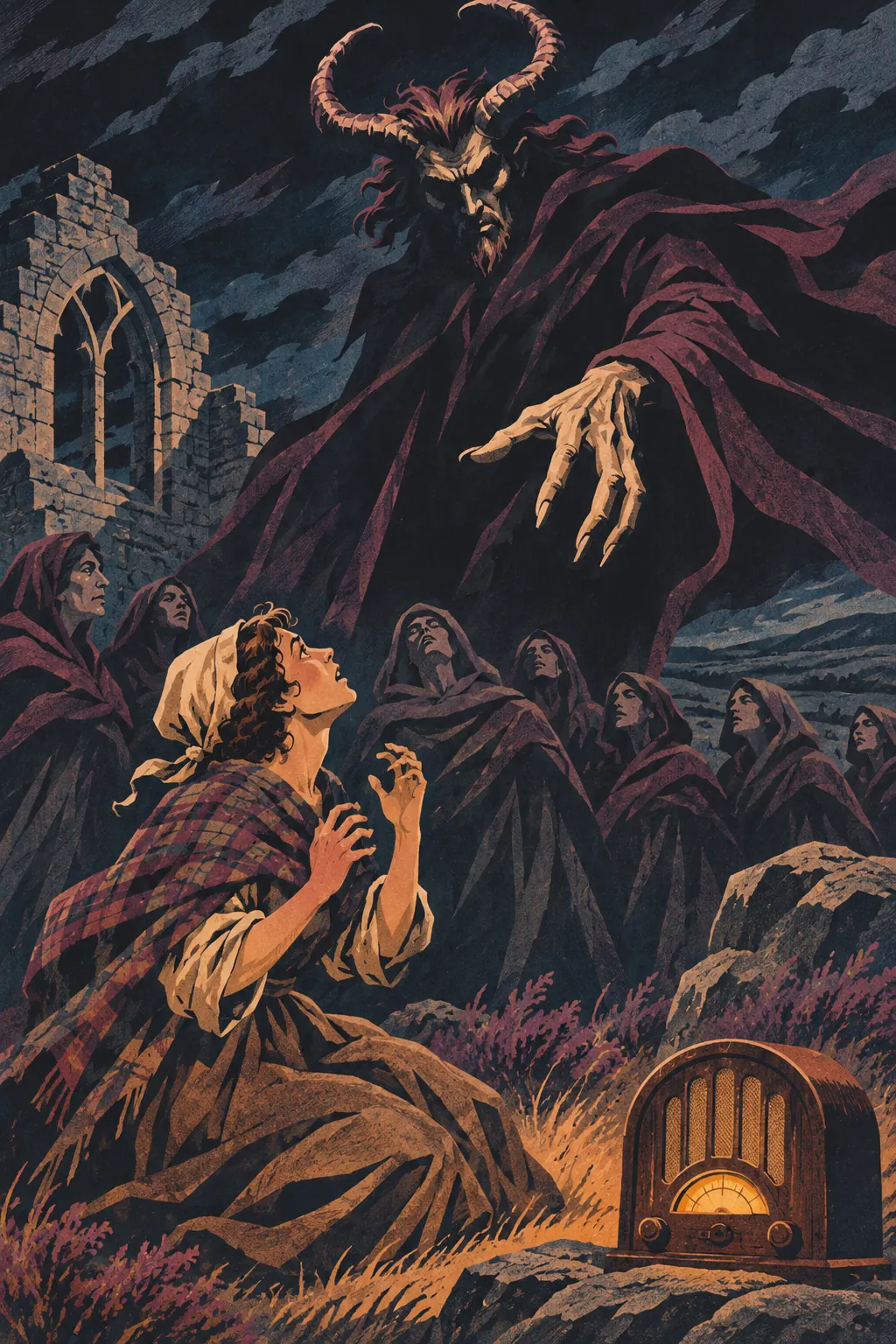
The original stories drew on the pulp magazines of the day, with vampires, werewolves, jungle curses and the occasional monster.3 Martin Grams, a historian of American radio who has researched the programme for years, lists among its subjects a severed hand, werewolves and ghosts.8 The darkest material came from history. “In the Devil’s Name”, first heard in 1932, was based on the confessions of Isobel Gowdie, a seventeenth-century Scottish woman who confessed to witchcraft.5 A recording dated 31 October 1932, a Halloween broadcast, preserves the first part, and only that first half is known to survive.57
Finding a new Nancy
The first Old Nancy was Adelaide Fitz-Allen, a veteran stage actress. Her name appears in several spellings, including Fitz Allen, Fitzallen and Fitz-Allan, and so does her age. The Radio Spirits biography says she was 75 when the series began, Radio Stars magazine put her at 78, and fan histories say she died at 79.239 The sources agree on the date of her death, 26 February 1935, which left Cole with a programme whose star could not be replaced simply by reading the same lines in a different voice.12
The search that followed is recorded in contradictory ways. Radio Stars, in a profile catalogued among its issues of late 1938, said that Cole auditioned nearly a hundred actresses and first chose Mildred Holland, another retired stage veteran in her seventies.9 Pavlansky writes that three different actresses played Nancy over thirteen performances, among them Martha Wentworth, and Wikipedia also lists Wentworth as an occasional Nancy.15 The arrangement did not last. The part went to Miriam Wolff, a child actress from Brooklyn who had been recommended to Cole by Nila Mack, the creator of the children’s programme Let’s Pretend.210
Wolff, who later spelled her name Wolfe, was born on 2 January 1922, so she was thirteen in the spring of 1935.10 She was no novice. She had made her radio debut at four on The Uncle Gee Bee Kiddie Hour on WGBS, and at six she had played the First Witch in a children’s production of Macbeth.10 The sources still disagree about her age at the audition. Her Wikipedia biography says twelve, the Radio Spirits account thirteen, and Radio Stars said she had been eleven when she began.2910 By one account she auditioned at midnight, after a broadcast, and Cole hired her on the spot.3 Wikipedia says it was her cackling laugh that won the part.10
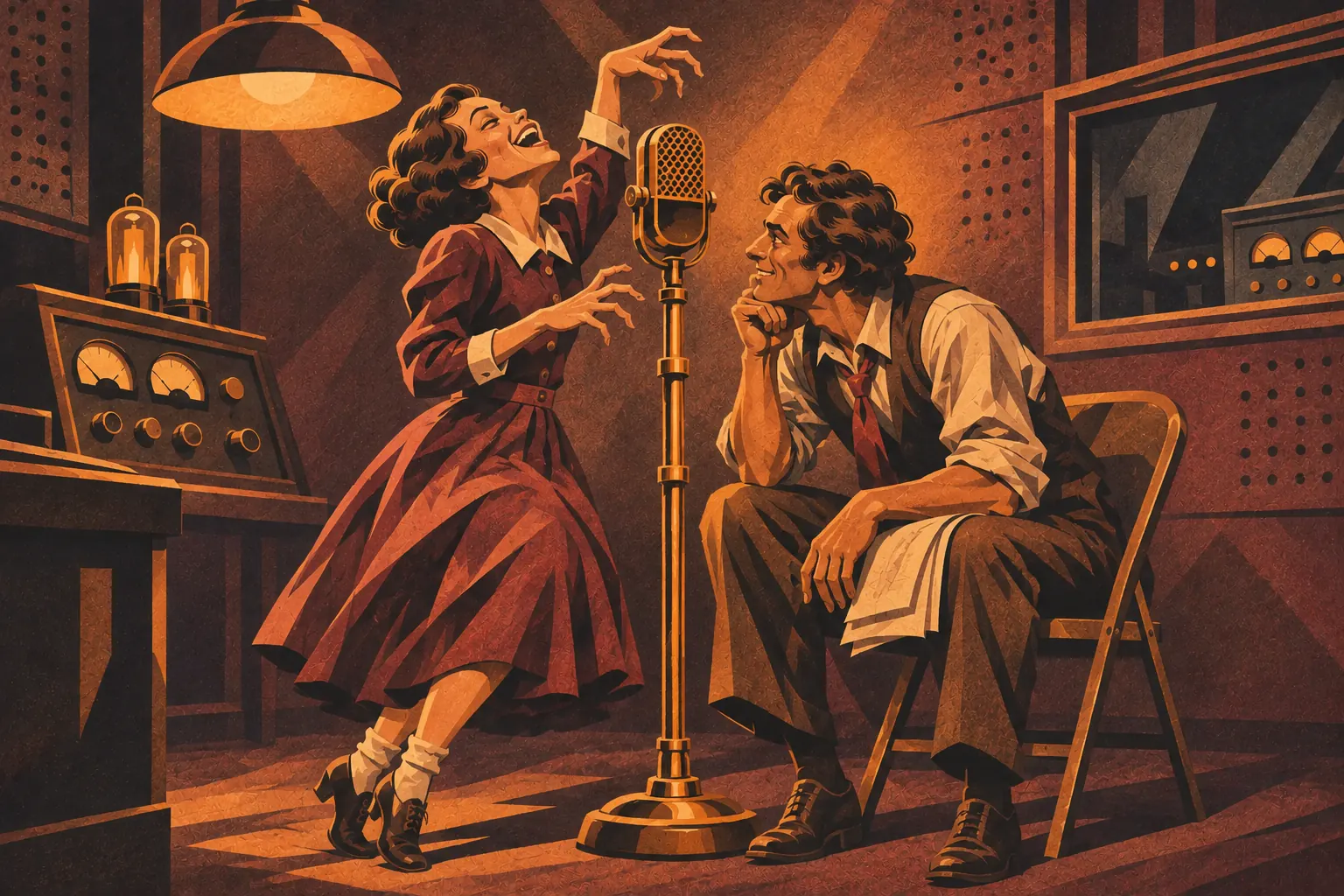
Cole knew what he had. Radio Stars described a hoarse and cackling voice coming eerily from the loudspeaker, and reported that Cole had “consistently refused to publicize the fact that Miss Wolff is a child”.9 Grams suspects that most listeners assumed an elderly woman was playing the part.8 Wolff stayed with the role until the series ended, while also working in the repertory company of Let’s Pretend, which she had joined in 1934 and where she spent years playing witches, queens and spirits.10
Did anyone hide behind the sofa?
Later descriptions of The Witch’s Tale are full of terrified listeners. The modern reissue of its scripts says the stories “frightened a generation” of listeners, and a 2000 obituary of Wolfe in the New York Times, as reproduced on the Cole blog, said that her cackle “sent chills over the airwaves”.211 Both were written decades after the broadcasts, and neither cites a listener.
The contemporary evidence that turned up in research for this article is thinner but more interesting.
Kardel’s column of 12 June 1931 is the earliest, and her sweat was a reviewer’s compliment, offered by someone paid to listen.1 By 1938 Radio Stars counted the series among the oldest serious dramatic programmes on the air, and its profile shows that the magazine thought Nancy’s voice was the attraction, and that Cole thought the illusion of her age was worth protecting.9
An Australian paper, the Brisbane Telegraph, told its readers in 1947 that the series was “not the sort of radio program the timid would enjoy”, a sentence that implies a reputation and was also, of course, publicity for the show.12 No letters from frightened listeners, complaints to WOR or reports of nightmares were found in the sources consulted. That gap may reflect what has been digitised rather than the nerves of the audience, but it means that claims of a terrified public rest on later memory.
The programme belonged to a moment when radio was still working out what to do with fear. Wikipedia calls it the first horror drama on radio.5 The communications scholar Matthew Killmeier, whose 2012 study “Aural Atavism” is devoted to the series, argues that “the genre of horror did not exist per se in the 1930s”, and the researchers Alyn Euritt and Leslie McMurtry count The Witch’s Tale among the first radio horror programmes to make use of the darkness in which people listened.13
By the middle of the decade it had company. NBC’s Lights Out, which began in 1934, became notorious for gruesome sound effects, and radio horror of this kind was often criticised for its vivid effects and gory storylines.13 The theatre scholar Richard J. Hand, quoted in the same study, has described the genre as a guilty pleasure for its listeners.13 Cole’s witch, with her cat and her cackle, was older-fashioned than that, closer to a ghost story told by a grandmother than to the crushed bones of Lights Out.
A witch in print
In late 1936 the witch moved briefly onto the newsstands. The Witch’s Tales, a pulp magazine edited by Cole, appeared in November and December 1936 and promised its readers weird, dramatic and supernatural stories.15 Its title added an “s” to the radio programme’s, a difference that the blogger behind In Search of Alonzo Deen Cole noticed in a period advertisement.2 It lasted two issues.5
The magazine is one of the few places where a Witch’s Tale story can still be read in a form its audience might have met. The Cole blog has posted scans of the December issue, the second and last, together with a 1936 booklet and image posts titled “Graveyard Mansion” and “The Were-Wolf”, though the scans carry little transcribed text.2 Whether the magazine stories were broadcast scripts turned into prose or new work is not clear from the material examined.
Discs on the road
The last broadcast went out on 13 June 1938, after 332 episodes.26 The programme’s life on the radio did not end there. Like many shows associated with Mutual, it had been recorded during live broadcasts onto acetate discs, and Cole used those recordings to sell the series to other stations.3 The Radio Spirits account and the 1999 Radio World review both say that syndication kept the programme going for another six years, and Pavlansky dates Cole’s withdrawal of the series to 1945.126
The programme also travelled abroad, and here the trail runs to Australia. The National Film and Sound Archive of Australia holds an episode titled “All Hallows’ Eve”, catalogued under the year 1941, which it describes as written as a Halloween broadcast and adapted for Australian radio by the Sydney producer and writer E. Mason Wood.1214 The AustLit literary database records a children’s book drawn from a long-running Australian radio serial called The Witch’s Tale, dated 1940 to 1951, though the entry does not say whether that serial was Cole’s.15
The Radio Horror Hosts site notes that some recordings now circulating, among them “Haunted Crossroads” and “Tourists Accommodated”, are Australian remakes of Cole’s scripts.3 Anyone listening today should bear that in mind, because a recording labelled with an American date of 1932 may carry an Australian Nancy and an Australian cast.

The bonfire of 1961
Cole kept working after the witch retired. He wrote for The Shadow and Gang Busters, and in 1943 he signed with CBS to write, produce and direct Casey, Crime Photographer, which began on 7 July 1943 and ran, under several titles, until 1955.2 He did not forget Old Nancy. In 1958 Television Programs of America planned a television Witch’s Tale with Cole as consultant, but the pilot never sold.25 Pavlansky says a pilot was filmed and that its quality was poor.1
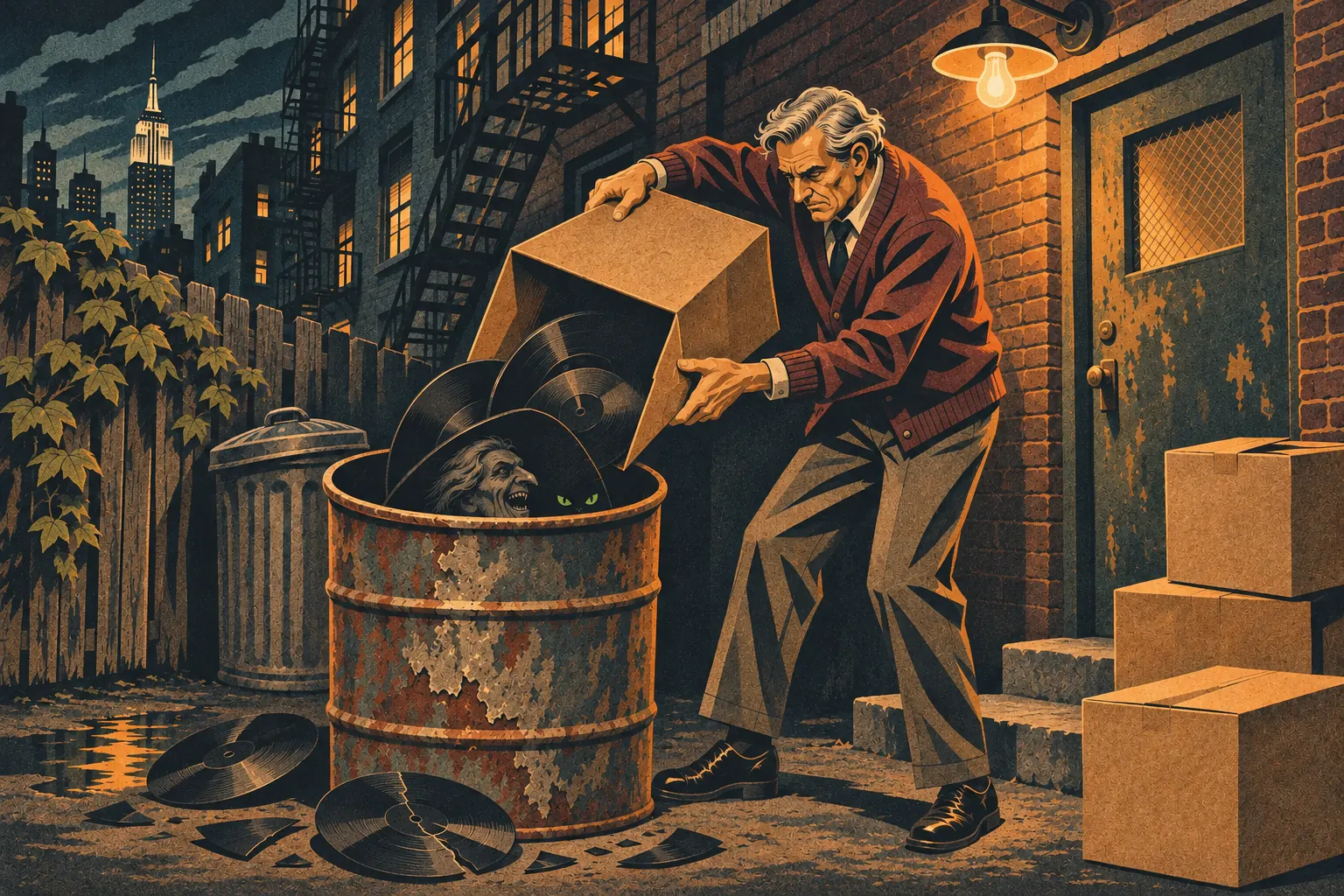
Three years later Cole made the decision that has shaped everything written about the programme since. In 1961, preparing to leave New York for California, he destroyed his own collection of recordings, believing, according to Siegel’s account, that they had no further commercial value.36 The Radio World reviewer Read G. Burgan called it “a twist of fate almost as ironic as some of Cole’s scripts”.6 Wikipedia describes the destroyed discs as the syndication recordings.5
What Cole did not destroy is disputed too. Pavlansky writes that he destroyed his scripts as well.1 The other accounts say that the scripts survived, all 332 of them, and later passed through a collector’s hands, and Grams writes that most of them carry a cast list on the front cover.68 Cole died in 1971, aged 73, after being diagnosed with a heart condition in 1962.2
Collectors and cartons
The recordings that exist today were saved by other people. The Radio Horror Hosts site puts the survivors at about three dozen, less than ten per cent of the run, and Burgan, writing in 1999, said that about thirty were known and that most were in very poor condition.36 Grams, who calls the survivors a large handful, has written that the programme’s preservation is “sorely needed”.8 In October 2023 he posted images from his files intended to show the cast and crew in rehearsal, and he says he gathers news items and magazine articles about the series roughly every other year, though no book is being assembled from them.8
The scripts reached print through one collector. David S. Siegel of Yorktown Heights, New York, began collecting old radio programmes in the 1960s and by 1999 owned more than 65,000 of them.6 According to Burgan, all 332 scripts were shipped to Siegel in four large cartons, in fragile condition, and he photocopied the whole set, though the review does not say who sent them.6
Siegel set aside every story that already survived as a recording and every adaptation of another author’s work, and chose thirteen original scripts from what remained. His wife Susan retyped each one, because the marginal notes made scanning impractical.6 The result, The Witch’s Tale, appeared from Siegel’s Dunwich Press in 1998 with an introduction by Wolfe, and a later BearManor Media edition carries her prologue and epilogue and a log of all 332 broadcasts with their dates and titles.1011 Siegel also wrote the notes for a ten-disc Radio Spirits set of the surviving recordings.2
The survivors are spread unevenly across the run. The Internet Archive collection includes a cluster of stories from 1931 and 1932, when Fitz-Allen was Nancy, and a handful from the later years, among them “The King Shark God” from 14 August 1935, “Four Fingers and a Thumb” from 19 October 1937 and “The Wedding Gift” from 29 March 1938, which belong to Wolff’s time in the part unless they are later remakes.37 The weekdays attached to the later dates include Tuesdays, Wednesdays and Fridays, which suggests that the programme changed its slot more than once in the Mutual years.37 The Radio Horror Hosts site also lists “The Gypsy’s Hand” as a 1940s rebroadcast.3
Online, the programme lives in a tangle of copies. One collection on the Internet Archive, uploaded in 2023, holds 66 MP3 files, many of them repeats, with file names that follow several different dating conventions and some repeat dates that contradict the originals.7 The online logs are no better. One widely copied list dates “The Boa Goddess” to 5 January 1931, more than four months before the programme began, while the Internet Archive collection dates the same story to 5 October 1931.716 The log in the Siegel edition is the obvious reference against which to check them, but it is in print rather than online.11
The public archives have little to add. Research for this article found no catalogue record for Cole’s scripts or his recordings in the Library of Congress or any other American institution, and the scripts’ present whereabouts were not established. The best-documented institutional copy of the programme turned up on the other side of the world, in the Australian national sound archive.14
Old Nancy’s descendants
The witch’s most famous descendant is a comic-book hag. According to Wikipedia, the EC Comics publisher Bill Gaines was inspired by Old Nancy when he created the Old Witch, who from 1950 introduced the stories in The Haunt of Fear.15 The Radio Horror Hosts site goes further and counts the programme among the inspirations for EC’s horror comics as a whole.3
Wolfe carried her own witch into later life. She worked for Cole again on Casey, Crime Photographer, one of many programmes on which she appeared.10 She moved to Canada in 1956, worked for the CBC and created a children’s series called Miss Switch, and later ran improvisation workshops in Paris and developed a method of teaching English pronunciation in Toronto.10 She received an award from the Friends of Old Time Radio in 1981 and died in Toronto on 29 September 2000, aged 78.10
The programme’s format outlived them both. The horror anthology with a recurring, mocking host, telling a different story each week, was running on WOR in 1931, three years before Lights Out and nearly two decades before the EC comics.513
Where the story stands
As of 12 November 2026, The Witch’s Tale is documented far better on paper than on disc. The 332 scripts appear to survive, thirteen are in print and the full broadcast log has been published.611 Roughly thirty recordings circulate, some of them Australian remakes and some incomplete, like the first half of Isobel Gowdie’s story from Halloween 1932.356 The first broadcast is still dated to both 21 and 28 May 1931, and the evidence that listeners were frightened rests on one columnist’s sweat, a fan magazine’s description of a voice and an Australian newspaper’s warning to the timid.15912
Most of what Old Nancy said went out over the air once or twice and was gone by 1961. The fullest record of it is four cartons of fragile typescript, photocopied by a collector in Yorktown Heights.6
From the archives
Sources16
- The Witch’s Tale Joe Pavlansky, Creature Feature Chronicles (Substack) · Accessed 2026-11-12
- In Search of Alonzo Deen Cole (blog), 2017 posts, including a repost of Radio Spirits’ biography of Cole of 22 February 2017 Anonymous blogger; Radio Spirits · 2017-11 · Accessed 2026-11-12
- The Witch’s Tale Radio Horror Hosts · Accessed 2026-11-12
- May 28, 1931: broadcast of The Witch’s Tale on WOR oldradio.org · 2014-05 · Accessed 2026-11-12
- The Witch’s Tale Wikipedia · Accessed 2026-11-12
- The Witch’s Tale (review of the Dunwich Press script collection) Read G. Burgan, Radio World · 1999-03-31 · Accessed 2026-11-12
- The Witches Tale Old Time Radio Show (collection of 66 MP3 files) Internet Archive, uploaded by Scott’s Vault · 2023-02-04 · Accessed 2026-11-12
- The Witch’s Tale (1931–1938): rarely seen photos Martin Grams (blog) · 2023-10-27 · Accessed 2026-11-12
- Radio Stars, page 79 (profile of Miriam Wolff), via Lantern Radio Stars magazine; Media History Digital Library · Accessed 2026-11-12
- Miriam Wolfe Wikipedia · Accessed 2026-11-12
- The Witch’s Tale: Stories of Gothic Horror from the Golden Age of Radio Alonzo Deen Cole, BearManor Media (publisher’s page) · Accessed 2026-11-12
- The Witch’s Tale: All Hallows’ Eve (1941) National Film and Sound Archive of Australia · Accessed 2026-11-12
- Immersive Night: Audio Horror in Radio and Podcasting Alyn Euritt and Leslie McMurtry, Refractory 35 · 2021-10-25 · Accessed 2026-11-12
- 82618: The Witch’s Tale: All Hallow’s Eve (catalogue record, NFSA ID 572126) National Film and Sound Archive of Australia · Accessed 2026-11-12
- The Witch’s Tale (AustLit record) AustLit · Accessed 2026-11-12
- The Witch’s Tale (episode log) Generic Radio Workshop · Accessed 2026-11-12