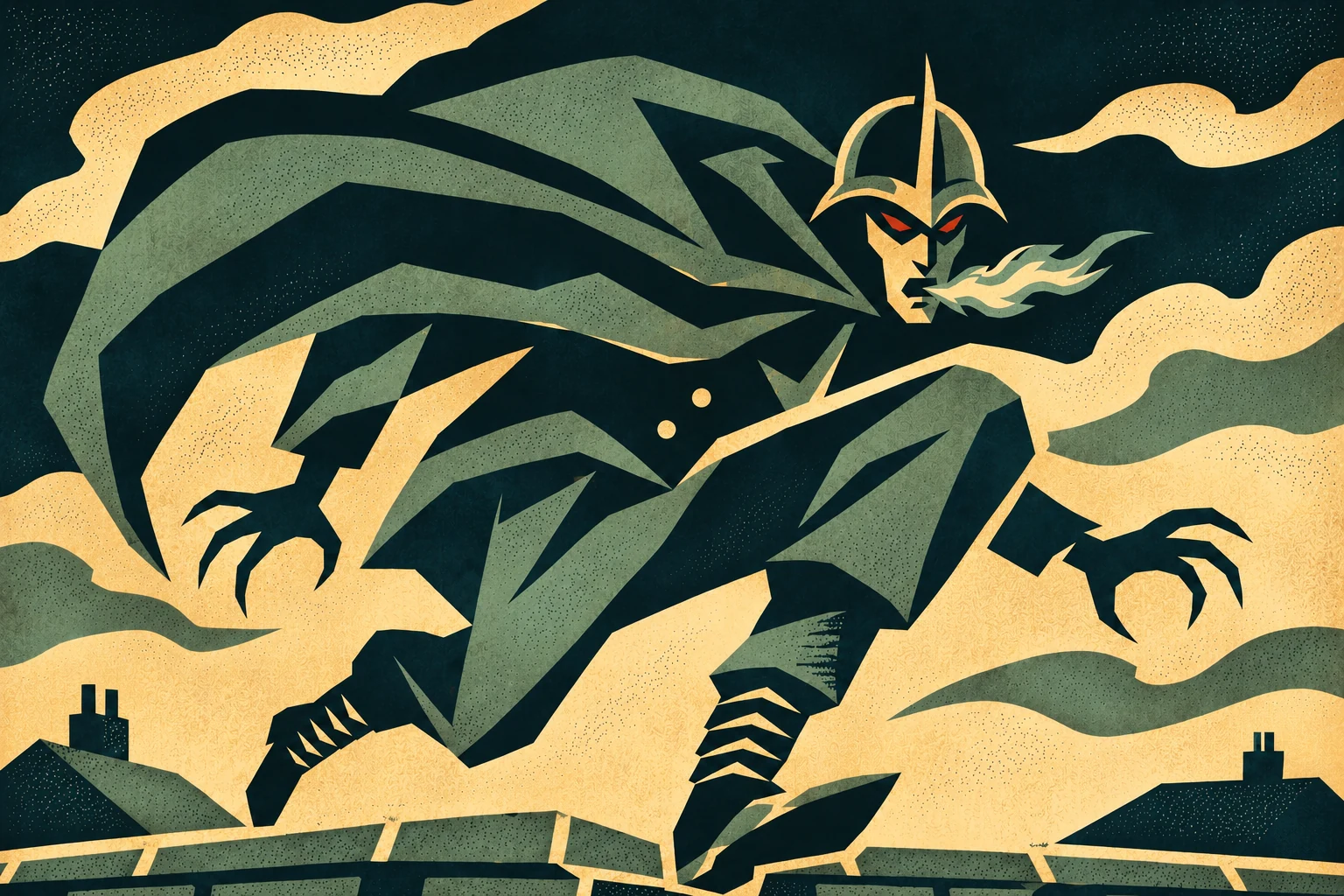
At about a quarter to nine on the evening of 20 February 1838, someone rang the bell at Bearbinder Cottage in Old Ford, east London. The man at the gate said he was a policeman and that Spring-Heeled Jack had been caught in the lane. He needed a light.1
A ghost reaches the Mansion House
Before Jack had a face, he had several bodies. In the villages around London, people talked of a white bull, a bear, a devil and a ghost. By January 1838, the stories had reached Sir John Cowan, the Lord Mayor of London. An anonymous correspondent, signing as a resident of Peckham, wanted him to step in. The letter described an aristocratic wager: someone had bet that he could visit the surrounding villages in terrifying disguises and break into gardens to frighten the households.2
The Times published the complaint on 9 January 1838. Its author claimed that seven women had been driven out of their senses and that two were unlikely to recover, and he accused the newspapers of suppressing the story for their own reasons. Cowan had a duller explanation, suspecting that burglars had frightened the writer, who was now looking to him for redress, and since the apparition had not entered the City, he said, its offences were outside his authority.2
London’s early Jack haunted its fringes. The reports came from places such as Barnes, Isleworth and Hammersmith, where the city gave way to villages, commons and lanes. He could be called the terror of London while haunting communities beyond the Lord Mayor’s reach. The letter carried a warning into the Mansion House, but its claims had travelled further than the evidence behind them.23
One reporter for the Morning Herald went looking, but although the stories were everywhere, the eyewitnesses kept slipping away, and people named as victims denied knowing anything about the ghost and sent him on to someone else. The police of T Division, whose patch stretched towards Brentford, found that nobody would say they had seen it for themselves. It was already a recognisable public scare, with a striking shortage of people describing their own encounter.3
Some stories did involve violence. A carpenter called Jones was said to have grappled with an armoured figure in Cut-throat Lane, Isleworth, only for two more ghosts to join in, and his clothes were reportedly torn to pieces. Stories like this made a gang seem as likely as a lone prowler. The fear could absorb several disguises and several attackers without letting go of the idea of one organised campaign.3
By 20 January 1838, the Sun was reporting on a committee trying to catch the culprits. The supposed wager had grown to £5,000, and a rumour circulating around the committee gave the villains a grotesque target of thirty deaths, divided among bachelors, unmarried women and servants. Even the committee could barely believe it. Its reward of £10 was more practical than the rumour’s elaborate arithmetic.4
The aristocratic explanation appealed for reasons beyond its luridness. A rich man could afford a costume, transport and time to waste on cruelty, and he gave ordinary people an enemy they could understand beneath the animal skin. But the anonymous letter named nobody, and the growing list of victims proved no deadly wager. Then a family in Old Ford took an account of an assault before a magistrate, with injuries, witnesses and a description of a stranger who knew the monster’s name.12
The candle and the blue flame
Jane Alsop’s family lived at Bearbinder Cottage, in Bearbinder Lane. In her statement, printed by The Times on 22 February 1838, she said she went to the door that Tuesday evening and asked the man outside not to ring so loudly. His answer turned her from a householder dealing with a nuisance into someone apparently helping the police.1
“For God’s sake, bring me a light, for we have caught Spring-heeled Jack here in the lane.”
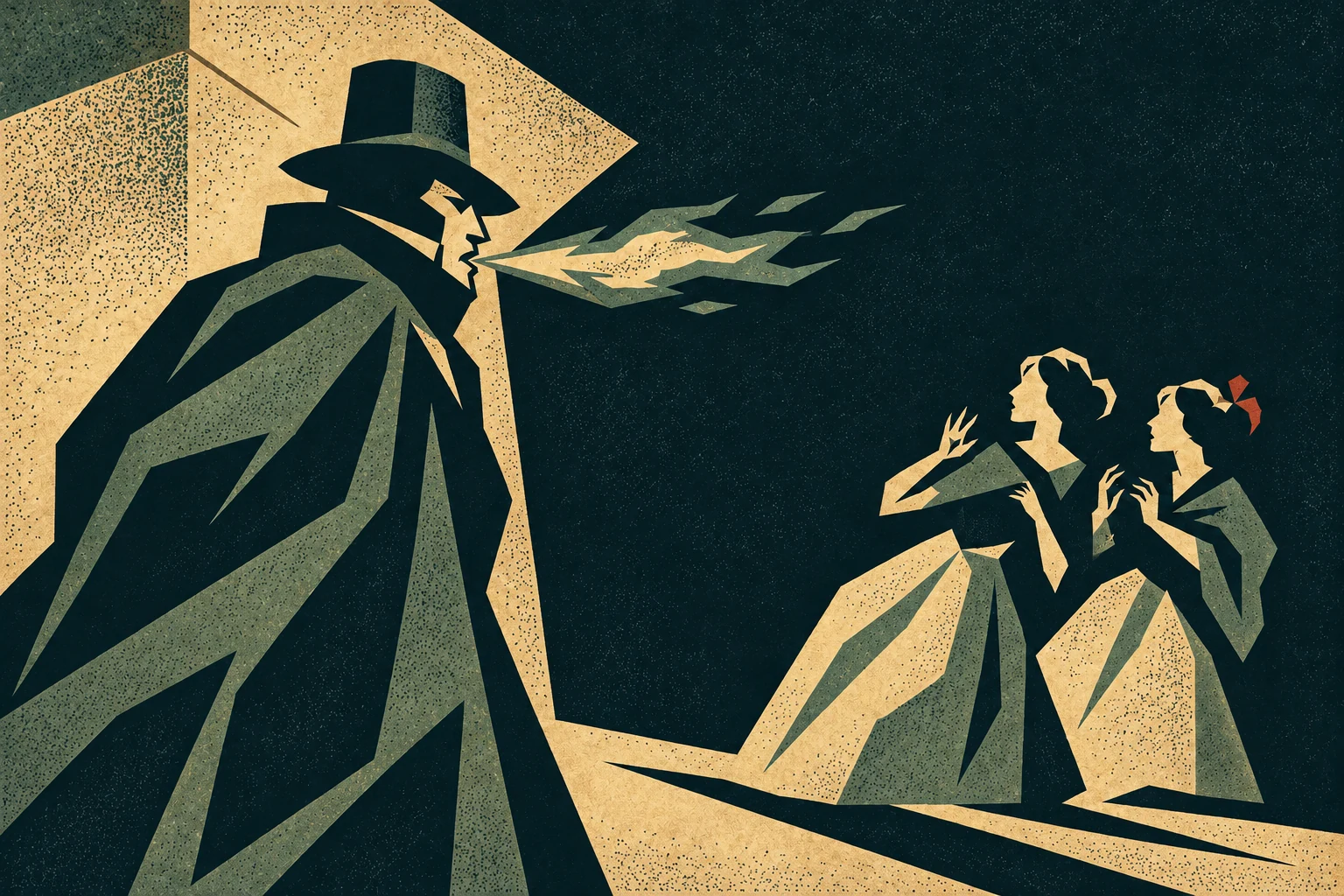
Jane fetched a candle. The stranger had been wrapped in a long cloak, and as soon as she handed him the light he threw it off and held the candle up to his chest. She described a helmet and tight-fitting clothes like white oilskin. His eyes looked like red balls of fire, and blue and white flames, she said, came out of his mouth.1
Those details come from the testimony at the time. The fire and the eyes were in print in February 1838, before generations of fiction reshaped the character. They were also seen during a terrifying encounter, with a candle held below the man’s face. A shining costume, a horrible face and a burst of flame could be described without settling whether the witness saw a stage trick, a distorted impression or something she could not explain.1
Jane said the man grabbed her clothes and the back of her neck, held her head under his arm and tore at her dress with claws that felt like metal. She broke free and ran for the house. He followed, caught her on the steps and attacked again, scratching her neck and arms and pulling out her hair. Her sister Mary came to the door but was too frightened to help. Another sister, Mrs Harrison, pulled Jane inside and shut the door.1
Mrs Harrison told the court she had found Jane being dragged down the steps, her dress torn and her hair pulled loose. The attacker went on knocking after the door was shut, and left only after the family shouted for the police from the upstairs windows. Jane’s father offered ten guineas for his capture. The family’s account described an attacker whose violence went well beyond a passing fright, though his name and purpose stayed unknown.1
A police officer, James Lea, later reported that a cloaked man had been frightening people in the area for weeks. Once, he had escaped men working for a Bow coach-master by being nimble and knowing the ground. Lea also heard that men answering the Alsops’ cries had passed a stranger who told them a policeman was wanted at the cottage, and had let him go on his way. Lea suspected they had met the attacker without knowing it.5
Eight days after the Old Ford attack, Lucy Scales reported another encounter, in Green Dragon Alley, Limehouse. At about half past eight on 28 February 1838, she and her sister were walking back from their brother’s house when they saw someone standing at a corner of the alley. Lucy was in front. She said the stranger blew blue flame into her face, blinding her for a moment, and she fell to the ground in violent fits.6
Her brother heard screaming and found Lucy on the ground, held up by their sister. The sister described a tall, thin, gentlemanly-looking man in a large cloak, carrying a small light like a policeman’s bull’s-eye lantern. He had said nothing, made no attempt to touch them and walked off. A surgeon’s certificate recorded fright and agitation. Her brother added an awkward detail: shortly before the women set out, one of them had been reading the newspaper report about Spring-Heeled Jack.6

The man in the white jacket
The police inquiries brought another figure into view: Millbank, a local carpenter who wore a pale shooting jacket and a white hat. He and a bricklayer named Payne were questioned after the Old Ford attack. A name promised less than an apparition, but here was a man who could be found, questioned and compared with Jane’s description. The difficulty was working out what he had done on an evening he admitted he could barely remember.7
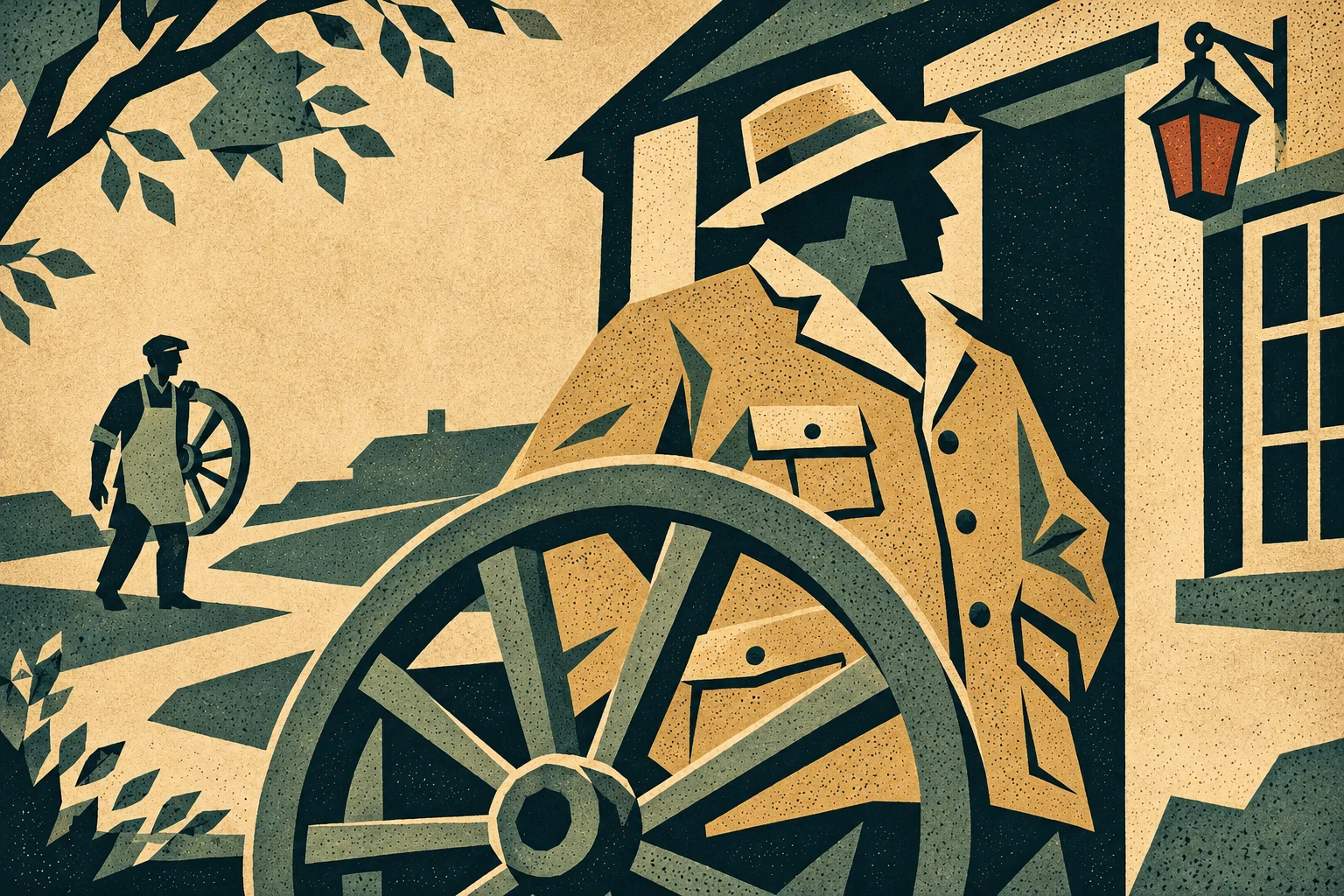
A coach-wheelwright called James Smith gave the most damaging evidence. He said he heard screaming while in Bearbinder Lane and met Payne and Millbank coming away from the cottage. Later, in Coborn Road, he overheard talk suggesting something disgraceful had happened. Smith said the man in the shooting jacket came up to him, interfered with the wheel he was carrying and challenged him about “Spring Jack”. He identified that man as Millbank.7
The accusation was specific enough to investigate. The pale jacket was an everyday version of the white oilskin Jane described. The men were in the right place, and Smith’s account seemed to tie their behaviour to the name used at the cottage gate. If he had the right man, the attacker’s extraordinary outfit could have been put together from ordinary clothes, transformed by candlelight and terror.7
Millbank and Payne denied both the attack and the incriminating conversation. Millbank admitted he had been drinking heavily and remembered little of the evening, which left him unable to give a clear account of his own. Jane and her sisters added a further problem: they insisted their attacker had been sober. The hearing faced conflicting memories of how the man behaved and what he looked like, with no disguise recovered to settle the matter.7
A shoemaker named Richardson then gave another version of events in the lane. He had met a boy and a young man in a cloak who joked that Spring-Heeled Jack was nearby. Smith insisted this was Millbank, and Richardson insisted it was someone else. Further inquiries turned up a man called Fox, who admitted being in the lane with a boy but denied wearing a cloak.8
By the end of the reported hearings, the hope of identifying a local culprit had broken into disputed encounters, with no agreement on who had worn the cloak, who had made the joke or whether Smith had recognised the right man. The magistrate, Mr Hardwick, told Millbank that he now believed him innocent and called for further inquiries, so the reports describe questioning and release, not a trial in which a man was acquitted because he could not breathe fire.8
Hardwick doubted the suspect but still believed the Alsop family had suffered a genuine outrage. Police scepticism about the costume and a magistrate’s faith in a distressed witness could sit side by side in the same inquiry, and neither needed a demon. The unsolved problem was how to link a credible complaint of violence to one particular person among those moving through the lane.78
The name Spring-Heeled Jack made that harder, because a drunken boast, a joke and a real assault might all invoke the same figure. The name was already circulating before Jane was attacked, as the stranger’s own trick showed, so anyone using it arrived with a ready-made reputation. Millbank was investigated because of evidence from that night, but the monster’s wider career was a much looser collection of stories.178
What could a man manufacture?
The flames were the hardest part of Jane’s account for investigators to square. Smith and Richardson said they had seen the candle brought out and would have noticed any brighter light, but neither had seen the brilliant display the family described, and when Hardwick questioned him, Smith said plainly that he had seen no light but the candle. Their evidence challenged the spectacle without explaining away the injuries.8
Hardwick was reluctant to dismiss the sisters’ repeated sworn statements. He allowed for exaggeration, but pointed to another girl’s description of a person in theatrical costume who seemed to produce similar lights. The inquiry had reached a practical possibility: the attacker could be real while his demonic appearance was a special effect. The magistrate did not have to choose between believing every extraordinary detail and treating the whole complaint as invented.8
The theatre offered an explanation. Mr Farrell, who ran the Pavilion Theatre, told the inquiry that coloured flames like those described could be produced with stage chemicals. He was showing that it could be done, not producing the actual device. No apparatus was ever found, and the witnesses still disagreed about whether any extra light had appeared.8
Lucy Scales’s experience made the flash harder to dismiss as one family’s peculiarity. But the man in the alley behaved differently: he walked away without touching either woman, whereas the Old Ford attacker chased Jane onto the steps and struggled with her sister. A similar visual trick could link the two encounters, but neither account identifies anyone in a way that would make the link secure.16
Later retellings tend to make the details more uniform. Jane described claws, scratches and torn clothes, and Lucy described the flame and her collapse, but neither mentions an escape over a building, since Jane’s father said the attacker ran off across the fields and Lucy’s visitor simply walked away. In the two best-known encounters, the name promises a leap the witnesses never described.16
Copycats soon produced simpler versions of the costume. In March 1838, a young man named Daniel Granville was caught wearing a mask with blue glazed paper over the mouth, an attempt to copy the fiery effect, and was let off with a caution. Another young man, James Painter, was fined for frightening people around Kilburn in a mask and sheet. The papers were reporting people who could be caught while playing a supposedly uncatchable character.9
A mask with blue paper did not explain the flash in Green Dragon Alley, but it showed how quickly the signature could become a prop. Once the newspapers had published a description, anyone could make a recognisable Jack without sharing the original attacker’s equipment or motives. A witness’s report, a cheap disguise and the fears of someone walking in the dark could feed one another.69
The inquiries best support human impersonation, involving a costume, intimidation, physical assault and escape. That leaves room for mistakes, exaggeration and more than one culprit, though it also leaves the Old Ford attacker unidentified, and a stranger who could create the impression of a devil had no need of the spring-loaded boots that became the legend’s favourite explanation.1789
Was Jack the Mad Marquess?
Henry de la Poer Beresford, third Marquess of Waterford, has been the story’s most durable suspect. The anonymous letter to Cowan had already blamed rich men and a wager, and Waterford had just the reputation to fill the gap: a sporting aristocrat whose drunken pranks had spilled over into intimidation and vandalism. Naming him gives the creature a title, a fortune and friends to help him.210
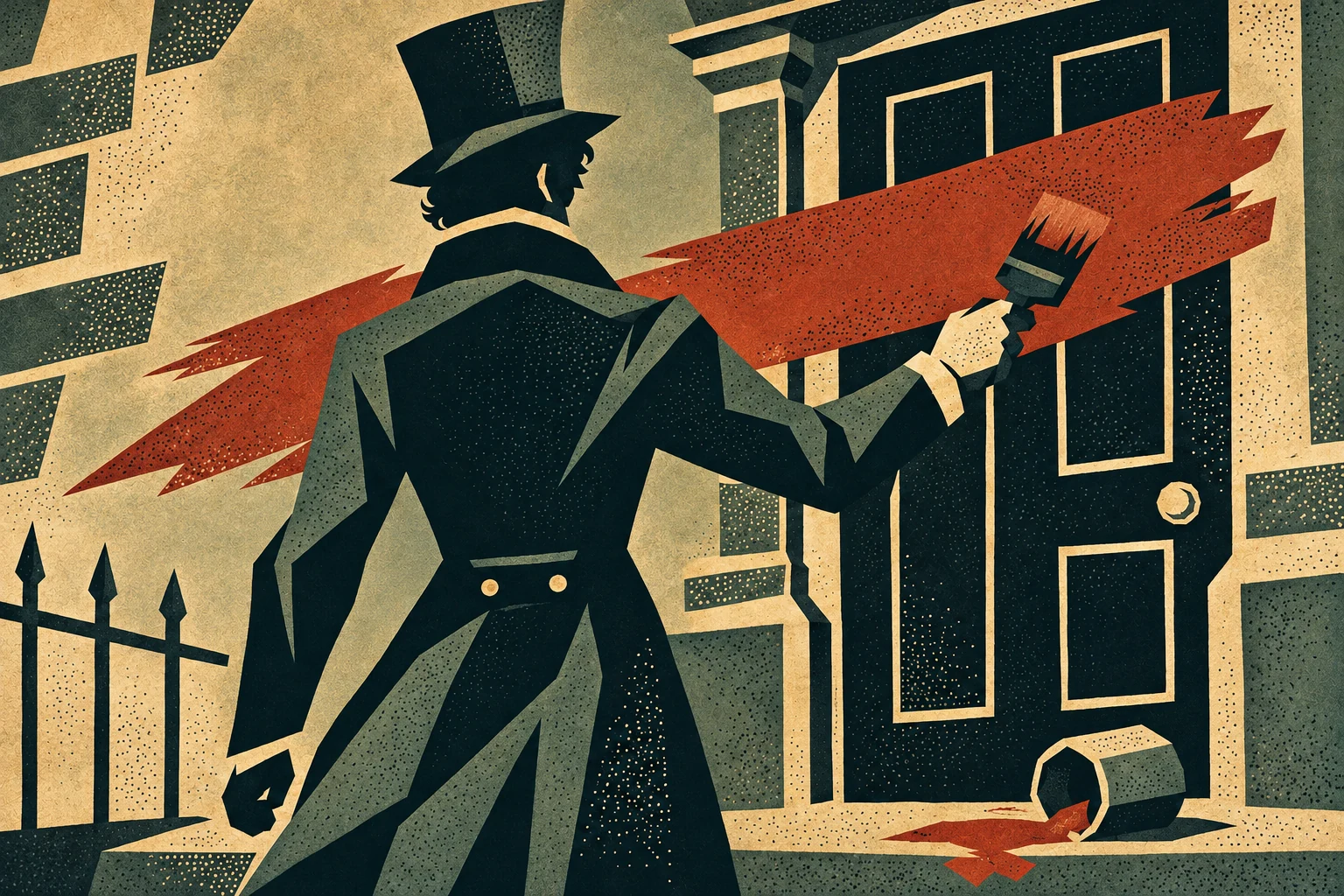
His notorious night at Melton Mowbray in 1837 made the link easy to imagine. Waterford and his friends ran riot through the town with red paint. The escapade came in the same period as the first rumours around London, and it showed a willingness to treat other people’s streets as a playground for privileged amusement. It gave people a reason to think him capable of cruelty, but it did not put him at Bearbinder Cottage.11
Later writers often stated the identification more confidently than the evidence allowed. H. Barton Baker’s Stories of the Streets of London, published in 1899, linked Waterford and his friends to Jack while admitting that no proof had ever been found. The passage neatly sums up the theory’s standing: it could sound like an open secret and still be an unproved allegation.12
The case against Waterford has also picked up clues that seem almost too convenient. In one story, a servant at a house in Turner Street glimpses an ornate letter W on Jack’s costume. In another, Polly Adams is attacked at Blackheath Fair by a nobleman whose bulging eyes point to Waterford. If genuine, these details would give the accusation something firmer than a bad reputation.1013
The historian Mike Dash could find no support for either detail in sources from the time. He traced the elaborate versions to Peter Haining’s 1977 book, The Legend and Bizarre Crimes of Spring Heeled Jack. The short contemporary report from Turner Street mentions no W. Without a traceable source, these clues cannot count as evidence against Waterford, though that does not show who invented them.13
Haining’s book helped give Jack a modern biography. Its detailed scenes suggest that someone had preserved the victims’ words and actions far more fully than the surviving newspaper reports. The original testimony is less obliging. Lucy’s sister, for example, becomes a fully drawn character in the expanded story, while the original report gives no such personal detail.13
Waterford returned to Ireland after marrying in 1842 and died in a riding accident in 1859. These dates limit the theory, but they do not neatly bracket Jack’s career. Reports went on long after Waterford’s death, so even if he took part in an early attack, the later appearances would need other culprits. And if there were other culprits, there is no need to give him the first attacks either.11
The nobleman remains believable as a type: rich, mobile and notorious for destructive fun. The case against him personally is far weaker. No witness reliably named Waterford as the Old Ford attacker, and no garment, confession or working device ties him to the cottage. Baker’s admission that there was no proof is more useful than the certainty that grew up around the story. Waterford’s bad reputation has survived, but it has never become an identification.1012
A monster becomes an avenger
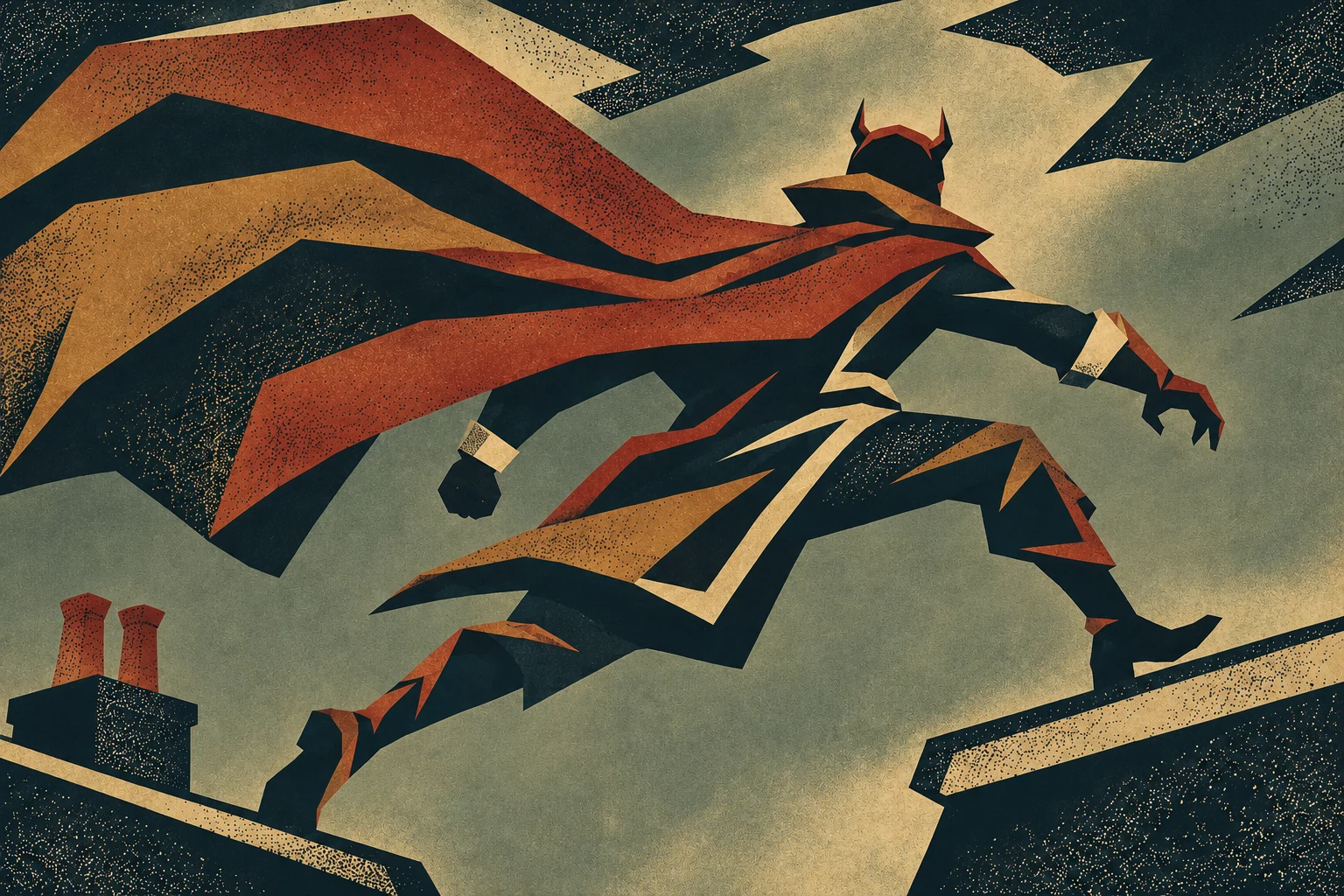
In popular fiction, Jack could have the identity that investigators never found. An anonymous serial preserved as Spring-Heeled Jack: The Terror of London introduces a wronged man called Jack Dacre. The story claims to draw on his journal and his descendants, then launches into melodrama. Its claim to be true is part of the entertainment, alongside a disputed inheritance, disguises and a hero who can do what ordinary pursuers cannot.14
Dacre’s extraordinary footwear gets a suitably exotic explanation. He says an Indian teacher told him of a spring mechanism, and that boots fitted with it will allow huge jumps, so he plans to build a pair to hunt down an enemy. A mysterious attacker becomes an ingenious avenger. His leaps have a device behind them, his pursuit has a target and his hidden identity can one day be restored.14
The fiction turns the story inside out in a way the first victims would hardly have recognised. A figure linked to people terrified at their own doors or in dark lanes now foils villains and rescues the innocent. In the end, Dacre regains his rightful place, marries and settles into domestic happiness. The serial even dismisses later Jacks as scamps copying him, while declaring its own romance the true history.14
That ending does useful work inside the story. It explains why the public might have heard of several vicious Jacks even though the hero himself deserved admiration. An author could keep the name’s notoriety and still let readers cheer the man who bore it. Whether Jack was one man or many, a question never resolved in real life, became a convenience for the plot.14
The historian Karl Bell describes a figure moving between rumour, newspapers, theatre and cheap fiction, with each setting changing what he meant. The criminal and the avenger could share a name without sharing a moral character. A recognisable costume helped audiences follow him from one setting to another, even as the individual stories contradicted each other.15
The monster also found his way into childhood. Writing to Notes and Queries in 1907, Thomas Ratcliffe recalled being afraid of “Jumping Jack” in the late 1840s, but also remembered stories in which Jack foiled wrongdoers and was seen as a kind of Robin Hood. These memories were written down many years later, but it is revealing that both survived. A child could meet the menacing visitor and the protective adventurer at the same time.16
Harry Hems, another correspondent, remembered his grandmother telling him that Jack was the Marquess of Waterford. In her version, he hid in lonely places and leapt out at people walking alone, preferably women. In family storytelling, the suspect and the monster had merged. Hems’s memory shows that belief reaching a child, but it offers no eyewitness identification at Old Ford.16
A public scare could therefore outlive the people who first reported it. The stories needed neither the original costume nor the original culprit. An invented device explained the leaps, a wronged aristocrat explained the secrecy and a grandmother supplied the name to fear after dark. So when a figure in white appeared outside a sentry box decades later, people already had a character ready for it.1416
Shots across Aldershot
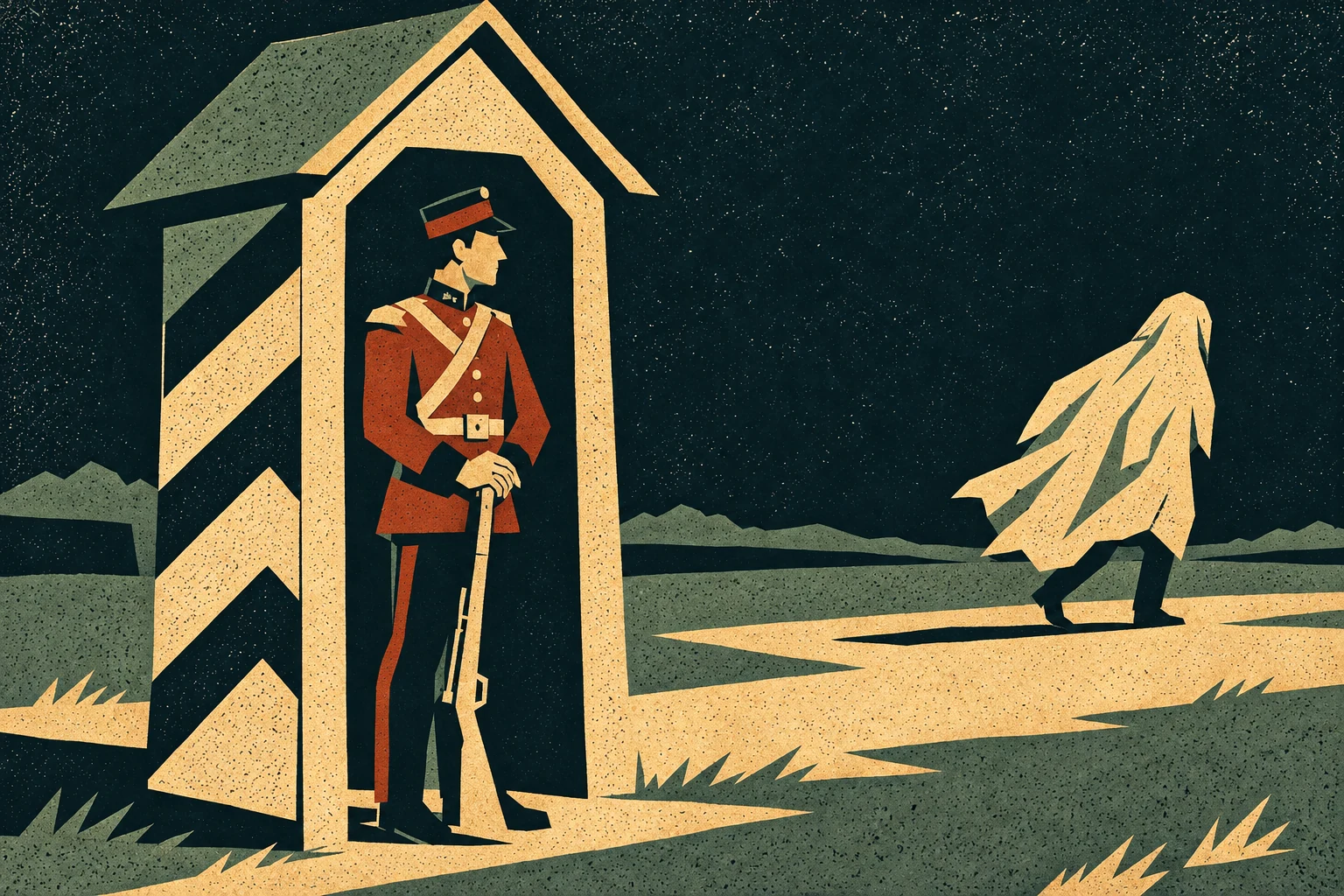
Nearly forty years after the attack on Jane Alsop, the name surfaced around the army camp at Aldershot. Sheldrake’s Aldershot and Sandhurst Military Gazette began reporting the affair on 17 March 1877. Its tone was teasing but cautious. Someone seemed set on playing dubious pranks on the night sentries, the paper said, while pointedly declining to vouch for the story.17
According to its report, a figure approached a sentry at the North Camp around midnight, ignored the challenge and darted around the sentry box before making off at speed. The soldier loaded his rifle and fired, but missed. A similar visit near the cemetery drew another shot that also missed. The paper’s worry was that someone would get hurt if the prank went on.17
The Times gave a fuller account on 28 April 1877. One sentry had been slapped, another had wrestled with the visitor and ended up with two black eyes, and pursuers had failed to catch him near the Female Hospital. The paper described his speed and his bounds. It was also direct about the shooting: one soldier missed his aim, and another fired without hitting the figure.18
Those reports later helped create a bulletproof Jack, as the supernatural version turned missed shots into immunity. The wording at the time suggests something more ordinary, a man running from armed soldiers who failed to hit him, and while the rifles made the prank more dangerous, firing them did nothing to test whether the visitor could survive a bullet.1718
Another Aldershot story appeared in the Illustrated Police News on 8 September 1877. This version gave Jack a clammy hand that felt like a corpse’s and a habit of climbing onto sentry boxes to touch the guard’s face. It also reported changes to the rules on live ammunition, followed by fresh visits. The visitor was growing more macabre, while the question of when soldiers were allowed to shoot stayed very practical.19
In November 1877, the same paper carried an even grander story from Newport Arch in Lincoln. A man in a sheepskin with a long tail was said to have jumped fifteen or twenty feet, escaped over the rooftops and survived being shot because his hide was so tough. The claims came from the paper’s local correspondent. Here at last were the spectacular leaps missing from Jane’s and Lucy’s accounts, reported of a differently dressed figure in another town decades later.19
Aldershot later gained a witness of its own. In June 1907, Colonel Alfred Welby wrote to Notes and Queries about jumping pranks at a remote ammunition store near the canal. His account had Jack leaping across the water, landing on a sentry and sometimes making off with his rifle. Suspicion, he recalled, had fallen on a high-spirited officer of the Rifles, but he knew of no conviction or confession.20
Welby was looking back thirty years. The leap across the canal comes from that later memory, while the newspaper reports of 1877 concentrate on dodging, running and bounding. A suspected officer gives the camp story a believable human setting without identifying anyone. Aldershot does not need to be a sequel starring the man who terrorised Old Ford in 1838. It has its own frightened witnesses, local suspicions and growing folklore.171820
The last leap in Everton
September 1904 is traditionally the date of Jack’s last appearance, in Everton, Liverpool. In the familiar farewell, hundreds of people watch him leap over terraced houses before he vanishes from history. The newspapers published during the scare tell a messier story. The News of the World of 25 September described crowds gathering in William Henry Street to see a ghost that had been given the name Spring Heel Jack.21
The report credited him with great leaps and with dodging people who tried to catch him, but it also said only a few people had actually seen him. The crowd was real enough to report on, but it was not presented as hundreds of witnesses to one display. The paper named no one who had seen a measured jump and gave nothing to link the visitor to any earlier Jack.21
The Star’s report of 24 September 1904 described objects falling down the chimneys of a supposedly haunted house. Bricks and bottles baffled onlookers, residents moved out, and crowds waited outside for the ghost to appear at a window. A youth was brought before the police court for breaking a window. Jack’s old name was revived amid a neighbourhood uproar centred on one house.22
More than sixty years later, an Everton resident, Mrs Pierpoint, shared her memories with the Liverpool Echo. She remembered the excitement over the haunted house and a local man who used to climb onto roofs, and whom the police or fire brigade would be called to bring down. As they came near, he would move from roof to roof. In her memory, that was what started the Spring-Heeled Jack rumours. Hers was a recollection from decades later, not an identification made at the time.23
The leap over whole houses belongs to the story’s later growth. The Liverpool Daily Post’s account in January 1967 described an athletic spectacle across named streets. Set beside the reports from 1904, it shows how much a retelling could add to a crowd waiting for a rumoured ghost. Jack’s “last appearance” is a convenient closing date for the legend, not the documented retirement of a known attacker.24
By then, Jack had already begun another life. David Clarke traces an extraterrestrial interpretation through Valentine Dyall’s writing in 1954, a reader’s suggestion that a visitor from a planet with heavy gravity could leap huge distances, and J. Vyner’s 1961 article in Flying Saucer Review. Vyner made Jack a stranded alien looking for help. A nineteenth-century disguise became a spacesuit, and the reported lights became the technology a twentieth-century theory required.25
As of 7 November 2026, the surviving accounts leave the Old Ford attacker unidentified. The best explanation combines real assaults and impersonation with rumour, copycats and later invention, and the claim that Waterford was the first Jack remains unproved. No proven superhuman leap connects the cottage, the army camp and the rooftops of Everton.18101721
The stranger at Jane Alsop’s gate had no need to explain who Jack was. He claimed a capture, asked for a light and let the name draw her out of the house.1
Linked case files
Sources25
- Outrage on a young lady: the Old Ford assault The Times · 1838-02-22 · Accessed 2026-11-07
- Mansion House: the Peckham letter and Lord Mayor’s response The Times · 1838-01-09 · Accessed 2026-11-07
- Early suburban ghost inquiries and the Isleworth report Morning Herald / Morning Chronicle · 1838-01-10 · Accessed 2026-11-07
- The suburban ghost committee and rumours of a wager The Sun · 1838-01-20 · Accessed 2026-11-07
- Officer Lea’s report from Old Ford The Morning Herald · 1838-02-23 · Accessed 2026-11-07
- Lambeth-Street: The Ghost, alias Spring-Heeled Jack, again The Morning Post · 1838-03-07 · Accessed 2026-11-07
- The late outrage at Old Ford: questioning Millbank and Payne The Times · 1838-03-02 · Accessed 2026-11-07
- The outrage at Old Ford: further examination The Times · 1838-03-03 · Accessed 2026-11-07
- Reports of imitators: Granville and Painter The Morning Post · 1838-03-20 / 1838-04-04 · Accessed 2026-11-07
- Spring Heeled Jack: The Terror of London The Unredacted · 2016-03-25 · Accessed 2026-11-07
- Spring Heeled Jack: Notorious Urban Legend or the work of the Mad Marquess of Waterford? Waterford Treasures · Undated article · Accessed 2026-11-07
- Stories of the Streets of London H. Barton Baker · 1899 · Accessed 2026-11-07
- Spring-heeled Jack: To Victorian Bugaboo From Suburban Ghost Mike Dash · 2005-04-02 · Accessed 2026-11-07
- Spring-Heeled Jack: The Terror of London Anonymous Victorian serial author · Undated serial; electronic edition2021 · Accessed 2026-11-07
- The Legend of Spring-Heeled Jack: Urban Folklore and Victorian Popular Cultures Karl Bell · Undated paper · Accessed 2026-11-07
- Spring-heeled Jack: childhood memories and the Waterford tradition Thomas Ratcliffe / Harry Hems, Notes and Queries · 1907 · Accessed 2026-11-07
- Spring-heeled Jack and the camp sentries Sheldrake’s Aldershot and Sandhurst Military Gazette · 1877-03-17 · Accessed 2026-11-07
- The Aldershot ghost The Times · 1877-04-28 · Accessed 2026-11-07
- Spring-Heeled Jack at Aldershot and Newport Arch Illustrated Police News · 1877-09-08 / 1877-11-03 · Accessed 2026-11-07
- Spring-heeled Jack: Aldershot recollection Alfred Welby, Notes and Queries · 1907-06-22 · Accessed 2026-11-07
- Everton’s reputed Spring Heel Jack News of the World · 1904-09-25 · Accessed 2026-11-07
- Liverpool haunted-house scare The Star, London · 1904-09-24 · Accessed 2026-11-07
- Mrs Pierpoint’s recollection of the Everton scare Liverpool Echo · 1967-05-19 · Accessed 2026-11-07
- The leaping horror of Liverpool Liverpool Daily Post · 1967-01-25 · Accessed 2026-11-07
- Spring-heeled Jack David Clarke · 2010-03 · Accessed 2026-11-07