Unpublished editorial draft awaiting owner review.
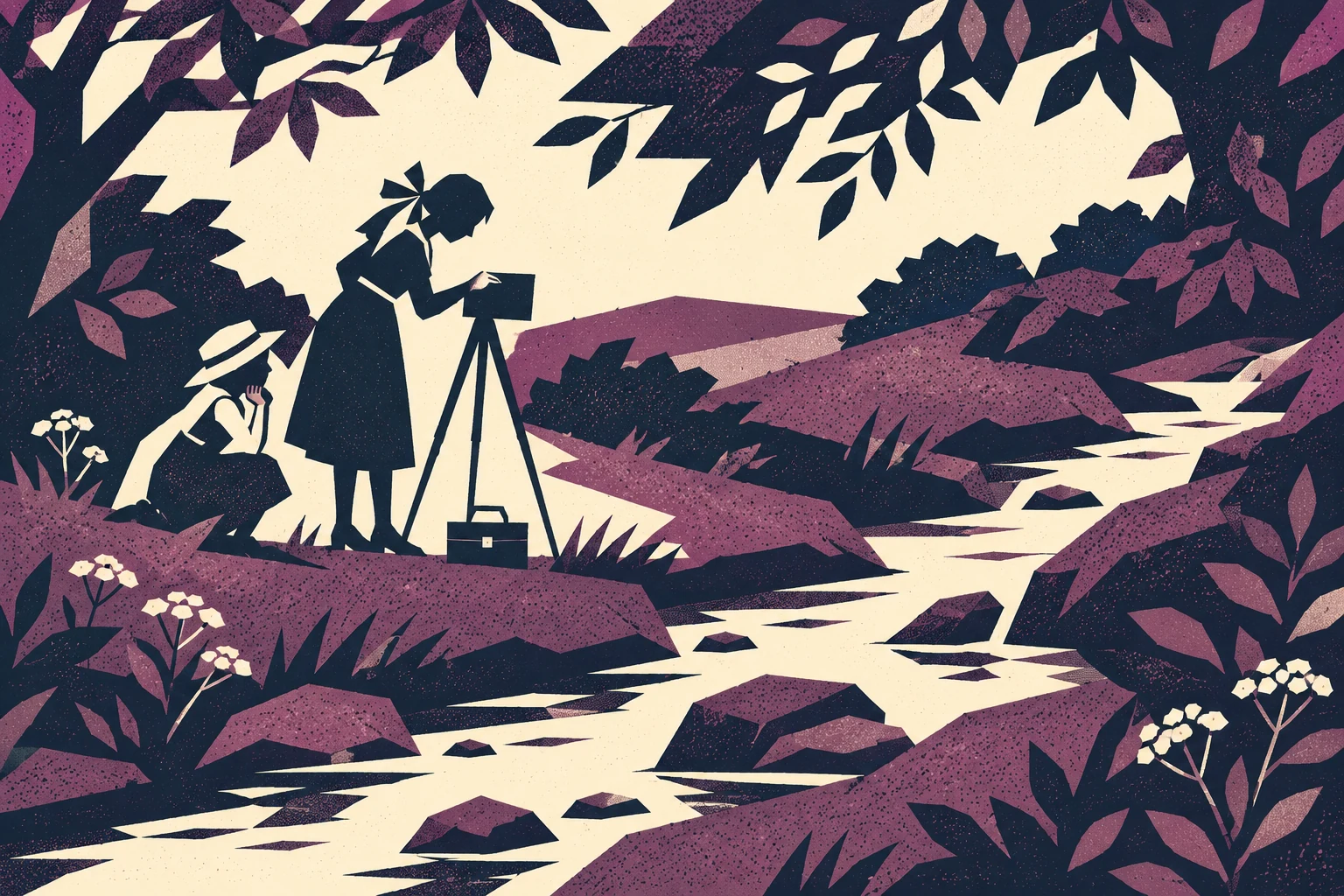
In July 1917, Elsie Wright borrowed her father’s camera and took her cousin Frances down to the stream behind their home at Cottingley, near Bradford. When her father developed the plate, it showed Frances gazing at the lens while small winged figures danced in front of her.1
A camera beside the beck
In the foreground of the picture, one of the figures carried pipes; a waterfall and rocks completed the scene. Within a few years the photograph would be offered to the world as proof of a form of life that ordinary eyes missed.1
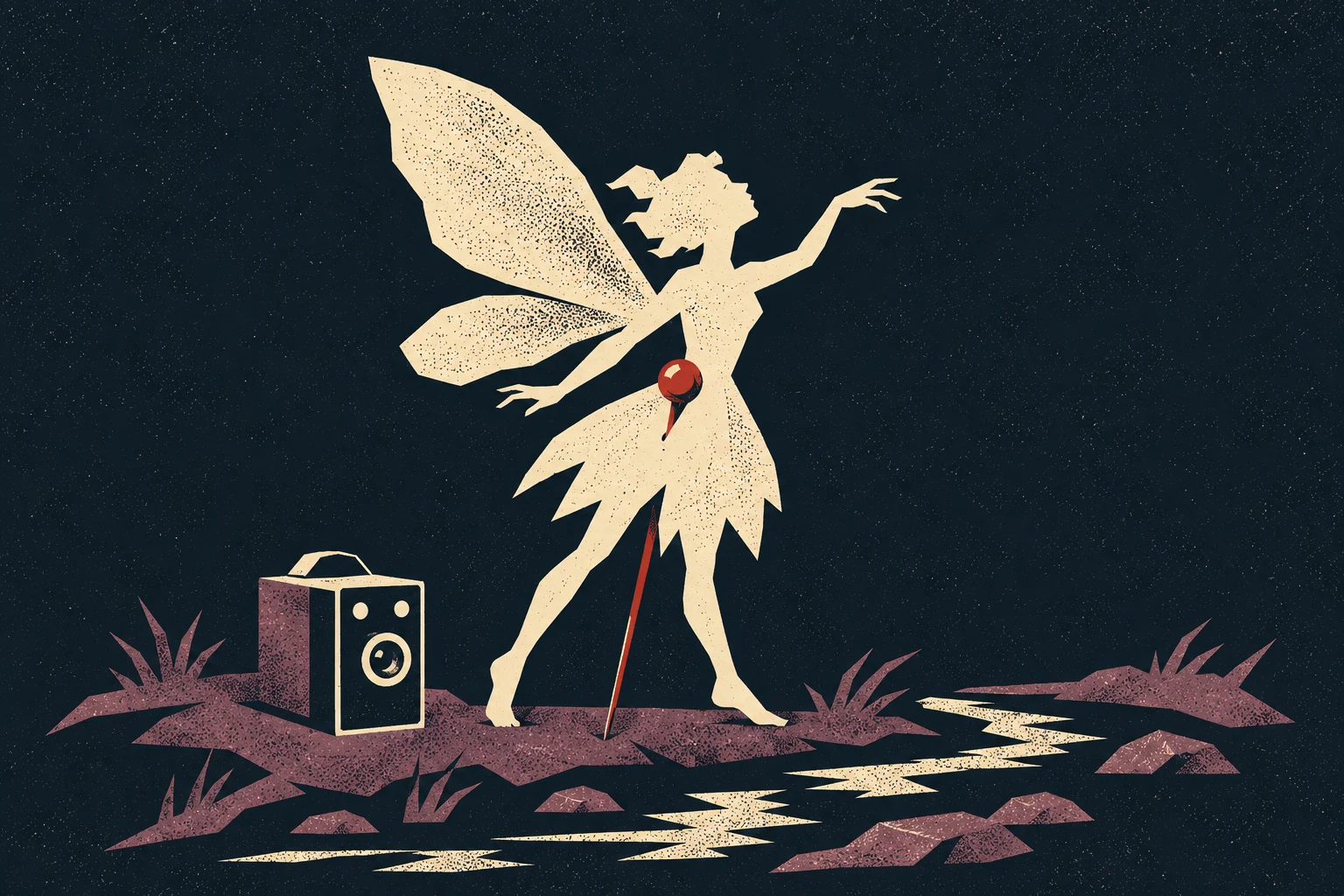
The place was real, and so was the exposure. The fairies were drawings, set up in front of the lens. That explains much of what followed: a negative can faithfully record whatever stands before the camera, even when the scene is a performance. More than sixty years would pass before the cousins publicly explained how they did it, and by then the pictures had travelled far beyond a Yorkshire garden.2
The camera belonged to Elsie’s father, Arthur Wright. It was a Midg quarter-plate model, which used sensitised glass plates, not the roll film of later family snapshots. According to Arthur Conan Doyle’s published account, Wright was at first reluctant to lend it, then gave the girls a single plate. They returned after a short absence and asked him to develop it, and the image that emerged was the one that eventually reached the public.1
A second photograph followed in September 1917, this time taken by Frances, showing Elsie beside a figure described as a gnome. The cousins had swapped places, so there were now two pictures and two photographers, and although the visitors were different, the claim was the same, that creatures met beside the beck had appeared on a photographic plate.1
The publicity brought a complication of its own, because in the published accounts Frances became Alice, Elsie became Iris and the family appeared as the Carpenters. The aliases were meant to protect the family, not to suggest extra children or a second location, so whatever the names in a caption, it describes the same cousins and the same handful of photographs.1
To the believers who took up the case, the setting mattered almost as much as the pictures. A modest family home, a father with a camera and an unremarkable stretch of Yorkshire stream seemed a world away from the trappings of a professional medium. Edward Gardner’s later account stressed how briefly the girls had been gone. Every ordinary detail became an argument that an elaborate trick would have been impossible.1
But almost nothing was known about the minutes that mattered. A father could lend a camera, develop a plate and describe both truthfully without ever seeing what had been placed in front of the lens. Confidence in his honesty could not close that gap. The plates recorded the beck, not how its foreground had been arranged.
The pictures reached an international audience through adults who believed they had found something far more important than a family curiosity. Gardner, a leading member of the Theosophical Society, became the cousins’ investigator and champion. Conan Doyle lent the most famous name. He was the creator of Sherlock Holmes, but the cause he now took up belonged to his other great project: his public campaign for a world beyond material explanation.1
How the pictures reached Doyle
Conan Doyle’s own chronology begins in May 1920, when the editor of the spiritualist journal *Light* told him about some alleged fairy photographs. He followed a chain of contacts, some of whom had not yet seen the pictures themselves, until letters and introductions led him to Gardner and to the images. His book preserves the whole progression, and the reader can watch an intriguing rumour gather authority as it goes.1
Gardner’s sister described his interest in fairies and his contact with the family. Another correspondent, E. Blomfield, sent the two pictures in June, explaining that Gardner had plans for them and did not yet want copies circulating freely. The photographs were already objects to be enlarged, exhibited, reproduced and copyrighted, not glimpses available only to someone standing in a Yorkshire glen.1
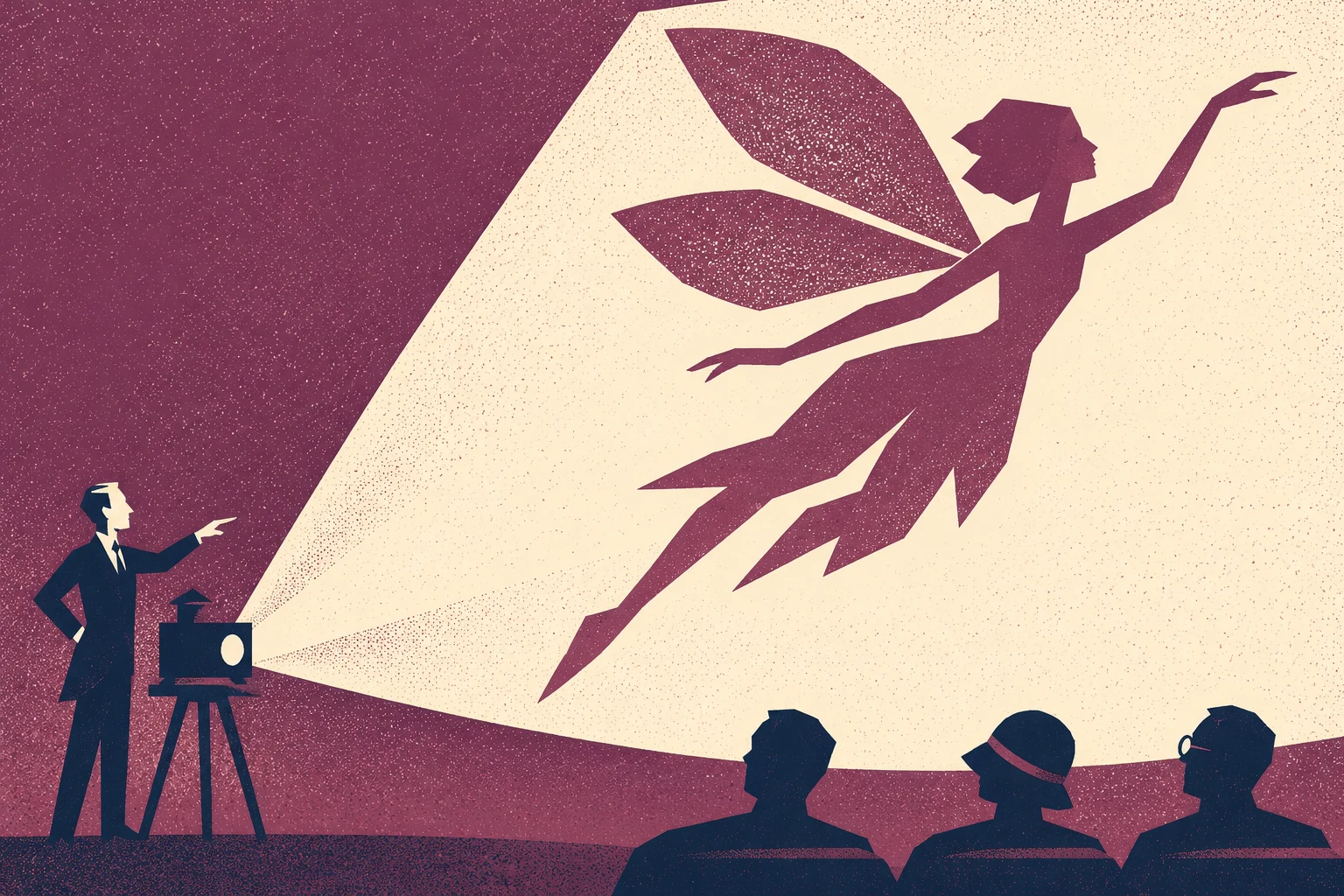
A photograph could travel without the people who made it. Viewers could study a print without meeting the girls, an expert could examine a negative in London and a lecturer could project the figures onto a screen. The portability that made the evidence so accessible also took each new audience further from the original exposure, which was where the real questions lay.
Conan Doyle did not simply print the first account he received. He sought opinions, corresponded about tests and backed a visit to Yorkshire. His failing was not a lack of inquiry. His correspondence shows him giving more and more weight to technical assurances and favourable impressions of character, though neither could stand in for seeing how the pictures were taken.1
Gardner went to Cottingley in July 1920. He met the family, found the sites and looked into the details that had troubled people studying the prints. An oddly shaped hand could be compared with Elsie’s own, the bank and the plants could be found, and the landscape matched. Each ordinary answer to an objection made the extraordinary central claim feel more secure to him.1
His report also recorded descriptions of the creatures’ colours and behaviour. The fairies were said to be pale pink, green or mauve, and the gnome wore contrasting clothes and carried pipes. None of that came from the plates. It was more testimony from the people whose claim was being examined, and vivid detail is not corroboration.1
Gardner concluded that the family’s honesty and simplicity were persuasive, and Conan Doyle accepted his judgement. A letter from Arthur Wright dated 12 July 1920, reproduced in the book, thanked the author for a book sent to Elsie and explained that the family had been away when it arrived. The letter shows a real relationship forming around the pictures. It says nothing about what the camera had seen.1
The photographs first appeared in the Christmas 1920 issue of the *Strand Magazine*, under Conan Doyle’s name. A second article followed in March 1921, and a book, *The Coming of the Fairies*, in 1922. This was no obscure private claim. The pictures reached readers who knew the author’s fictional detective, and the spectacle of the creator of Sherlock Holmes vouching for fairies made them all the more striking.17
What the experts actually said
Harold Snelling, a photographic specialist consulted by Gardner, gave the strongest technical endorsement. According to the correspondence Conan Doyle printed, he was certain that the first photographs were single exposures and that the fairy figures had moved while they were taken. Gardner described pressing him about cardboard cut-outs, paintings and studio trickery, and Snelling’s answers convinced him that every objection had been met.1
Snelling was claiming more than an absence of obvious tampering. Movement, if it could be securely shown, would count against fixed paper shapes. But readers heard his conclusion second-hand, through the believers, not from any controlled experiment showing the figures moving independently of the girls. Confidence in his ability to spot a trick became part of the case that there had been no trick.1
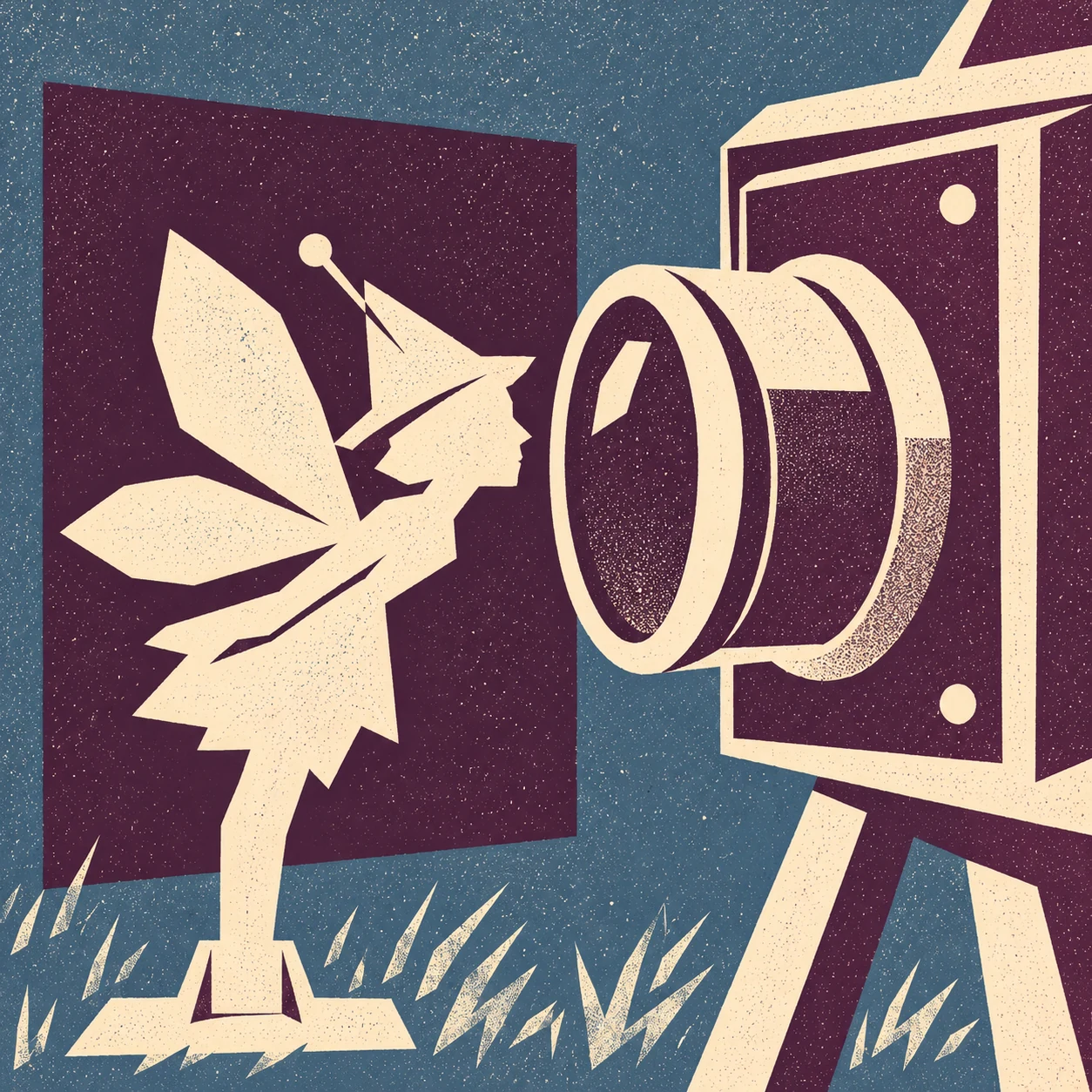
Conan Doyle also took the negatives to Kodak’s offices in Kingsway, and the answer he recorded was far more cautious. The examiners found no sign of double exposure or other photographic trickery, but thought they could produce similar pictures by ordinary means, and they would not call the images supernatural. Conan Doyle’s own book contradicts the familiar claim that the photographic experts vouched for the fairies.1
Kodak’s answer left a simple point standing. A photograph can be genuine as an object and misleading as a record of the world. A single exposure does not need a living subject: a camera pointed at a paper dancer records a paper dancer. The absence of a second exposure, a pasted composite or a retouched negative says nothing about whether the figure in front of the lens was alive.
They would not undertake to say that these were preternatural.
Conan Doyle understood the objection and resisted it. The fact that a skilled conjuror could imitate the result, he argued, did not show that an apparently untrained child had done so. As logic, that was sound: showing that a method is possible does not prove it was used. But the same logic left a perfectly feasible ordinary explanation standing, and it still had to be ruled out.1
His answer turned to the people, asking whether children in that household could have had the equipment, the skill and the motive, and whether a respectable family would keep up a fraud. They were fair questions, but the answers rested heavily on impressions and assumptions, since a person can be honest in most things, fond of a practical joke and perfectly capable of drawing a convincing little figure.
Expertise itself proved slippery. Snelling’s knowledge of photographic processes could help him spot a composite. It did not qualify him to judge whether a village girl could draw a paper figure, or whether a family’s reluctance to seek publicity ruled out an original joke. Several separate questions had been bundled together under a single photographic verdict.1
The charm of the pictures deepened the confusion. The fairies looked graceful and finished, not like clumsy props, and believers treated that grace as an obstacle to fakery. It was just as good a reason to ask whether the figures followed an existing style of illustration. What looked like the natural perfection of another order of life might simply be the practised line of a human artist.
The objection already in print
The paper-figure explanation was on the table long before the confessions. Conan Doyle printed criticism from Major John Hall-Edwards, a pioneer of medical radiography, who said the pictures could have been made with cut-out figures placed near the sitter. He also suggested a rephotographed composite. That second idea turned out to be unnecessary, but the first went straight to the point: arrange the fiction before taking the picture.1
Hall-Edwards also challenged the portrait of Elsie as incapable of such work, pointing to reports of her drawing and of her job in a photographer’s business. Some of his wider remarks about children and imagination reflected the prejudices of his day and said nothing about these particular girls. His technical objection stands apart from them: the negative alone could not rule out a staged scene.1
Gardner replied that working as an errand girl or shop assistant hardly made Elsie a master photographer. But he was answering an inflated version of the problem. Staging a paper figure needed no command of the darkroom and no sophisticated optics, only drawing, cutting, arranging a small object and using the camera to hand. By casting the alternative as an expert’s elaborate fake, Gardner made the children’s task seem impossibly hard.1
Frances’s pose in the first photograph also drew comment. She was looking at the camera, not reacting to the fairies. The believers said cameras were more of a novelty to her than fairies were, while critics saw a girl posing. Neither reading could settle the case, but the argument shows how easily an ordinary detail could be bent to fit either expectation.1
Movement went the same way, because for Snelling the figures had moved, while for the critics their frozen grace looked nothing like a snapshot of living things in motion. Gardner argued that fairy bodies did not have to behave like those of mammals with skeletons, and once that was granted, any mismatch with familiar motion could be recast as a trait of an unfamiliar creature, so the explanation stretched to fit the picture instead of being tested by it.1
The lighting drew a similar response. Asked about the differing shadows, Conan Doyle suggested that the creatures’ substance might give off a faint light of its own, altering their shadows. Nobody had ever measured such a glow. It was one more property introduced to rescue an interpretation from an objection, and the photograph seemed to reveal what a fairy was like only because the fairy was allowed whatever properties the photograph required.1
This was never simply a credulous age confronting a technology it did not understand. Sceptics at the time knew all about staged scenes, trick photography and reproduction, and the museum’s archival research has identified a teenage correspondent who suggested cardboard figures in 1920. Doubt was part of the story from the start. It did not wait for later generations to learn to distrust photographs.4
Conan Doyle even reproduced deliberate imitations. A picture by the photographer Ina Inman was good enough to be taken seriously for a while, though he and Gardner eventually rejected it. He went on distinguishing such expert imitations from the originals made by supposedly inexperienced children. The ordinary method kept resurfacing, and the believers kept placing it beyond the cousins’ reach.1
Three more from the glen
In 1920, the investigators supplied new equipment. Gardner arranged for cameras and marked photographic plates so that the cousins could try again when they were together, the marks guarding against any swapping of plates. Tighter control of the materials seemed to offer a way past the doubts about the first two pictures. It gave no control over what was placed in front of the lens.12
The new series comprised three pictures taken in August: a leaping fairy near Frances, a fairy offering flowers to Elsie and a group later known as *Fairies and Their Sun-Bath*. The first two repeated the familiar arrangement of a girl and a small figure. The last, the fifth photograph overall, was different. It showed the supposed fairy activity among grasses, with neither cousin in the frame.1
Gardner’s letter of 6 September 1920 announced success. He had received three more negatives, and the prints went to Conan Doyle, who was abroad. Snelling endorsed them again, and the image described as a fairy bower struck the believers as beyond any possibility of fakery. A new set of pictures, made with equipment they had supplied, hardened the conviction of people already persuaded by the first pair.1
On 21 October, writing from Melbourne, Conan Doyle welcomed them. He treated the new pictures as confirmation for the public, not as a result awaiting a hostile test, and said that he and Gardner needed no confirmation themselves. The inquiry had acquired a second purpose: answering the public’s objections to a discovery its investigators believed had already been made.1
The marked plates guarded against one real possibility, because if a photographer secretly swapped a plate, the mark might expose the substitution. But a photographer who exposed the correct plate to a drawing would trigger nothing, and the check would work exactly as designed while the fiction sailed through it, so Cottingley’s second round of precautions could succeed completely without ever testing the obvious alternative.
The new photographs also attracted interpretations added after the fact. The fifth contained a shape variously described as a sheath, a cocoon or a bower, which Conan Doyle’s caption explained as a kind of magnetic bath used by fairies. According to the story, the girls themselves had not understood it. Adult interpreters now claimed to know what the children’s camera had recorded better than the children did.1
It was a considerable leap. An uncertain shape among the plants had become evidence about the habits of an invisible population. That explanation did not come from repeated, controlled observations. It came from an existing occult account of nature, applied to a photograph already accepted as genuine, and the harder the picture was to explain, the more room it gave the interpreters to embroider their world.
Gardner returned to the sites and photographed their surroundings. Such visits could show where a picture had been taken and whether a particular bush or pool existed. They could not show that a small figure in the foreground had moved of its own accord. The investigation piled up genuine facts about Cottingley while the crucial moment of photography rested, as it had in 1917, on the cousins’ word.1
Paper, pins and a long silence
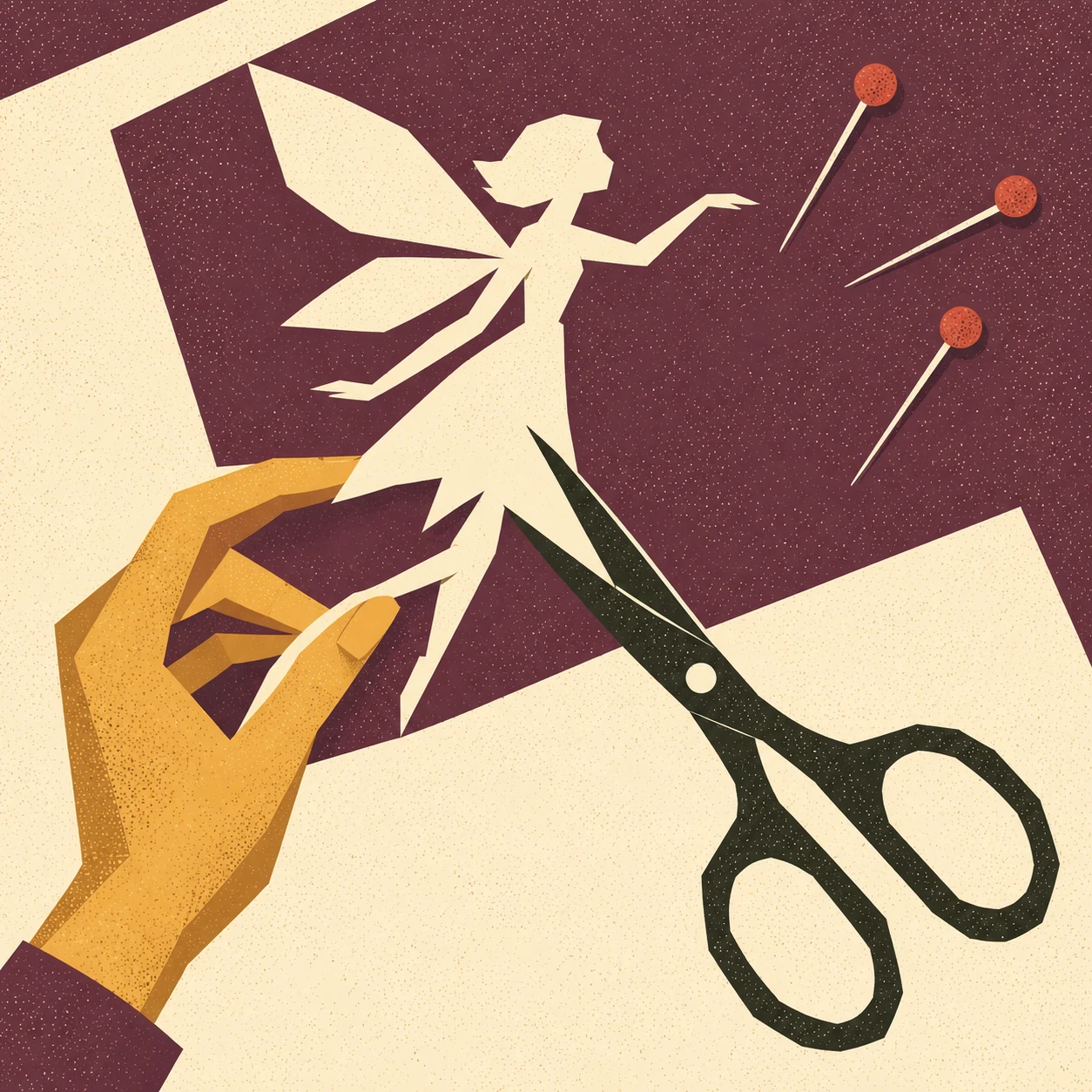
The truth, when it came, was modest. Elsie had made drawings based on illustrations in *Princess Mary’s Gift Book*, and the figures were cut out and held up with hatpins. The National Science and Media Museum preserves a later fairy drawing and Elsie’s correspondence with the photography writer Geoffrey Crawley, including a letter dated 17 February 1983. No hidden team of adult experts was needed.2
The source of the drawings adds a neat twist. The gift book included Alfred Noyes’s poem “A Spell for a Fairy”, illustrated by Claude A. Shepperson. A Christie’s catalogue dates the volume to 1914 and identifies those illustrations as the basis of Elsie’s fairies, and the Portsmouth Conan Doyle Collection notes that Conan Doyle himself had contributed to the same book. He had championed, as evidence of a hidden world, figures copied from a book with his own name in it.67
The fairies were copies drawn by Elsie, not figures cut straight from the pages; the museum’s account is specific about that. What mattered to the camera was the flat cut-out that resulted. Set small against a much larger landscape, it could look alive, especially once viewers had been told what they were looking at.2
The confessions came late, and an explanation offered after decades is not an exact recollection of every exposure. But these were accounts from the makers themselves, naming a feasible method and a source for the figures. They supplied the positive evidence that a debate conducted through outside inspection, and opinions about what the girls could have done, had always lacked.
Why keep the story going for so long? A practical joke is hard to retract once an eminent adult has vouched for it. That is a plausible account of how things developed, though no outsider can now gauge what the cousins felt at each stage. Their later descriptions are testimony about their own experience, with only limited access to the motives of their younger selves.
The historian Christine Ferguson offers a sharper reading. Her study of the surviving objects argues that the familiar tale of two cunning girls fooling great men obscures the unequal relationship between the makers and the powerful adults who controlled what the pictures meant in public. Cameras and plates could become obligations, and Elsie’s artistic ability was played down whenever it threatened the paranormal reading. Ferguson’s argument concerns power and agency, not the existence of fairies.3
It also shapes how the word “hoax” should be used. The photographs were fabricated evidence for the fairy claim, but that does not mean the cousins set out to deceive the world. A family game and an international campaign are different things, and the adults who carried the pictures into the world decided the scale and staying power of the story, even if they believed every word they wrote.
Conan Doyle’s own book makes that process unusually easy to see. It sets out the objections, the refusals and the ordinary alternatives alongside his replies. It was not that nobody had thought of paper fairies: the possibility was put to him again and again. He rejected it because it clashed with his estimate of the children and with the significance he believed the pictures held.1
Was the fifth photograph different?
Frances accepted that the first four photographs were faked but went on defending the fifth. Elsie said all five were false. The museum records the disagreement and identifies the fifth as the only picture on which their later accounts differed. Reporting a joint confession without that qualification would erase part of the evidence; treating the exception as proof of fairies would add something the evidence does not contain.2
Frances’s insistence shows that she continued to describe one image as genuine. It does not identify the shapes in it or rule out an ordinary photographic cause, and Elsie’s contrary account rules out any appeal to unanimous testimony. Neither woman’s confidence can replace a controlled record of an exposure made decades earlier.
Double exposure offers an ordinary route to overlapping, partly transparent shapes. Ferguson discusses it in relation to the fifth picture, setting that effect against the cut-outs used for the first four. No new technical investigation was carried out for this article, and the glass plate was not examined, so double exposure is an available ordinary explanation, not a certified reconstruction.3
The fifth picture had a special status from the start. It seemed to show more than its makers had noticed, and the believers supplied an occult reading of the unexplained shape between the figures. That history makes later certainty harder to judge. The image arrived wrapped in instructions on how to read it, and its strange appearance cannot be separated from the language that gathered around it.1
Could real fairies exist even though the first four photographs were staged? In the abstract, one does not rule out the other. As an account of what happened at Cottingley, though, it would need independent evidence for the creatures, and the faked pictures supply none. The disputed fifth cannot borrow that support simply because Frances’s confession did not cover it.
Conan Doyle had considered another escape route: perhaps the photographs showed thought-forms produced by a psychic process, not an independent population of small beings. He raised the idea in his chapter on the second series, though he thought it unlikely. It answered doubts about one extraordinary explanation by proposing another, with no test that could tell it apart from drawings.1
His book also included the observations of the clairvoyant Geoffrey Hodson, who visited Cottingley in August 1921 and described creatures he said he could see. His testimony shows what believers thought was happening there. It cannot explain how an earlier glass plate was exposed. A claim to see fairies and a photograph of a supposed fairy each need their own evidence, and neither can vouch for the other.1
The mystery that remains is a personal and historical one. What did Frances think she saw, and how did her account change as a family episode became a public controversy? The record supports careful questions about memory, belief and storytelling. It does not support diagnosing her, dismissing everything she said as conscious invention or treating her belief as a scientific exception to the method both cousins described.
What survives at Cottingley
As of 7 November 2026, the best-supported account is that the famous photographs were made by ordinary means, with the cousins’ own admissions establishing the cut-out method for the first four. The fifth preserves a disagreement in testimony, not a verified encounter with another form of life.34
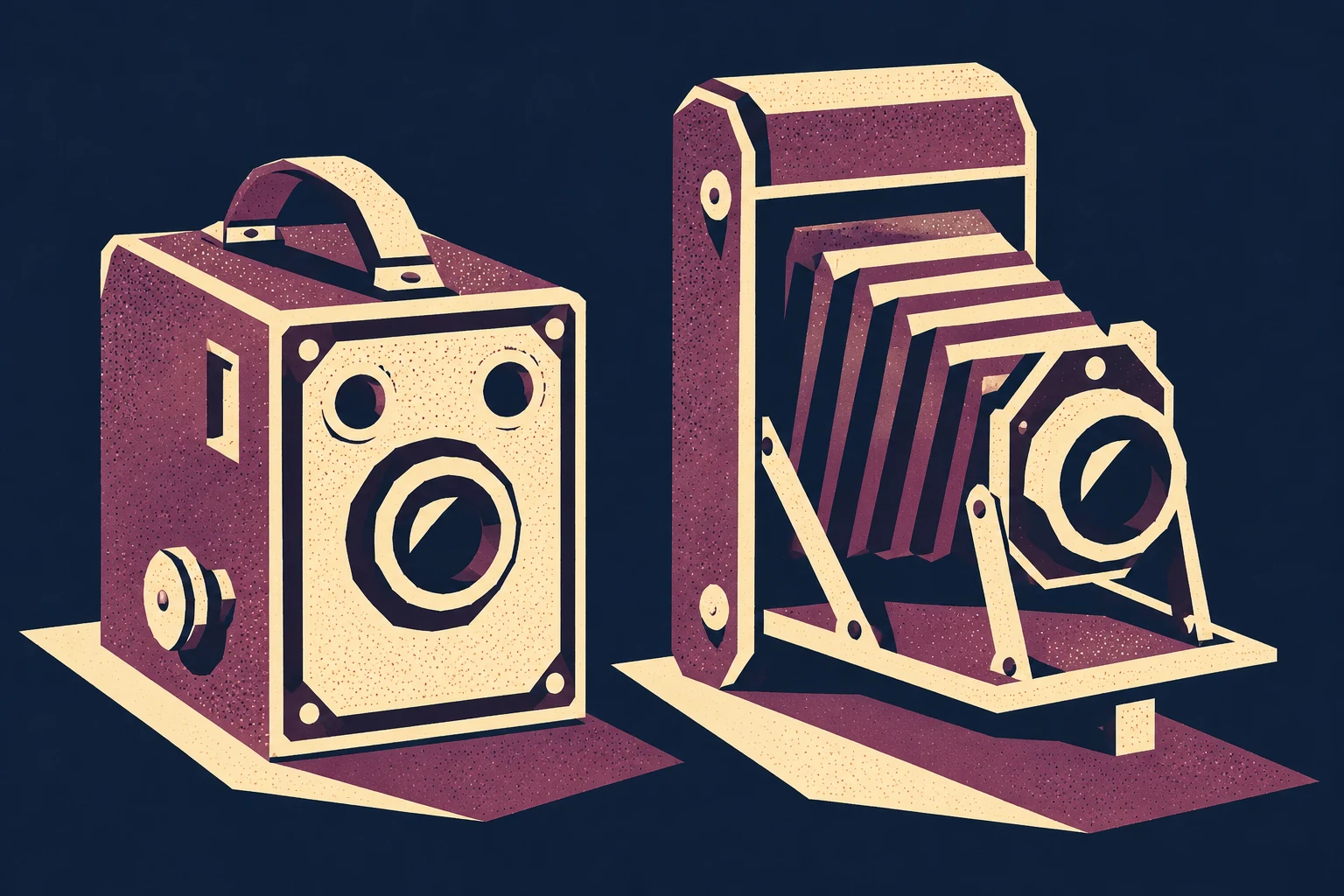
The cameras survive. In a conservation report published in 2024, the National Science and Media Museum described stabilising the Midg and a Cameo before taking them to the University of Bradford for CT scanning. The scans revealed how the cameras were built while protecting their fragile materials.5
They invite better questions than whether Conan Doyle was a fool: what the precautions actually controlled, what each expert ruled out, which version of a picture reached the public and how much say its makers kept over what it meant. The record from the 1920s is valuable because it preserves answers that were available long before anyone confessed.
For a century, the camera that took the first picture has been treated as a witness. It was always an honest one. It recorded a girl, a stream and a paper drawing held up on a hatpin, exactly as they stood in front of it in July 1917.
Linked case files
Sources7
- The Coming of the Fairies Arthur Conan Doyle · 1922 · Accessed 2026-11-07
- The story of the Cottingley Fairies shows that image manipulation is nothing new National Science and Media Museum · 2012-07-29 · Accessed 2026-11-07
- Power at play in paranormal history Christine Ferguson · 2024 · Accessed 2026-11-07
- Cottingley’s Scientific Fairies and Enchanting Technology Meg Warlow · 2025-09-26 · Accessed 2026-11-07
- Blog from the Basement: Conserving the Cottingley fairy cameras Eleanor Durrant · 2024-07-17 · Accessed 2026-11-07
- Princess Mary’s Gift Book Christie’s · Accessed 2026-11-07
- The Cottingley Fairies Portsmouth City Council, Arthur Conan Doyle Collection · Accessed 2026-11-07