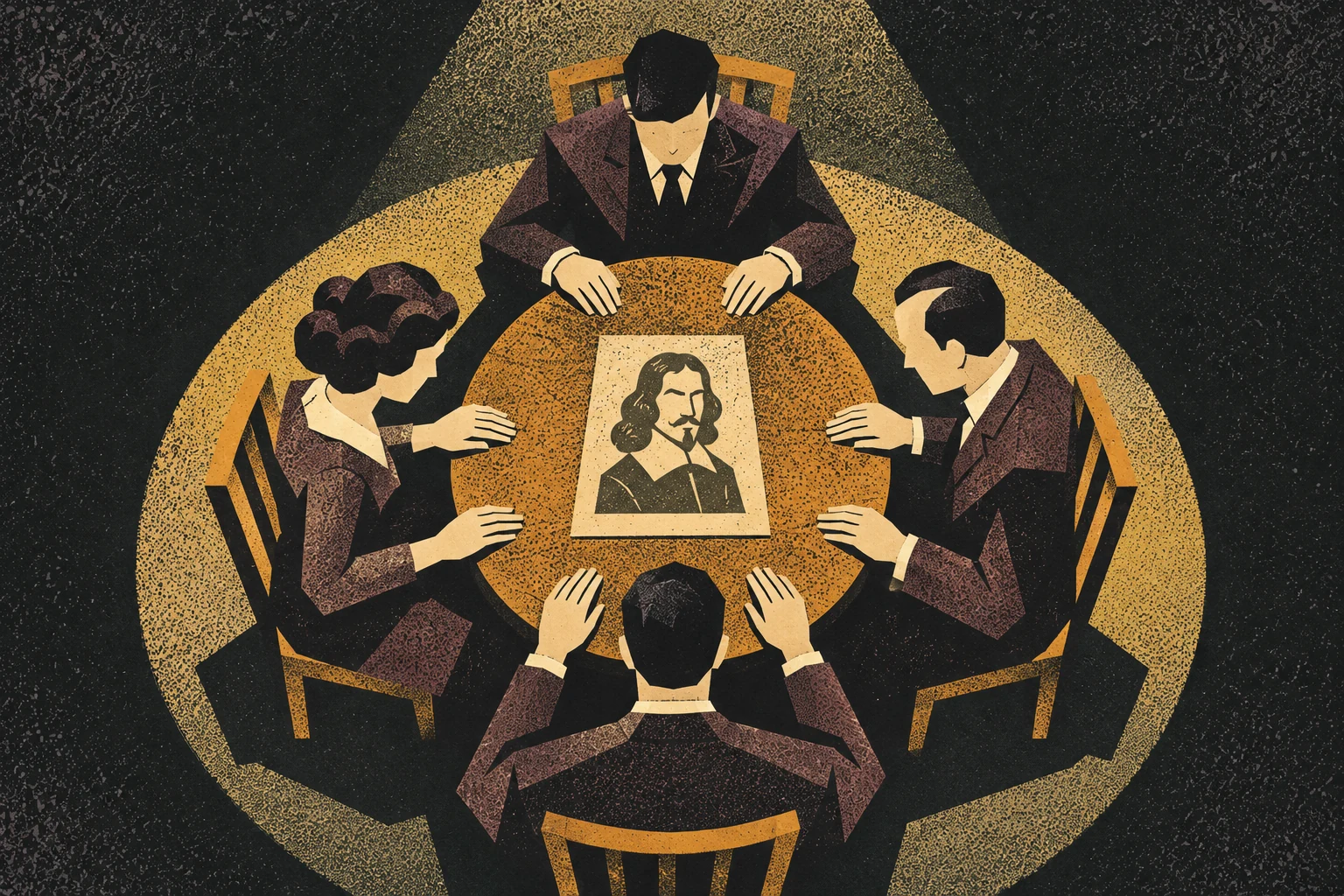
In September 1972, a group of researchers in Toronto invented a dead man, gave him a life story and asked him to speak. Months later, the table they sat around began to knock. Who, or what, was answering?1
A ghost with an author
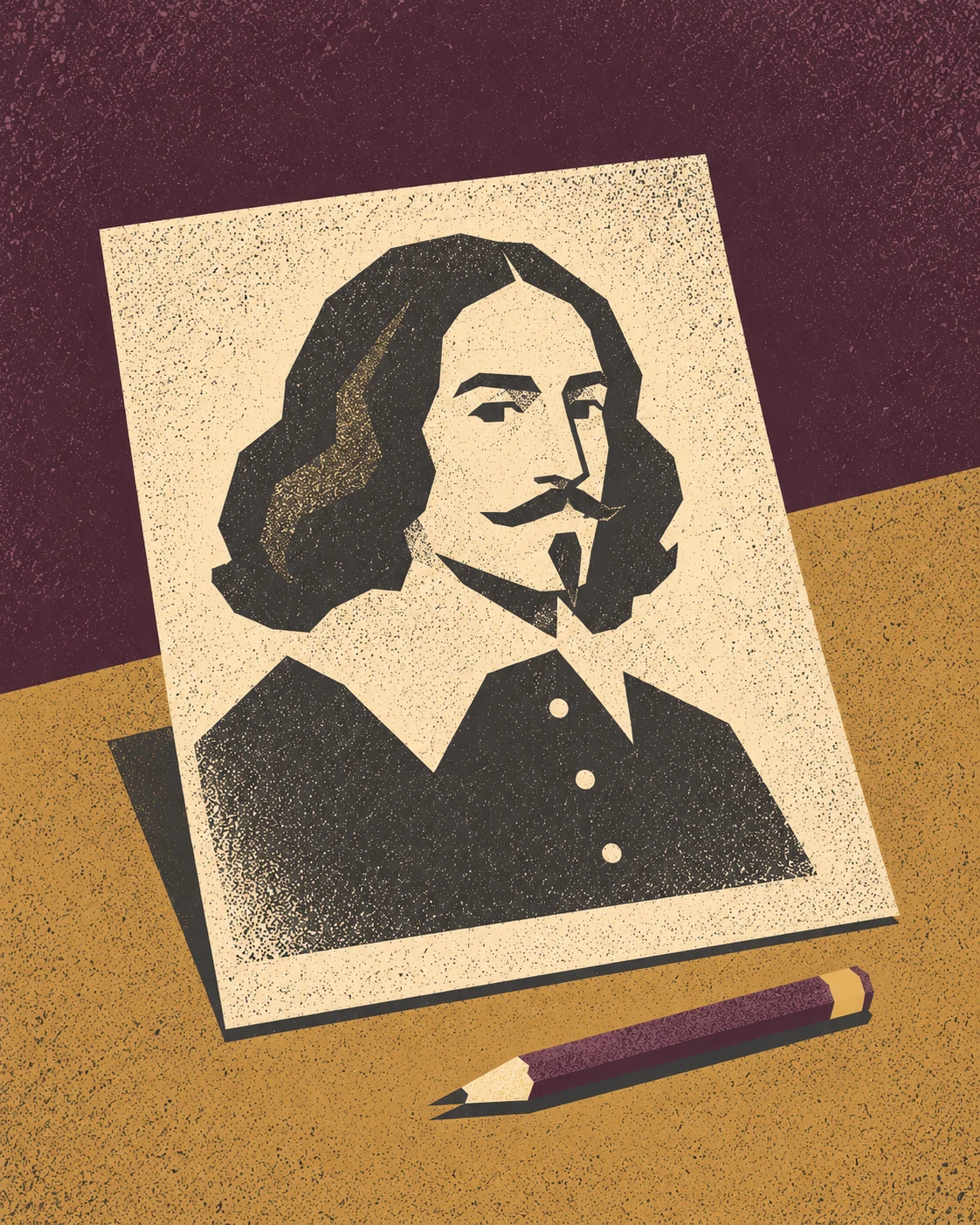
Philip was no missing person waiting to be identified, but an agreed fiction. Members of the Toronto Society for Psychical Research had started meeting to see whether sustained concentration could produce an apparition, and eight regular participants created an imaginary seventeenth-century Englishman, complete with a portrait and an unhappy personal history. Their first report appeared in January 1974.1
The choice was deliberate. A séance built around a real dead person invites arguments over obscure biographical details and facts supposedly unknown to the medium, but here the sitters had written the biography themselves. If something answered in character, it could not be the return of a historical man, because there had never been one.1
The original plan failed, because after months of meditation no apparition appeared. So the group changed its approach, swapping solemn concentration for singing, joking and encouragement, and the report describes sensations in the table, then audible raps and, later, movement. The sitters addressed the table as Philip, with one knock for yes and two for no, and for a man who had never existed, Philip turned out to be remarkably talkative.1
The experimenters knew how strange their claim was, and they were not offering a newly discovered ghost. Their proposal was more unsettling, because it suggested that the personality at a séance came from the living, even if the movements that accompanied it were, as they believed, paranormal. The idea undercut the simple spirit explanation while putting another extraordinary claim on the table: psychokinesis, the movement of objects by the mind.
That reverses the usual ghost story, in which investigators find a haunted room and only later learn who haunts it. In Toronto, Philip came first. His name, his character and the answers the sitters expected were part of the conditions under which they sought a result, and the surviving reports let us examine what happened next.
What a moving table proves
A later participant account describes a professional film directed by Ian Brims, with financing arranged by society member Bruce Raymond. It combined a re-enactment of how the experiment developed with demonstrations of the effects. Iris Owen, one of the group, described bright filming lights and further television appearances. The aim was to show the case to the world beyond the original circle.2
A film can record a movement without recording its cause. The camera may show a table tilting or sliding while the forces acting on it stay unknown. Hands resting lightly on the top are still a physical connection, and a shot that takes in faces and fingers may miss feet, the underside or the way pressure is distributed. Bright lights settle whether the room was dark. They do not settle whether the experiment was controlled.
Witnesses have the same limitation. An observer can reliably report a sound, a movement and their own surprise without knowing what caused any of them. A sceptic who changes their mind adds a perspective, but is not an instrument for measuring force. What counts is what each witness could inspect, and which ordinary explanations their position allowed them to rule out.
The lift outside the film
Owen’s 1975 report adds an important qualification about levitation. After filming had ended, she wrote, a private session produced a brief complete lift of the table. No adequate photograph was taken, so the lift forms no part of the film’s visual evidence. Retellings that run the filmed demonstrations together with the private claim make the record sound stronger than it is.2
None of this shows that anyone cheated. Failing to rule out an ordinary mechanism is not the same as catching someone in the act. The possibilities include deliberate action, unwitting action, a misreading of what happened and an effect the observers could not explain. The choice is wider than a genuine ghost or a proven fraud.
Better footage would have helped: an uninterrupted view of the whole table, calibrated measurements and clearly documented contact. The edited film remains valuable history, showing how the case was presented and what the participants believed. It cannot exclude every ordinary source of movement.
Faraday’s earlier investigation
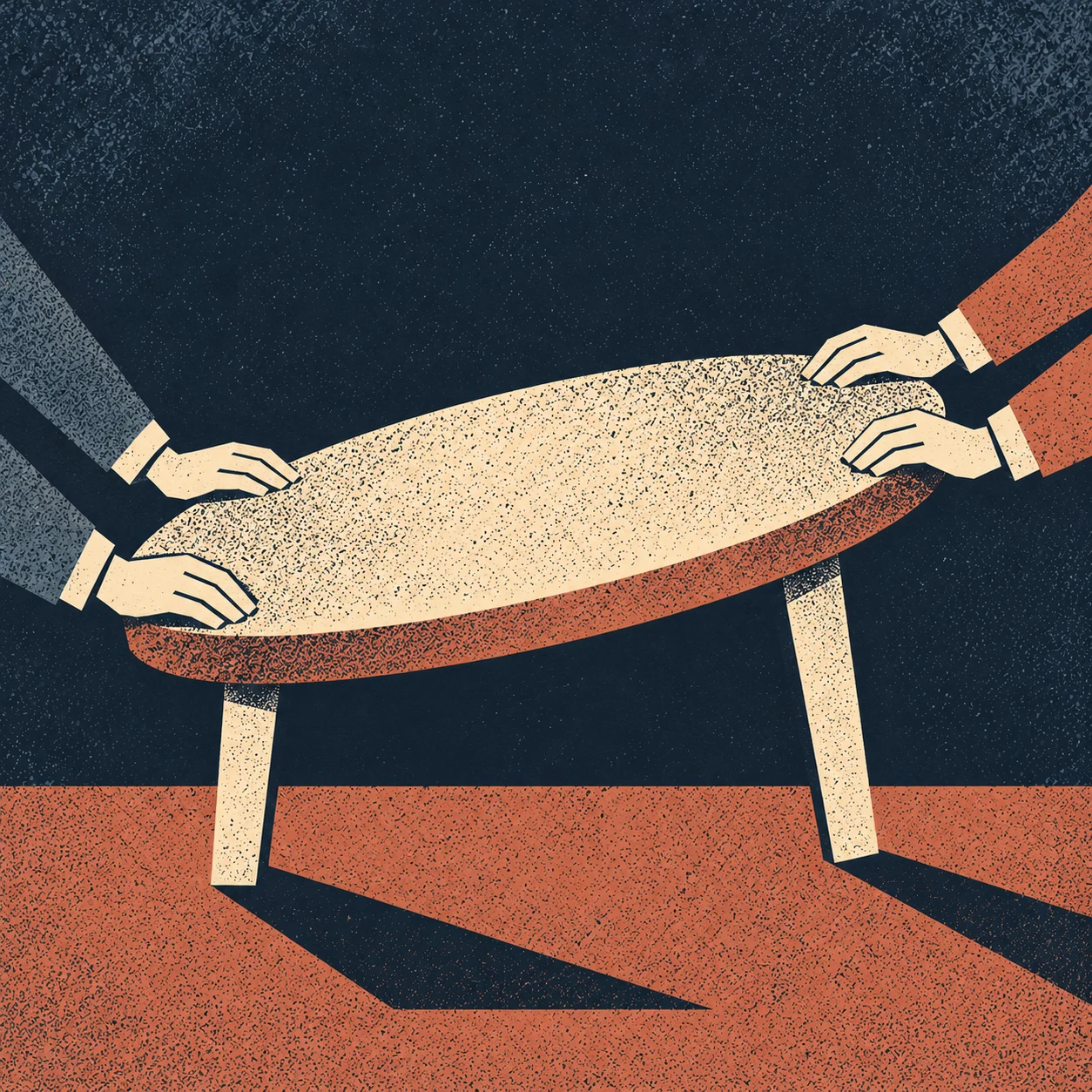
The central problem was already familiar to the Victorians. During the craze for table-turning in 1853, Michael Faraday investigated claims that tables moved beneath the resting hands of people who denied pushing them. Theories ranged from electricity and magnetism to some unknown physical force. Faraday reduced the question to something he could test: did the movement begin in the table or in the hands?5
He first checked whether placing different materials between the hands and the tabletop stopped the effect. It did not, which meant he could build materials into an apparatus without the sitters objecting that he was blocking the force. Faraday was not simply declaring table-turning impossible. He was trying to separate the explanations under conditions the sitters themselves accepted.5
His apparatus combined a movable surface with an indicator that made any movement of the hands relative to the table visible. If the table led, the indicator would move one way; if the hands led, it would move the other. A sitter’s feeling of following the table became a physical sequence anyone could watch. Nobody had to judge their own intentions.5
Faraday dated his letter to *The Times* from the Royal Institution on 28 June 1853, and his results pointed to unwitting muscular action. When the indicator was hidden or ignored, the sitters’ hands pushed in the direction they wanted the table to go, though they believed they were pressing straight down, but when they could watch the indicator, the movements stopped. It had shown them an action they had never noticed.5
The implication was uncomfortable but precise. A person could sincerely deny pushing and still help move the table, because intention, awareness and muscular effort were not the same thing. Faraday’s mechanism needed no conspiracy, since several people trying to follow the same movement could all contribute to it while feeling that it came from somewhere else.5
Sincerity, in other words, was compatible with error. Faraday did not need to accuse anyone of dishonesty before testing what their hands were doing, and assurances of honesty could not rule the mechanism out. He replaced an argument about character with a device that showed the evidence.5
Faraday’s experiment took place more than a century before Toronto, and it cannot diagnose every knock attributed to Philip. Its value lies in its method. It shows how a table can move in ways that contradict its sitters’ honest account of their own actions, so their statement that they were not pushing cannot settle the matter.
Nor does Faraday’s explanation make the experience trivial. A person who expects a response, feels an object begin to move and joins others in following it can find the moment powerful. The historian asks why the sitters read it as an outside agency, while the experimenter asks whether ordinary force can be ruled out, and neither question requires dismissing what the sitters felt.
The sound beneath the table
The Toronto investigators did try to get beyond impressions. In a 1975 paper, Joel Whitton described recordings made with a microphone fixed beneath a card table. He analysed seven raps selected from sessions in which the group had identified a sound as an answer, and compared them with deliberate taps, kicks and other contact with the table. He reported differences in how the sounds built up and died away.3
Whitton acknowledged the limits of his equipment: the frequency response and gain of the recording system as a whole were unknown. His analysis described the broad shape of the sounds, not their physical source. Even so, the paper proposed that the unusual traces reflected psychokinesis, which went well beyond showing that the selected samples differed from the comparison noises.3
The way the raps were chosen matters. A rap counted as unusual because the group had already heard it as an answer. Whitton was therefore comparing sounds the sitters had interpreted as communication with sounds made deliberately for comparison. That can reveal a pattern, but it cannot show that expectation played no part in deciding which sounds made the cut.
A sound recorded through a table depends on how the table is struck and how the recording system responds. Change the point of contact, the way the table is supported or how the microphone is attached, and the recording changes. None of this proves that any sitter made any particular rap. It does set out the tests a claimed paranormal sound would have to pass.
A second acoustic test
Whitton published a further acoustic study in 1976. It included recordings associated with a suspended steel plate and earlier material from another group. He described more than one characteristic sound shape and argued that the comparison supported the reality of unusual raps. The study moved beyond a single wooden table, but the old problem came with it: connecting a recorded waveform to its cause.4
An unusual trace is a starting point. To identify a new physical process, the comparison has to show that known ways of making and recording sound cannot produce it, and what matters is how many of those alternatives were actually tested. A strange waveform does not come with its explanation attached.
Whitton’s work deserves its place in the story. It supplies dates, methods, samples and claims that can be checked, and it records an investigator genuinely trying to tell sounds apart. Its conclusions are only as strong as that attempt.

The steel ball test
The group’s later work produced one of the most revealing tests in the case. In her 1976 report, Owen described a visit to Kent State University in Ohio in March 1975. One experiment used ten containers: one held a steel ball, the other nine green glass marbles. Each participant recorded a choice, and Philip was asked to choose too, by rapping. Owen reported that the group did poorly at finding the steel ball.6
She found another pattern more interesting, reporting that Philip’s choice tended to follow the participants’ majority choice, which Owen took as evidence of the group’s collective mental activity. What it did not show was Philip finding the hidden ball, and agreeing with the group is not the same as knowing something nobody in the group knew.6
That is the crux of the case. A communicator can echo what the circle expects without telling it anything new about the world. A historical personality can sound convincing because everybody knows the outline of the character. A hidden object is a different kind of test, because its location cannot be found by staying in character or reflecting a shared preference.
If several sitters agree that Philip would answer yes to a question about his fictional life, a yes-like rap fits their expectation and reveals nothing about how it was produced. A question with an independently recorded answer would tell us more, provided there were safeguards against ordinary clues and the scoring rules were fixed in advance.
The Toronto programme changed over the years. A 1977 report describes the original participants still meeting, with visitors and further demonstrations entering the record. This was a sustained practice, not one remarkable night, which helps explain why later accounts differ over the apparatus and the phenomena. Results from a later phase cannot be slipped back into the first experiment as if nothing had changed.7
Changing the method is not in itself a flaw, since investigators often adapt to what they observe, but each change alters the question. A claim about a card table with hands on its surface is different from a claim about a sound in a steel plate, and each result belongs with its own conditions, not in a growing list in which every success seems to confirm every other.
Did imagination move matter?
The experimenters offered an explanation that did not require Philip ever to have lived. The personality was invented; the physical effects, they proposed, came from the participants’ collective mental activity. The fictional character focused their attention, expectation and emotion, and psychokinesis linked that state of mind to an object in the room.16
Could that be what happened? The fact that the group imagined a personality does nothing to support the physical claim, because ordinary muscular action, deliberate intervention and errors of observation remain possible wherever the conditions allow them, and psychokinesis has to be shown to exceed all three. Proving Philip imaginary removes one explanation of who he was, but it does not prove another explanation of what the table did.
The British psychologist Kenneth Batcheldor had explored similar sitter-group methods before the Toronto work. A later account from the Society for Psychical Research describes his interest in relaxed conditions, the make-up of the group and the possibility that scrutiny suppressed results, and records that he was aware of unwitting muscular action. The connection helps explain why the Toronto group changed its procedure, though experiments run by different people are not interchangeable evidence for one mechanism.8
That creates a tension. Supporters may consider relaxation and confidence essential to producing an effect, while an independent examiner needs controls that change those very conditions. The tension does not prove the effect false, but it does mean the experiment needs an agreed procedure that can both produce a result and identify its cause, because an effect that vanishes whenever the ordinary explanations are properly tested is hard to interpret.
Repeating a séance can reproduce ordinary mechanisms as easily as extraordinary ones. A second group getting a table to move would show that the experience was not unique to one circle. It would show far more if that group worked under tighter controls and obtained a result those controls were designed to test. Repetition without that discipline simply multiplies the same uncertainty.
The reports are at their most valuable when they record failures and unexpected answers. Those details resist a tidy success story. They let us ask whether the communicator delivered information, whether a physical effect was measured and whether the result supported the meaning attached to it. A sympathetic account can contain the evidence that complicates its own conclusion, and Owen’s does.

A result that changes with its audience
Owen’s 1977 report describes public demonstrations and visitors alongside the group’s continuing private meetings. It presents the participants as practising and developing a shared skill over years: learning how to run sessions, how to recognise a response and how to explain the work to others. That history counts against any idea that they simply stumbled into one extraordinary event.7
An audience changes the setting without settling the mechanism. More witnesses can hear a loud knock at once, but they are also looking where the demonstration directs them, and the source of the sound can stay hidden. Wider agreement that something happened adds no new information about what caused it.
The useful questions are specific: which contacts remained, what was measured throughout and which failed attempts were kept in the record. A sympathetic report can be asked all of them without any suggestion that its authors meant to mislead, and the answers decide how much the surviving records can support.
Or did something else answer?
There was a more traditional supernatural explanation too. Owen’s 1976 report mentions letters from spiritualists warning that real spirits might be using the invented personalities. On that view, Philip’s fictional biography did not stop a separate intelligence from impersonating him. Owen saw no need for that explanation and presented the experiment as an alternative to communication with the dead.6
The impersonation theory solves a narrative problem: how could a man who never existed answer questions? It does so by adding an agent whose identity nobody can establish. Every response that fits the group’s imagination can be redescribed as a spirit borrowing the group’s fiction, and without a test that tells the two apart, the theory explains everything and can be checked against nothing.
The experiment did not disprove survival after death, since it did not test every form of supposed communication and Philip was designed to be fictional. Its challenge is narrower and sharper, showing that a coherent séance personality does not have to be a real dead person, because coherence can come from a story shared by the living. Whether anything paranormal accompanied it is a separate question.
As of 6 November 2026, the reports document a long-running experiment, striking experiences described by its participants and attempts to measure some of the effects, but they do not show that a spirit was created or that the mind moved the table. The most unsettling fact in the record is a simple one. Every time the table knocked, the people listening knew that the man answering was someone they had made up.
Linked case files




Sources8
- Generation of Paranormal Physical Phenomena in connection with an Imaginary Communicator Iris M. Owen and Margaret H. Sparrow · 1974-01 · Accessed 2026-11-06
- Philip’s Story Continued Iris M. Owen · 1975-04 · Accessed 2026-11-06
- Qualitative Time-domain Analysis of Acoustic Envelopes of Psychokinetic Table Rappings Joel L. Whitton · 1975-04 · Accessed 2026-11-06
- Paramorphic Table Rappings: Acoustic Analysis Joel L. Whitton · 1976-06 · Accessed 2026-11-06
- On Table-turning: letter to The Times Michael Faraday · 1853-06-28 · Accessed 2026-11-06
- Continuation of the Philip Experiment Iris M. Owen · 1976-06 · Accessed 2026-11-06
- Philip’s Fourth Year Iris M. Owen · 1977 · Accessed 2026-11-06
- Kenneth J Batcheldor Psi Encyclopedia / Society for Psychical Research · Accessed 2026-11-06