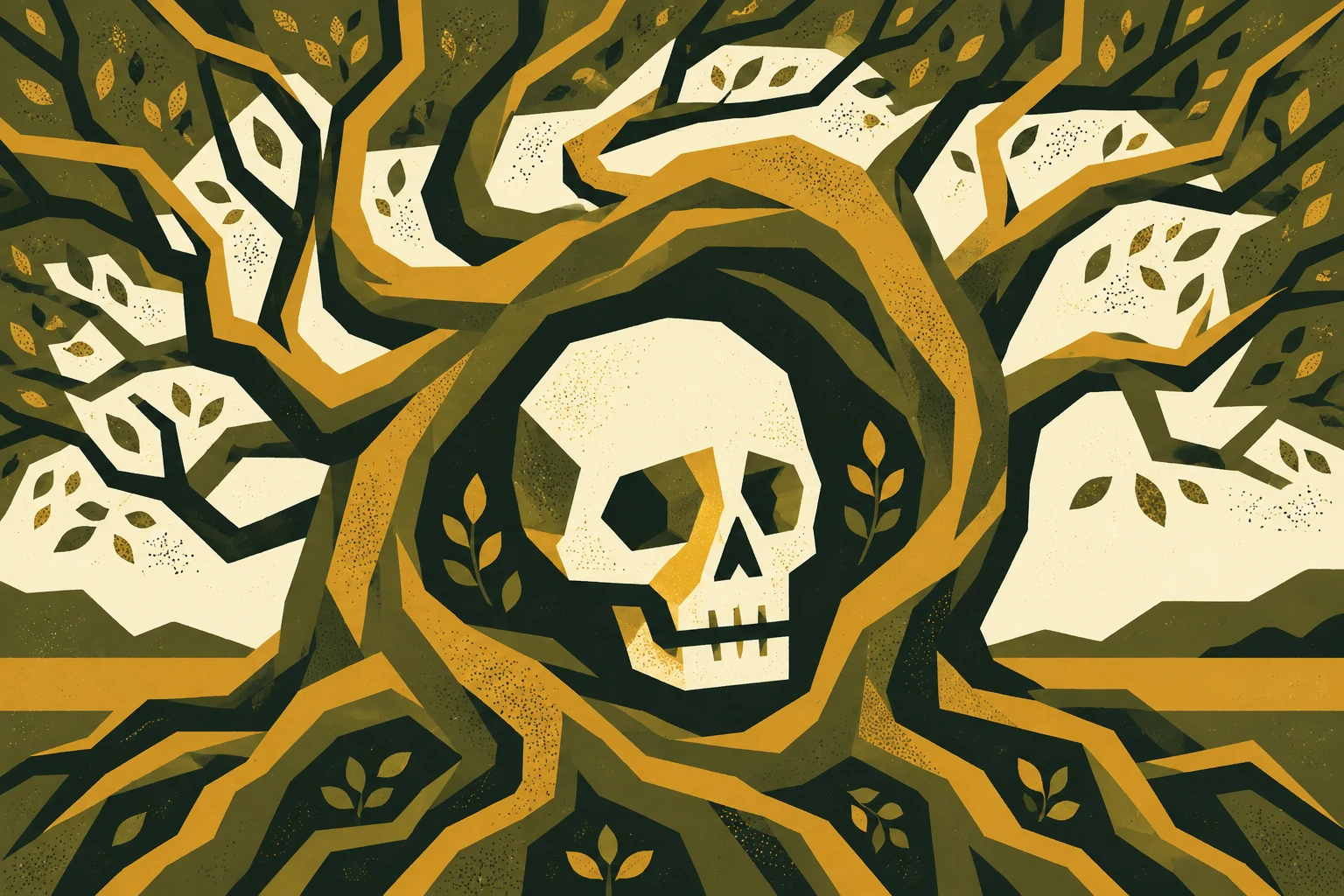
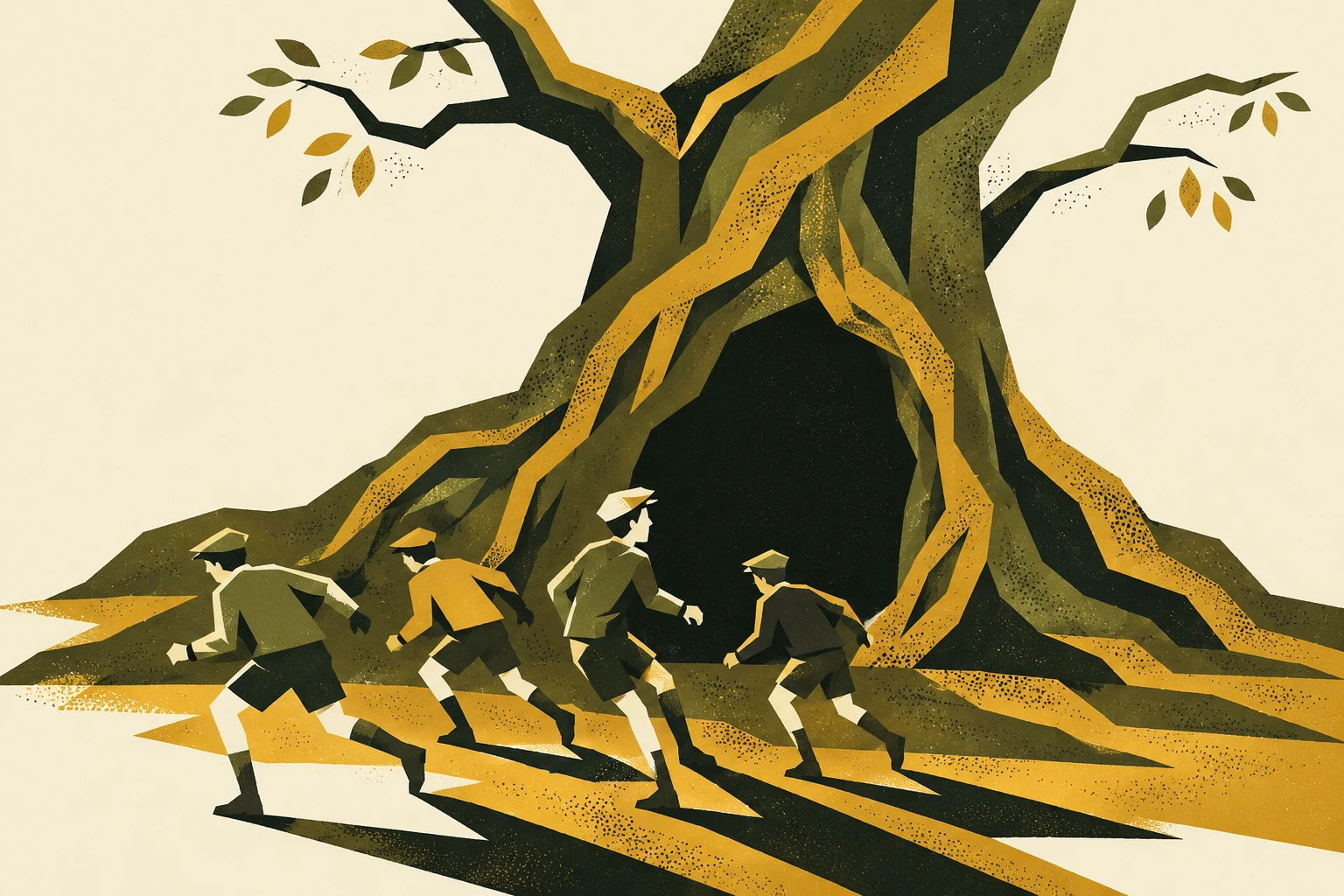
On 18 April 1943, a group of boys trespassing on the Hagley estate peered into the hollow trunk of an old wych elm. Something inside was looking back. Within months, a question would appear on the walls of the district: who put Bella in the wych elm?1
A body in Hagley Wood
At first the boys took the skull for an animal’s, until its human teeth and the remains of its hair settled the matter. They left the wood. Reporting what they had found meant admitting where they had been, and for a while nobody said anything. Eventually one of them told an adult, and the police were called.1
The delay mattered. The boys had handled the skull, and nobody could be sure what they had moved before the police arrived. Investigators would later try to reconstruct a death that had happened long before the boys climbed the tree, starting from a scene that had already been disturbed.1
The search recovered much of a skeleton, along with clothing and personal effects including a wedding ring, while some bones, among them those of a hand, lay outside the tree. The teeth were distinctive enough to offer a route to identification, so the police had the remains of a particular woman, with possessions and features that somebody ought to recognise, but not her name.1
Professor James Webster examined the remains. According to the county archive service’s account, he estimated that she was about 35 years old and about five feet tall, and had been dead for between eighteen months and two years. He considered suffocation possible and thought the body had gone into the tree feet first. These were judgements made from decomposed remains, not observations of the death itself. If he was right about the timing, she had died some time in 1941.2
Somebody might have recognised the ring or remembered the clothes, and the teeth offered another way in if a dentist could match them to a patient, but none of it produced a name. Had she been living far from anyone who knew her, or under another name? Or had someone reported her missing, only for the report never to reach the detectives at Hagley? Even the wedding ring raised a question it could not answer, which was whether a husband was looking for her.12
The detectives reconstructed her clothing and circulated descriptions, which the archive account lists as a mustard skirt, a striped cardigan, a light blue belt, a peach-coloured underskirt and blue shoes. Notices went out to dentists and missing-person reports were checked, but although the description was detailed enough to belong to a recognisable woman, it never led to a name.2
Wartime Britain made her disappearance easier to explain, because a refugee, a stranger passing through or somebody living under an assumed name could vanish without anyone raising the alarm, and later the same setting would make espionage seem plausible. But the war explains only why she might have been hard to trace, not who she was or how she reached that particular tree.
The name on the wall
The most enduring contribution to the case came from someone who never gave their name. As Christmas 1943 approached, messages began appearing on walls asking who had put Bella in the wych elm. Versions of the question would later become associated with the Wychbury Obelisk on the hill above Hagley. The words gave an unidentified woman a familiar name, and they made an accusation in the form of a question: somebody had put her there, and somebody else knew who.1
Did the writer know the woman? Was the message an accusation, a warning or a taunt aimed at someone who would understand it? The wording seemed to promise knowledge the police lacked. It could equally have repeated local gossip or borrowed from the newspapers, and nobody looking at a later copy could tell which. If the writer did know the truth, he or she never came forward to tell it.
Accounts differ over the spelling of the name and the exact wording of particular messages, but the date of each inscription matters more than its wording. An early message, written before the case was widely reported, could be a lead. An inscription painted decades later shows how long the case has haunted the area. It reveals nothing about the woman found in 1943.
Was Bella her real name? Perhaps the writer knew her by it, but no family record, reliable recognition or match with a missing woman has ever confirmed it. For now, the name belongs to the anonymous message, and whether it ever belonged to the woman in the tree is part of the mystery.
The question survived because it seemed to be addressed to someone who could still answer. A newspaper could move on and a police inquiry could run out of leads, but the words on a wall could always be written again. They kept the case alive long after the first attempt to identify the woman had failed.1
What the evidence can establish
Somebody had hidden a woman’s body in a tree, and the police treated the discovery as murder. What remains uncertain is how she died, and whether the tree was simply a hiding place or part of the killing itself, since she might have been dead when she reached the wood or put into the hollow alive. The surviving sources give no complete sequence.12
Hiding a body does not require a conspiracy. Someone responsible for a death, whether by assault, accident or something else, might simply have used the nearest hiding place. Nor does the tree prove that she died somewhere else. Retellings that describe her being carried through the wood or forced into the trunk go beyond anything the sources show.
A piece of fabric associated with the skull has supported the idea of suffocation. Later reporting has also raised questions about how the remains were disturbed when they were found, and ABC’s 2023 account discusses the boys’ handling of the skull. Where the cloth was found, and what it means, would need to be checked against the original forensic report before it could support any particular method of killing.9
The scattered hand bones have taken on a similarly definite role in some retellings, where their position is read as proof that the hand was deliberately cut off. Bones lying outside the tree show where they ended up, not how they got there. Proving that the hand was severed would require observations of the remains themselves.
What did investigators have? A skeleton, but not a name. A wartime date that makes espionage possible, but does not prove it. Bones found apart from the body that need explaining, but do not prove a ritual. Keeping those distinctions clear leaves room for investigation without turning an inference into a fact.
A hidden body suggests someone with a reason to hide a death, though not what that reason was. A private quarrel, a fatal assault and an attempt to conceal an accidental death would each leave a different story behind the same discovery. Something more elaborate remains possible, but it would need evidence connecting it to the woman. The tree was an extraordinary hiding place. That does not mean the motive was extraordinary too.

Anna's account
In November 1953, a woman signing herself Anna wrote to Wilfred Byford-Jones, a journalist at the *Express & Star*. She claimed to have information about the case and said the person responsible was dead. For the first time, there seemed to be an account involving identifiable people. It arrived a decade after the discovery, following renewed newspaper attention.3
“beyond the jurisdiction of earthly courts”
The phrase comes from Anna’s letter as transcribed by the researcher Giselle Jakobs. The writer was later identified as Una Hainsworth, formerly married to a man named Jack Mossop. According to Jakobs’s transcription of Hainsworth’s police statement, Mossop had told her about a woman and a man called Van Ralt. The woman had supposedly been drinking, and was left inside a tree on the assumption that she would wake up there.3
Had Anna finally explained how a woman came to be inside the tree? Her statement was more specific than anything the bones could offer: named men and a reported conversation about abandoning a woman. But she had not witnessed the events herself. Everything depended on what Mossop had supposedly told her, years before she wrote to the newspaper. Even if she remembered that conversation perfectly, was his story true?3
Jakobs separates the police statement from Byford-Jones’s later newspaper version, and the distinction is important. A story retold for publication can acquire sharper motives and more dramatic circumstances than the original testimony. The two accounts are not independent witnesses: both depend on the same conversation.3
Mossop’s death meant the allegation could not be put to him in 1953. Jakobs’s separate genealogical research places his death in 1942, correcting accounts that give 1941, and challenges simplified versions of his final illness. Nothing in the record justifies diagnosing him after the fact, or treating a supposedly disturbed state of mind as proof that he had taken part in a killing.4
The claim that the woman was expected to wake up in the tree leaves the cause of death unresolved. Taken literally, it describes someone being abandoned while believed to be alive. It does not show that she was alive, or explain how that belief arose, and it might be an attempt to play down responsibility. Later summaries that turn the incident into a deliberate execution add a motive and an intention that would need evidence of their own.
Anna’s account gave investigators a sequence they could try to test, but it still left the woman without a name. A reliable connection between Mossop, Van Ralt, a missing woman and Hagley Wood would transform its standing, and without one the statement remains a lead. Was it a delayed confession of something that really happened, a garbled account of a different incident, or a story that was never true? The evidence cannot yet say.

Was Bella a wartime spy?
The date of the death made the idea possible, and claims attached to Anna’s account gave it a sharper shape. Later writers connected the mystery with the German singer Clara Bauerle and the agent Josef Jakobs, tying the unidentified woman to a documented history of wartime espionage. Unlike the woman in the tree, Bauerle and Jakobs were real people whose lives could be researched.1
The appeal of the theory is obvious. If the woman had arrived under an assumed name on a secret mission, the failure to identify her would be no surprise, and a violent end could be put down to the dangers of intelligence work. But whether Bauerle ever reached Britain, or could be placed anywhere near Hagley Wood, are the questions a connection to a real agent raises, not answers it supplies.
Donald McCormick’s 1968 book *Murder by Witchcraft*, despite its title, did much to develop the spy theory. Giselle Jakobs’s published examination of the book describes its claims about an agent called Lehrer, a woman named Clarabella and the Dutch spy Johannes Dronkers. She identifies problems in McCormick’s narrative, including its treatment of Dronkers’s activities and the sourcing of its supposed intelligence. Her article reproduces passages from the book, so the claims can be compared with the records she discusses elsewhere.5
McCormick offered names where the original investigation had left gaps, which made his account an attractive avenue for later researchers and made its details testable. But a book published a quarter of a century after the discovery still has to show how its author knew what happened. The presence of genuine wartime agents in a story does not place them in Hagley Wood. Each name McCormick supplied could, in principle, be checked against the records, and that is what later researchers set out to do.
Bauerle’s death record provides a much firmer test. In 2016, Giselle Jakobs published a German registration recording the death of Hedwig Klara Bauerle in a Berlin hospital on 16 December 1942. The name and biographical details identify the singer whose supposed disappearance had kept the theory alive. Worcestershire’s archive service then published an update pointing readers to the record and explaining why it ruled her out as the woman in the tree.67
Could the woman in the tree still have been Bauerle? Only if the Berlin record were misread, referred to someone else or proved unreliable, and nobody has shown that it does. It places her alive in Germany long after Webster’s estimated date of death and records her death there, which answers one question without telling us who Bella was.67
The registration does not rule out intelligence activity in the woman’s life, but it removes the basis for one identification. An unnamed alternative agent would be a separate hypothesis, and espionage can survive as a broad possibility, though its most famous candidate has been ruled out by a document.
Could witchcraft have been involved?
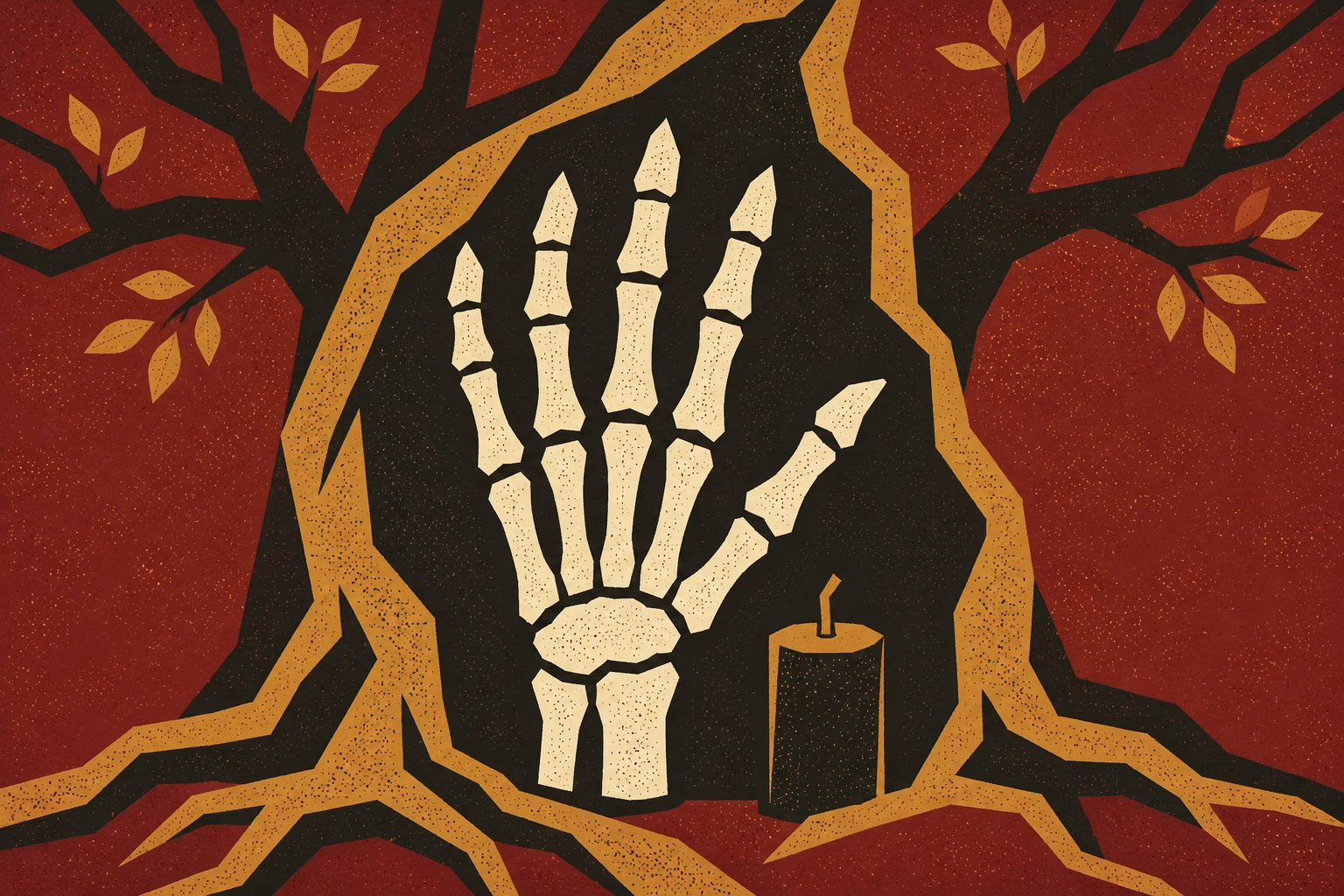
The hollow tree and the hand bones found apart from the body gave the witchcraft theory its most striking material. The anthropologist Margaret Murray read the case in terms of witchcraft and gave the hand a supposed ritual significance. It was a disturbing idea: that the strange disposal of the body was deliberate in a way an ordinary murder inquiry might miss.1
The hand was the apparent clue. If it had been removed and used in a ritual, its separation from the body would mean something very different. But had it been cut off at all? Bones outside the trunk record a position, not the act that put them there. The ritual theory depends on that missing step, and a reading of the scene cannot replace evidence of what happened to the remains.
The Mysterious Britain website preserves an older newspaper treatment alongside specialist discussion of the folklore. In the latter, objections attributed to historians of witchcraft challenge the ritual interpretation. The objections matter because they come from within the study of belief and folklore, not from outside it, though they remain reported expert views, not the result of a new forensic examination.8
There is a further gap between evidence of a belief and evidence of an act. Historians can show that people told stories about magical hands or feared harmful witchcraft. That does not show that anyone did such a thing in Hagley Wood. The case needs evidence linking a person and an action to the remains, and a tradition cannot supply it.
The same standard applies to claims of an official cover-up. Wartime secrecy makes such a theory conceivable, but secrecy elsewhere is no evidence of suppression here. A cover-up would need a positive sign of interference, a withheld identification or a document linking the case to an agency. Missing information is a reason to keep looking, not proof that someone removed it.
Why has the witchcraft story endured? It explains the features that made the discovery unforgettable, including the tree, the hidden body and the scattered bones, just as the spy story explains the wartime setting and the missing name. Both turn gaps into a coherent narrative, but neither has yet produced evidence connecting it with this particular woman.
The missing remains
The remains themselves might answer questions that decades of retelling cannot, but nobody knows where they are. ABC’s 2023 reporting describes the search for them and the absence of any documented final location, and revisits recollections of the discovery. Without the remains, even the most sophisticated forensic techniques have nothing to work on.9
Missing remains are not the same as missing paperwork. Giselle Jakobs’s 2017 account of obtaining the police files from Worcestershire Archives describes an uneven collection, with duplicated documents and absent folders, but also surviving material such as the forensic report and correspondence. Her experience does not support claims that every record vanished or that the file was deliberately destroyed.10
If the remains were found, their provenance would have to be established before any result could be attached to this case. Whether usable biological material survives would be a question for specialists, and an identification would require comparison with a suitable relative or another reliable link. A box labelled with the case name would be the beginning of that work, not the end of it.
Other research need not wait for a laboratory. The earliest inscriptions could be checked against contemporary reporting. The allegations in Anna’s statement could be traced through the people it names and the records they left. Possible missing women could be tested against the clothing, the physical estimates and the timing. Each task is narrower than solving the whole case, and each could produce results even if the woman’s name is never found.
As of 6 November 2026, there is no confirmed identification. Clara Bauerle’s documented death has undermined the most prominent theory, the account attributed to Mossop remains uncorroborated and the ritual explanation has no demonstrated connection to the death. A woman’s remains were hidden in Hagley Wood, and the only name she has was given to her by an anonymous hand. In recent years, the question has reappeared on the Wychbury Obelisk in large block capitals: WHO PUT BELLA IN THE WYCH ELM.1
Linked case files



Sources11
- The Hagley Woods Mystery: Bella in the Wych Elm The Unredacted · 2018-03-10 · Accessed 2026-11-06
- Monthly Mystery: Who put Bella in the wych elm? Maggie Tohill, Worcestershire Archive & Archaeology Service · 2016-09-02 · Accessed 2026-11-06
- Bella in the Wych Elm: The Mysterious Anna from Claverley Giselle Jakobs · 2018-01-12 · Accessed 2026-11-06
- Bella in the Wych Elm: The Story of Jack Mossop Giselle Jakobs · 2018-03-19 · Accessed 2026-11-06
- Murder by Witchcraft: Donald McCormick Giselle Jakobs · 2017-05-18 · Accessed 2026-11-06
- Clara Bauerle Is Finally Laid to Rest Giselle Jakobs · 2016-09-27 · Accessed 2026-11-06
- Update on Clara Bauerle and the Bella in the wych elm story Maggie Tohill, Worcestershire Archive & Archaeology Service · 2016-12-16 · Accessed 2026-11-06
- Who Put Bella in the Wych Elm? Mysterious Britain & Ireland · 2009-10-05 · Accessed 2026-11-06
- Mystery over who put Bella down the wych elm Lucia Stein and Rebecca Armitage, ABC News · 2023-04-07 · Accessed 2026-11-06
- The Disappointing West Mercia Police Files on Bella in the Wych Elm Giselle Jakobs · 2017-11-13 · Accessed 2026-11-06
- Hagley Wood, Worcestershire: approximate location and coordinates British Place Names · Accessed 2026-11-06