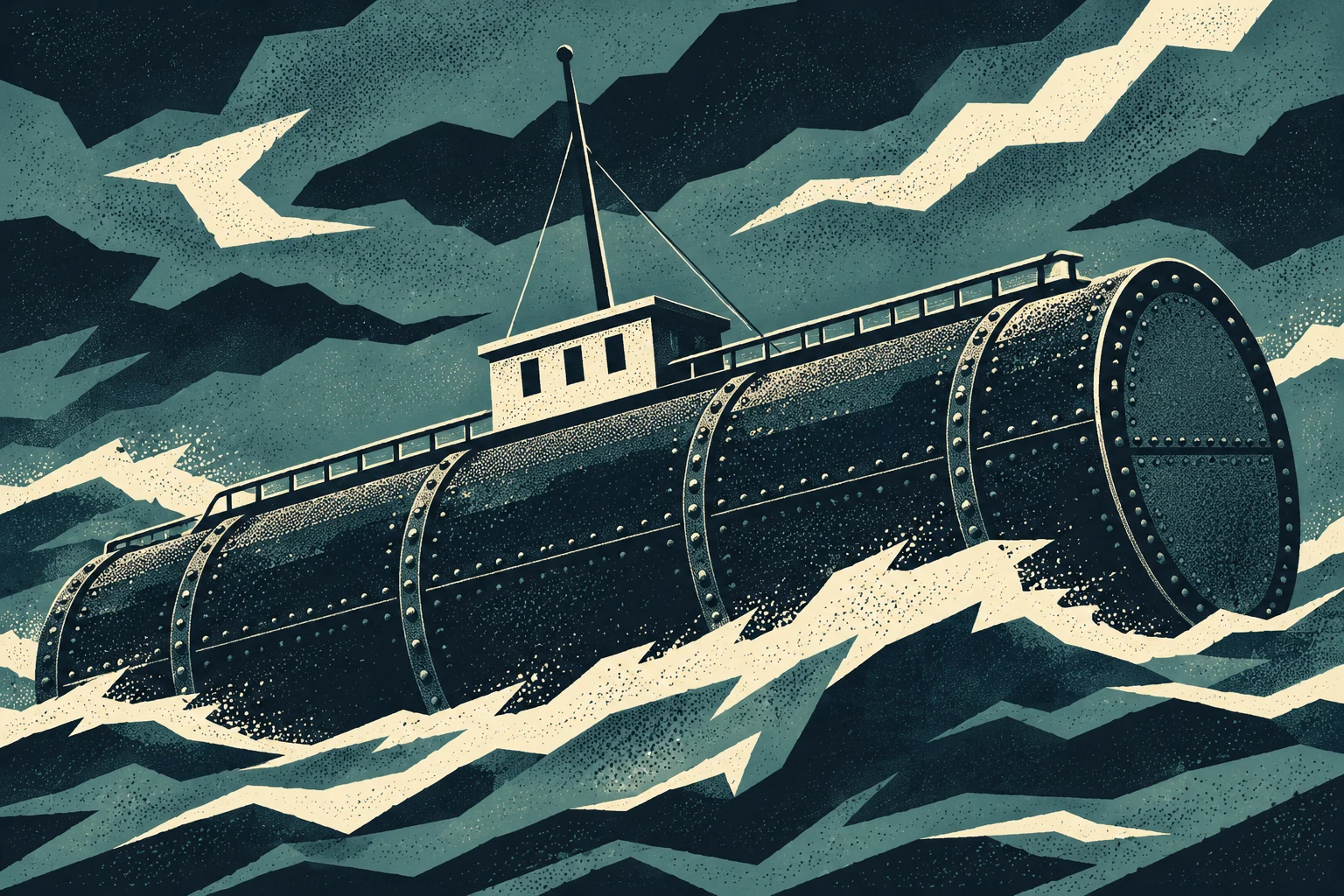
On 14 October 1877, in a gale in the Bay of Biscay, six sailors rowed out from a steamship towards a strange iron vessel lying on its side. None of them came back. Inside the vessel, abandoned by its crew, lay a 3,000-year-old obelisk bound for London.12
A gift nobody could move
The steamship was the *Olga*. Behind her she had been towing an iron cylinder fitted with a cabin, a mast and a rudder, and inside it, secured along almost its whole length, lay the obelisk, because the craft had been built around its passenger for the sole purpose of making one delivery.1
The cylinder was named *Cleopatra*. Captain Henry Carter commanded her, with a small crew who had to steer and tend a vessel that could not move under its own power and did not behave much like an ordinary ship. She had carried them from Alexandria through the Mediterranean and out into the Atlantic. Now the sea was threatening to roll their floating container over.1
The rescue boat was lost with all six men. Carter and his crew were eventually brought to safety, but the cylinder was cut loose, and the *Olga* reached England without it. The obelisk Britain had spent decades trying to acquire seemed to have been lost before the country could put it up.1
The stone had already outlived several civilisations. It was cut from Egyptian granite in the reign of Thutmose III and first stood at Heliopolis, and Ramesses II later added his own inscriptions. Eventually it was taken to Alexandria, where it was one of a pair whose twin now stands in New York.12
Cleopatra had nothing to do with either stone, both of which were ancient long before she was born, and the familiar name hides that far older history. Nineteenth-century writers found the association irresistible anyway, because a monument linked with Egypt’s most famous queen was an easier sell than an account of successive pharaohs and the relocation of temple furniture.23
By the time British visitors took an interest, the future London obelisk lay on its side, gradually disappearing under sand and building work. Its original religious setting had long gone. Depending on who was looking, it was an antiquity, an obstruction or a potential national trophy, and the last view would decide where it went next.12
British troops had wanted to take it home after the fighting in Egypt in 1801. James King’s later account describes soldiers chipping in money and moving the stone a short distance before the attempt was abandoned. Erasmus Wilson reproduced earlier travellers’ descriptions of its deteriorating surroundings. Neither writer considered staying in Alexandria a legitimate future for the monument.23
In 1819, Egypt’s ruler, Muhammad Ali, presented the fallen obelisk to Britain. Accepting the gift proved far easier than collecting it. Successive governments admired it without finding the money, the ship or the political will to move it. The stone stayed in Egypt while proposals came and went, until its immobility became part of its reputation.14
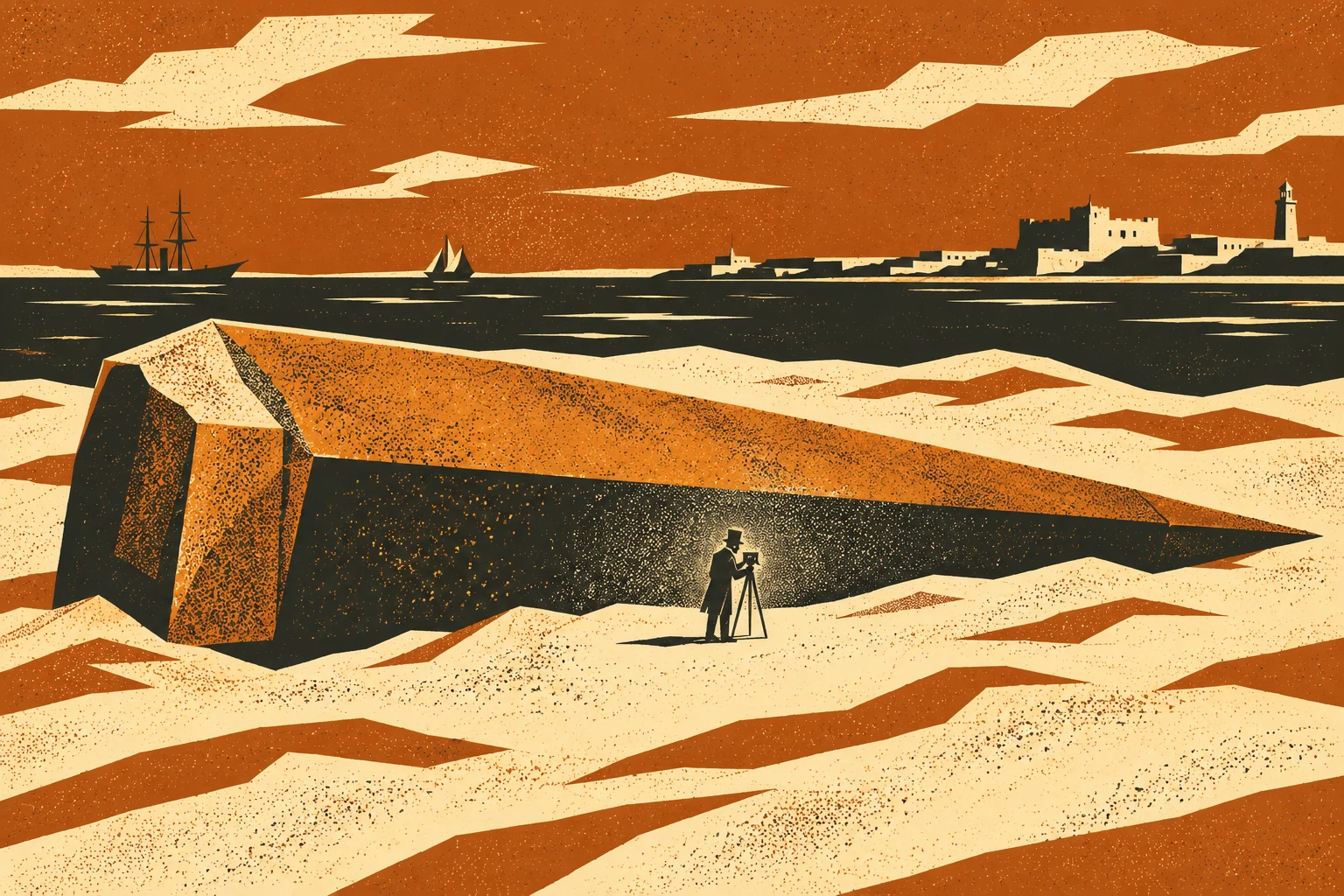
The practical problem was formidable. The obelisk was a long, tapering block of stone, chipped at its corners and lying on a shore where no ordinary ship could easily take it aboard. Lifting power alone was not enough. The engineers had to support it without breaking it, get it into the water and keep it safe over a long sea passage.1
Who would take the risk? In January 1877, an agreement finally answered the question, under which the engineer John Dixon would remove the obelisk and erect it, and Erasmus Wilson would pay £10,000 once it stood beside the Thames. After more than half a century, Britain’s Egyptian gift had become a private engineering contract.13
Building a ship around a stone
Wilson was a distinguished physician with the money and antiquarian enthusiasm to turn a proposal into a project. General Sir James Alexander had championed the neglected monument, and Dixon offered a method. Wilson’s own account dates the signed agreement to 30 January 1877 and presents it as the considered outcome of consultation, not an impulsive purchase.3
The terms mattered, because Dixon took on the risks of a difficult delivery for a fixed payment, so success would reward his ingenuity but extra costs would not bring extra money. Henry Honychurch Gorringe, the American naval officer who later shipped the twin obelisk to New York, wrote about the London contract with admiration for its daring and sympathy for its eventual losses.1
Dixon had options. Gorringe records proposals involving an ordinary ship, a modified vessel and a hopper barge that could take the stone in through its bottom. All of them tackled the same problem, getting an exceptionally awkward object from an exposed shore into a seaworthy carrier. Dixon chose a solution that avoided loading the stone into a ship at all.1
He would build a ship around it. Iron sections made in England would be shipped to Alexandria and assembled around the stone where it lay, and the finished cylinder would be rolled into the sea. Once afloat, it would be fitted out for its journey and towed to Britain.1
It was an elegant answer to the problem on land, and it imposed an unusual condition on everything that followed. A ship normally takes its shape from the work it has to do at sea. This one first had to behave like a giant roller. Its round cross-section made the launch possible, but its stability at sea would depend on the position, and the security, of the weight inside.1
Dixon worked with Benjamin Baker, whom contemporary accounts credit with help on the design, and the Thames Iron Works Company built the cylinder. Gorringe describes a vessel about 93 feet long and 15 feet in diameter, divided by watertight bulkheads. The obelisk rested on timber cushions to protect it from shocks and from the small flexing a hull undergoes in waves.1
The stone was not loose cargo in an iron tube. Its supports and the internal partitions formed a carefully arranged structure, with the heavy end facing forward, the tapering shaft extending towards the stern and ballast to lower the combined centre of gravity. The designers wanted the vessel to resist capsizing without rolling unbearably.1
In March 1877, the *Illustrated London News* described the planned cabin, steering position and small sails with striking confidence. The sails would steady the craft while the steamer supplied the towing power. The paper treated the vessel’s buoyancy as a guarantee against sinking and expected the rolling to be manageable. The ocean had yet to test either claim.5
That confidence hid two separate weaknesses. A vessel could have enough buoyancy to carry its cargo and still be impossible to live or work aboard. And it could be divided into watertight compartments that offered little protection if the doors between them were open. *Cleopatra* would run into both.1
At Alexandria, Waynman Dixon supervised the work around the monument, with Carter taking part in the preparations. Timbers and hydraulic jacks were used to shift the stone, and its narrow end was swung round into the alignment needed for the launch. Then the ground beneath the operation began to give way, and the engineers found something that would later lend the voyage a darker reputation.1

The remains beneath the obelisk
Gorringe’s account describes a small vault uncovered as the obelisk was being moved. It contained jars and human remains, including two skulls. The site was already crowded with buried structures and fragments, and moving the monument disturbed the archaeology around it, exposing objects while scrambling their original context.1
According to Gorringe, the skulls were then taken aboard *Cleopatra*. He reports that they were not seen again after the gale in the Bay of Biscay, and suggests that members of the Maltese crew had thrown them overboard out of superstition. He reports their presence, but names no eyewitness who saw them go over the side.1
Were human remains really carried across the Mediterranean inside the obelisk’s vessel? Gorringe’s contemporary history says so, but when it suggests they were thrown away to appease some dangerous influence, the same author offers that only as a guess. The first claim is disturbing enough without making the second more certain than its source.1
The launch preparations were revealing in less supernatural ways. The shallow water was littered with large stone blocks, so divers cleared a path and dynamite was used on heavy masonry further out. Much of the obstruction belonged to ancient Alexandria, which meant that getting one antiquity out involved moving or destroying parts of the ancient city around it.1
The cylinder also needed protecting from stones hidden in the sand. Huge timber rings were strapped around it near each end to act as wheels, with planking to guide it towards the shore. Wire hawsers wound around the hull would turn it as winches pulled, while other lines checked its progress. It was a controlled roll, with an enormous weight ready to run away if control was lost.1
There was a further complication, because the off-centre load that would steady the vessel at sea made it roll unevenly on land, lurching suddenly as the heavy side passed over the top. Iron rails were added temporarily as a counterweight, since the launch and the voyage needed different arrangements from the same hull.1
The operation began on 28 August before a large crowd. Gorringe describes an agonisingly slow movement, held up when the anchors of the lighters carrying the winches dragged under the strain; the hauling ropes were transferred to tugs, whose power kept the cylinder moving. By evening it had reached shallow water, but it was not properly afloat.1
The next day brought more work and little progress, and then the discovery that explained why the new vessel would not rise. A hidden stone had punctured the hull, so the vessel built to protect the obelisk was filling with water around it, and the damage was not confined to one compartment.1
The watertight doors had been left open. Gorringe quotes Dixon admitting the mistake in a later lecture, conceding that the builders had supplied bulkheads and doors but had not made sure the doors were shut, so once the hull was pierced, water could flow freely through the interior. The safeguard existed on the drawings and in the ironwork, and did nothing.1
“We had provided bulkheads, we had provided water-tight doors through them.”
The obstruction was removed, the cylinder rolled to expose the hole and a patch riveted over it. Then the pumping began. On 7 September, the vessel finally rose and fell with the swell. *Cleopatra* had not yet crossed a mile of open sea, and she had already needed rescuing once.1

Into the Bay of Biscay
After the launch, *Cleopatra* was taken round to the harbour and fitted out for her real work, with bilge keels added to reduce rolling and the cabin, bridge, mast and rudder fitted. The temporary counterweights used on shore came out and iron ballast went in, as the roller became a vessel with a crew.1
According to Gorringe, the ballast was not properly secured. That was a specific criticism, and it would matter later. The open doors at the launch had been a different failure, allowing water to flood the hull after it was holed. The ballast problem concerned weight that could shift inside a hull that was otherwise floating, changing the angle at which it settled.1
*Cleopatra* left Alexandria behind the *Olga* on 21 September, with Carter commanding the cylinder and Captain Booth the steamship. The cylinder could steer but depended on the steamer to move forward. Whatever grand hopes rode on the stone, the immediate job was the unglamorous one of keeping two very different hulls connected through changing seas.1
The early voyage gave grounds for confidence, with calls at Algiers and Gibraltar, as the cylinder made exactly the passage it had been designed for. The obelisk was no longer a proposal awaiting parliamentary interest or a relic half buried in a builder’s yard, but a cargo on its way to London by a novel method that seemed to be working.1
On 10 October, the two vessels rounded Cape St Vincent and turned north along the Atlantic coast of the Iberian Peninsula, towards the Bay of Biscay and the approaches to the Channel. Gorringe describes fair weather at the cape, then signs that it was turning. On the morning of 14 October, a heavy gale struck from the south-south-west.1
According to Gorringe, the cylinder steered badly even in easier conditions, and in the storm it yawed wildly, swinging away from its course while seas struck the cabin hard enough to threaten it. This was no longer just an uncomfortable passage, because both the exposed accommodation and the handling of the vessel were in danger.1
Carter decided to bring *Cleopatra* head to wind and ride to a sea anchor before dark, and signalled the *Olga* to cast off the tow. Before the manoeuvre was complete, a heavy sea struck. The vessel lurched, the ballast slid to the lower side and the cylinder went over on her beam ends. The weight that should have righted her had moved.1
Staying afloat and staying alive aboard had become two separate things. The iron shell could float while its crew clung to a vessel lying dangerously over on its side. They tried to secure the ballast but could not regain control, and abandoning ship became the only practical answer.1
Even that was difficult. Gorringe describes *Cleopatra*’s own small lifeboat being lowered and smashed beneath the rudder gear, an escape route gone almost as soon as it was tried. In that sea, with an unmanageable vessel lurching beside another ship, any rescue meant bringing boats close enough for men to cross between them.1
Could the obelisk have been saved without risking more lives? With hindsight, from dry land, the night can look like a series of decisions waiting to be judged, but aboard the *Olga* the urgent fact was that men were still on *Cleopatra*. Booth called for volunteers, six sailors stepped forward, and their boat went out into the storm.1

Six men in an open boat
They were William Askin, James Gardiner, Joseph Benbow, Michael Burns, William Donald and William Patan, and their names survive on the monument beside the Thames. They were not salvaging treasure from a wreck or escaping from *Cleopatra*, but going out from the towing ship to help the men aboard her.16
Accounts differ on exactly what they were trying to do. The memorial records an attempt to succour the crew, while Gorringe says Booth hoped the volunteers could help secure the shifted ballast. Both place the boat in the same emergency, with *Cleopatra* in trouble and her crew needing help. Neither turns the six deaths into a mysterious disappearance unrelated to the storm.16
The boat got clear of the *Olga* but was overwhelmed near the cylinder, and all six men were lost. There is no need to invent their last words, a premonition or a struggle nobody saw. The surviving account is brief, and that brevity is one reason their deaths are so easily overshadowed by the far more elaborate story of the obelisk’s construction and recovery.1
Carter and his crew were brought off later. Gorringe describes a line thrown over *Cleopatra* so that a boat could be hauled alongside, and the rescue that had already cost six lives finally took off the men in immediate danger. The *Olga* then cut the cylinder loose and searched for the missing volunteers without finding them.1
In the storm, the two vessels became separated, and when *Cleopatra* could not be found again Booth concluded that she had sunk. The *Olga* went on to Falmouth, arriving on 17 October by Gorringe’s chronology, and while the survivors came home, the giant stone, its ingenious carrier and everything still inside were believed lost to the Atlantic.1
Here a curse story could easily begin. An Egyptian monument had been taken from its resting place, human remains had reportedly been disturbed and sailors had died. Those elements could be assembled into a warning about meddling with ancient Egypt. But the documented sequence already contained a direct cause of danger: a severe storm and a vessel whose ballast had shifted.1
Gorringe did not simply admire the enterprise. He criticised the unsecured ballast and suggested that Booth might have saved the cylinder had he stayed nearby, and since Gorringe knew more than most about moving obelisks by sea, his opinion carries weight. But expertise and hindsight did not put him on the *Olga*’s bridge during the gale.1
Was abandoning the cylinder a failure? That depends on what was being saved. Holding on to a dangerous tow could have put the steamship and everyone aboard at risk, and leaving men on an unmanageable cylinder could have cost more lives. That the cargo later survived does not mean the men facing the emergency knew it would, or could safely have stayed with it.1
Nor do the deaths prove that the whole design was incapable of making the voyage. *Cleopatra* had already crossed the Mediterranean, and her hull would come through the storm intact. The disaster lay in the combination of weather, handling, shifting weight and men exposed in open boats. Calling it either a brilliant invention or a doomed expedition leaves too much out.1
On the Thames, the memorial states the central fact more plainly than any of the stories that followed, recording that six men died trying to help the crew during the storm of 14 October 1877. It is fixed to the obelisk they never saw erected, so London received an antiquity and a record of what it cost.16
The abandoned vessel returns
*Cleopatra* had not sunk. Losing sight of her from the *Olga* was not the same as her going to the bottom. Somewhere off the Spanish coast, the cylinder drifted on without her crew, the obelisk still safe inside its iron shell. The buoyancy that had failed to keep men safely aboard was enough to keep the cargo afloat once they had gone.1
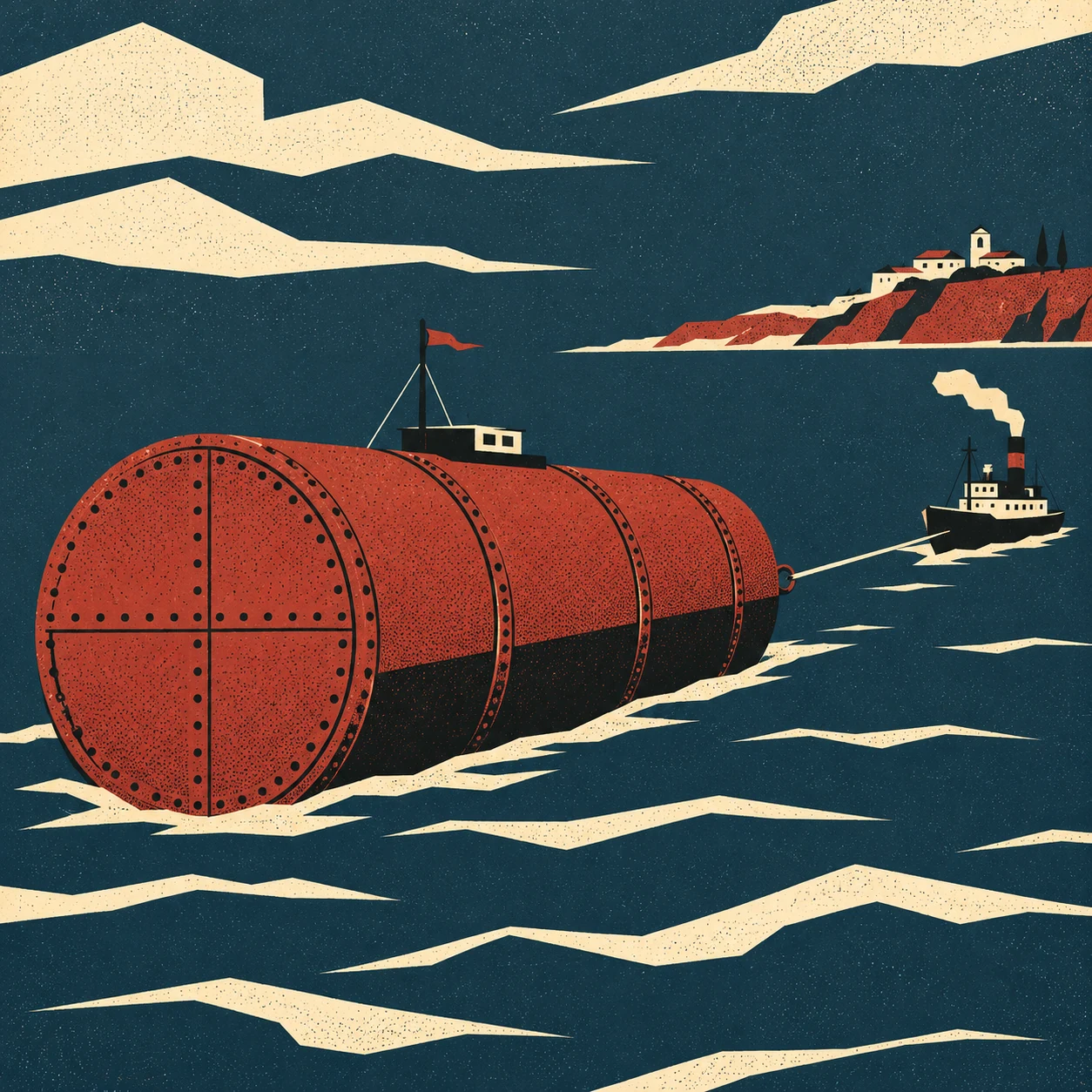
The steamship *Fitzmaurice* found the abandoned craft and towed it into the Spanish port of Ferrol. Gorringe places the find about seventy miles from that harbour, while James King’s shorter account names Vigo instead. Even accounts written close to the event did not agree on every detail of geography.12
Ferrol is the port named in Gorringe’s detailed engineering history and in the Royal Museums Greenwich account, and it is the one this article uses. The drifting vessel had become a salvage case, with another ship and crew entitled to claim payment for recovering it. Finding the stone did not put the project back where it had been before the gale.17
Gorringe gives a salvage claim of £5,000 and an award of £2,000, though a footnote acknowledges conflicting reports. The broad point is clearer than the exact figures: recovering *Cleopatra* added to the cost, the financial consequences were disputed and Dixon’s fixed-price contract left him to bear expenses far beyond the original plan.1
Rescuing the cylinder was not the same as delivering it. It still had to leave Spain and complete the voyage to the Thames. It had survived a storm severe enough to force its crew to abandon it, which was reassuring, but nobody could now mistake the operation for a simple tow.1
A different tug, the *Anglia*, carried out the final stage. The obelisk reached Gravesend on 21 January 1878, according to Royal Museums Greenwich, four months after leaving Alexandria. Britain’s gift had finally arrived, after a voyage interrupted by a gale, six deaths, abandonment, salvage and a long delay in Spain.7
Arriving was not the same as standing up. London still had to choose a site and prepare it to take the weight. Gorringe describes a long argument over the possibilities, including spots near Westminster Abbey and the British Museum, which turned partly on how the monument would look among the capital’s existing buildings and memorials.1
The proposed Westminster site sat above the Metropolitan Railway, which raised a practical objection. According to Gorringe, the railway company wanted a permanent guarantee against the stone crashing through into its tunnel. An object that could cross seas sealed inside an iron cylinder could still cause trouble when planners tried to give it a permanent address.1
The site eventually chosen, beside the Thames, made the last move simpler. *Cleopatra* could be brought close to where the obelisk would stand, avoiding another long journey overland. A massive concrete foundation was laid, giving the ancient shaft a reliable modern base and protecting the embankment from the concentrated weight it was about to carry.1
The cylinder was grounded on a timber cradle, its cabin cut away and its hull dismantled around the stone. The ship built for a single delivery was being taken apart to release its cargo. Hydraulic jacks and traversing machinery moved the obelisk onto the embankment. The voyage was over, but an immense stone still lay on its side, waiting to be lifted into the air.1

A curse, or a chain of failures?
The engineering record explains the disaster step by step. A hidden stone and open doors account for the flooding at the launch; a storm and shifting ballast for the near-capsize at sea; a boat swamped beside the cylinder for the loss of six men. None of it needs an unseen force to make sense.1
Not every detail is settled. The catalogue of the London Archives’ collection on Cleopatra’s Needle lists memoranda written aboard the *Olga*, letters about the abandonment, press cuttings on the salvage and accounts of expenditure. Those records could sharpen the picture. This article uses the catalogue as a guide to what exists, not as an eyewitness account.8
The serious alternative to a simple story of bad weather is an argument about preparation and responsibility, about whether the ballast was properly secured, whether the novel craft had been adequately tested and whether the towing decisions made things worse. Gorringe’s criticisms put those questions on the record, but answering them fully would mean weighing the crews’ own reports against his judgements made after the event.1
A second argument concerns the enterprise as a whole. Its promoters described the removal as rescuing a neglected monument and enriching London, aims that made the financial and engineering obstacles worth overcoming. They also put possession of the stone at the centre of the story, with Egyptian ground, buildings and labour appearing mainly as obstacles it had to pass through.13
Wilson’s book reveals that outlook clearly. He imagined the ancient monument among the institutions and churches of the British capital, where Egypt’s past would acquire a new setting and new meanings. His enthusiasm was sincere, but it was not a neutral description of what moving the obelisk meant to everyone involved.3
The curse offers a more dramatic explanation: removing the stone provoked retaliation. Modern folklore links the deaths and misfortunes to the disturbance of the monument’s resting place, and the reported skulls make a neat bridge between excavation and disaster. They are a genuine detail from a contemporary account, but that account’s guess about how they were disposed of is not evidence of a supernatural cause.19
The Haunted Palace’s modern discussion shows that the curse story circulates. It does not show that a curse was at work in 1877. An ancient object, a fatal voyage and an unexpected survival make compelling folklore, but nothing suggests that the Egyptians laid a warning on this particular stone, or that an unknown power acted on the ships.9
Could a curse explain why *Cleopatra* stayed afloat after her crew escaped? The same events read as disaster if you focus on the rescuers and as extraordinary luck if you focus on the cargo, and a supernatural explanation can absorb both. It adds atmosphere, but offers no way to tell itself apart from the effects of a storm and a tough hull.
There is a narrower mystery worth keeping: how did a vessel in such trouble survive being abandoned? The engineering answer is less comforting than it first sounds. The shell kept enough buoyancy to float, while the conditions made it unsafe for the men aboard. People and cargo faced different risks, and the obelisk could endure a position that living men could not.1
The tragedy does not need reducing to a moral about superstition or progress. It involved ambitious engineering, mistakes admitted at the time, dangerous weather and men trying to help other men. The uncertainty lies in how much weight each deserves, not in whether six sailors died.16

What London kept
For the final lift, a massive timber framework rose around the obelisk where it lay. An iron jacket gripped the stone, with pivots near its centre of gravity, and hydraulic jacks raised it in stages. It had to go high enough to swing upright without its base striking the pedestal beneath.1
The balance point had to be found by trial. The shaft was irregular at its damaged base, and the jacket and straps added weight of their own, so the engineers checked their calculations against the stone itself. The job called for control, not just more pulling power.1
On 12 September 1878, before crowds lining the river, the obelisk was swung upright. Gorringe says the movement took about half an hour, and the stone was lowered onto its pedestal the next day. The stone that had lain in the sand at Alexandria and rolled through the Bay of Biscay was standing in London.1
The pedestal also held a time capsule. Gorringe lists coins of the day, a railway guide, newspapers, religious texts, a map of London, a portrait of Queen Victoria, children’s toys, hairpins and specimens connected with the engineering work, along with a hydraulic jack. Beneath the Egyptian monument, the Victorians left a small record of themselves.1
The selection mixed the everyday with the official. A baby’s feeding bottle came from a different world from the standard measures or the account of the transport. Together, they would tell some future finder who had raised the stone and what they thought worth keeping. The imported antiquity had become the lid of a new deposit.1
The familiar bronze sphinxes came later, cast in 1881. They did not travel from Egypt with the obelisk and were not there when it first stood on the embankment. The setting Londoners know today grew up around the stone after it arrived.1
Dixon came out of it less well. Gorringe describes insurance litigation and heavy losses, while warning that the true accounts were hard to pin down. The agreed £10,000 was nowhere near the full cost of the project, and the obelisk’s triumphant erection did not erase the dangers that had come before it.1
As of November 2026, Cleopatra’s Needle still stands on the Victoria Embankment. Its ancient inscriptions record the names and claims of Egyptian kings, while the modern ones describe the British gift, its transport and the men who died on the way, carved three thousand years apart on the same stone.146
To a visitor hurrying past, the obelisk can look like a settled piece of London, with its tall stone, sphinxes, river and traffic, but the names at its base interrupt that view. The obelisk did not simply arrive. People dismantled its surroundings, built a ship around it, repaired a failed launch, crossed a sea, abandoned it and brought it back.1
Was it cursed? The evidence gives no reason to think so, and what happened is strange enough without one. Six men died trying to help the crew of a vessel that, with nobody aboard, would go on to survive the storm, and while the city got the monument it wanted, the six sailors named at its base never reached London.16
Linked case files




Sources9
- Egyptian Obelisks, chapter IV: Removal of the Fallen Obelisk of Alexandria to London Henry H. Gorringe · 1882 · Accessed 2026-11-06
- Cleopatra’s Needle: A History of the London Obelisk, chapter IV James King · 1883 · Accessed 2026-11-06
- Cleopatra’s Needle: with Brief Notes on Egypt and Egyptian Obelisks Erasmus Wilson · 1877 · Accessed 2026-11-06
- How Cleopatra’s Needle came to London London Museum · Accessed 2026-11-06
- Cleopatra’s Needle: contemporary reports Illustrated London News; later London guidebooks · 1877–1879 · Accessed 2026-11-06
- Cleopatra’s Needle: crew members lost London Remembers · Accessed 2026-11-06
- Cleopatra’s Needle Royal Museums Greenwich · Accessed 2026-11-06
- Collection GB 0074 Q/CN: Cleopatra’s Needle The London Archives / AIM25 · 1877–1880 collection; finding aid 2010 · Accessed 2026-11-06
- The Curse of Cleopatra’s Needle The Haunted Palace Blog · 2022-06-07 · Accessed 2026-11-06