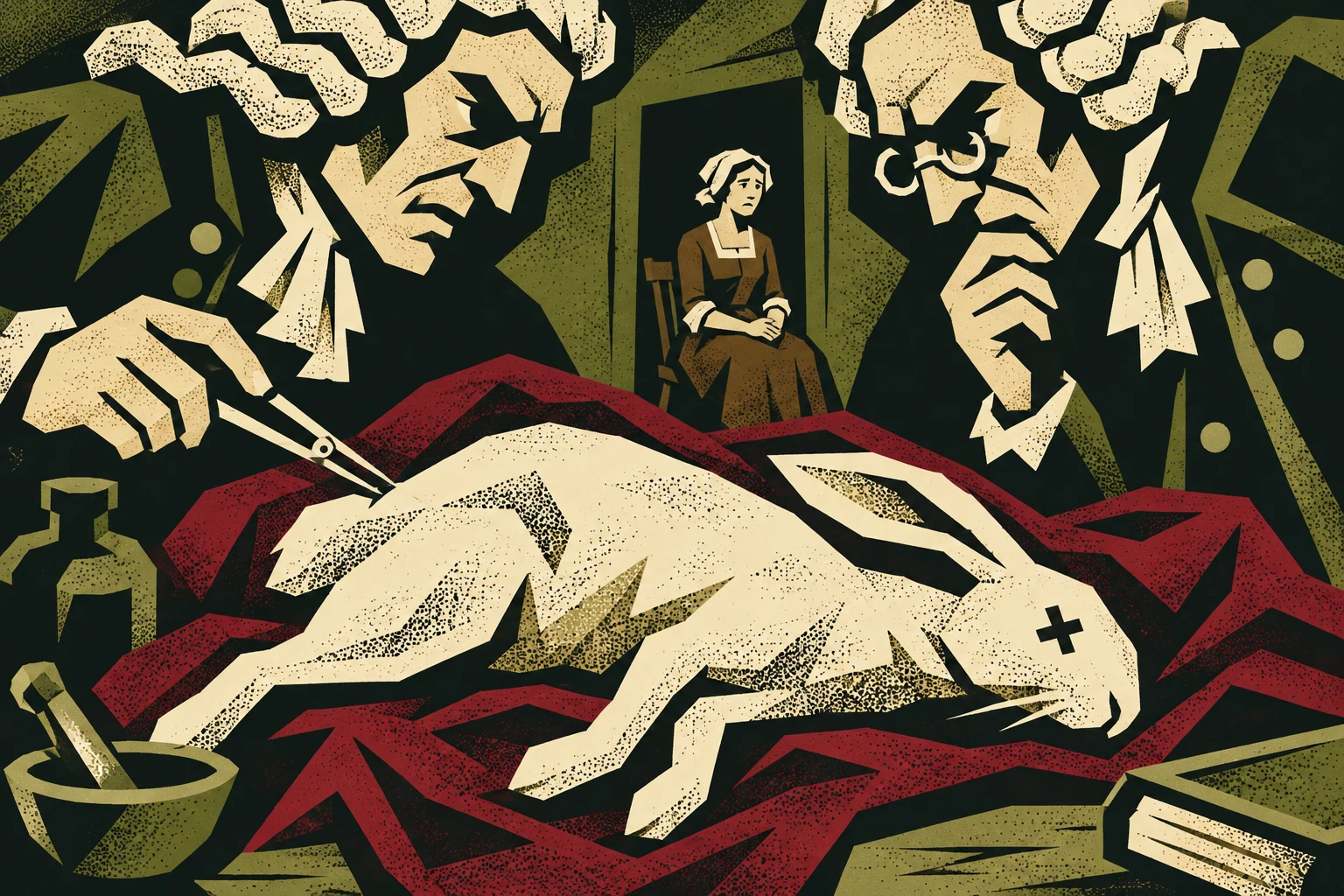
At about half past two on 15 November 1726, Nathaniel St André, a surgeon at the court of George I, arrived at a house in Guildford. He was told that the woman upstairs was in labour with her fifteenth rabbit. That afternoon, he delivered part of it himself.1
A wonder from Godalming
The early specimens did not look like a tidy litter. In St André’s published account, the first creature combined the features of a cat with the head and one paw of a rabbit, and later deliveries came in pieces: feet, internal organs, sections of bodies, skins and heads. The remains could be collected, preserved and examined. What made them extraordinary was the explanation attached to them.1
Mary Toft lived in Godalming, near Guildford, with her husband Joshua, a journeyman clothworker. The town museum records her baptism on 21 February 1703 and her marriage around 1720. She belonged to the young working families of the town, a world away from the court that would soon take an interest in her. The surviving record mentions a miscarriage before the rabbit affair, not an ordinary pregnancy that suddenly produced the wrong species.2
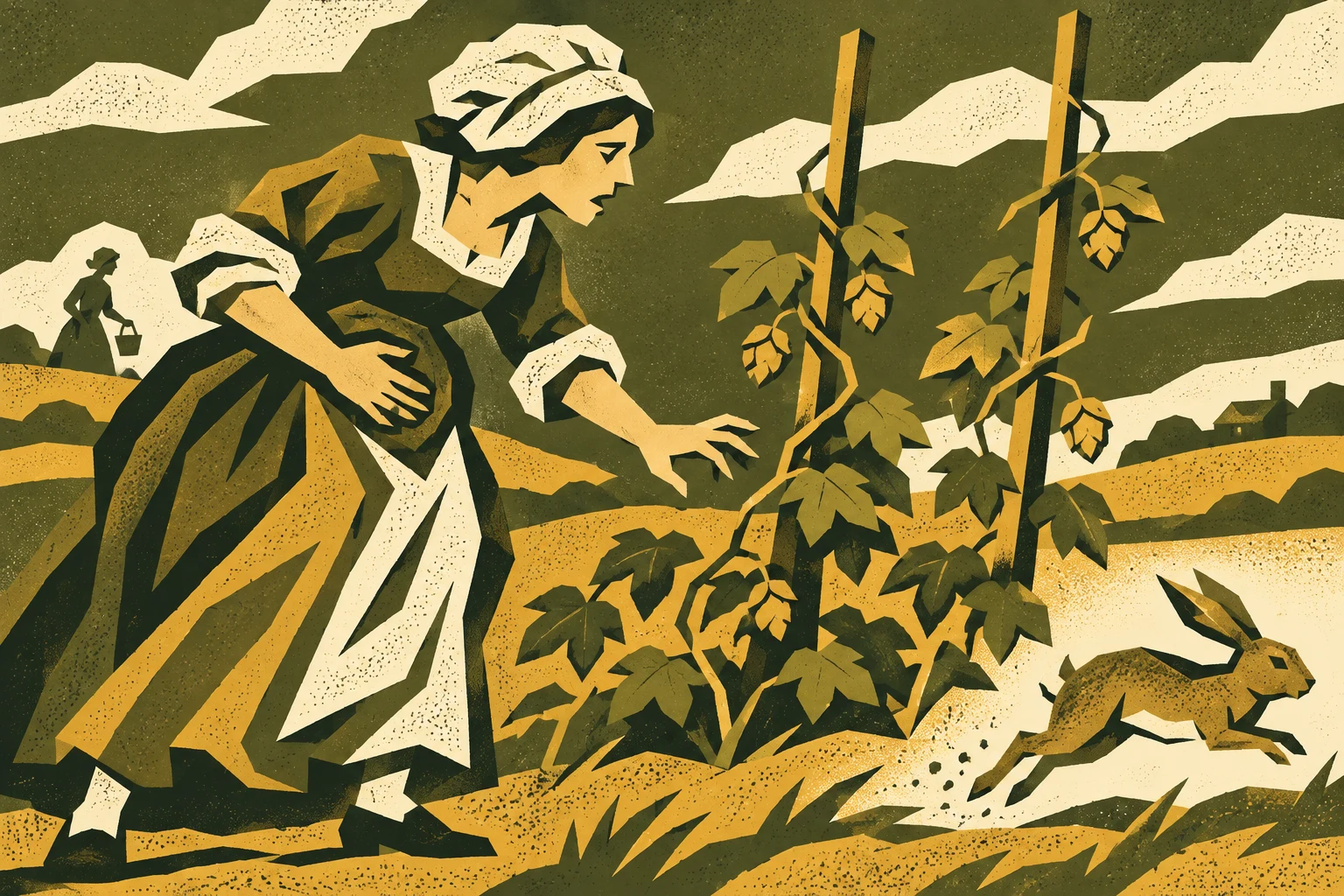
Her story reached the doctors through questions and retellings. According to St André, on 23 April she had been weeding when a rabbit leapt up nearby. She and another woman chased it without success, and a second rabbit got away too. That night, she said, she dreamt of rabbits, and afterwards she craved rabbit meat but could not afford it. That unsatisfied craving became the starting point for explaining what later seemed to emerge from her body.1
In the same account, bleeding and abdominal pain led to a miscarriage, followed by more bleeding some weeks later. On 27 September, Toft reportedly sent for her mother-in-law, Ann, described as a midwife. Material thought to be animal organs was taken to John Howard, a surgeon in Guildford. St André presented all this as the history he was given. Before he examined anything, the story was already built around the earlier craving.1
Howard’s involvement gave events in the household an audience beyond the neighbours. His letters, reproduced by St André, described rabbit after rabbit, and movements he took for another animal struggling inside her. One, dated 9 November, invited any suitably curious visitor to come quickly and remove a specimen in person. Howard had moved Toft to Guildford for convenience. He was offering access to a continuing marvel, with his professional reputation behind it.1
That invitation made the case far more persuasive. A reader was not merely asked to believe a story from somewhere else: he could travel to the woman, examine her and take part in the next delivery. Attention shifted to the moment of removal, and a visitor was encouraged to treat something brought out under his own hand as better evidence than anything first produced by a relative.
The explanation on offer was maternal impression: the belief that a pregnant woman’s strong experiences or desires could shape her unborn child. Dennis Todd’s study of the case places it within wider arguments about imagination and the boundary between mind and body. The rabbit story arrived with a framework ready and waiting, and to its supporters the craving and the animal remains were links in one chain of events.10
The theory put a strange burden on Toft. Her thoughts were the supposed mechanism, while other people handled the supposed results. The doctors could ask her to repeat the story of the field and then turn back to the specimens. Their curiosity would carry the rabbits to the King, while the woman who supposedly produced them stayed behind for the next examination.
Specimens for His Majesty
St André had travelled to Guildford with Samuel Molyneux, secretary to the Prince of Wales. Howard announced that Toft was in labour with a fifteenth rabbit, and they found her sitting beside a bed with several women nearby. St André examined her, waited for further pains and then removed the skinned trunk of a rabbit, with heart, lungs and diaphragm still attached.1
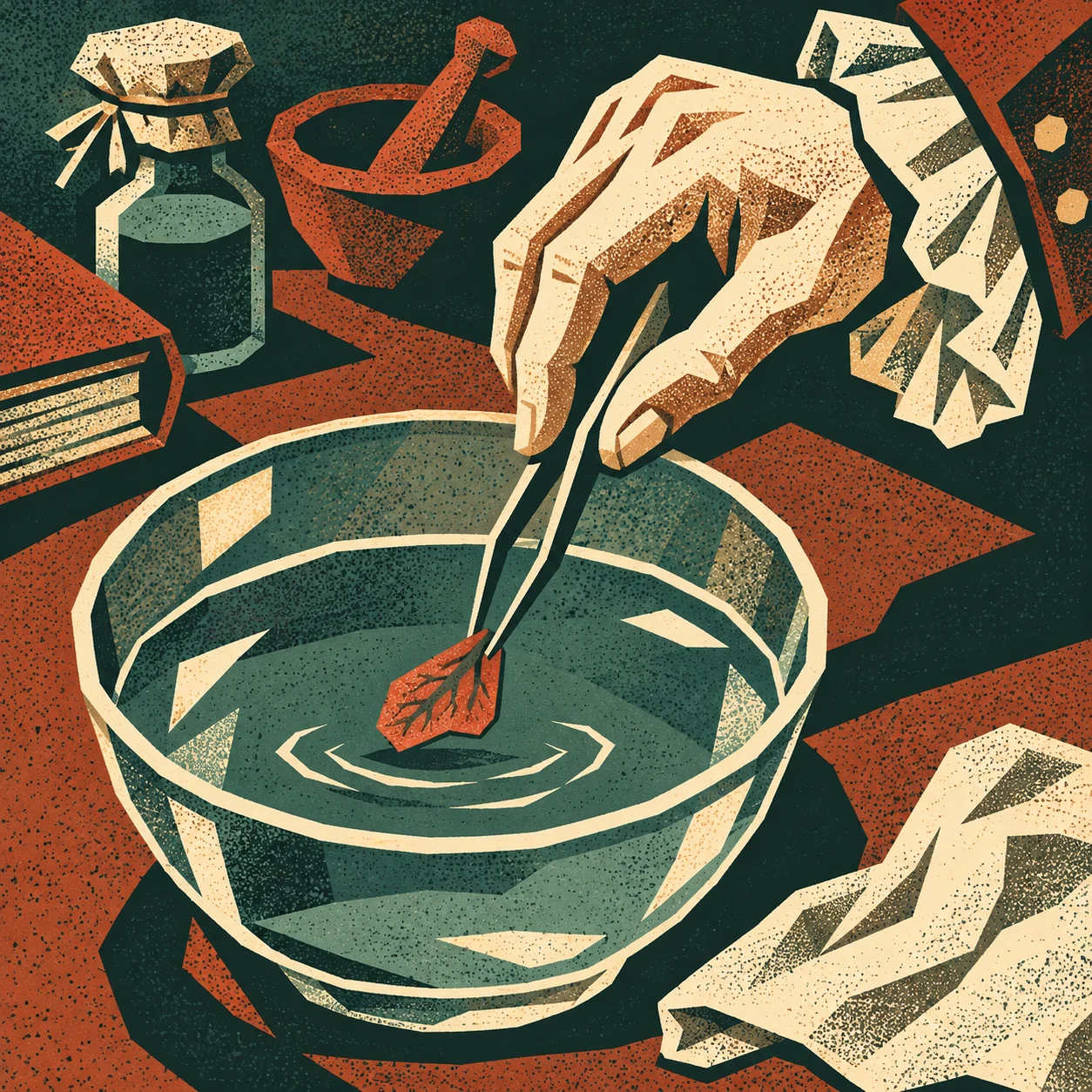
He tested a piece of the lung in water. It was slightly lighter than the water and rose slowly after Molyneux pushed it down. The organ was small and dark, and the heart had an opening that St André associated with an unborn animal. Examining Toft, he proposed that the rabbits had grown in her fallopian tubes and entered the womb only when the pains began. It was an anatomical argument, however mistaken, not a cry of miracle.1
The men left the room at intervals. During one absence, a nurse removed the lower half of an animal, which they judged to match the trunk already delivered. Later, St André described removing a rolled-up skin himself, and then a head. He kept returning to how carefully he had watched: who touched Toft, where he stood and whether he had stepped away. The narrative was built to shut out any possibility of trickery.1
Its central inference ran ahead of what any examination could show. An animal part can be inside a person without having grown there. Removing it shows where it was at that moment, not how it got there. St André treated the extraction and the supposed growth as though each proved the other, and the more certain he became that he had witnessed the first, the harder it was to give up the second.
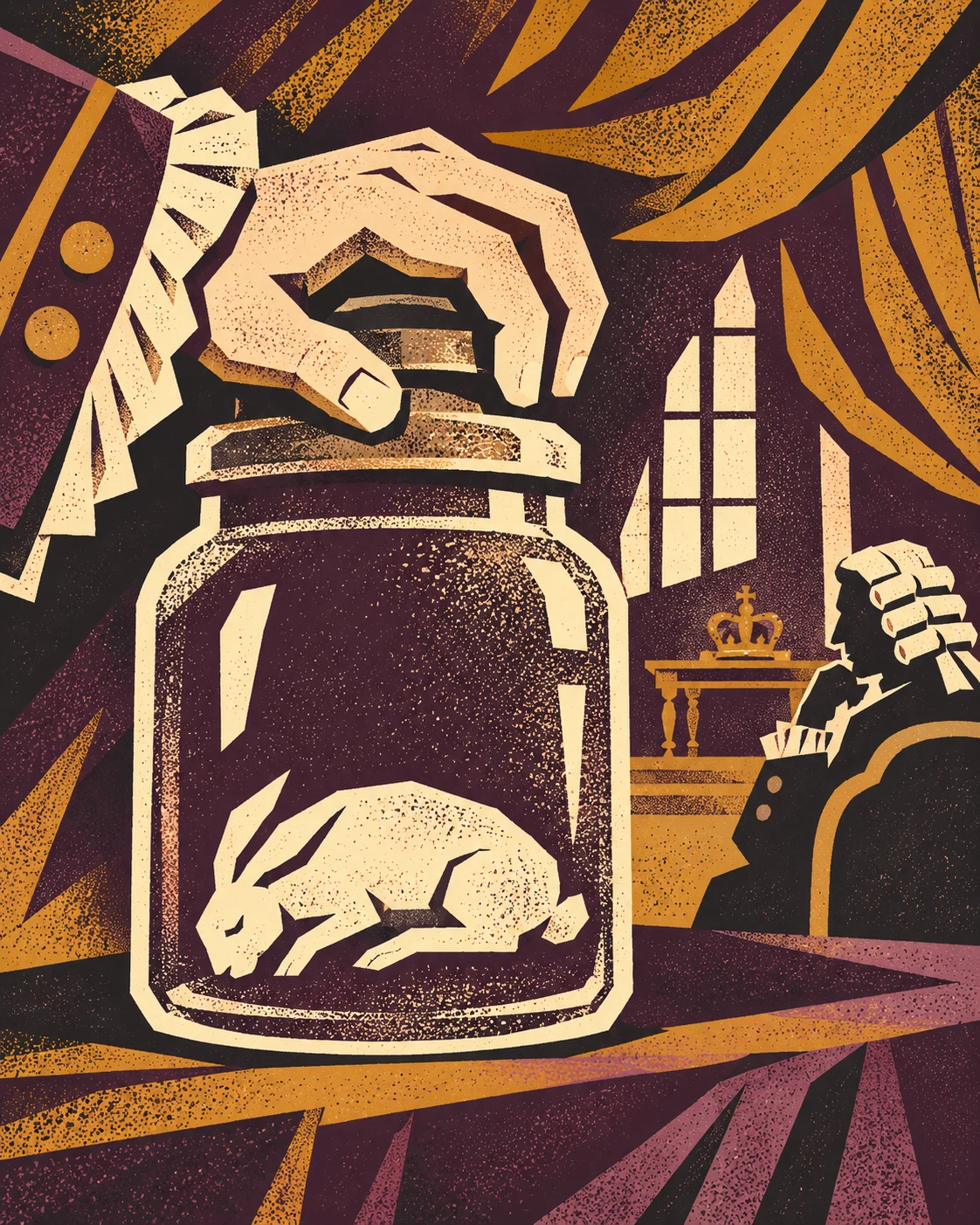
He examined the preserved remains in detail, recording bones, teeth, fur and organs and comparing them with ordinary rabbits, and took differences in their internal structure as evidence of an unusual origin. By his own account, specimens were shown to George I on 26 November. The claim had travelled from a working household into the royal court through a chain of objects, letters and examinations.1
Molyneux’s certificate, printed with the narrative, was more guarded. He said St André’s account matched his own record in its material details and that he had noticed nothing fraudulent during the visit. But he expressly left open whether the animals had been unnaturally produced or whether there had been deception. That reservation sits beside St André’s much stronger confidence. The two men did not put their names to the same conclusion.1
The affair does not fit the familiar picture of an entire medical establishment believing in rabbit births. Being present, agreeing that something had been removed and accepting its supposed origin were different positions, which later satire flattened into one scene of foolish doctors. St André’s own narrative preserves something messier, with close observation, strong conviction and formal reservation on the same pages.
St André signed his narrative on 28 November, before the London investigation reached its conclusion, and it would appear in print before Toft confessed, although surviving copies carry the following year’s date. His confidence now had a public form that could be quoted back at him. Another royal surgeon was already preparing an account that challenged both the evidence and the believers’ version of his own conduct.119
The surgeon who played along
Cyriacus Ahlers had visited on 20 November. In his later pamphlet, he described obstacles to an independent examination from the start. His companion was kept out of Toft’s room, supposedly because too many visitors might frighten her, though other women came and went freely, and Howard decided when Ahlers could examine her. Ahlers dwelt on those arrangements as much as on the animal remains, because the conditions of observation were evidence in themselves.3
Ahlers removed the hind part of a rabbit, but said Howard refused to let him examine her further for whatever remained. He described Howard positioning himself close to Toft and limiting what another observer could see. Those claims do not prove Howard was complicit. They show why Ahlers became suspicious, and why the invitation to witness a delivery was less open than it first appeared.3
All the same, Ahlers acted as though convinced, and that became the heart of a bitter dispute. St André printed sworn statements from people who said Ahlers had expressed belief, given Toft money and talked of a royal pension. Ahlers replied that he had deliberately hidden his doubts. He admitted playing the part of a convinced visitor while disputing the words put in his mouth. Agreement in the room could be presented as either genuine belief or an investigator’s disguise.13
The specimens, in his account, gave him his grounds for doubt. Ahlers described broken bones and several places where a sharp blade seemed to have cut the animal. He also examined hard pellets from a rabbit’s gut and found pieces of hay, straw and corn. Those findings fitted badly with an animal said to have grown inside a human body. They pointed to an ordinary rabbit that had lived and fed in a field, then been cut into pieces.3
The food in the gut and the cut marks answered a different question from St André’s comparisons of tiny organs. They gave the specimen a history before it was removed from Toft. Ahlers did not need to explain every movement in her abdomen to challenge the rabbit’s supposed origin, or to deny that a doctor had pulled it out. The same object could confirm the observation and destroy the explanation.
In a postscript, Ahlers also challenged the authority claimed for the demonstration at court. He reported that a Dr Steigerthal, who had been present, remained suspicious and was not satisfied by the comparative anatomy. Once again, attendance was being passed off as endorsement, and Ahlers objected to the use made of another man’s presence as much as to the contents of the jars.3
The investigation was not over, because Toft would be brought to London, where the doctors could control her surroundings far more tightly. The test ahead looked decisive, since it would show whether the rabbits kept coming once she was closely watched, but while it would expose the supply, it would also give the investigators far greater power over the woman at the centre of the claim.
Watching the rabbit woman
Sir Richard Manningham’s diary begins with his summons to Guildford at the end of November. He examined Toft, felt movements in her abdomen and later removed a membrane that looked and smelt to him like a piece of pig’s bladder. A bladder was fetched from the house for comparison, and Manningham said he did not believe the membrane had come from the womb. St André responded by restating his confidence in the rabbits he had already delivered.4
Manningham recorded an argument among the men, after which he agreed to hold back any public announcement while the case continued. His reason was investigative: a premature alarm might obstruct discovery. Staying involved did not mean believing in the rabbit births, but it let the spectacle continue under professional supervision, and the diary, written afterwards, also served to explain why he had waited.4
On 29 November, Toft was brought to Roger Lacy’s bagnio in Leicester Fields in London. A bagnio was a bath-house, and this one also provided rooms where she could be watched. Manningham sat up with her through the night, and his entries describe repeated examinations, apparent labour pains and fits over the following days. She was now under constant observation, and not one further rabbit appeared.4
Meanwhile, witnesses in Surrey were describing some very ordinary purchases. In depositions taken before Lord Onslow on 3 and 4 December, several sellers said Joshua Toft had bought young rabbits from them. Edward Costen said a dead one would have suited Joshua as well as a live one. Richard Stedman remembered being asked to keep the sale quiet, and John Sweetapple described rabbits bought after Mary had moved to Guildford. The investigators now had a trail to follow outside the examination room.15
Buying rabbits was not proof of fraud, since people ate them. But Elizabeth Mason, in whose house Toft had lodged, said none had been cooked there for her, and Mary Costen, her nurse, said she had never seen rabbit served to her during that time. Their evidence made the innocent explanation much harder to sustain, though it did not show who had inserted each specimen.15
In London, a porter confronted the doctors with the question of supply. Manningham records that Thomas Howard, the porter at the bagnio and a different man from the surgeon John Howard, told the magistrate Sir Thomas Clarges on 4 December about a rabbit procured secretly for Toft. The woman attending her admitted getting it but said it was for eating, and Mary eventually admitted asking for it for the same reason. Now the old excuse had to explain a specific purchase, made in the very building where she was being watched.4
Even then, Manningham resisted sending her straight to prison. He thought something might still be delivered and wanted the deception exposed as completely as possible. In a letter reproduced in his diary, he argued for keeping her under strict watch in a private house where medical men could continue to see her. His objection protected the investigation, and with it the doctors’ access to her body.4
By now, the scrutiny had changed its nature. A rural medical marvel had become a suspected crime under a magistrate’s authority, and the watchers no longer wanted another specimen to admire. They wanted an account of how the deception had worked. Toft’s own explanation was about to become the thing they most wanted from her, and one of the men applying the pressure would record how they got it.
Confession under threat
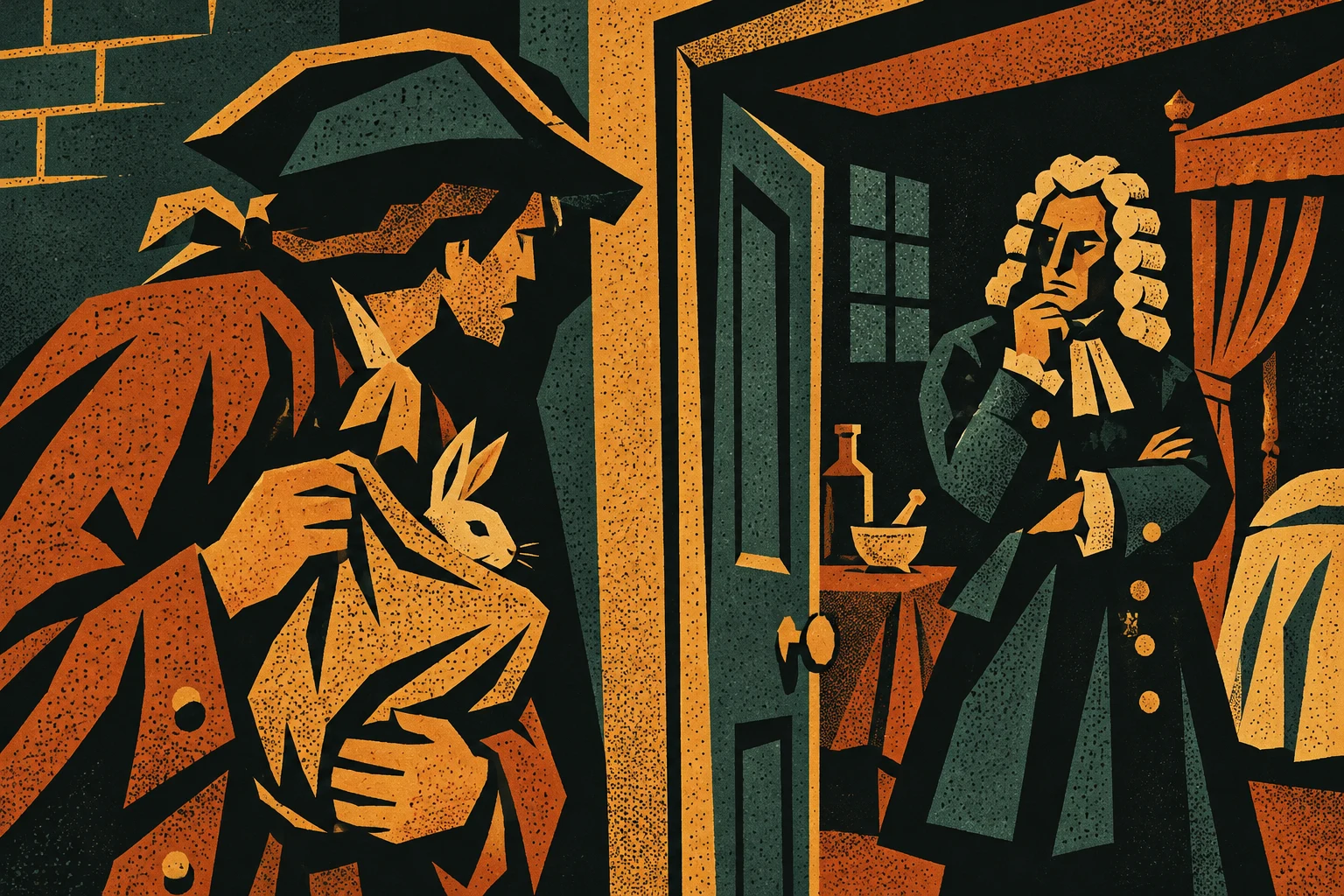
On 6 December, according to Manningham, Clarges threatened Toft severely. Then Manningham made a proposal of his own. He told her he believed she was an impostor and suggested that her anatomy must be different from other women’s if she could deceive them this way, and said he was prepared to carry out a painful experiment to find out. If she confessed instead, he promised to ask influential people to help her.4
I should immediately proceed to the Operation.
Manningham’s own diary spells out the choice: tell the whole story or face the operation. Toft asked to be left alone until morning. On 7 December, in the presence of Manningham, James Douglas, the Duke of Montagu and Lord Baltimore, she began to confess. The operation was threatened, not performed, and the diary establishes the pressure under which her confession was made.4
In Manningham’s summary, the method was simple: animal parts had been inserted into her body and later removed. That explained everything the doctors had handled without any animal growing inside her, and it did not require every symptom to have been invented. Later in the same pamphlet, Manningham accepted that some of her movements were involuntary, noting that he had seen them while she slept and after she had confessed.4
The confession never settled into a single account. Douglas recorded further statements on 8 and 12 December, and in Dennis Todd’s transcription the first blames an unnamed travelling woman associated with a knife-grinder, while the second drops that woman and implicates Ann Toft and John Howard. The third again names her mother-in-law as the instigator and describes an offer of a living, so with each statement, under pressure to tell the truth, Toft moved the blame.7
The first page of the first manuscript survives in the Douglas Papers in Glasgow, headed 7 December 1726, despite a caption on the digitised image that wrongly says September. The page is a mess of crossed-out words and additions, with a shifting line between Toft’s words and the recorder’s phrasing. Even without deciphering every word, its appearance rules out the picture of a calm statement dictated from start to finish.6
Karen Harvey’s account of working on these papers shows why the mess matters. Comparing the versions, she treated interruptions and deletions as clues to the different voices within them. A polished confession can merge questioner, speaker and note-taker into one smooth narrative. The rough drafts keep the marks of how the words were produced, including the places where an account was steered in a new direction.8
The rough version is not automatically the true one. Toft faced punishment and had every reason to shift the blame, and Douglas was choosing what to write down during questioning. A change of story might be a disclosure, an evasion, a response to pressure or all three at once. The confessions establish her part in a deception far more securely than they establish who organised it or who else took part.
Whose scheme was it?
Money is the obvious motive. The statements mention promises that the deliveries could provide a living, and the doctors’ accounts mention gifts and hopes of a pension. A woman exhibited as a curiosity might well attract payment. But nothing shows that Toft made a fortune, devised the scheme alone or could freely have stopped once it had begun.17
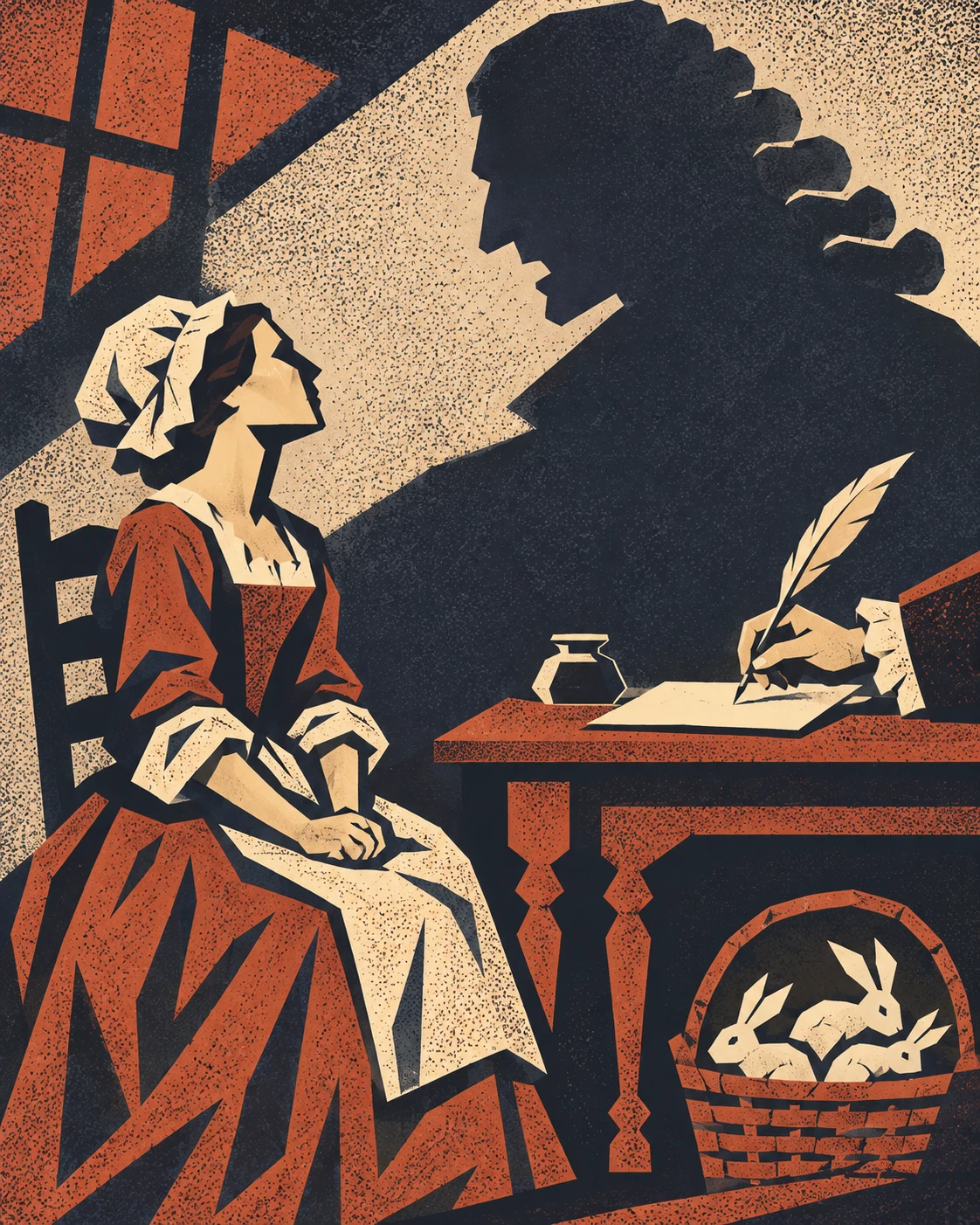
The cost to her body was considerable. In her study of the confessions, Harvey emphasises their repeated descriptions of pain and bleeding, and the role of female relatives and neighbours. She argues that the case should be read through the power those women held over childbirth and domestic life, not simply as a clash between an ignorant woman and learned men. The household could be a place of authority and coercion as well as help.5
That reading does not convict Ann Toft of anything, but it changes the questions to ask of Mary’s account. Who touched her, who told her what to do, who could enter the room and who had the power to describe what happened? Ahlers had asked similar questions when he complained about how an examination was managed. In the household, experienced women could control appearances as well as male doctors could.
That is why the people around Toft matter. The depositions include a nurse and a landlady as well as the men who sold rabbits, and they could see supplies, meals and family visits that the visiting surgeons never watched continuously. Mary Costen also commented on Joshua’s apparent lack of concern for his wife. That was her judgement of his behaviour, but it shows a witness paying attention to relationships as well as to the mechanics of a delivery.15
Harvey has also proposed a wider social setting for the hoax. Her research links the Toft family to local tensions over property and access to food, including Joshua’s involvement earlier in 1726 in a trespass case concerning a fishpond. She asks whether the rabbit affair might be connected with local discontent and protest. She is explicit that the link is circumstantial: a record of conflict involving a family member is not a statement of political purpose by Mary.9
Asked directly what Toft was trying to achieve, Harvey said in a later interview that she was not convinced Mary had a clear goal at all. Her interpretation allows for obedience to family and neighbours, hopes of money and grievances that need not have added up to a single plan. It is a serious alternative to the clever lone trickster, but it is still an interpretation of incomplete evidence.11
Sarah Fox’s review of Harvey’s book points to divisions of age, experience and status within the working community. That is a useful check on any simple contrast between poor women and powerful doctors: people who shared a neighbourhood or an income did not share equal authority over one another. The rabbit affair moved through several unequal worlds, and in every one of them, the claims were acted out on Toft’s body.12
These explanations can all be true at once. A planned spectacle could exploit an existing medical belief, while family pressure kept Toft going and professional rivalry kept the investigation going, though nobody can now recover a conversation in which all those purposes were agreed. The evidence exposes particular actions and competing interests, and it shows that the deception happened far more clearly than it shows whose idea it was.

Doctors in print
St André retreated publicly after the confession. An advertisement printed at the end of the Surrey depositions acknowledges that his narrative had helped spread belief in an imposture, declares his conviction that the affair was a fraud and promises a fuller account distinguishing the innocent from the guilty. Even his retraction carried on the argument about blame: admitting the central mistake was not the same as accepting the blame others attached to it.15
The printers were less restrained. *The Anatomist Dissected*, published under the name Lemuel Gulliver, put St André himself on the dissecting table. Its title made the man-midwife the patient, turning the authority of the bedside upside down, and its author claimed qualifications from the kingdoms of Lilliput and Blefuscu. It was satire dressed in the language of expertise.14
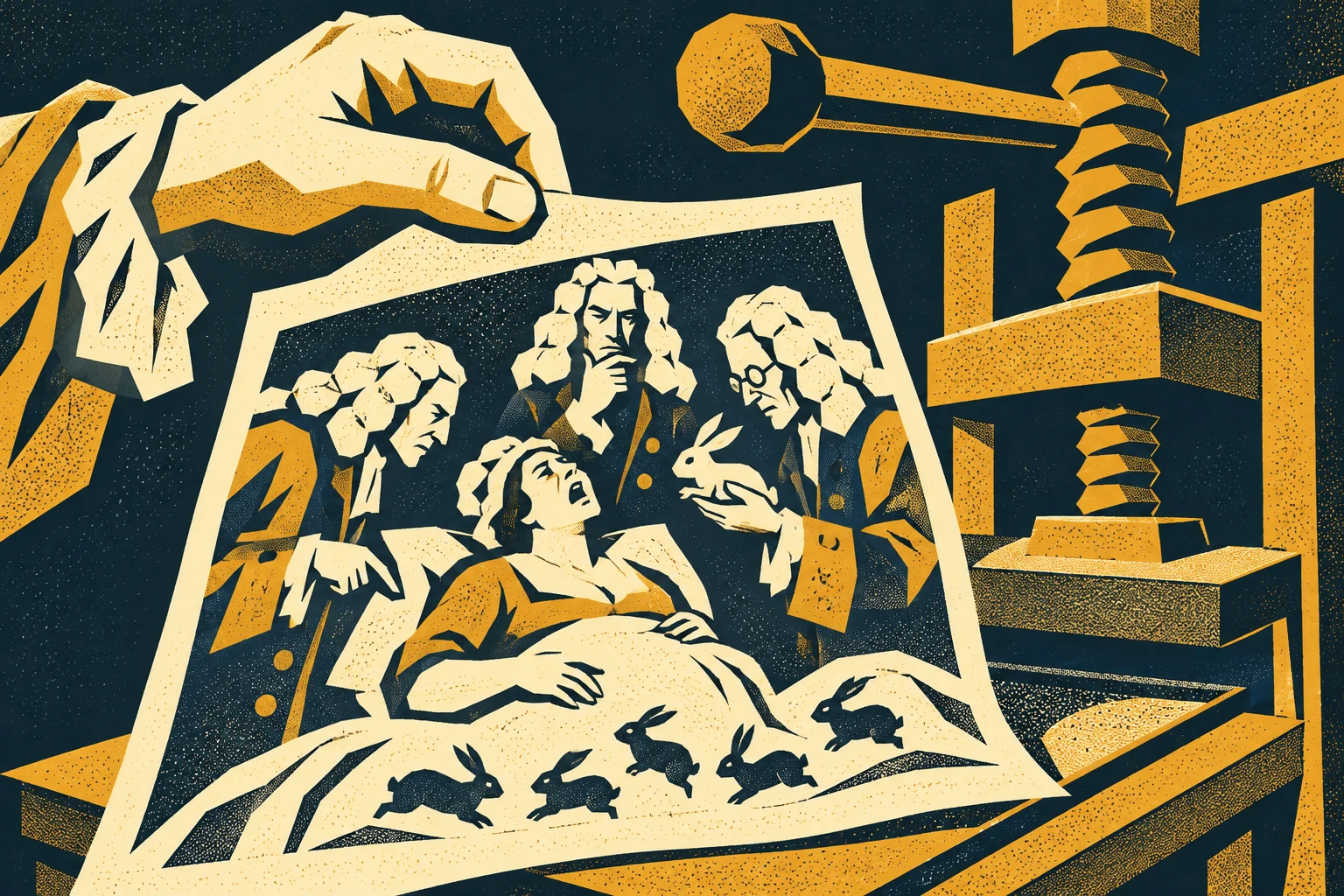
William Hogarth’s print *Cunicularii*, dated 22 December 1726 in the Wellcome Collection’s catalogue, turned the affair into a crowded farce. It shows Toft surrounded by family and medical visitors, each cast in a role in the joke. The arrangement recalls the Adoration of the Magi, with learned men greeting an extraordinary birth, and the satire makes their solemn attention ridiculous by setting rabbits and medical pronouncements on the same stage.13
The catalogue notes a distortion. Hogarth made no distinction between those who believed in the births and those who doubted them; every figure becomes part of a single display of gullibility. That is what made the image so memorable. It is powerful evidence of how the affair was mocked at the time, and an unreliable guide to who believed what in the room.13
The Royal College of Surgeons’ account describes the flood of pamphlets and songs, and the collecting of tracts about the affair, several of which are in its library. Toft had become a subject sold in every form: sensational report, defence, exposé and joke. Keeping the publications together allows their arguments to be compared, though the anecdotes they repeat are not independent witnesses.17
Exposure did not kill off every related medical belief. In 1727, James Augustus Blondel published an attack on the idea that a mother’s imagination could mark or deform her child. His preface criticised the weight placed on inherited stories and argued for anatomical reasoning. The book belongs to the argument over the very theory that had made Toft’s craving seem relevant, not to the sudden arrival of modern embryology.18
Blondel’s own ideas about reproduction belong to his time and cannot simply be swapped for modern knowledge. What his book shows is that the theory of maternal impression was under attack at the time. The choice was never between believing every report and possessing a full modern account of how embryos develop. A particular fraud could be exposed while wider explanations of reproduction went on changing.18
For the people writing and buying these publications, the confession was a fresh start. The good story was now the embarrassment, and its central exhibit was a doctor’s reputation, not a rabbit. Toft appeared everywhere in print and controlled none of it. Meanwhile, the authorities were still deciding what to do with her.
After the rabbits
Toft spent months in the Westminster Bridewell, the house of correction at Tothill Fields. Newspaper extracts collected by the local historian Ann Andrews describe crowds wanting to see her and restrictions on visitors to her room. The medical spectacle was over, but public curiosity followed her into custody. Reports of a planned prosecution show what was proposed, not a trial or a conviction.16
Howard faced proceedings too. A newspaper report in January describes a recognisance of £800 requiring him to appear and answer an accusation. That was a bond, not a fine for a proven offence, though later accounts have sometimes turned the sum into a verdict. The authorities pursued an allegation that he had been complicit without ever reaching the clear judgement a modern retelling might prefer.16
Harvey’s examination of the legal record finds that the case simply fizzles out. It never reached a documented trial that settled anyone’s role. The difficulties included finding an offence that fitted and establishing who had done what, though these are possible explanations; no surviving ruling says why it ended. A confident story of the establishment quietly protecting itself would go beyond the evidence too.9
By April 1727, newspapers were reporting Toft’s release without prosecution. She returned to Godalming. The museum records her burial there on 13 January 1763, more than thirty-five years after the scandal; the date of her death is not known. Her life went on long after the weeks in which London demanded that she explain the rabbits.2
The archive also shows how quickly a neat ending could be invented. Glasgow’s collection includes a broadside published at the time falsely reporting that she had killed herself in the Bridewell. It adds no tragedy to her life. It records a printer supplying one, and shows that a document can be contemporary with an event and still be wrong about whether it happened.19
An older medical history by S. A. Seligman presented the case as an extraordinary humiliation for the medical profession. More recent work has turned to the statements of the woman whose suffering made the deception possible. That does not rescue the biology, but it changes whose experience counts in an affair long remembered for making doctors look foolish.208
As of 7 November 2026, the rabbit births remain an established hoax, while responsibility and motive remain uncertain. The evidence supports inserted animal remains, competing medical accounts, a confession extracted under threat and a prosecution that never reached a verdict. It cannot recover every conversation in the household, or every decision taken about Toft’s body.
The rabbits were examined, preserved in jars and carried to the King. The doctors wrote down why they had believed, doubted or waited. Mary Toft left several accounts, each shaped by the men demanding it, and then went home to Godalming, where she lived for another thirty-five years.2
Linked case files

Sources20
- A Short Narrative of an Extraordinary Delivery of Rabbets Nathaniel St André · 1727 · Accessed 2026-11-07
- Mary Tofts (1703–1763) Rhiannon Jones / Godalming Museum · undated · Accessed 2026-11-07
- Some Observations Concerning the Woman of Godlyman in Surrey Cyriacus Ahlers · 1726 · Accessed 2026-11-07
- An Exact Diary of What Was Observ’d during a Close Attendance upon Mary Toft Sir Richard Manningham · 1726 · Accessed 2026-11-07
- What Mary Toft Felt: Women’s Voices, Pain, Power and the Body Karen Harvey · 2015-09-23 · Accessed 2026-11-07
- First confession, MS Hunter D324, folio 1r Mary Toft, recorded by James Douglas / University of Glasgow Library · 1726-12-07 · Accessed 2026-11-07
- The Three Confessions of Mary Toft Mary Toft, recorded by James Douglas; transcribed by Dennis Todd · 1726-12 · Accessed 2026-11-07
- Magical Source: Mary Toft’s Confessions Karen Harvey, hosted by Birmingham Eighteenth Century Centre · 2022-06-07 · Accessed 2026-11-07
- Rabbits, Whigs and Hunters: Women and Protest in Mary Toft’s Monstrous Births of 1726 Karen Harvey · 2018 · Accessed 2026-11-07
- Imagining Monsters: Miscreations of the Self in Eighteenth-Century England Dennis Todd / University of Chicago Press · 1995 · Accessed 2026-11-07
- Interview with Karen Harvey, author of The Imposteress Rabbit Breeder Karen Harvey, interviewed by Peter Ross / Sky HISTORY · undated · Accessed 2026-11-07
- The Imposteress Rabbit Breeder: Mary Toft and Eighteenth-Century England Sarah Fox / Reviews in History · 2020-07-17 · Accessed 2026-11-07
- Cunicularii, or the Wise Men of Godliman in Consultation William Hogarth / Wellcome Collection · 1726-12-22 · Accessed 2026-11-07
- The Anatomist Dissected: or the Man-Midwife Finely Brought to Bed Lemuel Gulliver (pseudonym) · 1727 · Accessed 2026-11-07
- The Several Depositions Relating to the Affair of Mary Toft Edward Costen, Richard Stedman, John Sweetapple, Mary Peytoe, Elizabeth Mason and Mary Costen · 1727 · Accessed 2026-11-07
- Mary Toft, the Rabbit Woman of Godalming Ann Andrews, transcribing contemporary newspapers · undated · Accessed 2026-11-07
- A Hare-Raising Tale Corinne Hogan / Royal College of Surgeons of England · 2018-03-29 · Accessed 2026-11-07
- The Strength of Imagination in Pregnant Women Examin’d James Augustus Blondel · 1727 · Accessed 2026-11-07
- The Curious Case of Mary Toft University of Glasgow Library Special Collections · 2009-08 · Accessed 2026-11-07
- Mary Toft: The Rabbit Breeder S. A. Seligman · 1961 · Accessed 2026-11-07