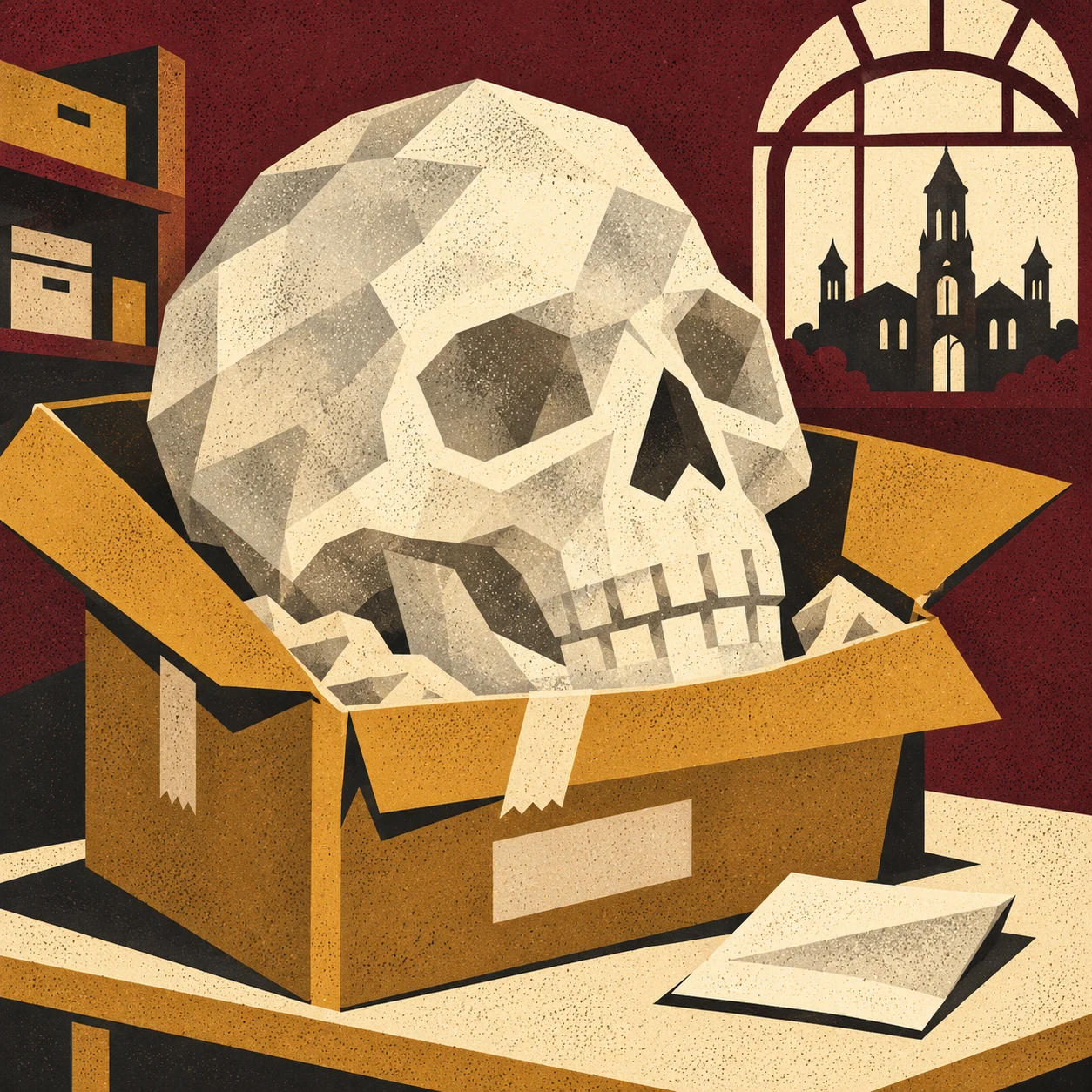
In 1992, a heavy parcel arrived at the Smithsonian with an unsigned letter. Inside was a skull carved from cloudy white quartz, larger than a human head. The letter called it Aztec. The investigation it set off would lead not to a temple, but to a salesroom.1
A skull in the post
The letter-writer said the skull had been bought in Mexico in 1960 and suggested that it had once belonged to the collection of President Porfirio Díaz. There was no excavation report. The parcel had even been addressed to a curator at a museum that did not exist under the name given.1
It found its way to the National Museum of American History, where the curator Richard Ahlborn asked the anthropologist Jane MacLaren Walsh to take a look. Walsh, a specialist in Mexican archaeology, knew that the British Museum owned a large crystal skull and that the Smithsonian had once displayed a small one as a fake.1
What, then, was this? The quartz was real, and somebody had gone to considerable trouble to hollow and shape it. The letter, though, offered a chain of assertions, not a history anyone could check. A purchase in twentieth-century Mexico said nothing about manufacture in ancient Mexico, and the link to Díaz was one more claim in need of evidence.12
Walsh accepted the skull into the anthropology collections, though keeping it did not mean accepting its label. It meant researchers could examine an object that would otherwise have vanished back into private hands with its story untested, and the parcel became the starting point for an investigation that ran through laboratories, museum archives and nineteenth-century auction records.13
It was not the first polished crystal death’s head to arrive with an impressive story. By then, skulls in public and private collections had been attributed to the Aztecs, the Maya and other Mesoamerican cultures, and some had acquired more extravagant origins, from Atlantis to visitors from space. Every version dwelt on how the object looked. Few said exactly where it had been found.24
For the famous museum examples, the archaeological trail was missing, since none had come from a controlled, well-recorded excavation. What researchers found instead were dealers, collectors, gifts and sales, records that could show where a skull had been in the nineteenth or twentieth century but not the ancient burial or temple it was supposed to have come from.24
None of this made crystal carving impossible in the ancient Americas. Mesoamerican craftspeople worked hard stone with great skill, and skull imagery is familiar in their art, so the real question was whether these particular carvings could be tied to those traditions by how they were made, how they looked and where they had been. A genuine artistic tradition could not vouch for every object later sold in its name.2
Nor were the skulls a single family. The Smithsonian’s was milky and hollow, the British Museum’s, the best known, was clear rock crystal, and the privately owned Mitchell-Hedges skull had a separate lower jaw and a more elaborate finish. Calling them all “crystal skulls” invited the public to see one ancient lineage where there might be several very different histories.25
Each finding had to stay attached to the right object. A museum purchase was not an excavation, and the age of the quartz was not the age of the carving. Walsh’s first real lead was a name that kept recurring in the older records: Eugène Boban, a French dealer with a remarkable talent for bringing Mexican antiquities to market.23
Following the dealer
Boban was no casual seller of curiosities. He had lived in Mexico, collected widely and built a serious knowledge of its cultures. During the French intervention of the 1860s, he advertised his connection with the Emperor Maximilian and took part in the French scientific commission, and objects from his collection went on show at the Paris international exhibition of 1867. In Boban’s world, scholarship, commerce and imperial ambition overlapped.23
His collection included crystal skulls, some of them tiny and drilled through vertically, nothing like the life-sized death’s heads that would later become famous. They show that the trade in such objects predated the better-known twentieth-century discovery tales, and that crystal skulls did not first reach the public through an explorer lowering his daughter into a Maya ruin.34
Back in France, Boban ran an antiquities business in Paris. Much of his Mexican collection passed to the explorer Alphonse Pinart and entered the French national collections in 1878, crystal skulls included. A dealer’s stock had acquired the authority of a national museum.23
The large skull that would eventually reach the British Museum appears in Boban’s Paris sales catalogue of 1881. It was an accomplished piece of carving, but the catalogue gave no excavation site. The skull had a history as merchandise long before anyone could show it had a history as an antiquity, and that pattern would repeat.2
Boban took the skull to Mexico, where an attempt to sell it to the national museum failed in 1885. According to the archival reconstruction by Margaret Sax and her colleagues, the museum regarded the carving as modern and even mistook it for glass. Doubts about the skull were not invented by later sceptics in Europe or America. They were there in Mexico City in 1885.2
A second warning followed. A letter sent in 1886 to the Smithsonian archaeologist William Henry Holmes discussed Boban’s failed ventures and asserted that he had obtained the skull in Germany. The letter shows the allegation was circulating at the time, though it names no carver and offers no workshop receipt.23
Boban moved on to New York. At an auction in 1886, the large skull sold for $950, an exceptional price in a sale of much cheaper objects. Researchers traced it through a buyer associated with Tiffany’s to George Sisson. Tiffany & Co. eventually supplied it to the British Museum, whose acquisition paperwork dates the purchase to November 1897.23
The museum’s registration number begins with 1898, which is why many accounts give that year instead, repeating an accession number as though it were a purchase date. The more serious error would be to treat either date as evidence that the skull came from an Aztec site, because neither says anything of the kind.2
Had Boban commissioned a fake? His recurring presence in the trade is suspicious, and the scientific evidence points to a modern European origin for the London skull. But no record of a commission has been recovered, and suspicion is not a licence to invent a meeting, a payment to a named German craftsman or a confession that no source supplies.2
The mechanism, at least, is clear. A beautiful object moved through respected commercial and collecting networks until it reached a great museum, and every transfer made it look better established while the facts about its earliest history stayed missing. Boban’s name links the transactions, but it does not turn them into an archaeological discovery.23
A temple or a salesroom?
The Mitchell-Hedges skull came with the adventure the museum skulls lacked. In its best-known version, Anna Mitchell-Hedges found a gleaming object in the ruins of Lubaantun, in what was then British Honduras and is now Belize. A perilous opening, fallen masonry and a crystal skull waiting in the dark made for a story that was hard to forget.56
Anna’s account changed over time. Versions placed the discovery beneath an altar or inside the ruined structure, at various dates in the 1920s; a later retelling settled on 1924 and her seventeenth birthday. These are recollections, not archaeological records, and their differences matter when the whole claim is that one object was found in one place.56
A commercial crystal-skull website preserves a transcript said to come from Anna’s appearance in a 1996 BBC programme, in which she describes seeing something shining through the stones and being lowered into the chamber. It shows how she told the story late in life, but it is not a field notebook from the excavation.6
The documents lead somewhere far less remote. In February 1933, the London dealer Sydney Burney wrote to the American Museum of Natural History offering a life-sized crystal skull with a separate jaw. Walsh published details of that correspondence. In 1936, a study in the journal *Man* photographed the same skull and compared it with the one in the British Museum.5
On 15 October 1943, the Burney skull was sold at Sotheby’s for £400. The buyer was Frederick Arthur Mitchell-Hedges, the explorer whose name it would carry. In a December letter to his brother, reproduced in Walsh’s account, he described acquiring it from the Burney collection. The skull had a documented commercial history that owed nothing to his daughter’s memory of a temple.5
Could the sale have been a family buying back its own property? Anna later suggested as much, saying the skull had been left with Burney as security while her father needed money. Walsh traced the correspondence in which that explanation took shape, and it reads as an attempt to reconcile the discovery story with the sale, since no independent record of an earlier loan has surfaced.7
A purchase record cannot rule out every imaginable earlier owner, but nor can an unsupported loan story cancel the record simply by fitting around it. That would take proof of the original transfer, its terms or an acknowledgement from Burney, and without it the skull’s documented history begins with Burney.57
Frederick Mitchell-Hedges gave the skull a darker identity in his 1954 memoir, *Danger My Ally*. He presented it as ancient, linked it with Maya priests and repeated a legend that they could use it to will death. Nobody had witnessed such a ritual, but the skull’s popular name, the Skull of Doom, turned the legend into a memorable warning.7
“There’s no way of proving its age.”
After Frederick died in 1959, Anna kept the skull in the public eye, and the art restorer Frank Dorland joined in promoting it with his own theories about how it was made and what it meant. Walsh’s reading of the correspondence describes a growing publicity enterprise, whose next step would add a persuasive ingredient in the name of a respected electronics company.78
By now there were two separate questions. Had the skull been found at Lubaantun? And did the carving have properties that ordinary workmanship could not explain? An answer about quartz could settle nothing about ownership in the 1920s, but the two were often allowed to prop each other up, as if impressive material made the discovery story more likely.58

What Hewlett-Packard actually found
Hewlett-Packard knew quartz. Its laboratory in Santa Clara worked with the material for precision oscillators and thermometers, so this was not a promoter asking an unrelated celebrity for an opinion. The company’s researchers could examine the crystal structure and test specific ideas about the skull and its separate jaw.8
The company’s staff magazine, *Measure*, described the examination in February 1971, in a playful article that mixed laboratory observations with material from a mystery story. It repeated Anna’s supposed discovery in 1927 and entertained Dorland’s far-reaching ideas about the object’s travels. That background came from the visitors; the laboratory had not tested it.8
The tests themselves were narrower. The skull was immersed in a liquid chosen to reduce the optical difference between the crystal and its surroundings, making internal features easier to study under polarised light. The laboratory concluded that the main carving was almost certainly cut from a single quartz crystal, not several pieces joined together.8
The team also examined the jaw, and its orientation and the internal features visible under polarised light showed that it came from the same original crystal. That was a genuine finding about how the object had been made, but it did not place the workshop in ancient Belize or anywhere else.8
The article admired the workmanship, repeated an estimate of the enormous labour involved and offered a joking figure for what a replica might cost. Lifted out of context, such remarks sound weighty. Neither was a measured production history; nobody had watched the original artisan at work.8
*Measure* quoted the components manager, Jim Pruett, saying there was no way to prove the skull’s age. His admiration for its beauty did not depend on its being ancient. Read in full, the article does not claim that HP established a Maya origin or showed that modern machinery could not have made it.8
Identifying a material is not the same as dating an object. Quartz existed long before anyone carved it into a skull. Showing that the skull is natural quartz identifies what the carver used, and showing that the jaw and cranium came from one piece reveals something about how they were made. Neither tells us when the cutting happened.
The same goes for the skull’s shifting appearance. A polished transparent object can bend light in striking ways. The HP article described how a slight movement of the viewer or the light produced different patterns, and suggested that this might account for some of the skull’s hypnotic effect. No hidden projector or supernatural force was required.8
Did later scientists overturn an endorsement from HP? Not really, because the two investigations looked at different things. HP reported on composition and structure, while later studies examined the marks of manufacture in far greater detail and combined them with the ownership record, and a genuine single crystal can perfectly well have been shaped with modern tools.28
In popular retellings, though, the examination grew, on the reasoning that a reputable laboratory had handled the skull and so the ancient mystery must have survived a definitive test. The limits were all there in the original article, but they were less exciting than Atlantis and the death-dealing priest, and easily dropped.8
The publisher’s description of Chris Morton and Ceri Louise Thomas’s book shows how far the story travelled. It presents the HP visit as concluding that the skull should not exist. The company magazine reported something much more modest.811
Marks beneath the polish
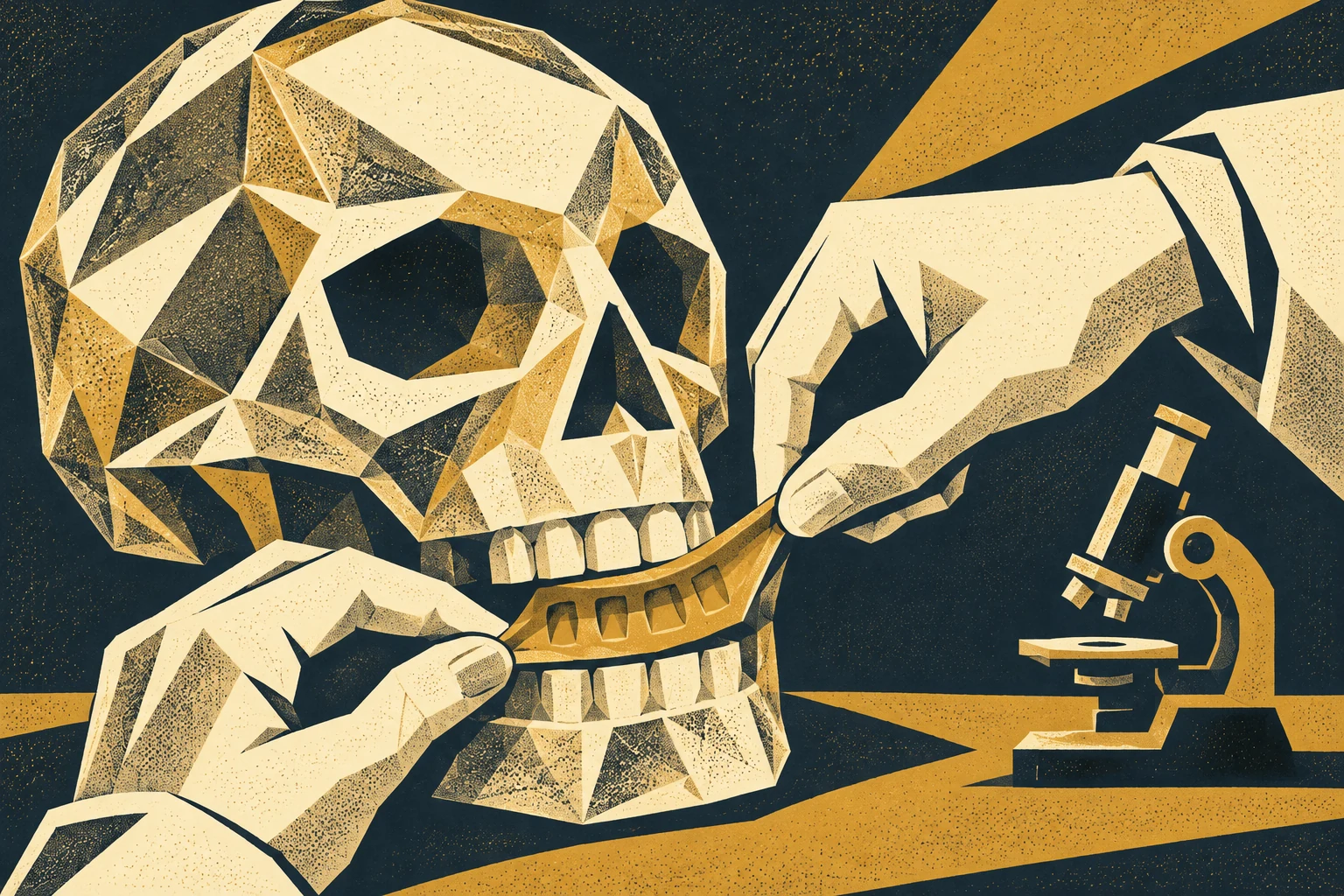
In 2008, Sax, Walsh, Ian Freestone, Andrew Rankin and Nigel Meeks published a detailed study of the British Museum and Smithsonian skulls in the *Journal of Archaeological Science*. They combined the historical record with an examination of tool marks, abrasive residues and the quartz itself. The skulls’ own surfaces became the evidence.2
The researchers began with optical microscopes. They then took silicone moulds of selected features so that the fine surface detail could be studied under a scanning electron microscope. The impressions captured traces deep inside recesses that were hard to see directly.2
Everything depended on comparison, because a groove does not reveal its maker just by looking unfamiliar. The team made experimental cuts in quartz with different tools and abrasives, and examined genuine Mesoamerican objects from documented contexts, among them a Mixtec rock-crystal goblet and Aztec or Mixtec crystal beads, with historical descriptions of stoneworking as a further check.2
The comparisons avoided a false choice between miraculous ancient craftsmanship and superior modern science. Ancient lapidaries could shape and polish hard stone. The question was whether the marks on these skulls matched the tools and methods documented for those cultures. A brilliant object can be wrongly attributed, just as a crude one can be genuinely old.2
On the British Museum skull, the researchers found the work of rotary wheels in the engraved teeth and mouth and across the carving. Regular striations and the curved profiles of the cuts matched the experimental evidence. Similar traces survived beneath the polish in recessed areas and on other surfaces. The case did not rest on one suspicious scratch.2
The Smithsonian skull held a different clue. A small deposit in a cavity was identified by X-ray diffraction as silicon carbide, known in the abrasive trade as carborundum, a material of modern lapidary technology. Together with extensive evidence of rotary tools, it strongly supported twentieth-century manufacture for that skull.2
The authors did not find silicon and carbon and declare every skull a fake. They identified a specific abrasive in one specimen, considered how it could have been used and related it to the marks on the surface. The London skull had its own material and manufacturing evidence, and the dramatic result from one object was not borrowed to explain the other.2
The quartz of the British Museum skull contained tiny inclusions that offered clues to how and where it formed. They suggested a source such as Brazil or Madagascar, well outside the ancient Mexican trade networks in question. The authors set that inference beside the nineteenth-century supply of large crystals to European workshops. The inclusions could not identify a particular quarry or the person who carved the skull.2
Taken together, the findings pointed to modern manufacture for both skulls. The London skull was associated with nineteenth-century Europe; the Smithsonian carving was probably made not long before its reported purchase in Mexico in 1960. The paper was stronger at ruling out ancient origins than at naming a workshop or a year.2
The Mitchell-Hedges skull needed its own examination. Walsh studied it in 2007 and 2008, again taking impressions of the carved features. Her published account describes marks consistent with small, high-speed rotary tools coated with diamond. She concluded that the technology was modern and that twentieth-century manufacture was the most plausible explanation. The verdict rested on the skull’s own surface, not on what had been found in the Smithsonian specimen.9
Could an ancient skull have been reworked?
One obvious objection remained, which was that modern marks might only show that someone had repaired or altered an old object. Could an ancient skull have passed through a later workshop, picking up suspicious scratches without losing its original identity? The question deserved an answer, because the last time an object was worked is not always the first.2
It had already come up with the British Museum skull. Earlier microscopic inspection suggested that its teeth had been cut with a rotary tool, but investigators allowed that they might have been recut. The 2008 paper discusses that later work on the teeth explicitly.2
What counted was how widely the marks were spread. The 2008 study found evidence of rotary cutting on recessed, flat and convex surfaces, including traces preserved beneath the final polish. That implicated far more of the shaping than the sharpening of a few teeth. Any reworking theory would have to account for the carving as a whole.2
Later polishing would not supply the missing ancient context either. Even if part of an object were old, the ownership records would still have to connect it with a pre-Columbian setting. A hypothetical ancient core cannot do the work of an excavation record. It is a theory in need of evidence, not a refuge for every question the modern-carving evidence leaves open.2
There is one real case in which the idea makes sense. Walsh suggested that some of the earliest small skulls might have been carved from older crystal beads, keeping their vertical perforations. The material could have had an ancient life before taking on a much later skull-shaped form; the age of the hole would not date the face around it.4
Could a lost indigenous technology explain the wheel marks? Archaeology is incomplete, and new finds do change what we know of ancient practice. But the researchers had comparison objects, tool histories and surface evidence. A lost technology needs evidence of its own, ideally from a secure archaeological context, not merely the suggestion that something might have vanished.2
The study is also careful to distinguish rotary drills from lapidary wheels. Pre-Columbian craftspeople did use rotating action: drilling can leave circular traces without any wheel-driven carving. The researchers’ conclusions rest on the character and distribution of the marks and on experimental comparison. They do not treat every circular groove as an anachronism.2
Least convincing of all is the claim that sceptics underrate ancient artisans. The securely identified work of Maya and Aztec craftspeople is the very evidence used to test the skulls. Admiring their achievements and rejecting a European carving sold in their name are entirely compatible.2
What about a modern copy of a genuine ancient skull? The close resemblance between the British Museum and Mitchell-Hedges carvings has prompted talk of copying, and Walsh considered the Mitchell-Hedges skull an elaboration of the London one, with a separate jaw and finer detail. The likeness may point to a commercial relationship between the two, but it does not conjure up an authentic ancient original behind either.9
The real maker may never be named, and the ancient attribution can still collapse. Rejecting it does not require solving every undocumented sale or identifying every tool. It requires evidence strong enough to choose between the competing histories of the object, and for these skulls that evidence exists.2

Thirteen skulls and a lost world
The most expansive stories left individual discoveries behind. Crystal skulls became stores of lost knowledge, instruments of healing or members of a set waiting to be reunited. Atlantis supplied an advanced civilisation; visitors from space supplied technology beyond the people to whom the skulls had first been attributed. Each version could absorb new objections by changing the history it relied on.410
The number thirteen gave the legend its shape. One skull was an intriguing object, but a scattered set implied a quest, a purpose and a final reunion, and in modern spiritual retellings bringing the skulls together could unlock knowledge or avert disaster. The incompleteness was part of the appeal, since any unidentified carving might be one of the missing pieces.10
That claim needs evidence too. Skull imagery in Mesoamerican art does not establish the modern story of thirteen crystal skulls. Books, broadcasts and websites repeating the legend show how widely it has spread, but none has produced an ancient text or archaeological deposit describing such a set.210
The idea of the skull as a computer sounds more concrete than it is. Quartz has genuine uses in electronics, as HP’s own work shows. That does not make a polished skull a memory device. A claim about encoded knowledge would need to explain how the information got there, how to retrieve it and what has been recovered so far.8
Healing and visions are a different matter. People may sincerely report powerful experiences in front of an arresting object. Their testimony records those experiences; it cannot establish an external power, an ancient maker or a medical effect, and it says nothing about where the skull came from.
The darker legends proved just as adaptable. Frederick Mitchell-Hedges linked his skull with a priest who could will death, while later promoters preferred to speak of love, knowledge or spiritual transformation. The same carved face carried both reputations, and the menacing one never had to be retired to make room for the benign.7
Museums made the stories harder to untangle. A skull could be examined, borrowed or exhibited without its legend being accepted, but a photograph of it in a museum setting travelled further than any careful explanation of why it was there. To a reader who saw only the picture, investigation could look like authentication.37
The 2008 Indiana Jones film brought crystal skulls a fresh wave of fame. The Smithsonian responded with an exhibition of its own specimen and an account of the research behind it. Its curators had grown suspicious long before Hollywood took an interest; much of the documentary and technical work was already done.14
Could museums be hiding the truth about an advanced civilisation? The investigation is a matter of public record: collaborative examination and published results that anyone can check against the methods and objects described. A cover-up theory would have to explain away that published evidence and the missing archaeological record, and disagreement with a legend is not proof of suppression.2
The skulls kept their hold on the imagination because an arresting carving stays arresting after its label changes. Ancient relic, Victorian curiosity, oracle and disputed collectible are very different identities, and none of them stops a visitor finding the object unsettling.
What remains unknown
As of November 2026, the principal published investigations support modern manufacture for the British Museum, Smithsonian and Mitchell-Hedges skulls. Their quartz is real and their craftsmanship considerable. What fails against the documentary and technical evidence is the claim that these particular objects are pre-Columbian.29
The finding has limits. The 2008 paper studied two skulls and Walsh’s later work examined the Mitchell-Hedges skull, but neither tested every skull-shaped crystal in private hands. A new object would need its own history and examination, because staying out of the laboratory does not make it ancient.29
Some questions remain open, including who carved the London skull, where exactly Boban obtained it and who supplied the Mitchell-Hedges skull to Burney in 1933. The known records narrow the possibilities without completing the story, but a missing maker’s name is common in the history of traded objects, and it gives no support to an ancient origin over the evidence of modern tools.25
The German workshop remains a plausible lead, not a recovered commission. A contemporary letter placed Boban’s purchase in Germany, and European lapidary centres had the materials and skills required. That is reason to keep looking, not grounds for naming a particular craftsman or assuming every skull came from the same bench.2
The Smithsonian skull has gaps of its own. The unsigned letter’s purchase in 1960 is not a documented chain back to a workshop, and nothing in the technical examination supports the suggested link to Díaz. The carborundum helped date the carving, but it could not identify the anonymous sender or the owners before.12
The London skull shows how a museum’s authority can become part of a problem it later helps solve. Bought from a respected jeweller and displayed among genuine antiquities, it became the model against which later carvings were judged. Once its attribution was questioned, the museum’s own records allowed researchers to trace that authority back through the market.23
The full answer is messier than either a miraculous relic or a single exposed fraudster, because there were different skulls, different sellers and different generations of stories. Some small objects may have reused older material, but the larger examples were made with modern carving technology, and later promoters added the discovery scenes and the extraordinary powers, which the original dealers are not known to have claimed.247
Each kind of evidence answered its own question: the geology of the quartz, the marks of a wheel, an appearance in a dealer’s letter, the wording of a laboratory report. Together they trace the skulls from catalogue to collection.258
Were the skulls ancient instruments of death or lost stores of knowledge? The evidence supports neither, and what it shows is in its way more troubling. Objects with no excavation history entered some of the world’s most prestigious collections and lent their borrowed authority to new legends. The British Museum skull, bought from Tiffany & Co. in 1897, was shaped with a wheel, but whose hand guided it no catalogue has yet recorded.2
Linked case files

Sources11
- Science in the News: The Truth about Crystal Skulls Smithsonian Institution · 2008 · Accessed 2026-11-06
- The origins of two purportedly pre-Columbian Mexican crystal skulls Margaret Sax, Jane M. Walsh, Ian C. Freestone, Andrew H. Rankin and Nigel D. Meeks · 2008 · Accessed 2026-11-06
- The Man Who Invented Aztec Crystal Skulls: introduction Jane MacLaren Walsh and Brett Topping · 2018 · Accessed 2026-11-06
- Legend of the Crystal Skulls Jane MacLaren Walsh · 2008-05/06 · Accessed 2026-11-06
- The Skull of Doom: Acquisition History Jane MacLaren Walsh · 2010-05-27 · Accessed 2026-11-06
- Anna Mitchell-Hedges recounts finding the crystal skull in Lubaantun Ancient Crystal Skulls · 2025 · Accessed 2026-11-06
- The Skull of Doom: Fictionalized History Jane MacLaren Walsh · 2010-05-27 · Accessed 2026-11-06
- History or hokum? Santa Clara’s crystal lab helps tackle the case of the hard-headed Honduran Hewlett-Packard, Measure · 1971-02 · Accessed 2026-11-06
- The Skull of Doom: Under the Microscope Jane MacLaren Walsh · 2010-05-27 · Accessed 2026-11-06
- Discover: Legend of the 13 crystal skulls Ancient Crystal Skulls · Accessed 2026-11-06
- The Mystery of the Crystal Skulls: publisher description and excerpt Chris Morton and Ceri Louise Thomas; Bear & Company / Simon & Schuster · Accessed 2026-11-06