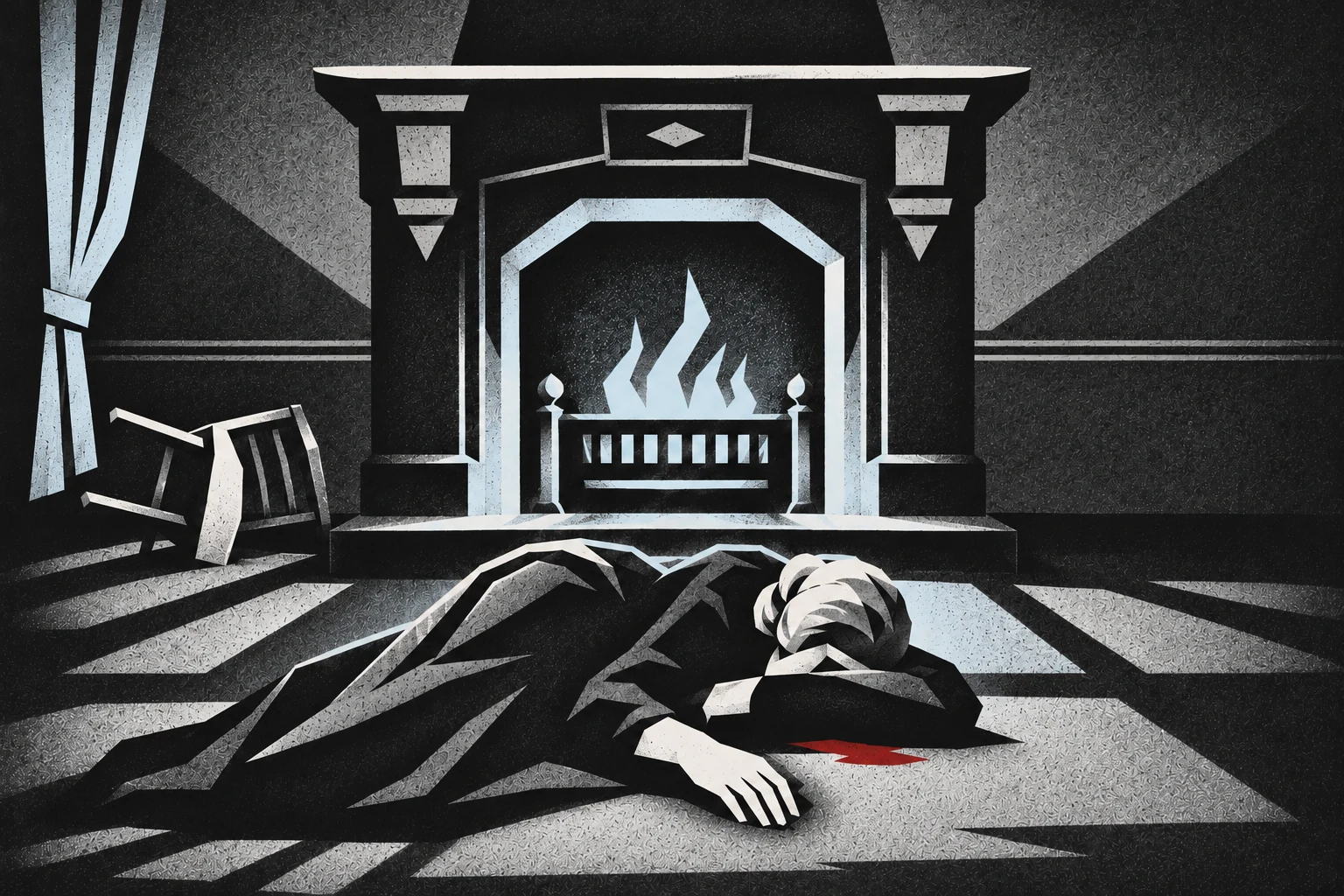
On the evening of 19 January 1931, a man telephoned the Liverpool café where the city’s chess club met and left a message for a member. He called himself R. M. Qualtrough, and the address he gave did not exist. By the next night, the member’s wife was dead.12
Raymond Chandler, who knew something about murder mysteries, judged the killing of Julia Wallace the one by which all others should be measured.1
A message at the chess club
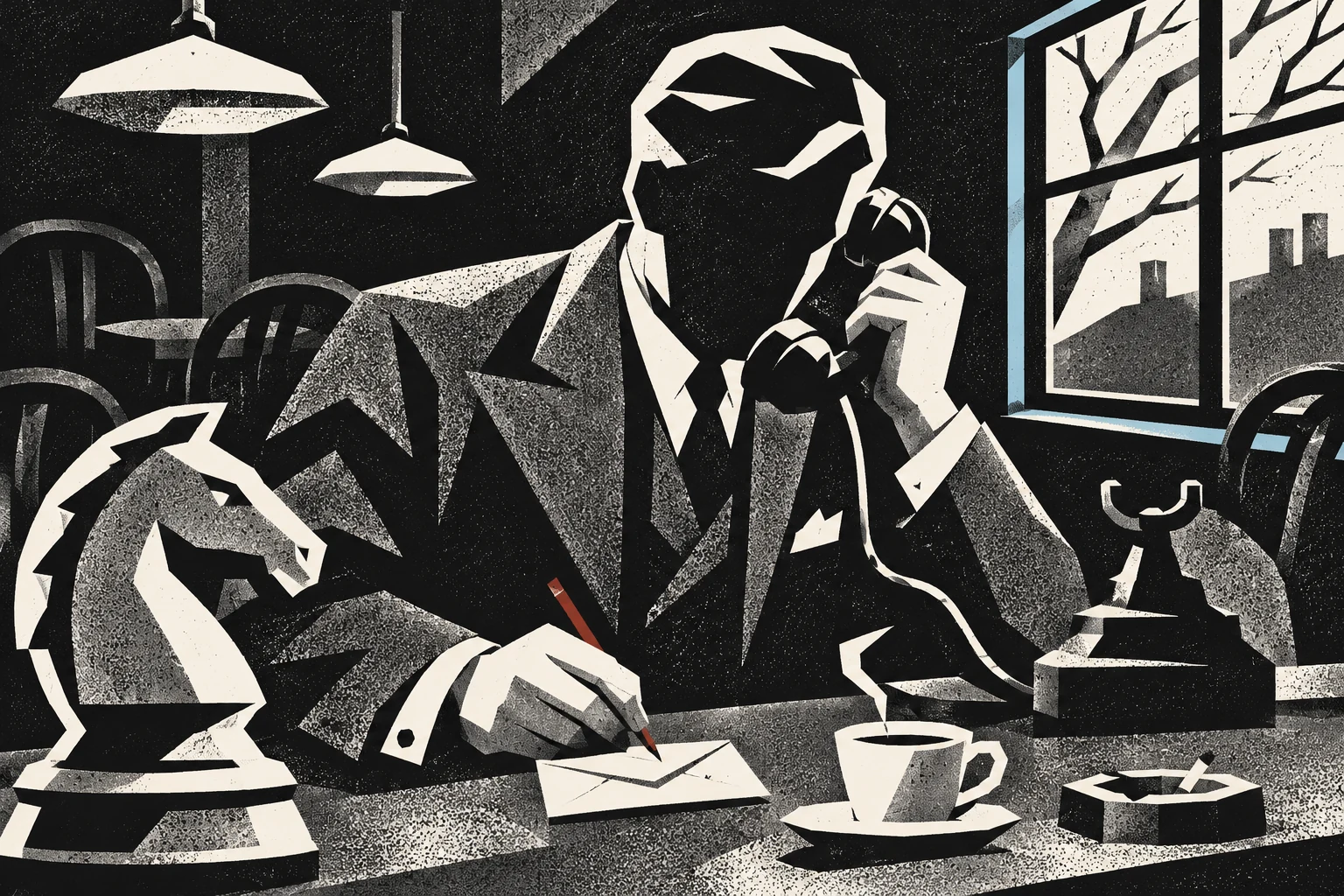
The call came to the City Café in North John Street, home of the Liverpool Central Chess Club, and the caller asked for William Herbert Wallace. Wallace was not there. The caller left a name and an appointment for the following evening at half past seven: 25 Menlove Gardens East, Mossley Hill, on a matter concerning Wallace’s business.12
Wallace collected insurance premiums for the Prudential. His work took him into people’s homes, carrying money and keeping records of their payments, so an enquiry from a prospective customer was something he could reasonably follow up. What was odd was that it reached him at his chess club, from a man whose name he did not recognise, instead of through his ordinary rounds.1
The club captain, Samuel Beattie, took the message and wrote the details on an envelope. At the trial, he described a strong, rather gruff male voice. When he passed the message on, the talk turned to the unfamiliar name and where the street might be. Someone had given Wallace an address precise enough to find a numbered house, yet vague enough that none of the men discussing it could place it.2
The chess club gives the story its most tempting metaphor, a future defendant at a chessboard planning several moves ahead, and Edward Winter’s detailed study of the chess connections shows how readily crime writers seized on the image. But playing chess is no evidence of planning a murder. The real questions are what the caller knew, and how he knew it.3
The café was open to the public as well as club members, and a board listed scheduled games, so anyone could find out when Wallace was due to play. But as Beattie’s evidence made clear, a fixture on the board did not guarantee that the player would turn up, and Wallace’s attendance had been irregular. A stranger could learn the fixture. Neither a stranger nor a fellow member could be sure the message would reach him that night.2
To those who suspected Wallace, that uncertainty was the fatal flaw in any outsider’s plan. Why build a burglary around an invitation that might never be delivered, to a man who might be ill, busy or uninterested in unsolicited business? Wallace himself faced none of those problems. If he had invented Qualtrough, he could make sure the message was received and the appointment kept.1
An outsider could still have tried his luck. A caller might have known more about Wallace’s movements than the noticeboard revealed, or been playing a joke that would cost little if it failed. The cleverness of the call does not identify its author. The precision that makes Wallace look calculating could belong to someone else, or be exaggerated by what followed.
The call was later traced to a public telephone box at the junction of Breck Road and Rochester Road, roughly 400 yards from the Wallaces’ home in Wolverton Street. That gave the police a powerful reason to look at Wallace, who could have used it on his way to the club, but anyone else could have used it too, so the box gave investigators a lead, not a caller.4
The street that wasn’t there
On the Tuesday evening, Wallace set off for the appointment. By his account he left home at about a quarter to seven, heading from Anfield to the Menlove Gardens area in the south of the city by a series of trams and enquiries. What should have been an address turned into a string of people being asked to explain it.1
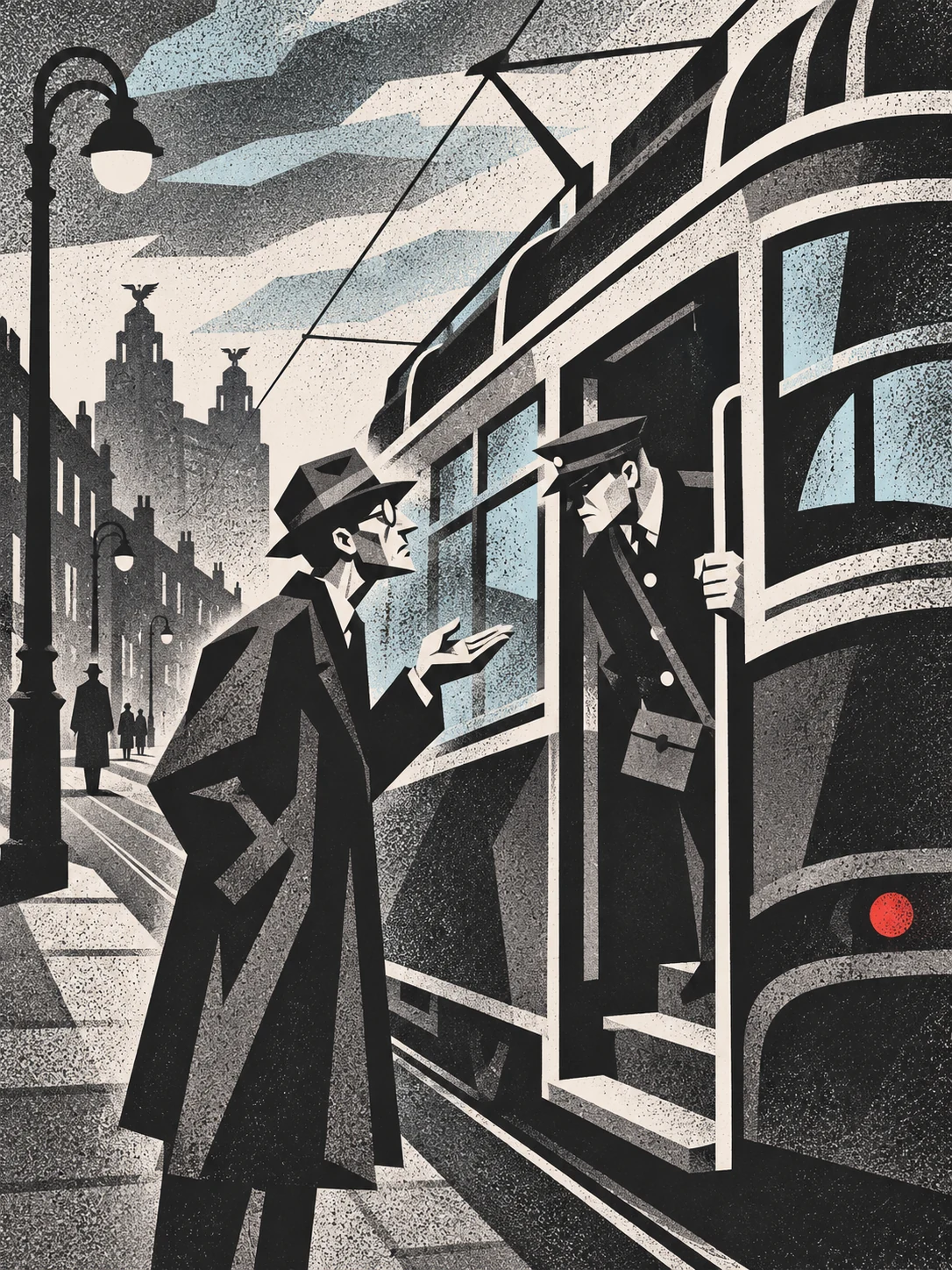
One of them was the tram conductor Thomas Charles Phillips. Wallace asked him about Menlove Gardens East more than once, presenting himself as a stranger to the district and anxious to reach his destination. Phillips advised him about the cars and the change at Penny Lane. He remembered the exchange because it later became important; he had not set out that evening expecting to record an alibi.2
Once Julia was dead, the same conversation could be read two ways. To a passenger seeking directions, asking again and again is entirely practical, a matter of checking before boarding, again when the fare is collected, and making sure the conductor remembers the stop. To an investigator suspecting a planned murder, the same exchanges look like a deliberate effort to be remembered, so the words stay the same while their meaning changes.
Wallace’s job did not settle the matter either. Collecting premiums meant he knew parts of Liverpool well, and he had connections in the area he was visiting, which made his professed confusion look suspicious to later writers. But knowing a district does not make an unfamiliar address easy to find. Anyone’s knowledge of a city is patchier than a reconstruction drawn up with hindsight allows.1
The fictitious address had a particularly clever flaw. Menlove Gardens North, South and West all existed, but East did not, so Wallace had not been sent to an obviously imaginary street. He had been given a plausible fourth member of a real group, the kind of address that encouraged him to keep hoping the next resident, shopkeeper or policeman would know where it was.1
He tried a house in Menlove Gardens West. He asked people in the neighbourhood and a police constable, and enquiries at a shop turned up no customer called Qualtrough. Those encounters placed him away from Wolverton Street for much of the evening. They said nothing about what was happening inside his house, or whether Julia had been alive when he left.1
The suspicion that Wallace was manufacturing witnesses remains one of the strongest arguments against him, because the journey achieved exactly what a planned alibi would need. But a diversion arranged by someone else would have achieved the same result, and the journey shows only that Wallace followed the message, not who wanted him to.1
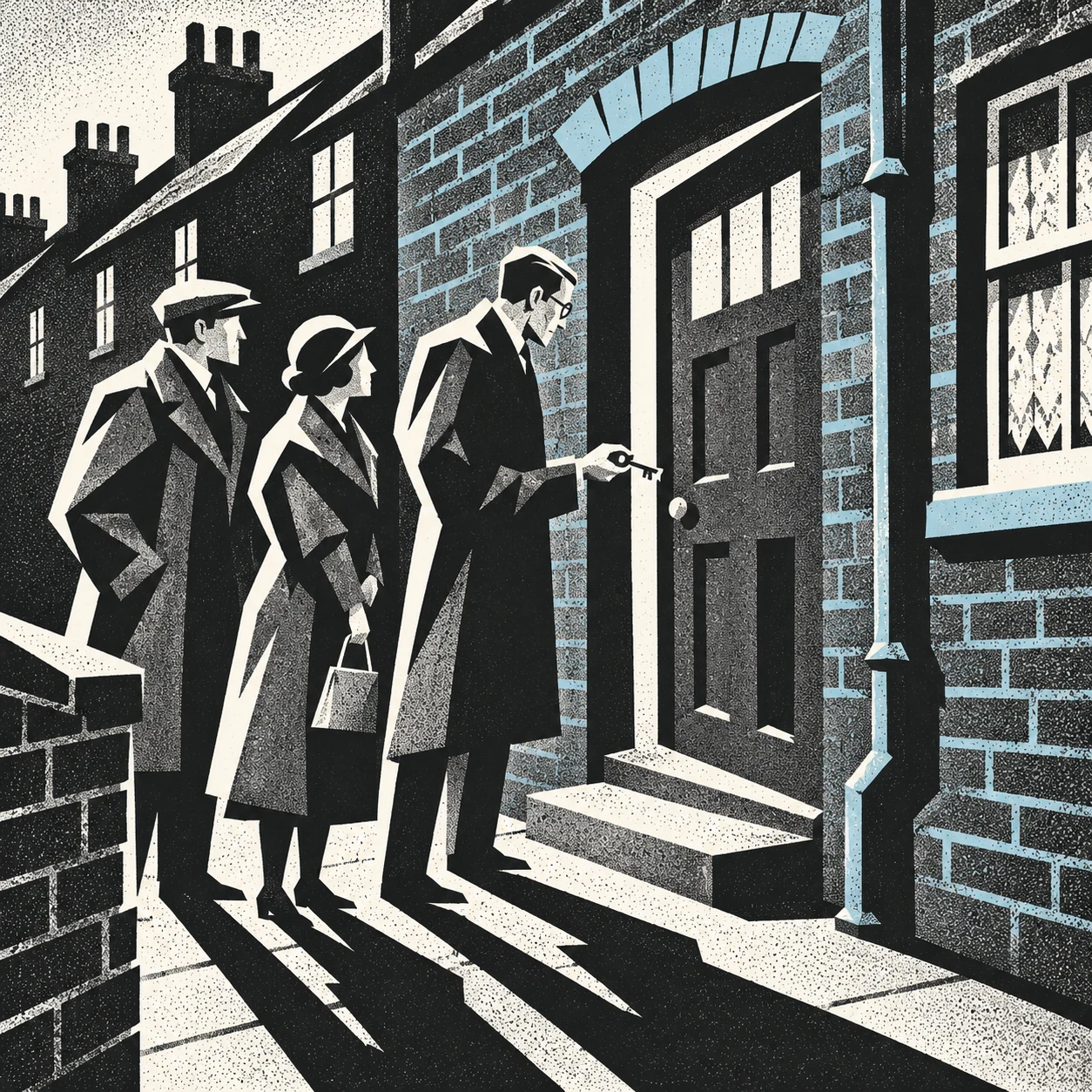
Eventually he gave up, since no customer had appeared and there was no house to wait at. He arrived back in Wolverton Street at about a quarter to nine and, in the passage behind the houses, met his next-door neighbours, John and Florence Johnston, and told them he could not get in.1
Behind the parlour door
The business with the doors could also be read in opposite ways. Wallace said he had tried both the front and the back, but with the Johnstons watching the back door opened, and he went in, found Julia in the front parlour and called the neighbours in. Suspicion later fixed on the timing, and on whether he had arranged an audience before revealing something he already knew was there.1
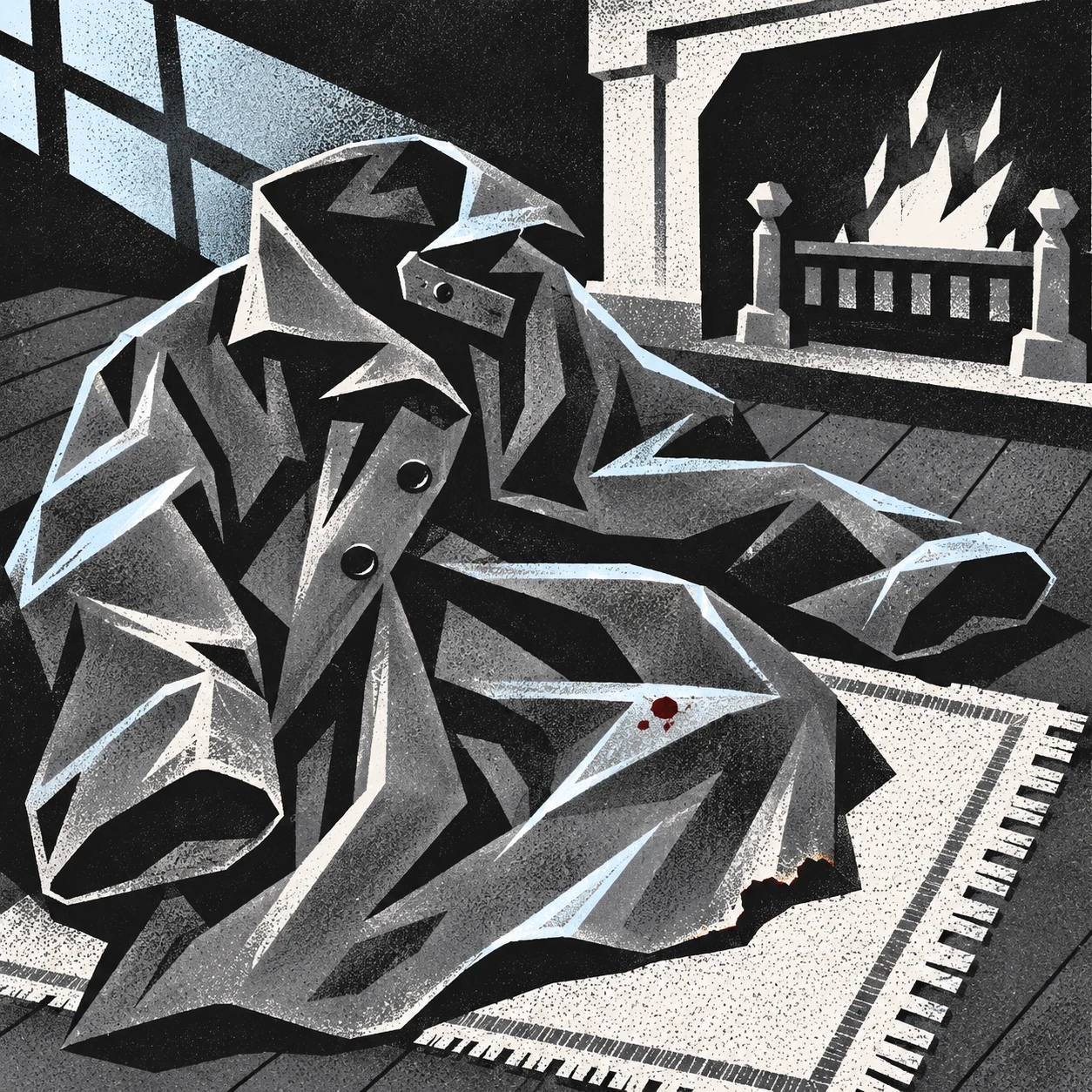
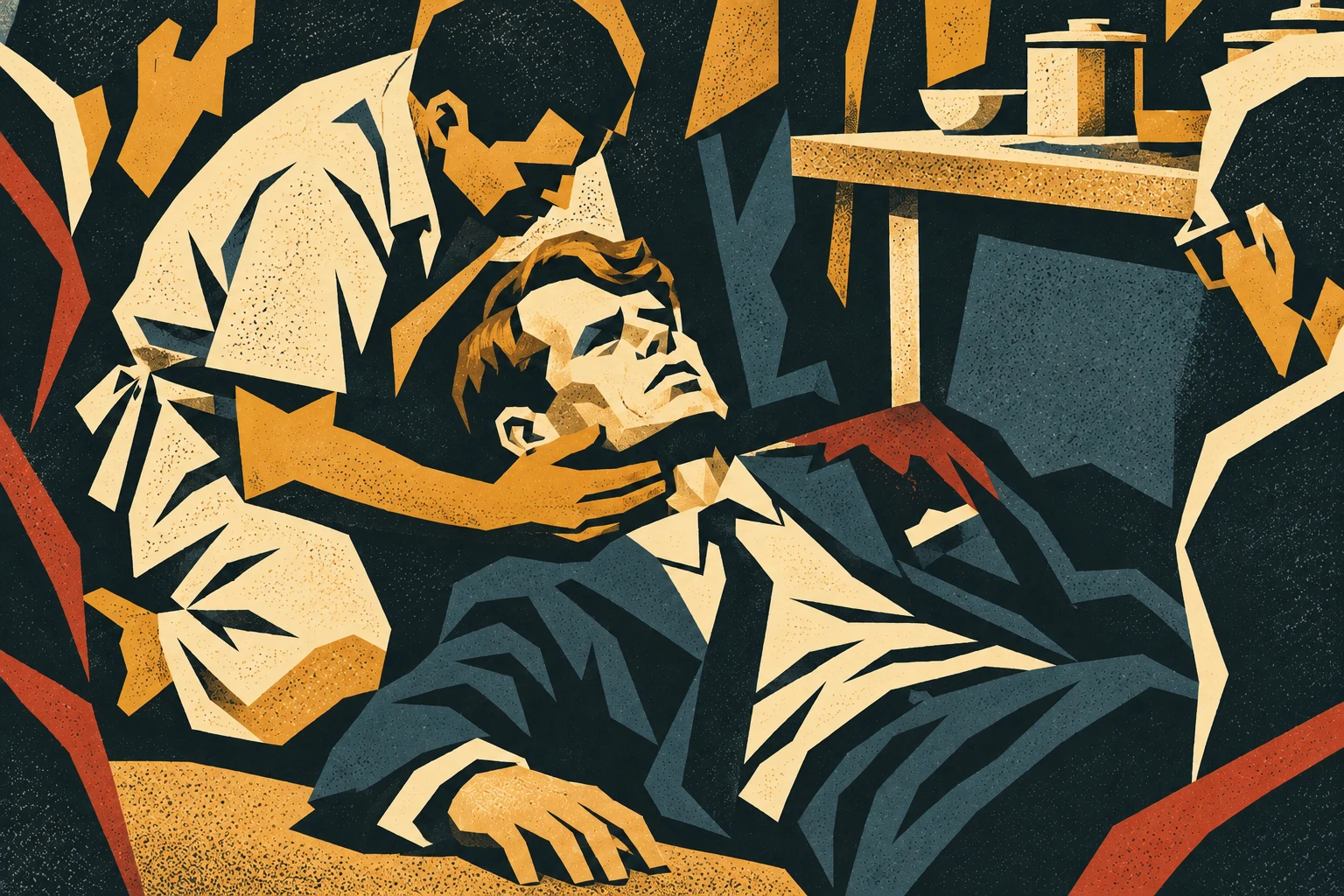
Nobody witnessed the attack. Julia had been struck repeatedly about the head and lay by the fireplace in a bloodstained room, and beneath part of her body was her husband’s mackintosh, partly burned, which would become central to every reconstruction of the crime. The coat was real, but how it got there was never agreed.1
Wallace reported that about four pounds was missing from the money he kept for his insurance work. Other money remained, including cash associated with Julia’s handbag. The house did not look systematically ransacked. That pattern encouraged the theory that a robbery had been staged, but it was equally consistent with a thief after one particular source of cash, or one who fled in alarm.1
The figure for the missing money came from Wallace himself; nobody else had counted it before and after the killing. If he was innocent, his information was essential to understanding a theft. If he was guilty, the reported loss could be part of the performance. The same doubt that hung over his journey now hung over the cash box.1
The violence offered no shortcut to a motive. The repeated blows have been read as pointing to personal hatred rather than an interrupted robbery, and a sustained attack can certainly invite that suspicion,1 but it cannot reveal the relationship between victim and attacker. Fear of being recognised, a sudden confrontation or a determination to kill could all lead to extreme violence, and none can be read from the number of blows.
The weapon was never found. The Wallaces’ charwoman described implements kept by the fire that she no longer saw, including an iron bar used for reaching underneath it. A missing household object could be significant, but no weapon was ever recovered that linked anyone to Julia’s injuries. The poker or bar that appears in later reconstructions was never an exhibit in court.12
Even the photographs need care. The police photographer Harry Hewitt Cooke admitted in court that a chair had been moved between two views of the parlour. That does not make the pictures useless. It does mean that no theory about the attacker’s movements can treat every chair in every photograph as a record of the same untouched moment.2
Nor was this a room that only Wallace could have entered. A locksmith described a worn front-door lock and a stiff, rusty back-door mechanism, witnesses disagreed about exactly how the back door behaved, and Julia could simply have let a visitor in. Despite its reputation, this was never a locked-room puzzle, only a question of who entered an ordinary house, how and when.2
What did investigators have? A murdered woman, a bloodstained room, a coat, a reported loss of money and an unknown caller; they had neither a witnessed attack nor a recovered murder weapon identifying the killer.1
Minutes that would not settle
The most important visit of the evening was an ordinary milk delivery. Alan Close knew Julia and said he had seen her at the house that evening. If she was alive shortly before Wallace left, the prosecution’s theory that he killed her before setting out had to fit into a very narrow window. Timing became one of the central battles of the case.1
The trial record gives Close’s age as fourteen, and it preserves how he arrived at his time. He said he had passed Holy Trinity Church when its clock showed twenty-five past six, then reached the Wallaces’ house about five minutes later. Under cross-examination, counsel took him step by step through the walk, his return to the dairy, the fresh milk and his other deliveries.2
That questioning matters more than any neat assertion that Julia was definitely alive at 6.45. Later accounts have treated the supporting evidence from other deliveries as fixing the sighting precisely.1 The testimony itself leaves room for argument about how long the sequence took. A boy may remember whom he saw more reliably than the exact minute he saw her.
Other young delivery workers were drawn into the argument, recalling the church clock, their own errands and their encounters with Close. Their accounts are useful checks, but no clock recorded the murder. Each witness saw one moment in a moving sequence, and the steps in between had to be reconstructed. A margin of five or ten minutes on paper can hide a good deal of uncertainty.1
The tram was another fixed point, though not an exact one. Phillips put his departure from the relevant junction at about 7.06 or 7.10, explaining that services were running late, and although 7.06 often hardens into a timestamp in later accounts, it was a working conductor’s recollection of a particular journey, given after the event.2
The police tested how quickly the first part of Wallace’s route could be covered, and Mark Russell’s history records pairs of officers setting off from Wolverton Street at different times for the stop in Smithdown Lane. Their times varied, so the experiment showed what was possible without showing that Wallace made the journey in the same time, in the same state.4
Nor did it measure everything else the prosecution needed him to do. A murder before he left required time for the attack, for whatever precautions kept his clothes free of blood and for handling the weapon. Shaving minutes off a tram journey could not establish how long those unwitnessed acts took. The whole argument depended on combining estimates, each of which could stretch or shrink the window.
Medical evidence might have settled it. Instead, opinions based on the state of Julia’s body gave the court one more disagreement. In his summing-up, the judge reviewed the conflicting evidence on rigor mortis and the blood, and the difficulty of drawing a useful time from either. The body did not fix a moment when Wallace could be placed beside it, or far away.2
Reading the trace: The milk delivery and tram journey constrain a reconstruction, but their disputed timings cannot be added together as though both came from a recording device.12
An early sighting gives Wallace more time before leaving; a later one gives him less; a death later still, while he was being seen in Allerton, would point to someone else. None of that tells us which starting point is right. The court’s task was to decide whether the evidence established a guilty sequence, not whether an ingenious one could be made to fit.

The case for the Crown
The prosecution’s case was economical. Wallace, it said, had invented Qualtrough, telephoned his own club, killed Julia and then made a pointless journey to make it look as if someone had lured him away. The phone box was close to his home and the message went to a place where he was expected, while the search produced witnesses and his return produced neighbours to watch him discover the body.1
It was a coherent account, and it had one great advantage over the theory of a random intruder: it connected the phone call to the murder. There was no need to imagine a stranger who somehow knew about both the insurance money and the chess fixtures. Wallace knew his own household and could decide for himself whether to keep the appointment. Every uncertain part of the plan became a choice under his control.1
The difficulty lay in getting from opportunity to proof. Nobody saw Wallace make the call. Beattie, who knew him, described the caller’s voice without recognising it as his. Wallace could have disguised his voice, but that was a proposal, not evidence. That he could have arranged the call did not show that he did, still less that he carried out the attack and left the house in the time available.1
The coat was supposed to explain why there was no blood on him. The prosecution suggested that he had stripped and worn the mackintosh while he attacked Julia, protecting the clothes in which witnesses later saw him. The defence offered another explanation: Julia had thrown the coat around her shoulders to answer the door. The appeal report records both.5
The coat beneath her body proved neither. Its burning could be linked to her contact with the fire, but no witness saw anyone put it on for an attack or take it off afterwards, and the image of a naked killer, vivid enough to dominate accounts of the trial, was never an observation.
Then there was motive. Writers have often invented a hostile marriage to explain what was otherwise hard to explain, leaning on Wallace’s reserve and Julia’s habits, but what neighbours, acquaintances and later writers said about the marriage is no window into the couple’s private life, and no motive was ever demonstrated.1
His manner attracted the same kind of attention. He seemed cold or oddly controlled after a brutal discovery, and to some his earlier fussing over directions looked theatrical. A guilty man can perform grief, and an innocent one can fail to show it in the way onlookers expect. Impressions like these may explain why a jury disbelieved him. They cannot take the place of evidence connecting him with the call or the blows.
None of this means that circumstantial cases are inherently weak, since indirect evidence can prove a crime beyond doubt when it rules out every reasonable alternative. Here, though, the disputed timings, the unidentified caller and the possibility that someone else was let into the house gave the defence a precise objection. The Crown had built a possible story about Wallace, but was it secure enough to hang him?
A verdict that would not stand
The trial opened at St George’s Hall in Liverpool on 22 April 1931. Three days later, the jury convicted Wallace and Mr Justice Wright sentenced him to death. Wallace had denied the charge throughout; there was no confession to settle the remaining doubts.25
His appeal was heard in London on 18 and 19 May. The court’s decision deserves to be read separately from the arguments that preceded it. Wallace’s counsel, Roland Oliver, criticised aspects of the prosecution and the police inquiry, but those were submissions made in an effort to overturn the verdict, not conclusions the judges adopted.5
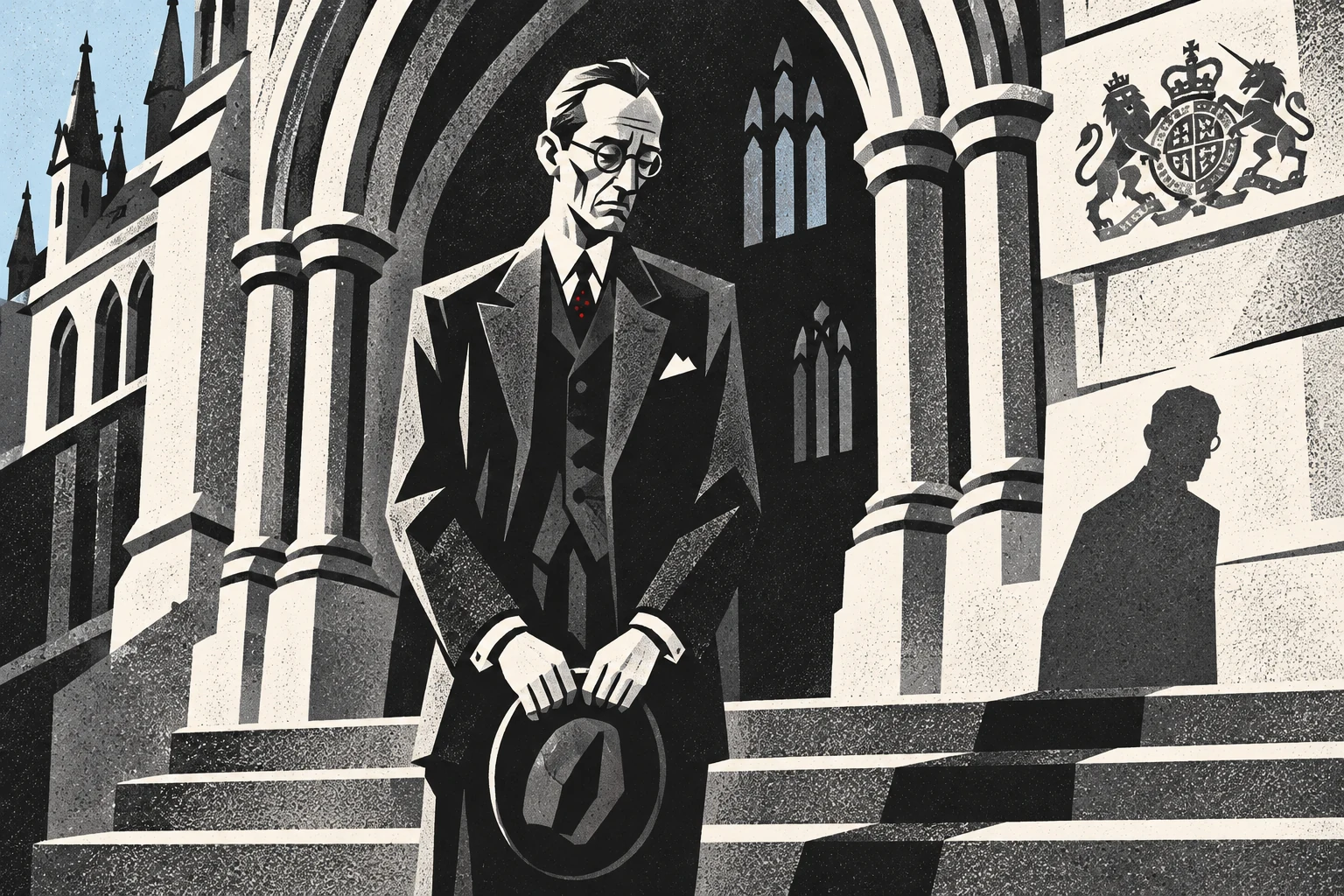
The Lord Chief Justice, Lord Hewart, called it a case of difficulty and doubt. He said the trial judge’s summing-up had been fair and accurate, and he rejected the suggestion that the police had behaved unfairly. The decisive question was whether the evidence was sufficient, not whether officers had manufactured a case.5
We are not concerned here with suspicion, however grave, or with theories, however ingenious.
The court quashed the conviction because the case had not been proved with the certainty a guilty verdict required, and Wallace walked free. The result is sometimes retold as a technical escape, as though a form had been filled in wrongly. The reason was more fundamental: the evidence could not safely support the verdict on which his death sentence rested.5
The appeal did not identify another killer, endorse any particular account of the evening or clear the unknown caller of violence. Wallace was no longer a convicted murderer. The question of what had happened in the parlour remained exactly where it was.
He died in February 1933, less than two years later. A remark he reportedly made on his deathbed to a member of his defence team has been read as a final riddle. It is tempting to ask a last sentence to reveal a man’s whole inner life, but a recollected remark cannot do what the trial evidence could not.1
The legal record left a firmer legacy than that, in a court refusing to let a compelling theory stand in for proof even after a jury had accepted it. For Julia, though, the reversal brought no answer, and whoever had attacked her was still unknown.
The man at the garage
Richard Gordon Parry offered an alternative with genuine links to the household. He had worked in insurance and had covered Wallace’s round when Wallace was ill. In a statement in January 1931, he described handing over cash, settling the books and visiting the house, where Julia had given him tea. He also knew that Wallace played chess at the café, because Parry rehearsed there with an amateur dramatic society.6
That made him far more relevant than a stranger picked from the neighbourhood. A former colleague would know that money passed through the house and could have a plausible reason to call. His visits to the café could explain how he knew about the chess fixture. None of that shows that he used either opportunity to commit a crime.
Parry’s movements have to be separated by day. Where he was on Monday evening bears on the phone call, and where he was on Tuesday bears on the killing. He could be ruled out of the parlour on Tuesday and still have made the call on Monday, or be innocent of both. Calling his alibi strong or weak without saying which evening is meant only muddies the question.
The statements of Olivia Brine and Harold Denison put Parry at Brine’s house for much of the Tuesday evening, until about half past eight. They are contemporary accounts, preserved in later reproductions, and they have to be weighed with everything else. They cannot be brushed aside because a later investigator thinks Parry fits the story well.7
Jonathan Goodman’s 1969 book, *The Killing of Julia Wallace*, helped make Parry central to the debate, under the name Mr X. Parry was not a late addition to the story: the police had questioned him in 1931. What came later was a new allegation about a man already connected with the case.13
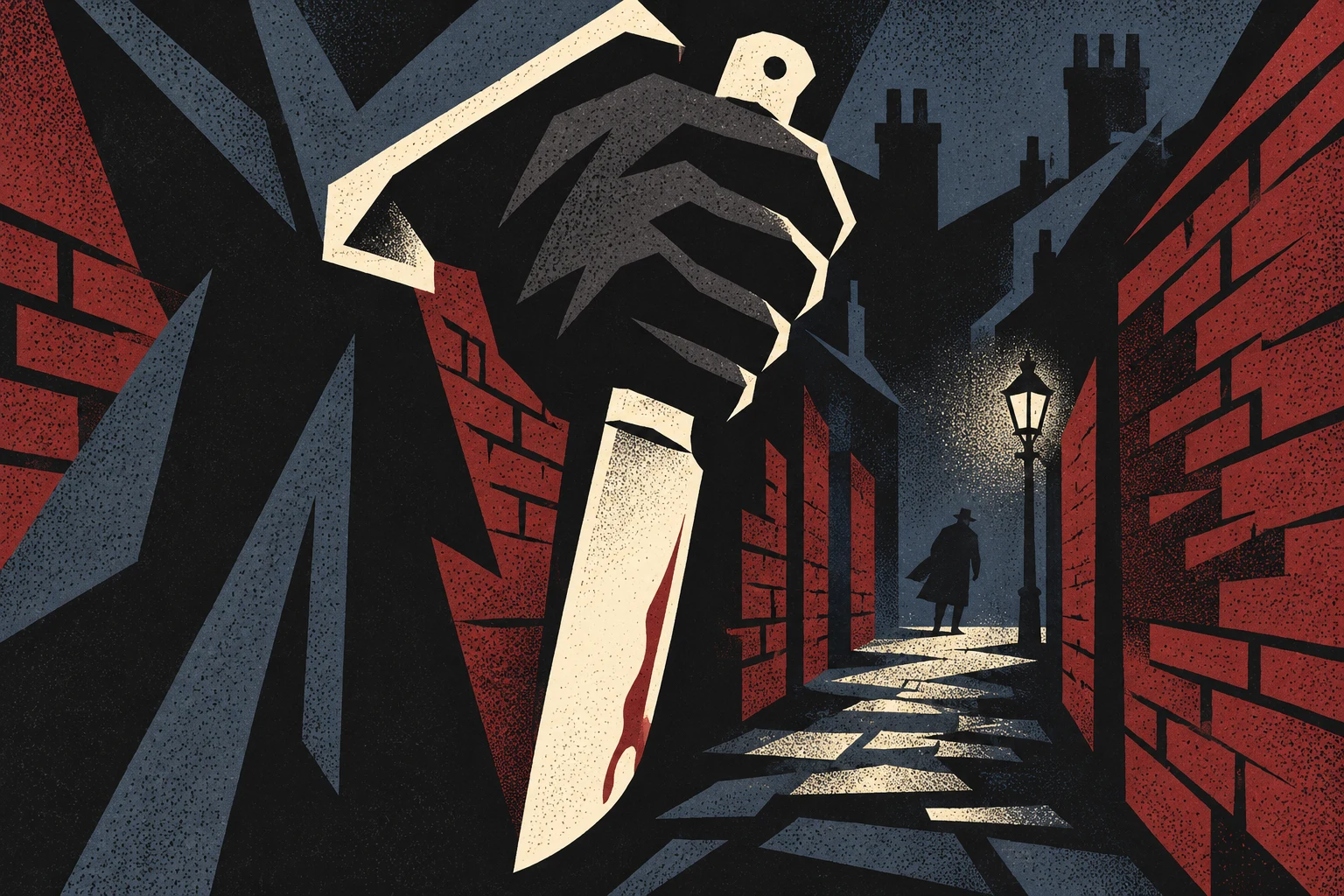
The most damaging claim surfaced in 1981, through Roger Wilkes’s investigation for Radio City. A garage worker, John Parkes, recalled Parry bringing in his car late on the night of the murder, or early the next morning, and demanding a thorough wash. Parkes said he found a bloodstained glove, that Parry made an incriminating remark about it and that he mentioned an iron bar dropped down a street drain.18
If accurate, that recollection would be explosive. A bloody glove and knowledge of a discarded bar could link a familiar visitor to the violence in Wolverton Street. But neither object was ever produced for forensic examination, and a stain that looked like blood is not proof that it was Julia’s. Everything rests on the reliability of a remembered encounter.
When Parkes first told the story is also more complicated than the date of the broadcast suggests. He claimed to have told others earlier: notes attributed to the interviewer, Mike Green, say he described telling members of the Atkinson family the next day. He also claimed the police had shown interest in the garage. The 1981 account is late evidence about an alleged early disclosure, not proof that he kept silent for fifty years.8
Some details are hard to reconcile. In the reproduced recollection, Parkes remembers learning that Wallace had already been charged before the car was washed, though the arrest came later. A muddle in an old memory would not make the whole encounter false. It would make it unsafe as a precise clock for the night of the murder.38
Parry was dead by the time of the broadcast. The accusation could draw on his old statements and on people who remembered him, but he could never answer Parkes. The garage story remains a serious historical allegation, with a gap that no amount of emphasis on Parry’s character can close.1

Too many solutions, one missing caller
One way around Parry’s Tuesday alibi is to give him an accomplice: Parry made the call while someone else went to the house looking for the insurance money. Antony M. Brown’s Cold Case Jury project presents that among its alternatives. It is a theory about dividing the work, not a second offender anyone has identified.9
It explains how someone involved in the diversion could be elsewhere during the attack. But it creates another person whose identity, entry, movements and connection to Parry all need evidence. Knowing the insurance business is not evidence of a partnership, and a theory that moves one man away from an awkward location still has to establish who was actually in the parlour.
Another accomplice theory gives Wallace the organising role, with someone else killing Julia while he gathered witnesses in Allerton. Lily Hall said she saw a man she identified as Wallace talking to another man near his home that evening. Such an encounter might bear on his movements. It does not make the other man a hired killer.1
In 2013, the novelist P. D. James proposed a different split. She suspected Wallace of the murder but believed the call was a malicious prank by Parry, which Wallace then exploited, so her theory separated the man who made the call from the man who struck the blows. Reporting at the time recorded both her confidence and the objections to her conclusion.10
James’s idea shows why unmasking Qualtrough would not necessarily solve the murder. A prank, a burglar’s diversion and a self-made alibi could all begin with the same phone call and part company only afterwards. Her account still has to establish what Wallace did, when, and how the coat was used. Changing the caller leaves all of that to be proved.
Other writers have turned to the neighbours who witnessed Wallace’s return. A much later allegation against John Johnston rested on an account of a supposed confession made decades after 1931, far more remote than the Johnstons’ evidence about the discovery. Knowing the house well would explain how someone got in. It is no evidence that Johnston did.1
It is tempting to choose whichever explanation makes the fewest details look like coincidence. A phone box near home points to Wallace, a pointless appointment points to a diversion and a bloody glove points to Parry, but these details have very different histories. The call was investigated in 1931, while the glove reaches us through a memory recorded half a century later, and they cannot be weighed as though they were equally secure.
As of 7 November 2026, nobody has established who killed Julia Wallace. The legal position is clear, since her husband’s conviction was quashed, but every claim to have solved the case remains a competing reconstruction. Later interviews and books have added material to examine, yet no recovered weapon, identified caller or proven sequence of events has settled it.15
A reliable link between any person and the Qualtrough call would be a major advance. Independent corroboration of the garage story would shift the balance against Parry. A contemporary record placing another visitor inside the house would change the story of Julia’s last evening. Each would answer one specific question, which is more than any complete imagined scenario has managed.
For all its fame as an impossible murder, the case rests on a simple fact. Someone went into the parlour in Wolverton Street and attacked Julia Wallace, and nothing about that was impossible. What the record lacks are the minutes inside the house, because it can put her husband on a tram and her neighbours at the back door, but not the killer in the room.
Linked case files


Sources10
- The Killing of Julia Wallace: An Impossible Murder The Unredacted · 2018-02-26 · Accessed 2026-11-07
- Rex v William Herbert Wallace: Liverpool Spring Assizes transcript Barnett, Lenton & Co shorthand record; later transcription by John Gannon · 1931-04-22 to1931-04-25 · Accessed 2026-11-07
- Chess and the Wallace Murder Case Edward Winter · 2007 onward; updated compilation · Accessed 2026-11-07
- Julia Wallace Murder Mark Russell / A History of Liverpool City Police · undated · Accessed 2026-11-07
- William Herbert Wallace, Court of Criminal Appeal:23Cr.App.R.32 Lord Hewart, Branson J and Hawke J; reported judgment · 1931-05-19 · Accessed 2026-11-07
- Richard Gordon Parry: full statements Richard Gordon Parry; reproduced courtesy of John Gannon · 1931-01-23; web reproduction2020-09-03 · Accessed 2026-11-07
- Olivia Brine and Harold Denison: full statements Olivia Alberta Brine and Harold English Denison; reproduced courtesy of John Gannon · 1931-01-26; web reproduction2020-09-03 · Accessed 2026-11-07
- John Parkes Radio City transcript John Parkes; interviewer Mike Green for Radio City; transcription Gerard Fagan · 1981interview; transcript posted2023-09-22 · Accessed 2026-11-07
- Move to Murder: proposed verdicts Antony M. Brown / Cold Case Jury · undated · Accessed 2026-11-07
- Book News: P.D. James Says She’s Solved a Real Murder Annalisa Quinn / NPR, republished by NHPR · 2013-10-29 · Accessed 2026-11-07