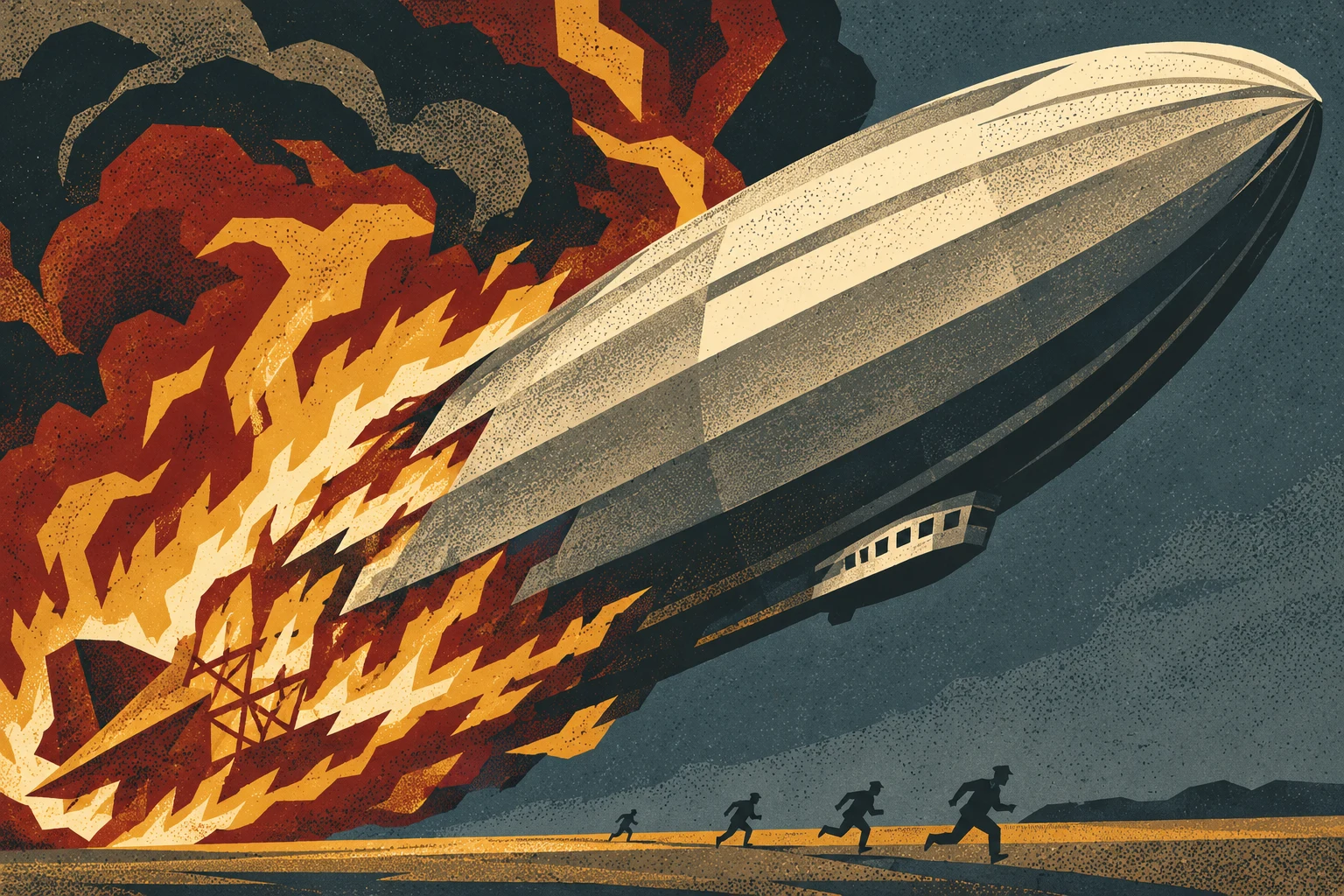
On the evening of 6 May 1937, as Hindenburg hovered over the landing field at Lakehurst, New Jersey, a man on the ground saw its silver skin ripple. Moments later the airship was burning. Within about half a minute, it had crashed onto the field.1
A liner held up by gas
Hindenburg arrived at the start of a new season of Atlantic crossings. It had left Frankfurt on 3 May with 36 passengers and 61 crew aboard. Headwinds slowed the westward passage, but the American investigation described the crossing as otherwise uneventful. The trouble began near the end, when bad weather kept the airship circling off the New Jersey coast.1
The ship had a formidable record. In 1936, its first year in service, the German report credited it with 55 flights, 34 ocean crossings and about 2,800 passengers carried without an accident. That record explained the confidence placed in it, and it sharpened the question afterwards: how could a vessel that had crossed the Atlantic so often burn while coming in to land?2
Its sheer size added to the puzzle. LZ 129, as its builders called it, was about 245 metres long. Inside the fabric covering stood a rigid framework of light metal girders, braced with wires and divided into compartments holding sixteen gas cells. Hydrogen supplied the lift; four diesel engines, in separate cars outside the hull, supplied the power. Passengers travelled inside the hull itself, not in a cabin slung beneath it.1
The silver exterior was not one big gas-tight balloon. The covering gave the ship its streamlined shape and protected what lay beneath. The hydrogen sat in separate cells inside, with space between the cells and the outer skin, so a leak could release gas into that space without tearing a visible hole in the silver surface. That layering would matter for what witnesses could and could not have seen.1
Passages ran through the framework, including a central corridor, and shafts allowed released gas to escape upwards. Officers in the control car could open valves to reduce lift, release water ballast to lighten the ship and shift weight along its length to keep it level. The airship’s apparent ease in the sky depended on a constant balancing act between buoyancy, weight, speed and the forces on its control surfaces.1
Those same systems could produce misleading evidence. Gas might be released deliberately during a normal manoeuvre, a crewman hurrying towards the bow might be obeying a trimming order rather than fleeing a leak, and a broken propeller in the wreckage might have shattered when it hit the ground. Investigators would have to establish the order of events before treating any damaged part as a cause.1
The airship’s certificate of airworthiness had been renewed in March 1937, with German authorities reporting that its safety devices had passed inspection. The certificate and the record of crossings said something about the ship’s condition and history. They could not prove that every cell, wire and electrical connection was sound at a particular moment during its last landing.1
Lakehurst was a naval air station equipped to handle such a ship, and that evening the ground party numbered 92 naval personnel and 139 civilians, most of them experienced in landing airships. A mooring mast, cables and winches would bring the liner down in a delicate operation, because people on the ground had to take control of an aircraft still floating far above them.1

The landing that kept moving
After reaching North America, Hindenburg flew south from Nova Scotia over the Boston area, Long Island Sound and New York before arriving at Lakehurst, but it could not land straight away. Thunderstorms had built up over New Jersey, so the ship spent several more hours cruising along the coast, and since it had been due that morning, every hour of delay squeezed the turnaround before the evening departure.1
The American report preserves the radio messages, so the wait can be followed almost minute by minute. At 4.42 pm Eastern Standard Time, the station advised waiting for further word. At 5.12 pm, it judged conditions suitable for an approach. At 6.08 pm, it recommended landing as soon as possible. Because the report uses standard time, its 6.25 pm fire is the familiar 7.25 pm in daylight saving time.1
That clock change explains a puzzle in many retellings, because accounts giving 6.25 and 7.25 are not describing different events or an uncertain hour, only using different clocks. The evidence contains plenty of genuine disagreements, about what individual witnesses saw and how much rain the airship met, but the hour is not one of them.1
At the field, the winds were light and changeable. The American weather account describes a shift in direction, low cloud and rain that was easing. Conditions varied with height as well as time, so the commander could not simply point the bow at the mast and hold his course. To land into the changing wind, Hindenburg had to alter its approach, turn and adjust its engines while the ground crew waited.1
According to the German reconstruction, the ship made a wide turn beyond the field, then altered course again as the wind swung round to the south-east. During the approach, water ballast was released from the stern and gas was valved from forward cells. Six men were sent forward because the ship was heavy at the tail. All of that is on record. Whether it revealed an unusual loss of lift at the rear became one of the key questions.2
The witnesses disagreed. Albert Sammt, the second in command, put the tail heaviness down to fuel consumption and said it caused little concern. Charles Rosendahl, the commander at Lakehurst, also thought it explicable in the conditions. Hugo Eckener, the leading Zeppelin authority, who gave evidence to the inquiry, thought the amount of trimming might point to something unusual. The inquiry recorded all three views and drew no diagnosis from the six men alone.1
As the airship slowed, the engines were reversed and then set to combinations of idling ahead and astern. The landing ropes dropped from the bow. The port rope was connected to the ground tackle and pulled taut; the starboard rope was in the hands of its landing party. The main bow cable had not yet reached the mast. Hindenburg was still an aircraft being manoeuvred into position, not a liner tied up at its berth.12
Several minutes passed between the ropes touching the ground and the fire, and that gap would prove almost as important as the ropes themselves. Contact with the wet ground offered a path for electrical charge. But any electrical explanation had to account for the delay. Why should a ship survive the moment of contact intact, and then ignite while the landing went on?12

A ripple before the fire
R. H. Ward was in charge of the port bow landing party. Shortly before the fire, he noticed movement in the covering high on the port side, towards the stern, in the region the American report places between frames 62 and 77, around gas cell 5, and described a wave-like flutter with no smoke and no split in the fabric.1
He thought gas escaping beneath the covering could explain it, and ruled out the slipstream of the propellers, which lay well below. R. W. Antrim, watching from the mooring mast, also reported loose, fluttering fabric behind the rear port engine. Their accounts offered something more specific than the general knowledge that the ship was full of hydrogen: a possible disturbance close to where the first flames would appear.1
Neither man could see through the covering. Ward was interpreting a movement on the surface, which fits the idea of a leak without revealing its size, how much gas had escaped or what caused it. Later diagrams often turn the theory of a snapped wire and a torn cell into a sequence that looks as though someone watched it happen.1
The first visible flames appeared high towards the rear, just ahead of the upper tail fin. Witnesses’ accounts differed. Combining descriptions with marked diagrams, the American board concluded that the first open flame most probably appeared above cells 4 and 5, and explained why witnesses might disagree: the vast hull, their different vantage points, the daylight and the sheer speed of events.1
Helmut Lau was inside the stern, near the lower fin, when he heard a muffled detonation and saw a bright glow inside cell 4. He told the investigators that the cell vanished in the heat and that the cells next to it caught fire. Lau did not claim to have seen where the fire started. But he saw what no one on the ground could: the disaster spreading through the inside of the ship.1
Others aboard first felt a jolt or vibration, and some thought a landing rope had snapped or the ship had struck something. First impressions like these are valuable records of experience, but they do not establish what happened, and the board distinguished the rapid combustion it believed began the disaster from the explosions that followed. A loud bang during the destruction did not prove that a bomb had started it.1
The fire raced forwards as the stern lost its lift, so the tail sank, the bow reared up and the frame cracked and collapsed. By the American estimate, about 32 seconds passed between the first glimpse of flame and the main body of the ship hitting the ground, though fabric, fuel and wreckage went on burning long after.1
Thirteen passengers, 22 crew members and one member of the ground party died. Sixty-two of the 97 people aboard survived, some badly injured. The figures blur when everyone aboard is called a passenger, or when the death on the ground is counted among those on the ship. That so many lived did not make the fire any less violent. It reflected how close to the ground the ship was when it burned, and how quickly people got out.1

Two boards, two sparks
An American aeronautical inspector was on the field when Hindenburg burned, and more investigators reached Lakehurst before midnight. Public hearings ran from 10 May to 28 May. German specialists took part as observers and witnesses, then carried out their own investigation and laboratory work. Both inquiries drew on weather records, photographs, films, wreckage and the testimony of people aboard and on the field.12
The comparative report compiled by R. W. Knight in 1938 remains a useful guide, setting the American findings beside an English translation of the German report. Knight warned that his commentary gave his own views, not his department’s, and drew attention to a difference between the two inquiries that disappears whenever the result is boiled down to a sentence about static electricity.3
Both boards put leaking hydrogen at the heart of the explanation. Hydrogen had to mix with air, and something had to supply enough energy to ignite the mixture. Treating those as separate requirements let investigators weigh possible causes of a leak against possible causes of ignition. A broken wire might tear a cell without producing a spark; a spark might be available without any gas beside it.12
Ordinary seepage through the cell fabric was judged too slow to build up the gas required, given the ventilation. A stuck valve was possible, but no persuasive testimony supported it. A fragment of the rear port propeller attracted attention, but examination and the engine mechanic’s evidence pointed to it breaking on impact. The broken part in the wreckage ended up weakening that theory of the leak.1
A bracing wire snapping and tearing a rear cell remained a serious possibility. It fitted the sharp turns, the flutter and a possible build-up of gas beneath the covering, and the German commission included it in its most probable reconstruction. The Americans accepted a leak near cells 4 and 5 without committing themselves to its cause. Neither board could reconstruct the whole chain of wire, tear and ignition.12
For the ignition, the Americans preferred a brush discharge, sometimes called St Elmo’s fire: an electrical discharge into the surrounding air that occurs when an electric field becomes strong enough. The Weather Bureau physicist W. J. Humphreys thought such a discharge might have occurred after the landing ropes reached the ground and lit the leaking hydrogen. He also explained why it might have gone unseen in daylight.1
The German commission preferred a different electrical path: a spark between the damp outer covering and the metal framework, as their electrical states changed at different rates. The wet ropes would have helped bring the metal frame towards the electrical potential of the ground, while damp patches of covering behaved differently, and under the right conditions a spark could jump the gap. German model experiments ignited a mixture of hydrogen and air this way, showing that the mechanism could work.2
The two theories belonged to the same family: both involved hydrogen and electricity, but the path of the spark differed. Experiments could show that each was feasible under recreated conditions. They could not recover the spark that actually flew at Lakehurst. Knight concluded that the true cause remained unknown, and the original reports themselves spoke of probability.123

The search for a saboteur
Sabotage was considered from the start. The German commission asked whether a device could have been smuggled aboard, or the ship attacked from outside. The American report examined both, including incendiary bullets and a planted device, and reached a clear conclusion.12
To date, there is no evidence to indicate that sabotage produced the grim result.
The German report did not claim to have ruled out deliberate destruction with certainty. It acknowledged that no cause had been completely proved, while judging an accidental combination of circumstances more probable. That stops short of declaring sabotage impossible, and equally short of treating it as just as likely as an accident. A possibility not excluded remained a possibility; it gained no physical evidence from gaps in the alternatives.2
The FBI’s released file shows how suspicion played out on the ground, as agents followed up leads and sat in on the hearings, watching for any federal crime within the bureau’s jurisdiction. A June report described a review of letters passed on by the Commerce Department inquiry, most of them theories from members of the public, and their presence in an official file proves only that someone sent them.4
Even footprints briefly became part of a criminal story. When the possibility of an intruder was raised, tracks leading into the reservation were photographed and cast in plaster. Further enquiries, according to the FBI file, identified them as the tracks of sightseers looking for a better view of the landing. The sinister clue had an ordinary explanation, and retellings that keep the clue but drop the explanation turn the evidence on its head.4
The most persistent suspicion fell on a passenger, Joseph Späh, whose name is spelled several ways in the documents, and Rosendahl asked the FBI to investigate him. The file records accounts, passed on through Eckener and members of the crew, of Späh visiting the area where dogs were carried and of an impression that he was an aloof, unsympathetic passenger. These were observations and allegations about his behaviour, and nobody found an incendiary device.4
The chain of hearsay matters, because an agent writing down what Rosendahl said Eckener had heard from crew members was not witnessing Späh commit sabotage. The file also records Rosendahl’s account of Eckener privately favouring sabotage despite his public position, an entry that is evidence of a reported conversation and of disagreement among experienced airship men, not a confession, a bomb plan or a recovered trigger.4
The FBI’s enquiries among Späh’s neighbours found that people who knew him thought well of him. Its closing summary noted that the Commerce Department investigation had found no direct evidence of sabotage and that the definite cause had not been established. A good reputation cannot account for everything a man did aboard a ship. Neither can visits to a restricted area, or another passenger’s dislike, supply the missing evidence of an attack.4
The politics of the moment help explain why sabotage seemed plausible. Hindenburg was a German prestige project flying under the Nazi regime, and the German commission had been appointed by Hermann Göring. Its destruction invited questions about the regime’s enemies and the reputation of its technology. The investigators’ institutional loyalties deserve scrutiny, but they are not evidence that two countries secretly agreed to hide a known saboteur.25
What would change the picture? A device reliably connected to the origin of the fire, a credible record of its being planted or independently corroborated evidence of a plan would all do so, but the surviving files show only suspicions and enquiries. Sabotage belongs in the history of the investigation, not as the answer to the fire.124

The recording and the replay
The disaster was soon something people could relive again and again. The radio reporter Herbert Morrison had come to Lakehurst with the recording engineer Charles Nehlsen, and his description was cut onto discs as the landing unfolded. It was not broadcast live: listeners heard the recording afterwards. That is easy to forget when the sound is laid over newsreel film, because the two together look like a single live transmission from the field.6
The recording is itself a physical survivor of the event. The National Archives describes a shallow groove where the shock jolted the cutting head of the portable recorder. Morrison’s voice and the machine’s stumble give the fire an extraordinary immediacy. They cannot reveal an unseen spark inside the hull or the identity of anyone responsible for it.7
The films have the same power and the same limits. They show an immense aircraft turning into a burning skeleton in seconds. But what most viewers see is a disaster already under way: by the time a fire is visible to a camera, it is releasing energy and changing the very structure under examination. Working backwards from those images to the first failure requires reconstruction, even where the later collapse can be followed frame by frame.12
The original boards combined films and photographs with the evidence of witnesses in different positions. An image could test a particular account of the ship’s attitude or the progress of the flames. It could not show the state of a sealed cell before the covering burned. The disaster was photographed from many angles, and its most important instant still went unrecorded.12
A different kind of replay took shape in books and films. In 1962, A. A. Hoehling’s book named the rigger Erich Spehl as a saboteur, linking his access to the ship, his amateur photography and alleged anti-Nazi connections to a possible bomb, an accusation made after the fact against a man who had died in the fire rather than a finding of the 1937 boards. Michael MacDonald Mooney’s later book and the 1975 feature film carried versions of the sabotage story to new audiences.5
The sabotage narrative ended up in a courtroom, though not a criminal one. In 1980, the United States Court of Appeals described the competing works and the theory they shared while deciding whether historical facts and hypotheses could be an author’s property. The court was not reinvestigating the disaster or judging Spehl. Its judgment is useful evidence of how the story spread, not a forensic endorsement of it.5
A named saboteur gives a disaster film what it needs: a motive, a plan and an act that explains the ending. The original reports offer something less satisfying, a probable leak and a likely electrical spark. The story’s dramatic completeness cannot supply the missing link between the accused man and the ignition, and a film’s invented ending should never be mistaken for another witness.125
The same caution applies to newly discovered material. Footage from another camera position might reveal an overlooked movement or refine a timing estimate. It does not become evidence of a bomb simply because the original investigators never saw it. What it shows, when it starts and how it fits with the other records all have to be established first.8

What burned, and what began it
One later theory changed the fuel. In a 1999 paper, Addison Bain and W. D. van Vorst argued that the airship’s covering, not the hydrogen, was responsible for the fire, putting the treatment of the outer skin at the centre of the explanation. It was a technical alternative to the conventional account, and quite separate from claims of sabotage.9
The covering was not bare cloth. The American inquiry described fabric treated with coats of Cellon and a material containing aluminium powder, with a red protective coating on the inside of the upper covering. Those details gave the coating theory something concrete to work with. The ship contained several combustible materials, and any convincing account had to distinguish what lit the fire, what spread it and what simply burned.1
It is perfectly possible to accept that the covering burned without concluding that it started the disaster. Once a mixture of hydrogen and air was alight, the fire could destroy the cell fabric and engulf neighbouring materials. Equally, showing that a piece of treated fabric can burn in a laboratory does not show that the spark available at Lakehurst could have lit it in the way required.110
In a detailed critique in 2004, the physicist A. J. Dessler tested the central claims of what became known as the incendiary-paint theory, challenging the energy attributed to the proposed spark, the direction it would have had to travel and the speed at which the coating could spread fire. He also rejected the comparison between the covering and solid rocket propellant or thermite, so his objections went to the mechanism itself, not just the appearance of the photographs.10
Dessler also explained why bright flames did not clear the hydrogen. Fabric and other materials caught up in a hydrogen fire could make it highly visible, so the argument that hydrogen burns with a faint flame could not show that it played no part in starting the fire. Dessler did not claim to have identified the exact ignition. He argued that the coating theory failed important physical tests.10
The 1937 investigators had already examined several other heat sources. Diesel exhausts, glowing particles, electrical wiring and the gas-pressure instruments all came under scrutiny, and testimony and experiments led both boards to give them little weight. The question was never simply whether a component could get hot. It was whether its heat could reach a flammable mixture in the right place, given the actual layout of engines, passages and cells.12
The radio equipment was investigated too. Hindenburg’s transmitters had been switched off before the fire, though a receiver was still in use, and a low-power transmitter on the ground was judged inadequate to cause ignition. The reports treated geometry, power and timing as real constraints, which separates a specific electrical accident from a vague claim that any nearby equipment could have been to blame.12
Neither the speed nor the colour of the fire settles the question alone. Any explanation also has to fit the flutter, the apparent origin towards the rear, the testimony from inside the ship and the delay after the ropes were dropped. A theory that explains one striking feature but not the others is incomplete. The hydrogen-leak account has lasted because it ties several kinds of evidence together, even though its exact starting conditions remain uncertain.123

Four minutes in a laboratory
In 2021, the PBS series *NOVA* returned to the gap between the airship’s covering and its frame. The chemical engineer Konstantinos Giapis built a model from fabric and a metal scaffold, investigated coatings and tested how rope behaved electrically. His work tackled a weakness in the simple grounding story: the fire did not start the moment the landing lines touched down.811
Caltech’s account reports sparks between a dampened covering and the grounded frame. Giapis proposed that grounding changed how much charge the system could store, so that it took time to build up again. He also suggested that sparks could have occurred in several places, instead of a single spark improbably finding the one leak. The result was a refined version of the electrical explanation, supported by experiments and calculations. It was not a new eyewitness.11
The programme also examined little-known film shot from a different position, which allowed parts of the approach and sequence to be checked against another view. The experiments and footage strengthened the case for an accidental electrical ignition without showing the lost moment itself. The video is now marked as expired on the PBS website, but the programme’s transcript remains available, and this account draws on it and on Caltech’s report.811
The 1937 investigators had run experiments too. The German report describes laboratory work on pressure instruments, exhaust particles and electrical ignition, including model tests that ignited a mixture of hydrogen and air. The American report included tests on a section of landing rope at different levels of humidity. The modern work is a fresh attack on an old physical problem, not the first.12
Every reconstruction has a limit, because a model requires choices about materials, spacing, moisture, voltage and gas concentration. A spark under those conditions shows what is possible, but calling it the historical spark requires showing that conditions aboard Hindenburg were the same, and much of the original fabric and the gas cells burned while other components were wrecked in the collapse. The object needed for a perfect repeat no longer exists.1211
The same limit applies to the broken-wire theory. Tight turns put stress on the structure, and a snapped wire could have torn a cell. But no surviving wire can be traced through a particular tear to a build-up of gas and then to ignition. The German reconstruction remains plausible without every step becoming fact, which leaves a useful engineering explanation instead of a crime falsely solved.12
As of 6 November 2026, the original reports and later research point to an accidental hydrogen fire with an electrical cause as the strongest explanation. They do not identify a saboteur, and they do not provide a complete, certain account of the first failure. The differing conclusions of the American and German boards still matter: agreeing on hydrogen and electricity was not agreeing on every link in the chain.12311
A new document, a physical find or a more precise model could still settle part of the story. Until then, the best clue to what happened before the flames remains the one R. H. Ward saw from the ground: a ripple running through the silver fabric above him, as if something beneath it had already given way.1
Linked case files


Sources11
- Report of Airship Hindenburg Accident Investigation United States Department of Commerce · 1937-07-21 · Accessed 2026-11-06
- Report of the German Investigation Commission German Investigation Commission; contemporary United States English translation · 1937 · Accessed 2026-11-06
- The Hindenburg Accident: A Comparative Digest of the Investigations and Findings R. W. Knight; Bureau of Air Commerce · 1938-08 · Accessed 2026-11-06
- Hindenburg, Part 3 of 4 Federal Bureau of Investigation · 1937 · Accessed 2026-11-06
- Hoehling v. Universal City Studios, 618 F.2d 972 United States Court of Appeals, Second Circuit · 1980-03-25 · Accessed 2026-11-06
- Crash of the Hindenburg: National Recording Registry essay Michael McCarthy / Library of Congress guest essay · undated · Accessed 2026-11-06
- National Archives sound preservation announcement United States National Archives · 2003 · Accessed 2026-11-06
- Hindenburg: The New Evidence NOVA / PBS · 2021-05-19 · Accessed 2026-11-06
- The Hindenburg tragedy revisited: the fatal flaw found Addison Bain and W. D. van Vorst; International Journal of Hydrogen Energy24(5),399–403 · 1999 · Accessed 2026-11-06
- The Hindenburg Hydrogen Fire: Fatal Flaws in the Addison Bain Incendiary-Paint Theory A. J. Dessler · 2004-06-03 · Accessed 2026-11-06
- History’s Mysteries: Caltech Professor Helps Solve Hindenburg Disaster Emily Velasco / Caltech · 2021-05-17 · Accessed 2026-11-06