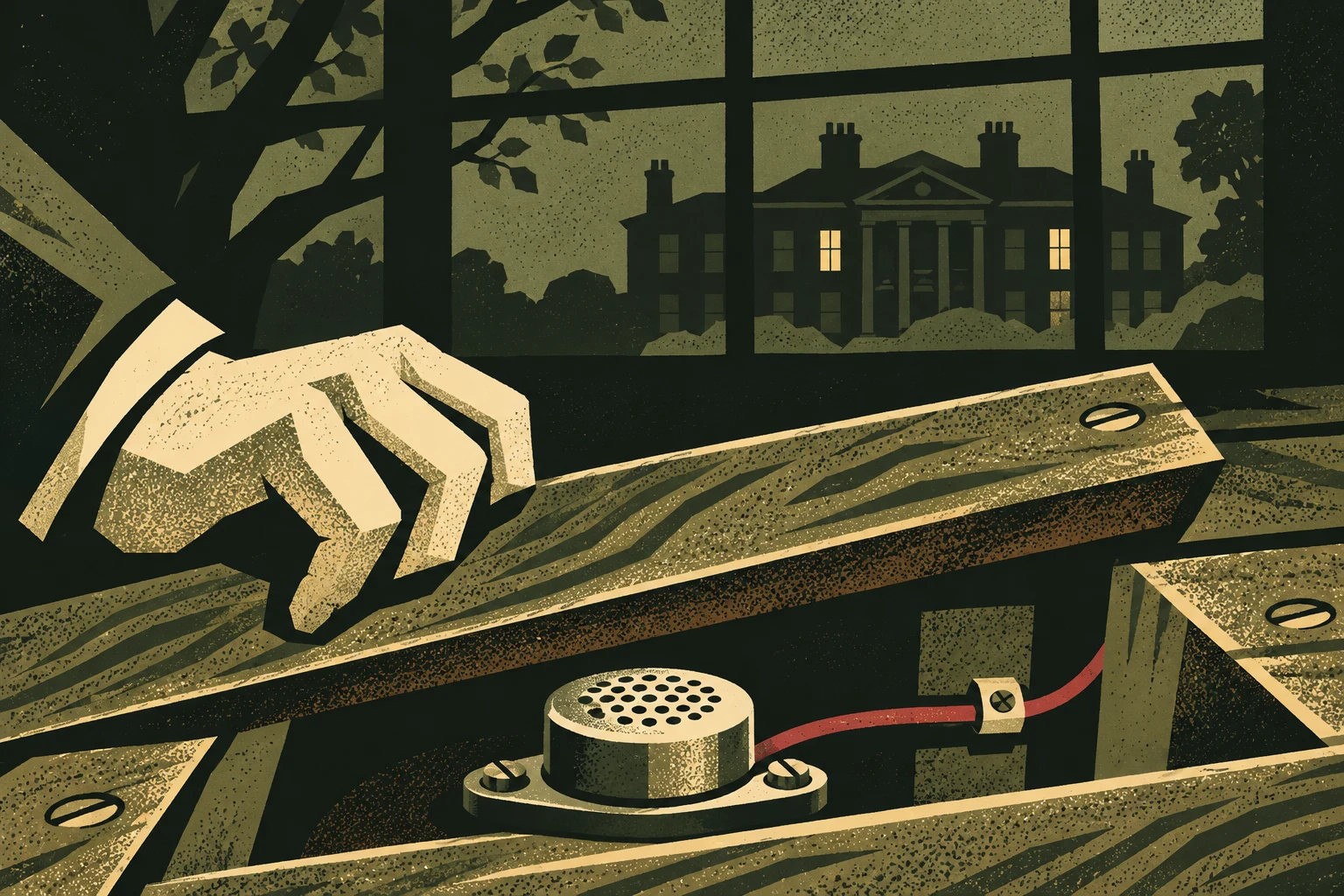
Before dinner on 6 August 1945, a British major took Otto Hahn aside at a country house near Huntingdon and told him the BBC had announced an atomic bombing. Hahn, whose work had helped reveal nuclear fission, was devastated. When he told the others, hidden microphones were listening.1
Ten guests who could not leave
Farm Hall, in Godmanchester, stood a comfortable distance from the wrecked laboratories its new occupants had left behind. The men arrived on 3 July 1945 and stayed until 3 January 1946, and although the British called them guests, free to talk, read and spend time together, they could not go home. Their host was an intelligence operation, and the house had been prepared to listen.12
The ten included Werner Heisenberg, one of the founders of quantum mechanics; Otto Hahn; and Max von Laue, a Nobel laureate who had opposed Nazi interference in physics. With them were Walther Gerlach, Paul Harteck, Kurt Diebner, Carl Friedrich von Weizsäcker, Karl Wirtz, Erich Bagge and Horst Korsching. Their scientific interests overlapped. Their wartime roles, politics and loyalties did not.6
This was not a gathering of ten interchangeable bomb designers. Some had directed or administered research, some had worked on the materials and processes needed to harness nuclear energy, and von Laue had stood apart from the core uranium work altogether. Holding them together made eavesdropping possible. It also tempted later readers to treat one man’s words as the confession of all ten.25
The operation grew out of Alsos, the Allied mission that followed the armies across Europe to investigate German nuclear research, with Colonel Boris Pash leading its military side and the Dutch-born physicist Samuel Goudsmit its scientific work. Captured scientists, equipment, uranium and papers could answer the question that had helped drive the Manhattan Project, which was how close Germany was to an atomic bomb, and the laboratories showed that Germany had fallen far behind.2
The Allies had good reason to fear the worst. German scientists had helped establish the physics of fission, and German forces controlled resources and research centres across occupied Europe. The absence of any visible explosion said nothing about what might be happening in a secret laboratory. Alsos was meant to replace fear with knowledge, and by the end of the war it was investigating a failed nuclear effort, not dismantling a finished German bomb.23
Even after Germany’s surrender, the scientists’ knowledge remained valuable, and so did their whereabouts, as the wartime alliance began to give way to rivalry over expertise and territory. Keeping the men together under British control allowed the Western Allies to question them, stop them returning to unrestricted work and listen for anything they might say only among colleagues.2
Diebner suspected as much, and in an early recorded exchange he asked Heisenberg whether the house might be bugged, but Heisenberg laughed it off with a joke about British methods. The exchange is often told as the perfect opening to a spy story, but it also shows that suspicion came in degrees, because at least one detainee thought surveillance possible, even though much of the surviving conversation sounds strikingly unguarded.5
Arguments between the men could reveal what formal interrogation might not. Colleagues who shared a professional future could also quarrel over who deserved credit, who had obstructed whom and who had misunderstood the science. Farm Hall brought all those tensions within range of the microphones. On 6 August, an event nobody at the house had planned gave the listeners their most revealing material.15

The reactor in the cellar
The German programme began investigating the military and technical potential of fission in 1939. The discovery itself had come from experiments by Hahn and Fritz Strassmann, interpreted physically by Lise Meitner and Otto Frisch. Meitner had fled Nazi Germany. That history undermines any story of a self-contained national school of physics simply handing its discoveries to the German state.510
Fission releases energy when a heavy atomic nucleus splits. It can also release neutrons that trigger further fissions, and a self-sustaining chain reaction needs enough of those neutrons to keep the process going instead of escaping or being absorbed. Researchers had to establish whether the reaction could be controlled, which materials would allow it and whether a different arrangement could release the energy explosively. Knowing the principle was a long way from having an industrial method.411
The Farm Hall reports use the word “engine” where we would say reactor. A reactor and a bomb were different goals, though reactor research had military implications: a working reactor could help produce a new explosive material, plutonium, while enriching uranium offered a second route to a weapon. Neither route opened just because a laboratory experiment produced more neutrons than it absorbed.511
German nuclear research continued after the military authorities decided in 1942 not to give it the enormous immediate commitment a wartime bomb would require. Heisenberg and his colleagues pursued experimental reactors, with rival groups doing related work elsewhere. The ambition was scaled back and redirected, but research went on until the regime collapsed. Accounts that say the project was simply cancelled miss that.34
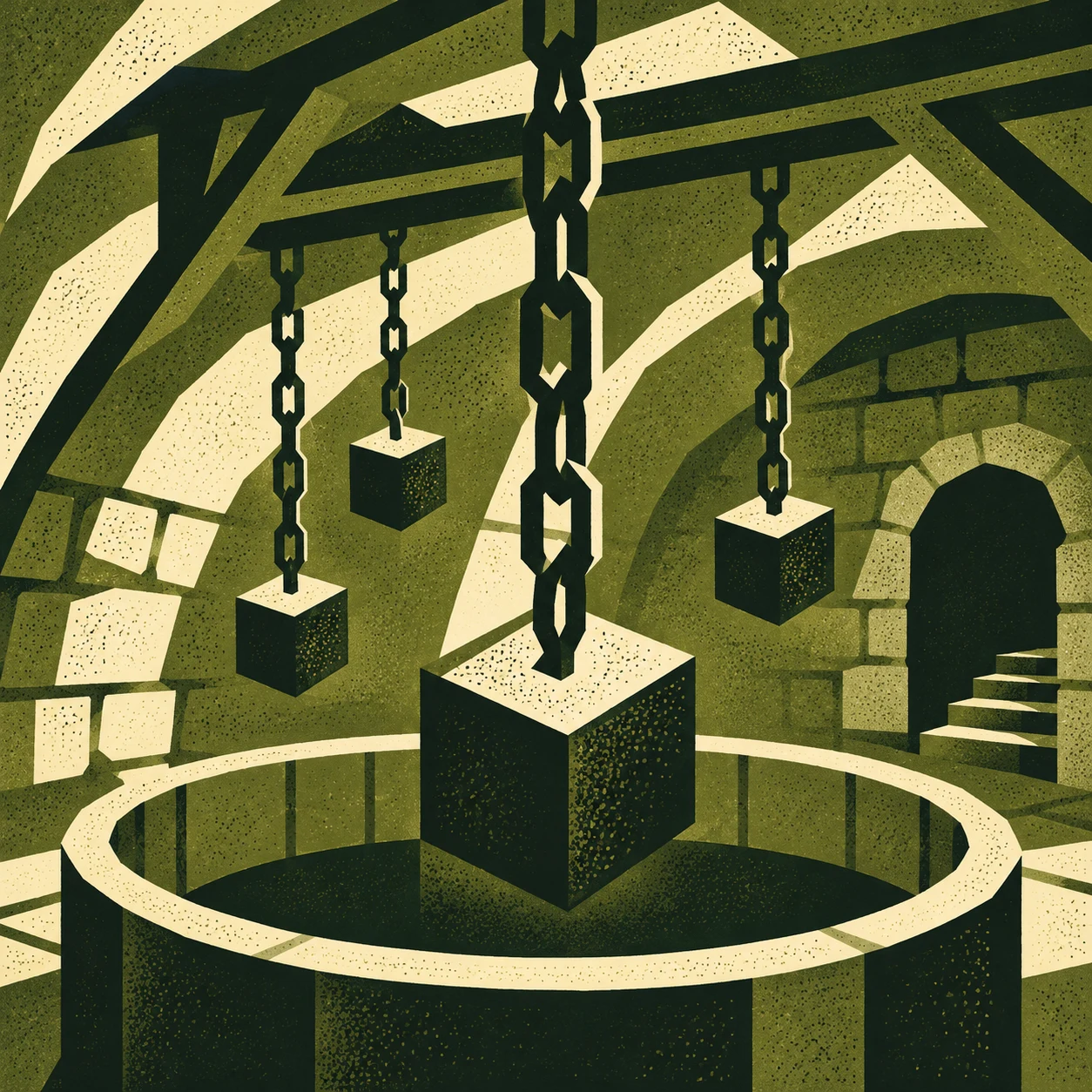
One of its last homes was a cellar beneath Haigerloch in south-western Germany. There, the B8 experiment suspended chains of uranium cubes in heavy water, surrounded by a reflector to reduce the loss of neutrons. The metal cubes and that strange underground apparatus are more solid evidence than any later claim about a scientist’s intentions. The experiment multiplied neutrons. It never achieved a self-sustaining chain reaction before American forces dismantled it in April 1945.11
Heavy water contains a heavier form of hydrogen and can slow neutrons without absorbing too many. German researchers depended on a limited supply, mainly from occupied Norway, and they also needed enough uranium in the right arrangement. Those were material and organisational problems that no amount of scientific prestige could solve. A celebrated theorist could not replace missing industrial capacity with a calculation.411
Even a working reactor would not have produced a usable bomb straight away, because weapon material would still have had to be made and processed, and a working weapon designed. The distance between those stages is crucial, so Germany’s failure to run a reactor shows where the programme stood, not a countdown measuring how many days remained before a bomb would otherwise have appeared.11
The Allied programme, by contrast, had achieved a self-sustaining reaction in Chicago in December 1942 and committed itself to immense production plants. Its success combined theoretical physics, engineering, chemistry, labour, money and political authority. At Farm Hall, the Germans would soon try to understand that combination, at first without knowing any of its details. Their captors had deliberately told them almost nothing.25
By 1945, the two programmes were unequal in achievement, but that does not explain why they diverged. A decision against a costly enterprise might reflect a realistic judgement, a mistaken estimate of the difficulty, a wish to protect other work or relief at avoiding a moral choice, and several of those motives could coexist. The recorded conversations are most valuable where the men themselves struggle to pull them apart.34
The broadcast at nine
The officer who broke the news was Major T. H. Rittner. According to his report, Hahn was deeply distressed and felt personally responsible, because his discovery had made such a weapon possible, and the report records how many deaths Hahn feared, which is evidence of his reaction, not a casualty count for Hiroshima.1
Hahn carried the news to the others, and their first response was disbelief, as they wondered whether the Americans could really have separated enough uranium, whether the weapon was genuinely atomic and whether an ordinary explosive had been misdescribed. Rittner’s report preserves theories proposed and abandoned as the men tried to square a radio announcement with everything they thought they knew, and they were not calmly recognising a secret, but trying to understand something that had already happened.15
Heisenberg at first thought the report might be bluff or a misunderstanding, while Hahn suggested that the Americans must have kept their achievement remarkably secret. Wirtz said he was glad Germany had not had such a weapon and Weizsäcker condemned its use, but Heisenberg replied that the bombing might end the war quickly, so technical astonishment and moral reaction ran through the conversation together.1
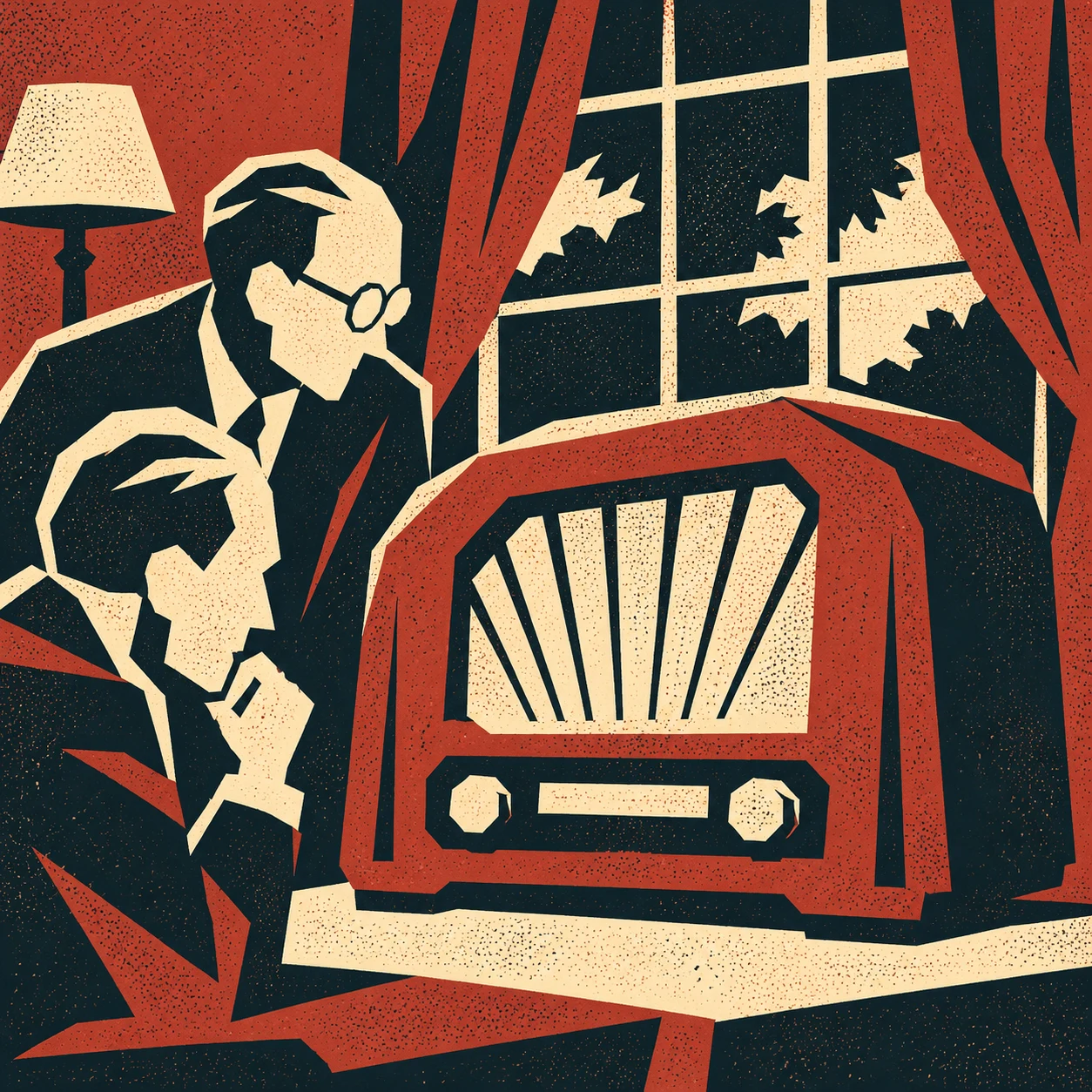
At nine o’clock, the men gathered to hear the official broadcast, which according to Rittner convinced them the report was true, and then they were left alone to talk. For the listeners the sequence was useful, giving them first a period in which the scientists still doubted the news and then a conversation among men who accepted that the Allies had built and used an atomic bomb.1
Their first explanations were about scale. Harteck considered how the Americans might have separated uranium isotopes in vast quantities, and the names of British and American researchers came up, some of them former colleagues. The Germans had known that nuclear work was possible abroad. What they had failed to grasp was its size, its success and how completely its results had been hidden from them.1
Korsching praised the Americans’ talent for cooperation and contrasted it with German rivalry, and Gerlach angrily rejected the criticism of the uranium group, an outburst that rules out any picture of unanimous hindsight. Even before they knew the full Allied story, the men were arguing about their own collaboration, so the defeated programme had several would-be historians in the same room.1
The conversation also exposed the weakness of the resources argument, because Germany had poured huge efforts into other weapons, and when Weizsäcker asked about the labour used on the V-1 and V-2 rockets, Diebner acknowledged its scale. That did not prove a nuclear programme of similar size would have succeeded, but it did leave “we lacked resources” incomplete until someone asked why nuclear work had been given lower priority.1
The scientists’ estimates of American staff and spending were guesses prompted by the news, not checked statistics. They had not toured Oak Ridge or Los Alamos. The report records what they imagined the Allied success must have required, and their attempts to reconstruct it show the limits of what they knew.15
Hahn’s reaction ran through the evening with particular force. He recognised the scientific achievement and was horrified by its destructive use, and neither feeling cancelled the other. His work had revealed a property of matter, and a vast military enterprise had turned it into a weapon. The microphones caught the personal burden he felt, without settling how responsibility should be divided between discoverer, builder and user.1
A calculation after the event
The most technically contentious material concerns Heisenberg’s understanding of how much fissile uranium an explosive chain reaction required. His early remarks on 6 August swung between very different quantities, and Hahn challenged him by recalling a much smaller estimate from earlier. The exchange sits awkwardly with the idea that Heisenberg arrived at Farm Hall with a fully worked-out, reliably remembered theory of the bomb.45
The physicist Jeremy Bernstein read the confusion as evidence that Heisenberg had never carried out a serious wartime calculation of the critical mass. His 1992 commentary distinguished between knowing that an atomic explosive was possible and understanding quantitatively how it would work.5
A later event complicates any claim of simple incapacity. On 14 August, Heisenberg gave his colleagues a lecture setting out a much better account of the bomb’s physics, showing that he could work through the problem once he knew the Allies had solved it. Supporters and critics agree the lecture matters, but they disagree about what it reveals about his knowledge before Hiroshima.46
There are several possibilities. A physicist might never have worked the problem through in detail, or might have made rough estimates and then forgotten or confused them after years of other work. He might have understood the principles but reached first for the wrong calculation, or he might have chosen what to reveal in captivity, and weighing them means testing each against the surviving work, not treating them as equally likely.45
Klaus Gottstein, who had worked at Heisenberg’s institute, examined the contradictory estimates in a 2016 defence of his former director. He accepted that Heisenberg had never completed a precise critical-mass calculation. In Gottstein’s reading, Heisenberg had concentrated on a reactor because a bomb seemed impracticable in wartime, and his rapid recovery after Hiroshima showed an ability that had simply not been pointed at a bomb before.4
That is quite different from saying Heisenberg secretly knew everything and lied. Gottstein considered a theory put forward by Carl H. Meyer, that Heisenberg might have hidden his knowledge to preserve its bargaining value, and offered a simpler explanation: the old estimates were no longer fresh in Heisenberg’s memory. Gottstein preferred the simpler account but would not rule out Meyer’s.4
The bargaining theory is easy to state and hard to prove. It asks us to infer deliberate concealment from remarks that confusion explains equally well. The lecture shows that Heisenberg could produce a better explanation after the news. It cannot date that explanation to a secret wartime discovery, or show that his earlier confusion was an act, and nothing in the record admits such a deception.45
The lack of a finished wartime bomb theory needs to be kept in proportion. It does not erase Heisenberg’s scientific achievements or prove general incompetence. A specialist can know that a technology is possible while misjudging how soon it could be built, and brilliance in quantum mechanics is no evidence that every hard nuclear calculation had already been done. Farm Hall supports a narrower judgement about one particular problem.4
On that problem, the record is clear. The Germans were not hearing confirmation of something they had mastered and chosen not to build. They were trying to understand how others had overtaken them. Exactly how Heisenberg’s estimates evolved remains a matter for technical historians, but the argument takes place inside a well-established gap in what the two sides had achieved.4511

Who wanted Germany to succeed?
The moral argument was sharper still. Weizsäcker proposed that the German physicists had failed because, at bottom, they had not wanted to make the bomb. Hahn rejected that at once, while saying he was grateful they had not succeeded. Retellings often merge the two positions, but being glad something did not happen is not the same as having stopped it.1
I don’t believe that but I am thankful we didn’t succeed.
Heisenberg said he was pleased that the work had concentrated on an engine. He also argued that relations between the Nazi state and its scientists would have made a vast undertaking difficult even if they had wanted one. Those remarks describe ambivalence and constraints. They describe no plan of obstruction, no agreement among the scientists and no act that stopped an otherwise imminent weapon.1
Gerlach reacted very differently. Rittner describes him retreating to his bedroom in distress while colleagues tried to comfort him, speaking of saving German physics and of the humiliation and danger awaiting them at home. When Hahn asked whether he was upset that Germany had not built the bomb, or that the Americans had done better, it was clear in Rittner’s account that scientific and national defeat had become painfully entangled.1
Gerlach denied wanting such a weapon, yet spoke of the political power its threat could bring. A man could fear the bomb, want German science to succeed and see atomic energy as a bargaining chip, all at once. The report will not let those attitudes be tidied into a single statement of opposition, and Gerlach’s distress should not be assigned to everyone else in the house.1
In private, Bagge directly challenged Weizsäcker’s claim to speak for them all. Weizsäcker himself, Bagge argued, might not have wanted success, but that did not describe the others. Bagge and Diebner also criticised Heisenberg’s leadership and the low priority given to isotope separation. The microphones preserved a disagreement that would vanish if the story were told only through the later public explanations of its most famous participants.1
The word “sabotage” does appear in the conversations, but not always as resistance to Hitler. Wirtz and Weizsäcker accused Gerlach and Diebner of undermining their work, a charge about rivalries inside the programme. Quoting the word without its speaker and target turns an accusation of professional obstruction into apparent evidence of an ethical campaign, which is the opposite of what the conversation shows.1
Rittner believed the men’s horror at the bomb’s destructive use was genuine. His view is worth reporting, but it is the view of the officer doing the listening. Distress could coexist with wounded pride, anxiety about release and a desire for useful work, and the reports record all of those pressures. They show scientists far more individual and inconsistent than either secret heroes or identical villains.1
The best-supported explanation for Germany’s failure needs no successful conspiracy within the programme. Research never became a properly supported weapons project; the technical and industrial obstacles remained; and the experimental reactor never worked. Individual reluctance may have shaped decisions, but making it the decisive cause would require evidence linking intention to action and outcome. Conversations held after defeat cannot provide that link.3411
The same limit applies in reverse. Showing that a public explanation served the speaker’s interests does not prove that every private expression of relief was false. Hahn’s gratitude, Heisenberg’s preference for reactor work and Gerlach’s concern for German science deserve to be weighed separately. The historical question is what these men did and understood under the Nazi regime, and a postwar remark can illuminate that without settling it.13
The history they began to write
By the next morning, Weizsäcker was already describing how he thought history would remember them. The British and Americans had built the bomb, he said, while Germans under Hitler had pursued peaceful reactor development. It neatly reversed the victors’ moral position. It also assumed that the German work had produced a working reactor, which it had not.111
There was another flaw: the Allies had built reactors as well as bombs. Weizsäcker was reasoning from incomplete information when he set German peaceful research against Allied destruction. His statement is valuable evidence of a story taking shape, but it is not an accurate summary of either programme, and it cannot show that German nuclear research had been kept free of military purpose.14
The historian Wolfgang Krieger, writing after the reports were released, saw the emerging story as an act of collective self-protection: a technically unsuccessful wartime group constructing a record of restraint that would serve its members in postwar German science. He stressed the gap between their bitter private arguments and the far more coherent picture later presented to the public, and his interpretation concerns their reputations as much as their research.3
Gottstein disputed key parts of that reading. He argued that the scientists had rightly judged a bomb impracticable in wartime and were relieved to work on a reactor instead, and he rejected the idea that Heisenberg and Weizsäcker had simply claimed moral superiority over their Allied colleagues. His account draws on personal acquaintance and technical argument, but it is openly a defence, and its sympathetic explanations deserve the same scrutiny as any accusation.4
The useful distinction is between abstaining and sabotaging. A researcher might decline to propose a huge weapons programme because it looked unrealistic. That decision might spare him a moral conflict and also reduce his government’s chances of getting the bomb, without amounting to an organised attempt to wreck an achievable programme. Much of the argument clears once the two are no longer treated as the same thing.34
The microphones also caught the men thinking about the future. Several hoped their knowledge would earn them work with Britain and America. They discussed the Soviet Union, whether it could build a bomb of its own and what American atomic power would mean for Europe. Their predictions were uncertain and sometimes wrong, but they show the detainees already placing themselves in the emerging postwar order.1
Their self-interest is part of the evidence. A wish to return to research can explain why a scientist stresses the value of reactors or presents himself as politically acceptable. That does not make every scientific statement made for that reason false. The task is to test each claim against laboratory records, surviving materials and other witnesses, with the circumstances of its making in mind.1311
Hahn’s later career shows how much that future mattered. According to the Max Planck Society, Max Planck wrote to him while he was detained, asking whether he would accept the presidency of the Kaiser Wilhelm Society. Hahn went on to lead its successor, the Max Planck Society. Postwar German science would be rebuilt by the same men, carrying both their expertise and their difficult histories into new institutions.10
Farm Hall did not end with the Hiroshima broadcast, because the men remained in detention through the autumn and into the new year. In 1945, Hahn was announced as the winner of the 1944 Nobel Prize in Chemistry, adding another contrast between scientific honour and captivity, and while none of that erases his recorded anguish, it places it within a continuing life instead of freezing him at the moment the news arrived.61012

A meeting without microphones
The argument over Heisenberg’s intentions reaches beyond Farm Hall to a conversation nobody recorded. In September 1941, he visited Niels Bohr in German-occupied Copenhagen. Heisenberg later described it as an attempt to raise the ethical and practical questions surrounding nuclear weapons with his old mentor, and the visit became central to the image of a physicist trying to prevent the bomb, not build it.47
Bohr remembered it differently. In February 2002, the Niels Bohr Archive released eleven documents, including unsent drafts and private notes written or dictated by Bohr, that challenged the version associated with Heisenberg and with Robert Jungk’s book *Brighter than a Thousand Suns*. The archive stressed that these were drafts and private records, mostly from the last years of Bohr’s life, never sent to Heisenberg.7
An unsent recollection written years later is powerful evidence of what Bohr believed had happened, not a transcript of what was said in 1941. But the fact that he never sent it does not make the disagreement go away. The documents rule out presenting Heisenberg’s version as one that both men accepted.7
Gottstein’s defence treats the meeting as a failed attempt to communicate under occupation and secrecy, in which Heisenberg approached the subject cautiously and Bohr misunderstood him. That is a serious interpretation with a named advocate and supporting recollections. It cannot be used to resolve every contradiction automatically in Heisenberg’s favour.4
Copenhagen matters here because the same moral story draws on both episodes. Farm Hall supplies recorded expressions of relief and reluctance, while Copenhagen supplies an earlier attempt to discuss restraint. Put together, they can look like a continuous campaign. The bridge between them still rests on disputed memories and inference, and neither a later statement of intent nor a failed conversation proves a coordinated wartime refusal.47
A more extravagant theory holds that the Farm Hall conversations were a performance staged for the microphones. Diebner’s early suspicion gives it a foothold, and the men knew their British hosts were assessing them, so some guarded speech is likely. The stronger claim, that the confusion, anger and private criticism were an organised act to deceive the listeners, needs evidence it does not have.15
The report contains a great deal that would make an awkward script for such a performance. Bagge disputes the claim of universal reluctance, Gerlach talks about national prestige and atomic leverage, and colleagues accuse one another of obstruction and opportunism. Some of the men may well have spoken strategically at times, but the record is hard to read as a seamless collective effort to manufacture innocence.1
The same caution applies to stories of a hidden, successful German bomb programme. Farm Hall could not capture everything done in wartime Germany, and the detainees did not know everything. But the gaps in the record are not evidence of a weapon missing from the captured programme. A claim of a German test or working device needs its own documents and physical evidence.211

What the listeners left behind
The record that reaches us has passed through other hands. British staff selected conversations, translated them and wrote reports for their superiors, and copies went to the US War Department through the British Embassy’s military attaché.8 Summaries sit beside passages presented as dialogue. The popular name, “the Farm Hall transcripts”, suggests a complete verbatim record in the original German. Most readers are consulting something else, as Charles Frank’s introduction to the published reports made clear.613
The original recordings are not available for anyone to check against the translated text. That limits any argument built on tone, hesitation or a single translated word. It also makes the officers’ choices visible: what counted as relevant, what could be summarised and where a conversation was reproduced in full. The reports are invaluable because of where they were made, but the listening operation is part of their authorship.513
For decades, their secrecy shaped the argument. Published accounts and memoirs circulated while the reports themselves stayed closed. In May 1993, the defence minister Archie Hamilton told Parliament that the documents had been withheld on grounds of national security, reviewed in 1992 and judged no longer sensitive. That is the documented official explanation for their release.9
The public record widened with the 1992 release and the editions that followed. The American Institute of Physics locates the American copies in the Manhattan Engineer District records at the US National Archives, and its guide distinguishes the various editions, including Bernstein’s annotated version and Frank’s presentation of the reports. Readers need to know which version they are using before attributing an editor’s explanatory sentence to a scientist in captivity.6
As of 6 November 2026, new research is still testing the laboratory story. A paper by Patrick Park and colleagues, published in *PNAS Nexus* on 29 September 2026, used surviving uranium cubes, archive records and computer modelling to reassess the Haigerloch experiment. The authors concluded that, in the modelled configuration, it would have needed roughly twice the uranium and more than twice the heavy water actually used to sustain a chain reaction.11
That finding undercuts the postwar suggestion that the experiment fell only slightly short. It is a technical reconstruction based on specified materials and assumptions, not a verdict on Heisenberg’s conscience, and it sharpens the contrast between what the scientists later said about how close they had come and what their apparatus could actually do.11
The central facts are firm. The ten men were detained and secretly recorded; the news from Hiroshima took them by surprise; and the German programme had produced neither an atomic bomb nor a working reactor. Their individual motives remain more tangled than their shared confinement. In Farm Hall, they argued over those motives before they knew which version of events would survive outside the house, and the most revealing passages are the ones in which they could not agree.111
Linked case files




Sources13
- Transcript of Surreptitiously Taped Conversations among German Nuclear Physicists at Farm Hall (6–7 August 1945) British intelligence; German History in Documents and Images · 1945-08-06/07 · Accessed 2026-11-06
- Alsos Mission Atomic Heritage Foundation / National Museum of Nuclear Science & History · 2014-06-05 · Accessed 2026-11-06
- The Germans and the Nuclear Question Wolfgang Krieger · 1995 · Accessed 2026-11-06
- Werner Heisenberg and the German Uranium Project (1939–1945): Myths and Facts Klaus Gottstein · 2016-09-09 · Accessed 2026-11-06
- The Farm Hall Transcripts: The German Scientists and the Bomb Jeremy Bernstein · 1992-08-13 · Accessed 2026-11-06
- Farm Hall Transcripts: Heisenberg Web Exhibit David C. Cassidy / American Institute of Physics · undated · Accessed 2026-11-06
- Release of documents relating to 1941 Bohr–Heisenberg meeting: introductory comments Finn Aaserud / Niels Bohr Archive · 2002-02-06 · Accessed 2026-11-06
- Operation Epsilon: the Farm Hall transcripts, 1945, collection record American Institute of Physics, Niels Bohr Library & Archives · undated · Accessed 2026-11-06
- Operation Epsilon: written answer Archie Hamilton / UK Parliament · 1993-05-06 · Accessed 2026-11-06
- Otto Hahn Max Planck Society · undated · Accessed 2026-11-06
- Nuclear archaeology reassesses Heisenberg’s last reactor experiment Patrick J. Park, Brittany Robertson, Miriam E. Hiebert, Jason Zhao, Ciara B. Sivels and Timothy W. Koeth · 2026-09-29 · Accessed 2026-11-06
- The Nobel Prize in Chemistry 1944 Nobel Prize Outreach · undated · Accessed 2026-11-06
- Farm Hall, 1945: extract from Charles Frank’s introduction Charles Frank; reproduced in Science, Politics and Drama programme · 1993; reprinted 2009 · Accessed 2026-11-06