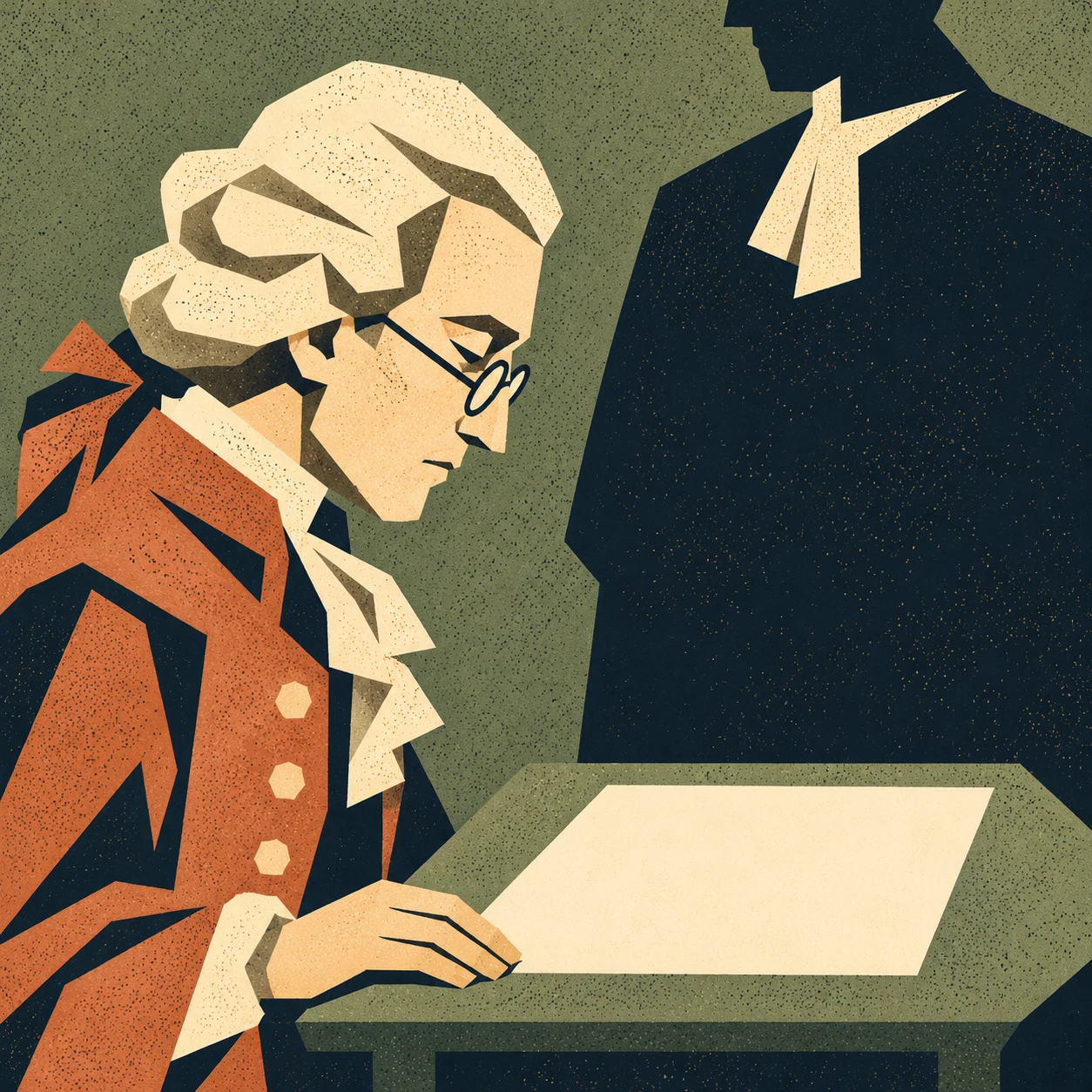
A recruit is seated before a sheet of paper and told to read it. He sees no writing. Spectacles are brought. Still nothing. His eyes are washed, and he is told an operation is necessary. For more than two centuries, nobody outside the society could read these instructions.5
A book without a reader
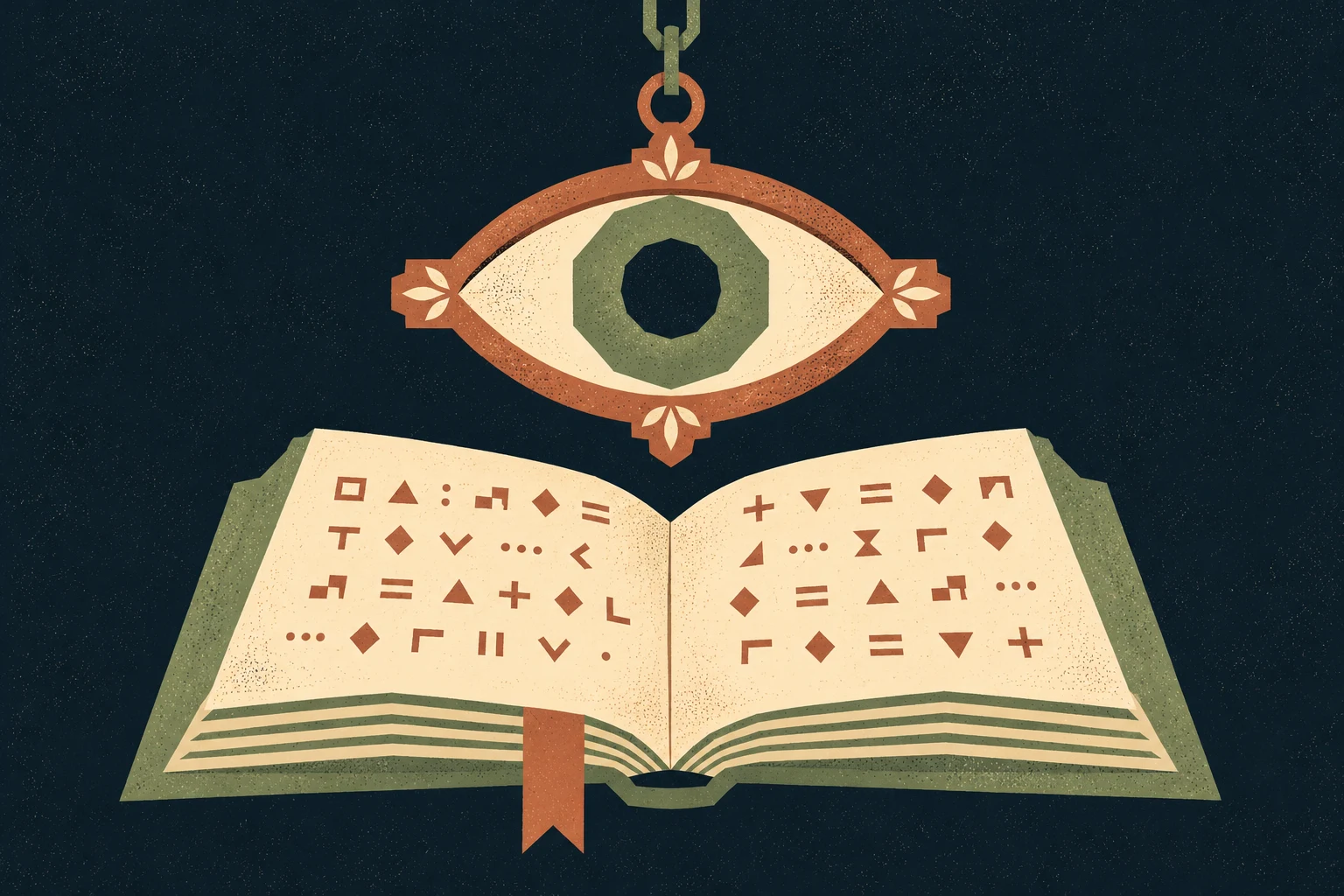
The book offered nothing to an uninvited reader. Across 105 pages, a careful hand had written roughly 75,000 characters, mixing ordinary letters with Greek forms, mathematical-looking marks and larger symbols that behaved like no ordinary writing. There were paragraphs, headings and punctuation but no spaces between words, so anyone could see it was a book, yet nobody could read a sentence of it.12
Its few unencrypted inscriptions were tantalising. One read “Philipp 1866” and another, near the end, read “Copiales 3”, which gave the manuscript its modern name, but neither is a reliable signature or date. The 1866 inscription has been read as an ownership mark on a manuscript a century older, so a name that looked like an answer turned out to be one more clue.1
Even its age is uncertain. Stockholm University’s project page describes a manuscript from around 1730. The researchers’ historical paper dates the physical volume to 1760–1780 from its materials, while the historian Andreas Önnerfors places the content in the 1740s. The estimates concern different things, the paper and binding, the act of copying and the rituals described, and none fixes a single year for the book.134
Breaking the cipher changed what could be asked, because the marks concealed German. The first section set out the initiation ceremonies and rules of the Highly Enlightened Society of the Oculists, an eighteenth-century fraternity associated with Wolfenbüttel in northern Germany, and much of the rest described Freemasonry, including its ceremonies, recognition signs and claims about higher degrees. The cipher was solved, but its historical setting was another matter.15
The breakthrough was a collaboration between Kevin Knight, a computer scientist at the University of Southern California, and the Uppsala University linguists Beáta Megyesi and Christiane Schaefer. They turned the handwriting into machine-readable data, tested hypotheses and used their knowledge of language to judge which results made sense. A technical account appeared in June 2011, and USC’s announcement on 25 October brought the work to a wide audience.26
Anyone expecting a lost prophecy would find the contents surprisingly personal. The opening pages regulate how a stranger enters a room, who takes his hand, what he must promise and which members may know what follows. The text keeps returning to other fraternities. A candidate already sworn to another society is questioned about his obligations: the Oculists want loyalty before they teach anything, and they do not trust a promise made elsewhere to be safely forgotten.5
That detail captures the atmosphere better than any talk of occult knowledge. This was a society afraid that a recruit might join under false pretences and carry its secrets back to his old brothers, and its answer was to make him renew his loyalty in stronger terms. He might belong to overlapping worlds, but the ceremony tried to settle which came first. The book’s secrecy concerns living relationships as much as unreadable marks on paper.
A rulebook has limits, though, because it describes what an institution wanted done, not how often the rules were followed, who attended a particular meeting or whether a doubtful recruit slipped through. Copiale gives close access to a prescribed ceremony, not a witness statement from everyone who went through it, and that matters most when the text turns to an operation.5

Letters that meant silence
Before anyone could read the ritual, the researchers had to work out which marks carried the message. The ordinary Roman letters looked like the obvious place to start, so their first approach treated the strange symbols as decoys and attacked the familiar letters, but it failed. The solution turned that assumption upside down, because the plain, unaccented Roman letters generally marked the breaks between words, while the unfamiliar symbols carried the German text. The most readable-looking marks were the ones doing the hiding.2
Several different symbols could stand for the same letter, a technique known as homophonic substitution. Other signs represented combinations of letters or whole words, and a colon could double the preceding consonant. The researchers recovered the system from patterns in neighbouring characters and their knowledge of German. It took both computation and interpretation: a computer could count recurring patterns, but it could not decide what a master’s hat meant in a secret society.27
An ordinary substitution puzzle helps explain it. If every E becomes the same symbol, its frequency gives it away. Give E several symbols, and that frequency is split between them. But all those symbols still keep similar company, because they replace the same letter. The giveaway is the company a sign keeps, not how often it appears, and that is how a neat page could hide a language while preserving enough structure for an investigator to work backwards.
The encoded spaces set a related trap. A reader used to gaps between words looks for separate units. In Copiale, a familiar-looking letter may be a boundary, not part of the word on either side; read it as a letter and both words are corrupted. Delete every such letter as meaningless, and the information about where words begin and end disappears with it. Dismissing the Roman letters as junk underrates the ingenuity of the system.
The manuscript’s own instructions show that the cipher was a skill to be earned, not decoration. Would-be masters had to show they could read and write it. Instruction was withheld until promotion had been agreed, and the rules forbade giving a learner a plain alphabet of the system. A member could take part at a lower rank without being able to read the society’s full constitution.5
That was a different kind of barrier from a locked door. Someone who got hold of the book might still be unable to use it, and a member taught only the signs of his own rank could not work out what the next degree involved. The script reinforced the hierarchy, handing out knowledge in stages. Its survival as an unreadable object extended the same arrangement, by accident, long after the teachers and learners were gone.
The larger symbols needed another step. These were logograms, signs standing for whole words, which the published German transcription labels as “master”, “society”, “eye” and so on. An early label resembling “lip” was only a convenient name for a shape, and did not mean the society worshipped a mouth. Once its context became clear, the sign was recognised as an eye, and linked to the Oculists.35
A real solution has to keep working beyond one promising phrase. In Copiale, the language runs on through administrative rules, elaborate questions and answers and long accounts of other rituals, and the solution opened all of them to comparison. It also explained the book’s most striking scene: a candidate asked to read a sheet with nothing on it, by people who know exactly why he will fail.5
The impossible eye test
The junior doorkeeper brings the candidate in from another room and leads him before the presiding master. The opening questions establish that he wishes to join, will submit to the society’s rules and will keep its secrets. Then comes the small action that opens proceedings: the master puts on his hat. Copiale records such movements because they tell everyone present that ordinary conversation has become lodge business.5
The candidate is handed to the master of ceremonies, beside a side table set with lights, instruments, spectacles, optical apparatus, a cloth and a glass of water. He sits and studies the blank sheet, and when he says he can see no writing, he is given spectacles and asked again, but they do not help. The master of ceremonies offers comfort and hope, washes the candidate’s eyes and announces that an operation is required.5
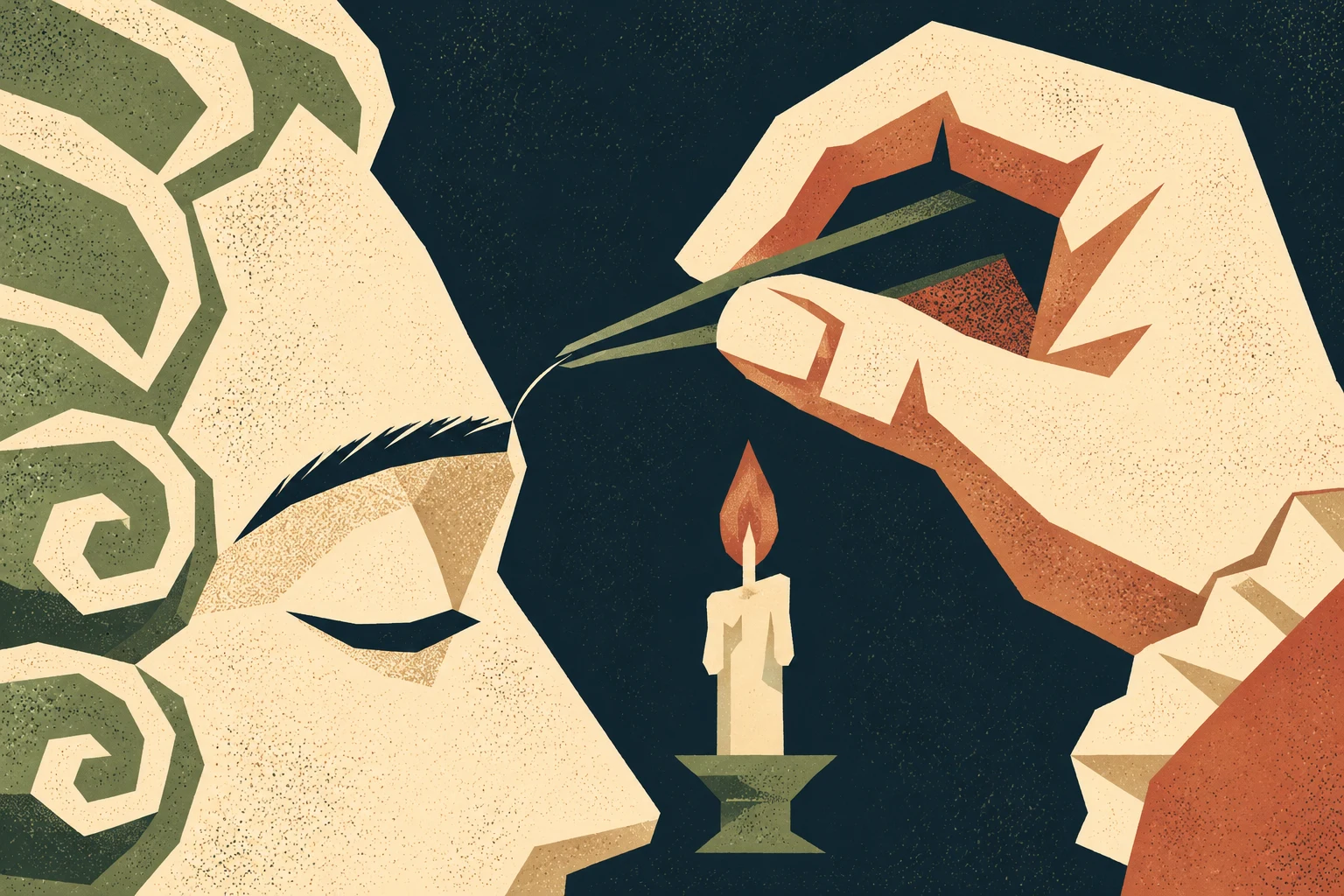
Stop there and it sounds alarming, but the next page explains what the operation involves. The members take up the lights and gather round, and with a small pair of tweezers the master of ceremonies plucks a single hair from the candidate’s eyebrow. That is the whole operation, with no cutting of the eye, no removal of a lens and no treatment for cataracts, and the solemn sequence of failed remedies builds to an ordeal far smaller than its medical language suggests.5
Here the book corrects its own sensational reputation. A ceremony centred on eyes can be described as an eye operation, and the early publicity dwelt on ophthalmology, but the passage is a staged admission ritual whose meaning lies in the transformation it enacts, not in a surgical technique. No real test of sight is involved, because a blank page guarantees failure.5
The master then warns the candidate not to dismiss the society because its ceremonies seem frivolous, and tells him to look beyond their outward form to what they signify. The scene could be comic and coercive at once: a group sets an impossible task, surrounds the newcomer and inflicts a token discomfort before explaining that he has misunderstood. Copiale prescribes the words and actions. It does not record whether a particular recruit laughed, feared for his eyes or left unconvinced.5
The candidate then places his right hand on the eye worn at the master’s neck and repeats an oath read by the secretary. He promises to reveal only what he is permitted to reveal, and to join no other secret society without special permission. The oath extends to present and future members, whatever their nation. The penalty is public disgrace: if he breaks his word, he accepts being declared a dishonour to his sex and to all respectable society.5
Only then does the blank page change. The secretary has replaced it with the apprentice’s instructions, so the recruit can now find writing where there was none, an effect that depends on a simple substitution by the people controlling the lesson. It is a neat piece of ritual theatre about access to knowledge, in which the society does not merely claim to open eyes but decides when there will be something to see.5
The written instructions are not meant to be kept. Copiale directs that they be torn up before the lodge closes, which the master signals by taking off his hat, so instruction, oath and the destruction of the paper form one sequence, and the new member leaves with knowledge and obligations while the sheet that conferred them disappears.5
A gesture across the room
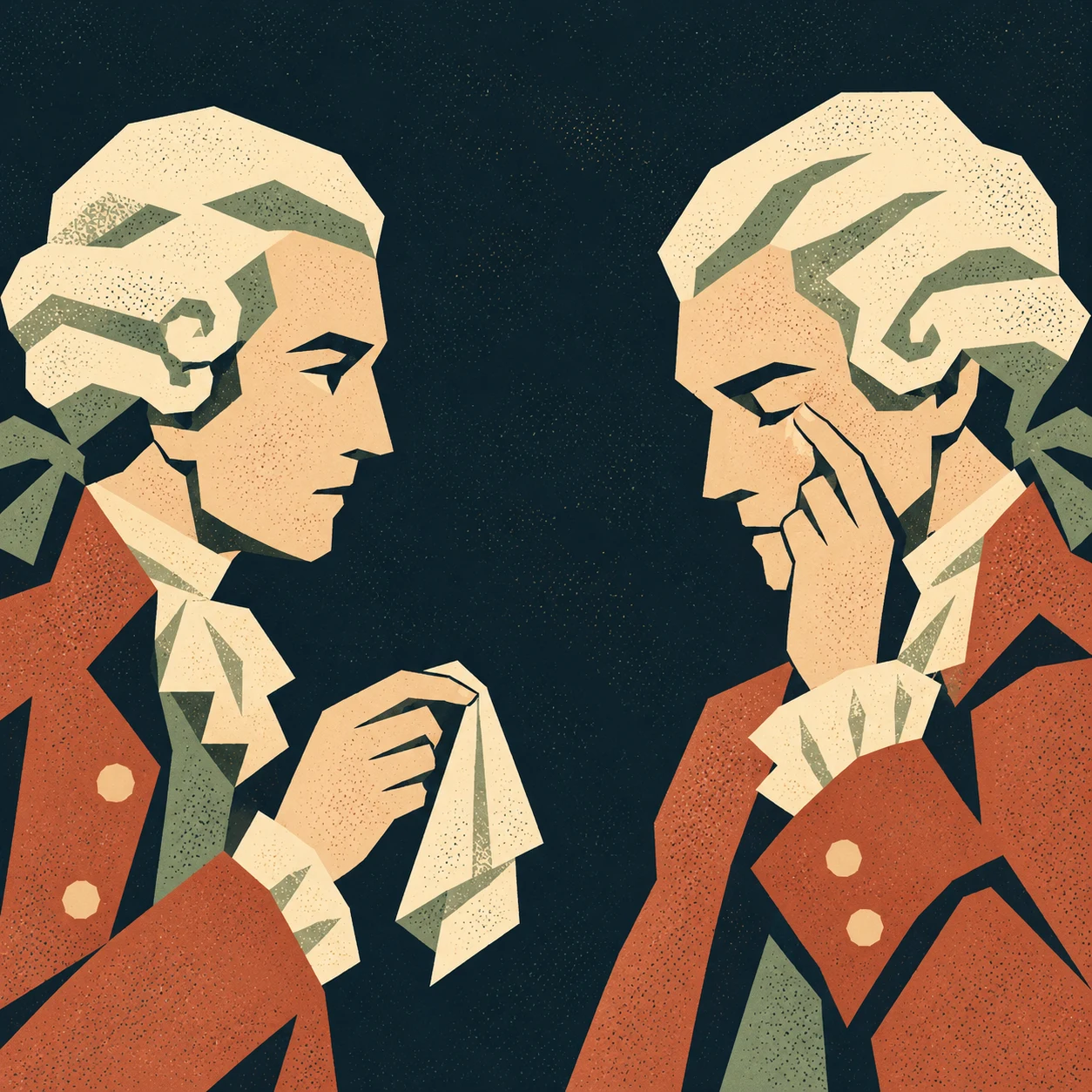
Next, the apprentice must learn to recognise a fellow member. Copiale prescribes actions that could pass for ordinary behaviour. One person turns his head left and then right, as if looking for something, and the answer involves a handkerchief and a glance. Another moves one hand while keeping the other still, and the reply uses the opposite hand. A pinch of snuff taken with particular fingers of the left hand is answered by touching the left eye.5
These are paired signals, not a universal badge, and a gesture means something only when it receives the right answer. The instructions distinguish each question from its response and allow the order to vary, and the exchange is meant to be mutual, so that one member does not keep asking while the other gives nothing back. Each participant has to show some knowledge before extracting more from the other.5
One correct movement is not enough, because a brother identifying himself must be able to describe his initiation and name those who were present. That adds a human check to the physical signals, since an impostor who had copied a hand movement would still have to give a believable account of his admission. It also reveals a weakness, because knowledge of the ceremony and of real members would serve an intruder far better than a picturesque emblem.5
The instructions even cover blunders in mixed company. If strangers are present and a member says or does something careless, the correct response is an apparently casual remark that the matter is already known, which in context is a warning. The book is concerned with practical concealment in social situations, not just silence behind a guarded door. Members were expected to move between lodge life and company that must never suspect lodge business was going on.5
Promotion brought more elaborate tests. For a fellow, touching the right eye is answered by a movement down the same side of the neck. Questions about how long someone took to learn his knowledge, or what time it is, are answered by counting the signs already exchanged, so the correct number depends on the conversation that has just taken place. An eavesdropper hearing only the final answer would miss the rule behind it.5
The instructions insist on order. Nobody should be tested as a fellow before answering the apprentice’s questions correctly, or recognised as a fellow without knowing the whole ceremony of that promotion. The document builds a ladder of proof, though not one that would satisfy a modern investigator. Each level had to be demonstrated before the next was even mentioned.5
The master’s sign moves into conversation. One participant mentions a brother called Hans, the reply introduces Anthon, and the next speaker offers Nicolaus, then Sebastian, each new name beginning with the second letter of the one before. The exchange sounds like ordinary talk about acquaintances while quietly proving that both speakers know a shared rule, and because the example survives in the decoded text, the mechanism can be checked, not guessed from a modern retelling.5
These rules also show how little the manuscript can tell us about everyday life. It supplies scripts for secrecy, including ways to spot hesitation and disguise a warning, but cannot show how often two members actually used them in a crowded room. That would take letters, membership lists or reports of real encounters. The rulebook reveals what the organisers feared and valued, while most of the people who followed it remain unnamed.
Who earned the hat?
Rank was policed inside the society as well as outside it. An apprentice seeking promotion was questioned again about his loyalty and about joining other fraternities, and an unsatisfactory answer could bar him from ever becoming a fellow. A successful candidate renewed his oath with his hand on the master’s eye emblem and promised not to reveal a fellow’s teaching even to an apprentice. Secrecy divided members of the same lodge.5
At the master’s degree, the candidate’s trustworthiness was again put to the assembled members, and only with their approval did he move on to a practical demonstration: showing that he could read and write the society’s cipher. Here the medical vocabulary gives way to a very specific skill. Whatever else a “light hand” might mean, the manuscript makes literacy in the cipher a condition of authority.5
The new master received the master’s ornaments and hat, heard the meaning of the society’s seal explained and was taught what the text calls its true secret. With promotion came permission to make selected notes in cipher. Even then, he could not own every document: a complete copy of the secret constitution was reserved for an authorised master with the relevant powers. An ordinary master could copy the sections he needed, and each lodge was to have no more than one copy.5
The authorised master had to produce a sealed diploma proving his right to found and close lodges, admit candidates and grant promotion. In Copiale, authority travels through recognised documents as well as knowledge. The diploma proves that its bearer can act for the organisation, not merely that he has learned its signs.5
The constitution is revealing about Freemasons. They could join the Oculists as apprentices and fellows, but the rules forbade their promotion to master, and that ban was to be kept from them. A Mason could be welcomed into the lower ranks without being told that his membership elsewhere had permanently blocked his advance. The society’s layered teaching protected a rule that some of its own members were never meant to discover.5
A master also had to hide the society’s interest in the Masons, even from fellows. The awkwardness is deliberate. Members knew enough to take part while being kept in the dark about a large part of the programme. On the manuscript’s own terms, there was no single Oculist belief shared equally by every member. What a man understood depended on how far he had risen and what the organisers chose to tell him.5
Recruitment depended on another claimed expertise. Fellows were told to study the eyes of people they met and infer their characters, so the lodge could build a portrait of each potential recruit, and Copiale presents this as a way of judging suitability. It offers no evidence that anyone’s moral character can be read in their eyes, but the instruction shows the society’s methods and its confidence.5
Women appear in the text too. The oath has masculine and feminine versions, and the society’s origin story explicitly criticises the Masons for excluding women, which gives women a place in the Oculists’ idea of themselves. The manuscript does not identify any women who joined, or show how far practice matched the rhetoric. Its language rules out a purely male order without supplying a social history.5
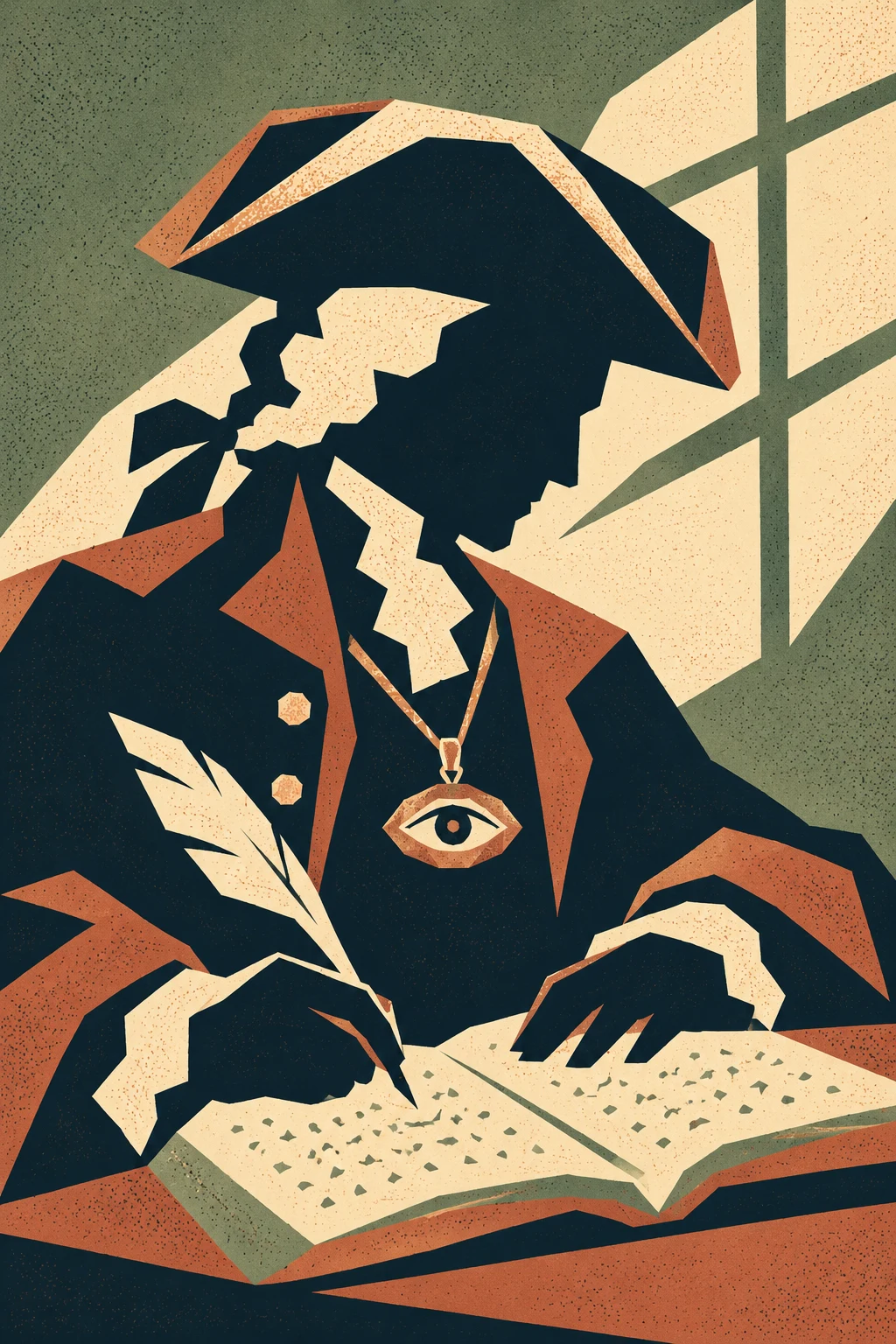
What the masters were told
The true secret begins with an observation about human curiosity: people want to know things simply because they are hidden. According to the story taught to masters, a group of friends in England discussed this weakness and decided to test it. They would create a society whose purpose stayed hidden until after admission, and see how many people would bind themselves to it without knowing what they had agreed to.5
“We often want to know something merely because it is kept secret.”
In this version, the founders devised recognition signs and arranged another meeting to finish their plans, but one of them missed it. When he returned, the others had founded Freemasonry, and some had forgotten, or never knew, his part in the original discussion, so he chose not to reveal himself. Disliking their careless choice of members and their exclusion of women, he went on to found the Oculists instead.5
It is a pointed origin story, not a verified account of how Freemasonry began, and it is designed to give the Oculists the upper hand. Their founder knows how the rival society started and sees the emptiness behind its pretensions, while the Masons are said to know nothing about the Oculists. One fraternity can watch the other without being watched in return.5
A few pages later, the society’s aims are spelled out. Boastful Masons are to be kept in check so that they cannot exaggerate the importance of their knowledge, while modest Masons are still to be valued. The secrets of Masonry should circulate quietly enough to curb foolish speculation and gossip, and to discourage the merely curious from swearing unnecessary oaths. The Oculists expect to enjoy all this without outsiders, including the Masons themselves, realising what is going on.5
That is firmer evidence of the society’s purpose than the eye imagery. It comes from the section the compiler labels the society’s most secret intentions, and it undercuts any description of the Oculists as an ordinary Masonic lodge. Copiale borrows the structure of degrees and shares a world of ceremonial secrecy, while making rivalry with Freemasonry central to its own story. Whether the relationship was imitation, reform, competition or some mixture of all three, the text leaves open.
The eye and the watching animal make sense in that light. According to the researchers’ historical account, the society’s seal showed a cat watching three mice, together with optical and lodge emblems. The image fits the manuscript’s wish to observe a rival while staying hidden. It cannot prove that the Oculists had informers, penetrated a particular lodge or stole anything. An emblem can announce an ambition without recording its results.3
There is another side to the story. The Oculists’ public face concerned eyes, and the related Wolfenbüttel collection included optical instruments, medical extracts and a model eye, so the ophthalmology was not invented by a modern headline. Yet the researchers found no sign that the society performed eye operations, and the master’s practical test in Copiale was reading and writing cipher. Medical interests and ritual symbolism could coexist.3
The more useful question is what the medical theme allowed the society to do. It supplied an admission ordeal, a language of improved vision, a way of sizing up recruits and a public identity quite different from the guarded programme taught to masters. Whether that public identity also reflected members’ actual professions would take a study of the membership to settle. The manuscript shows how the claim was constructed, not the working lives behind it.

A guide to the Freemasons
From page 27, the manuscript turns to a long account of Freemasonry. The details are practical: rooms, furnishings, offices, admission procedures and the questions used to test a brother’s knowledge. A lodge should ideally have separate rooms for gathering candidates, preparing them, admitting them and conducting or recording business. The compiler was describing how a fraternity worked, not just collecting impressive names.5
The preparation of a Masonic candidate is harsher than the Oculist eye test. In Copiale’s account, he is stripped of metal objects, partly undressed and blindfolded, and questioned about his intentions before he is let in. Later the blindfold is removed amid sudden brightness and a ring of sword points. It is a ceremony built on controlled ignorance and revelation, though still the compiler’s report of another society’s practice, not an observed meeting with named participants.5
Another section concerns the Scottish master’s degree, retelling the story of Hiram and the lost master’s word, introducing sacred objects and describing recovered knowledge. Such stories belong to the ritual’s claimed history, and finding them in an eighteenth-century cipher does not mean that modern lodges descend from the builders of Solomon’s Temple, or that any medieval recovery happened as the dialogue describes. It shows only that the story was being passed on.5
In a conference paper in 2015, Önnerfors argued that this material belongs within early German fraternal culture. He dated the content to the middle or late 1740s, drawing on internal references and comparisons with contemporary exposés and degrees, and considered a possible Jacobite reading of the political material. That is a historian’s hypothesis about the text, not a new decryption or a proven plot.4
The passage most easily turned into a revolutionary discovery comes near the end. Pages 100–104 describe a Key Lodge whose imagery includes a drum beating for a general uprising, weapons and a monstrous figure representing tyranny. Its questions speak of natural freedom, oppression and recovering what has been lost. The candidate is represented as born free, answerable to God instead of human law. The political language is explicit enough to deserve attention.5
So is the introduction to the section. The compiler calls the Key Lodge objectionable, blames it on restless idlers and suggests it has largely collapsed. He is reporting a programme he disapproves of. Lifting the language that follows out of that frame and announcing that the Oculists were plotting revolution turns the reporter into the subject.5
That only deepens the intrigue. Why collect a detailed account of a dangerous or ridiculous rival? Copiale does not explain every choice its compiler made, but including the Key Lodge may reflect the wider project of exposing and assessing other societies’ secrets, since a report can preserve ideas its author rejects, and a cipher can protect a survey of other people’s subversion as easily as its writer’s own plans.
The final page repeats the lesson. It describes a Consolation Lodge, an alchemical society in Halle concerned with fixing mercury, and dismisses it as unlikely to last and not worth further investigation. Then the text ends. Alchemy does appear in the book, and so does a verdict that this particular group was not worth taking seriously. A list of the book’s most sensational subjects would leave out the opinions that connect them.5

What remains behind the eye
Copiale rewards reading across its sections. The opening society uses an eye test to confer belonging. Its masters learn a story about the folly of people who chase secrets, and its later sections expose the ceremonies and claims of other societies. Again and again, the book stages the difference between the person who knows how something is arranged and the person who merely experiences it. Labels such as “medical guild”, “Masonic ritual” or “revolutionary manual” miss those shifts.
Some gaps no decipherment can fill. “Philipp 1866” does not identify the author, and a book copied in one period can preserve material from another. A constitution’s story of an English origin is not a certificate from an English founder, and the relationship between this volume and the Wolfenbüttel material still needs documentary comparison. No substitution key can supply a missing chain of ownership or turn an origin myth into history.15
The separate archive takes the investigation beyond a single enigmatic book. In February 2012, the project added further Oculist texts from Wolfenbüttel. One overlaps with the recognition signs, and a document headed *Die Algebra* explains features of the cipher under the guise of arithmetic lessons. These are separate documents, not missing pages restored to Copiale, and the project labels part of the material uncorrected.89
The arithmetic document is revealing. It explains the order of the cipher alphabet, the treatment of letters and the colon’s doubling function. A text that looks like a lesson in sums is really a lesson in secret writing, which underlines how much the master’s literacy test mattered. The cipher was an institutional skill, taught under its own disguise, not one writer’s private flourish.8
Nothing here requires a supernatural explanation. The book uses unusual symbols because people chose them, its ceremonies reveal their own mechanics, and a secret society is not a hidden government. The manuscript’s concerns are recruitment, loyalty, rivalry and access to knowledge, which are intriguing enough, while claims of an unbroken modern organisation or control over later revolutions would need evidence these pages do not contain.
Copiale’s modern afterlife has been more practical. In April 2026, Lei Kang and colleagues released a preprint using Copiale to train and test systems that read images of cipher handwriting directly as German text, using aligned examples from the already deciphered manuscript. The aim was to improve how historical handwriting is processed. Nobody claimed to have solved the book again or found a new secret.10
As of 6 November 2026, the project offers the manuscript’s images, transcription, decoded German and English translation online, alongside the related archive texts. Its broad reading is settled: an Oculist constitution followed by accounts of Masonic and other fraternal practices. Some rare symbols and historical relationships still need interpretation, and the volume’s exact authorship and date remain separate questions from the decipherment of its language.13
The next step would be a fuller comparison of the constitution, related manuscripts and identified members, with access to the original objects where necessary. That could show how the lodge’s medical identity, its recruitment and its hostility to Masonic pretension fitted together. Copiale has already given up the instructions for opening a recruit’s eyes. The people who stood round him with their candles, knowing the page was blank, are still waiting to be named.
Linked case files

Sources10
- The Copiale Cipher: project and downloadable texts Stockholm University; Beáta Megyesi · updated 2026-02-24 · Accessed 2026-11-06
- The Copiale Cipher Kevin Knight, Beáta Megyesi and Christiane Schaefer · 2011-06-24 · Accessed 2026-11-06
- The Secrets of the Copiale Cipher Kevin Knight, Beáta Megyesi and Christiane Schaefer · issue 2011; copyright 2012 · Accessed 2026-11-06
- Unveiling the Copiale-manuscript: layers of fraternalism, ritual and politics in eighteenth century Germany Andreas Önnerfors · 2015-05-29 · Accessed 2026-11-06
- Copiale manuscript: deciphered German, with original page markers Eighteenth-century manuscript; decipherment by Knight, Megyesi and Schaefer · German transcription August 2011 · Accessed 2026-11-06
- USC Scientist Cracks Mysterious Copiale Cipher USC Today · 2011-10-25 · Accessed 2026-11-06
- Language scholars solved 18th-century cipher Anna Malmberg; Uppsala University · 2011-10-27 · Accessed 2026-11-06
- Die Algebra: deciphered Oculist archive document Oculist archive, Wolfenbüttel; project transcription · 2012-02-04 · Accessed 2026-11-06
- Extra deciphered Oculist ritual and recognition signs Oculist archive, Wolfenbüttel; project transcription · 2012-02-04 · Accessed 2026-11-06
- Learning to Decipher from Pixels: A Case Study of Copiale Lei Kang, Giuseppe De Gregorio, Raphaela Heil, Alicia Fornés and Beáta Megyesi · 2026-04-26 · Accessed 2026-11-06