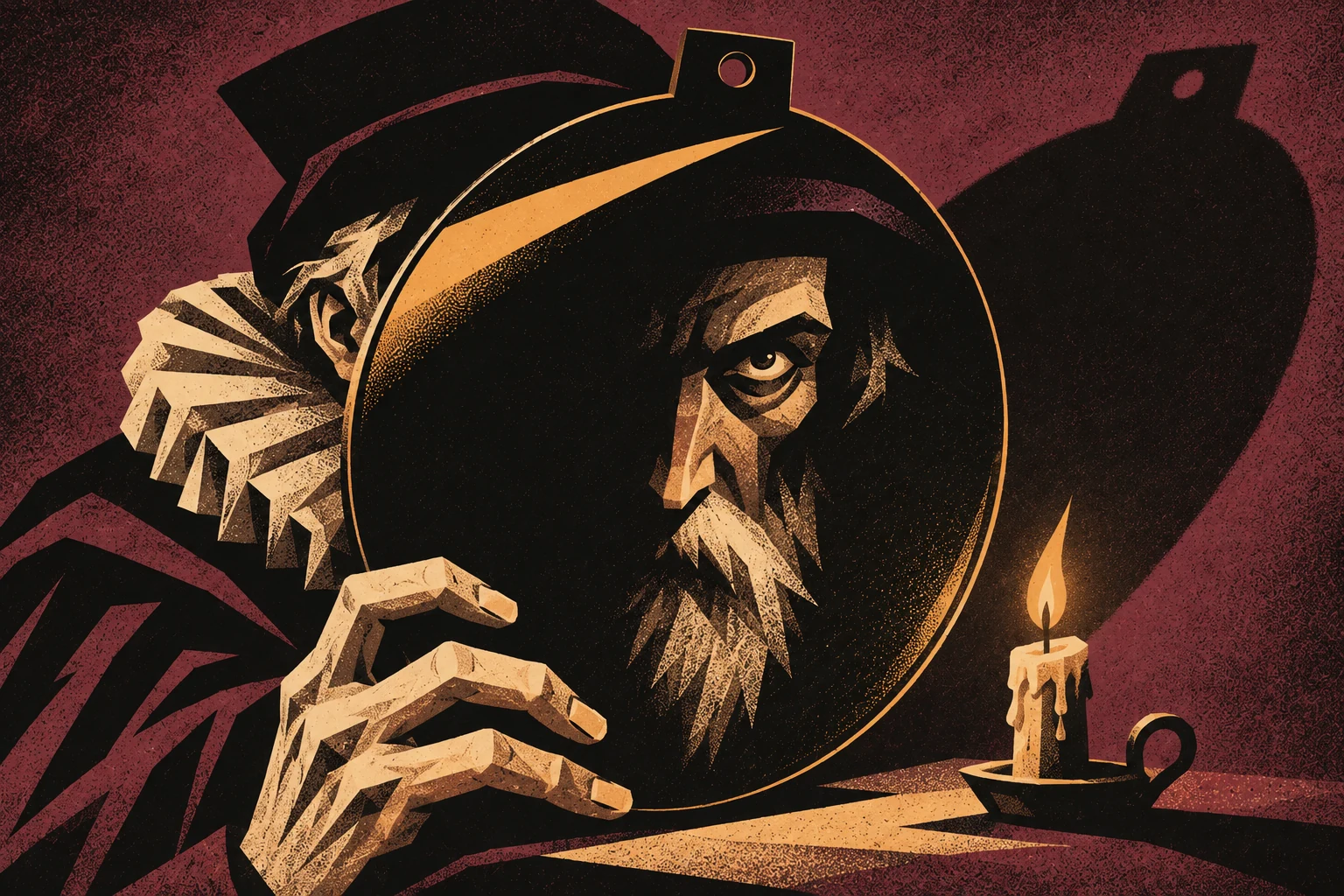
Among the British Museum’s collections is a disc of polished black stone, about the size of a side plate. For more than two centuries it has been known as the mirror the Elizabethan magician John Dee used to summon spirits. In 2021, scientists finally traced where its stone came from.12
A scholar with too many instruments
The mirror is roughly nineteen centimetres across, almost circular, with a short rectangular tab pierced by a hole. Both faces have been ground and polished, and the edges show the work of someone turning volcanic glass into a finished object. Without its label and the name attached to it, a visitor would see a remarkable piece of craftsmanship and know nothing of Elizabethan magic.2
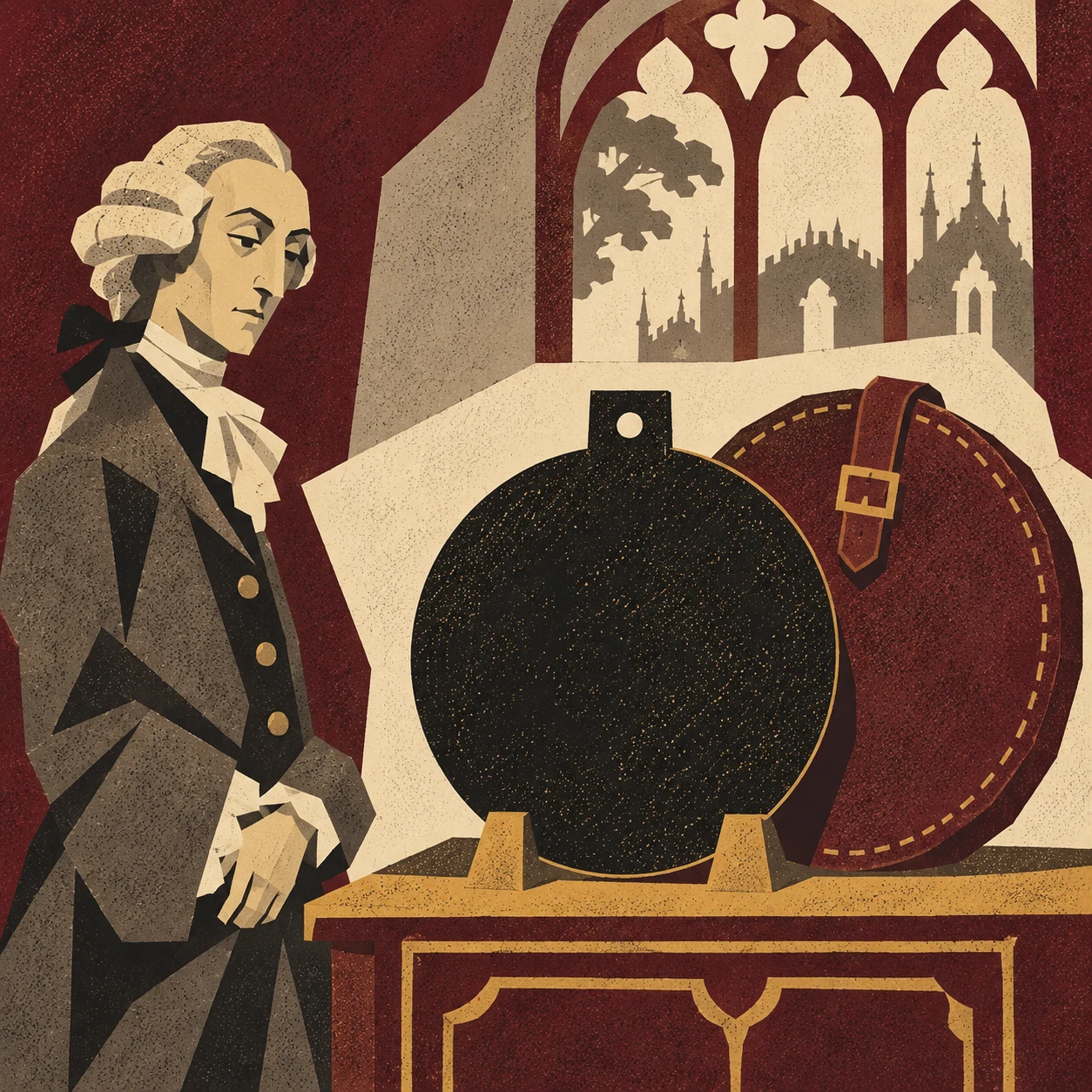
The fitted case changes that. A paper label in Horace Walpole’s handwriting links the stone with Dee’s spirits, then borrows from Samuel Butler’s satirical poem Hudibras to call it the Devil’s Looking-glass, and although Walpole acquired it in 1771, long after Dee’s death, his inscription made a claim about the object’s past that helped shape its future.1
Dee lived from 1527 until 1608 or 1609. He advised on navigation, studied mathematics and astronomy, collected books and instruments, and moved in the intellectual circles around Elizabeth I. His interests also took in astrology and alchemy. The surviving books from his library at the Royal College of Physicians carry his signatures, notes and drawings: direct evidence of an active reader whose interests ranged far beyond the supernatural.3
The habit of calling him the queen’s magician can make all of this look like preparation for a séance. His library suggests something larger. A reader of his time could move between geometry, ancient history, natural philosophy and alchemy without the boundaries a modern library would draw between them. Those connections made sense within his pursuit of knowledge, even where the answers he hoped to find no longer convince us.35
Alchemy, in particular, was about more than the promise of gold. The historian Jennifer Rampling has traced how Dee read, copied and passed on alchemical works, and the materials and apparatus he kept at his house in Mortlake. Texts supplied recipes and authority, while practitioners tested procedures and swapped information. Surviving margin notes and letters make this work visible, although most of the equipment has vanished.5
In the 1580s, Dee also tried to gain knowledge from angels. He employed go-betweens, or scryers, who gazed into stones or crystals and described what they said they saw. Edward Kelley became the most famous of them. Dee wrote down the communications, leaving a body of records that lets historians study what the two men did without accepting their explanation of where the messages came from.24
Scrying means seeking visions or information by staring intently at a reflective or translucent surface, such as a crystal or a mirror. Calling something a shew-stone tells us how its owner understood its purpose, but it is not a description precise enough to identify a particular surviving object. That vagueness would become a central problem for the black mirror.46
There were several instruments to confuse. Christopher Whitby’s study of the early spirit records found references to different crystals, including a stone in a frame. He also distinguished a concave optical glass, which could produce strange reflected images, from the flat obsidian disc. His conclusion about the museum mirror was cautious: the link was possible, but circumstantial.6
Yet the black surface suits the familiar picture of Dee so well that the attribution can seem obvious. An Elizabethan occultist, an unreadable stone and the promise of hidden knowledge appear made for one another. The mirror’s material history offers a firmer starting point. Before anyone in England could give it an angelic or devilish identity, someone in Mexico had to make it.2
Before the English magician
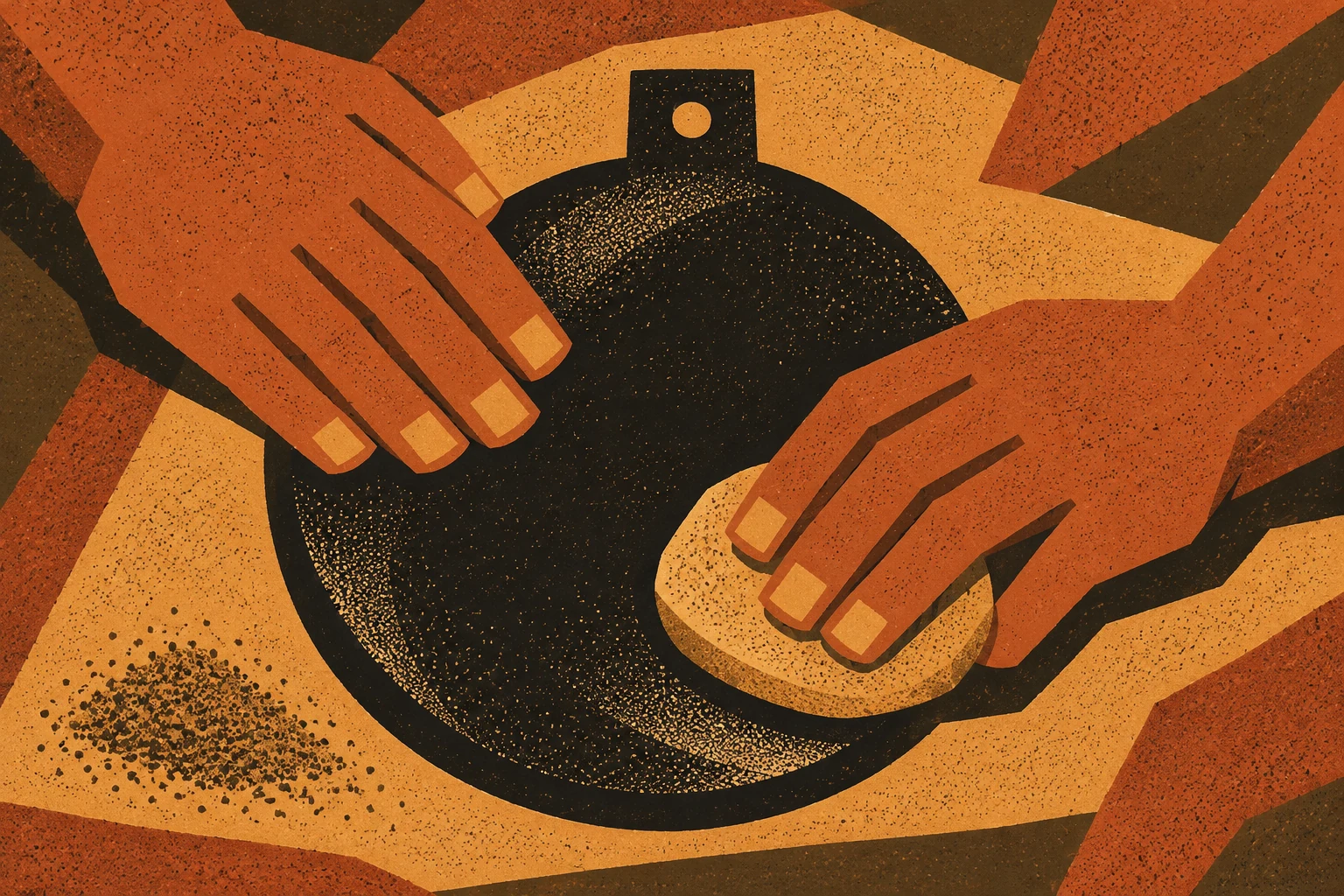
Obsidian is volcanic glass, and in Mesoamerica it was used in everyday work, in war and in religious life. A sharp blade and a polished mirror could both start from the same material, then demand different skills and serve different purposes. The finished disc belongs to that history of craft, in which stone was chosen, shaped and worked until it could reflect an image.2
The archaeological study published in Antiquity in 2021 was led by Stuart Campbell, with Elizabeth Healey, Yaroslav Kuzmin and Michael D. Glascock. They examined the mirror associated with Dee alongside three other British Museum objects, and placed all four within a wider group of Mexican mirrors and polished slabs held in collections around the world.2
Several details make the comparison useful. Two of the circular mirrors, including Dee’s, have square tabs, while another has a tab shaped more like a teardrop. The rectangular slab has one polished face, a rougher underside and deliberately worked edges. These differences lie in the objects themselves, beneath the names of the European collectors who later owned them.2
The tabs could have let a circular mirror be fixed to a person or a statue, and chipping around the hole in Dee’s mirror may have come from hanging it. Neither detail says where this particular mirror once hung. It is tempting to place it on a priest or the image of a god, but its original setting is not recorded in any of the sources consulted for this article.2
The researchers looked at pictures and written accounts as well as the stone. Indigenous images show circular mirrors in the culture these objects came from. An early colonial account compiled by the Franciscan friar Bernardino de Sahagún describes specialist mirror-makers cutting, grinding and polishing, which helps explain the skill that went into a finished reflective surface.2
The most evocative association is with Tezcatlipoca, whose name is usually translated as Smoking Mirror. In images of the god, mirrors appear on his head, chest or back, and can replace his missing foot. The 2021 study discusses their links with revelation, prophecy and power. Such images help recover what a mirror could mean in Mexica religious thought.2
But they do not identify the owner of this particular disc, and they do not make every piece of obsidian a sacrificial tool. A material used in so many parts of life cannot be given a single function just because its most dramatic religious meaning is well known. The mirror’s shape and the comparisons with other objects support a Mexican origin, but the loss of its archaeological context limits what can be said about how it was used.2
Dating raises the same difficulty. Campbell and his colleagues thought most circular mirrors of this kind probably belonged to the Late Postclassic period, the last centuries before the Spanish arrived, while allowing that they continued to be made after the conquest. An object that reached a collection without a recorded excavation cannot easily be placed on either side of that line. Chemistry could locate its stone, but not date the hands that polished it.2
What survives from Mexico? The material, the worked form and comparisons with other objects and images. The maker’s name, workshop and original owner remain unknown.2
A crossing without a passenger list
The Spanish conquest provides the broad route by which Mexican objects reached European collections, but not a passenger list for this mirror. After the destruction of the Mexica capital and the consolidation of Spanish rule, artefacts moved through tribute, seizure, gift-giving and collecting. Arriving in Europe could preserve a striking object while stripping away everything that had explained it.2
Lists of early shipments included mirrors. The Antiquity paper notes one consignment containing eight mirrors of different kinds, entrusted to Diego de Soto. That shows such objects could travel to Habsburg Europe in the decades before Dee. But no mark on the British Museum disc identifies it as one of those eight, and no receipt links it to that shipment.2
Even the line between plunder from the conquest and later exports is hard to draw for an object with no recorded history. The study notes that Hernán Cortés commissioned some of the artefacts sent to Europe, and Indigenous craftspeople went on working under new political and economic conditions. An unfamiliar object in a European cabinet might therefore combine an old technique with a new commission.2
No surviving record shows this mirror crossing the Atlantic. Mirrors certainly reached Europe in the years after the conquest, but the ship, the year and the person who carried this one are unknown.2
Dee had chances to come across unusual objects on the Continent. The researchers suggest his studies at Louvain in 1548–1550 as one possible occasion, and his later links with central Europe as another. These are possible settings for an acquisition, based on where he went and whom he knew. They are not competing eyewitness accounts of a purchase.2
His travels are better documented in other ways. In 1583, Dee and Kelley left England for east-central Europe with books from Dee’s library. Rampling’s research follows the alchemical texts, experiments and patrons that gathered around them. The two men’s interests overlapped, but Kelley’s growing name as a practical alchemist increasingly offered patrons something Dee’s spiritual ambitions could not.5
That evidence brings a mobile scholarly world to life. Books were copied, translated, lent and presented to would-be patrons, and recipes and reputations travelled together. It is easy to picture a rare Mexican mirror passing through the same courts and collections. But how easily a transaction can be imagined is no substitute for the document that would prove it.25
Would Dee have understood its Mexican meanings? Campbell and his colleagues suggest that his interest in the Americas might have made the object’s associations appealing to him. They also point out that Europe already had its own traditions of magic mirrors. An imported black surface could slip into an existing practice even if its new owner knew little of what it had meant in Mexico.2
The possibilities differ. Dee might have acquired the mirror because he knew something of its religious significance abroad, or he might have prized an unusual material for use in familiar European practices, or the link with him might have been made after his death. None of these requires an unbroken occult tradition crossing the Atlantic intact, because what survives is the record of an object passing between societies that could expect very different things of it.2
The collector and the missing years
By the eighteenth century, a story had settled around the stone. Horace Walpole’s description of Strawberry Hill, his house in Twickenham, placed it in the Great North Bedchamber. He called it a speculum of kennel-coal, an identification of the material that modern analysis has overturned. He also described it as an instrument with which Dee had fooled the public.7
Walpole’s account came with a named line of owners. The mirror, he said, had belonged to the Mordaunts, earls of Peterborough, before passing to Lady Elizabeth Germain and the duke of Argyll. The duke’s son, Lord Frederic Campbell, gave it to Walpole. The Lewis Walpole Library’s catalogue records the gift in 1771 and identifies the surviving object by its British Museum registration number.7
The fitted case and Walpole’s label anchor that part of the history. They are valuable because they place the Dee attribution in the hands of a known collector, and they also fix how far that collector stood from the events he described. Walpole could pass on a tradition about Dee, but he was born more than a century after Dee died.17
In a letter preserved in Yale’s edition of his correspondence, Walpole described the stone’s polished surface and its sturdy leather case. He referred to an earlier catalogue of the Peterborough collection and repeated the line of owners. That was enough for him to declare:
so there can be no doubt of its authenticity.
The confidence is revealing. Walpole’s evidence was an inherited description backed by a history of ownership. The editors’ note on the same page adds a problem for later researchers: the catalogues of the Peterborough and Germain collections have never been traced. The document Walpole cited as proof can no longer be set beside the mirror and checked.8
There is an earlier clue, and it stops the story collapsing into a simple eighteenth-century invention. Campbell and his colleagues discuss evidence given in a lawsuit in 1624. Thomas Hawes recalled seeing a round, flat, crystal-like stone in the house of John Pontois before Pontois left to work for the Virginia Company at the end of 1618. Pontois said an angel had brought it to Dee and that it had let him know strange things.2
This matters because Pontois inherited books and belongings from Dee. It puts a claim about a remarkable flat stone among Dee’s heirs, much closer to his lifetime. Hawes was repeating what Pontois told him about the stone’s history. The angel’s delivery is a belief recorded in the testimony, not a fact established by the lawsuit.2
Could that stone be the mirror now in the museum? Its round, flat shape makes the idea worth taking seriously, but the description gives no measurements or any other feature unique to this object. Pontois’s collection was broken up in 1625 and 1626, and the researchers suggest the first earl of Peterborough may have acquired it then. No record of that transfer survives to close the gap.2
After Walpole, the record becomes a history of collectors and sales, as the Strawberry Hill sale of 1842 sent the mirror into another series of private hands until the British Museum bought it from the Reverend R. W. Stannard in 1966. These records let the museum’s object be traced back through the market, but they cannot by themselves bridge the earlier gap to Dee’s lifetime.78
Reading the stone with X-rays
The scientific investigation tackled a question paper records could not settle. What if the stone itself had come from somewhere else entirely? A European source of obsidian would have complicated the Mexican story and raised the possibility that an object resembling a Mexican mirror had been made, or substituted, in Europe. Its black appearance alone could not decide the matter.2
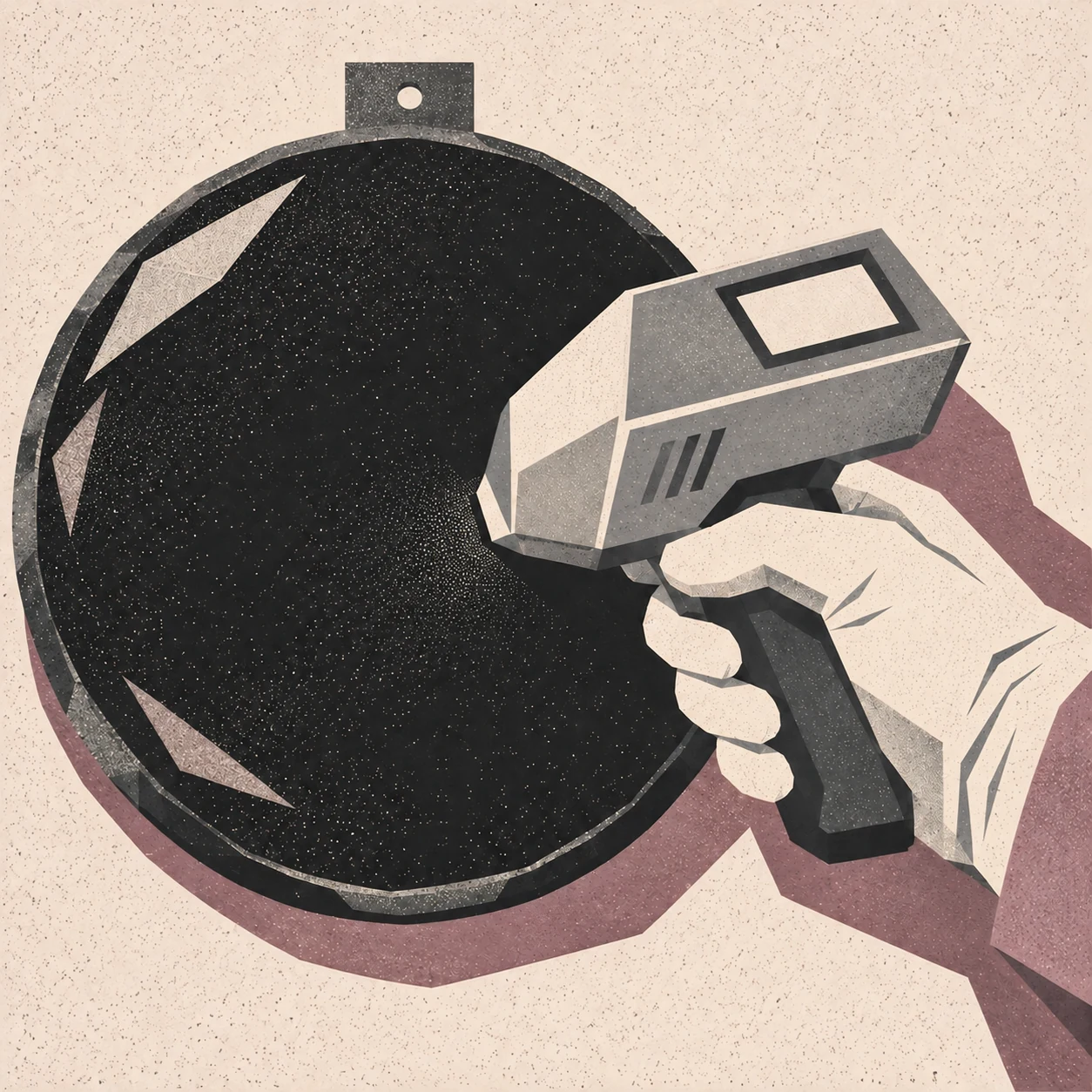
The team used portable X-ray fluorescence, usually shortened to pXRF, which measures the chemical elements in a surface. Each geological source of obsidian tends to have its own combination of elements, so an artefact’s make-up can be compared with samples taken from known deposits. The aim was to find where the raw material came from without cutting a sample from the mirror.2
They took repeated ninety-second readings at two spots on each museum object, which let them check whether different points gave consistent results. Reference standards helped calibrate the instrument. They then compared the artefacts with geological samples from four Mexican sources: Otumba, Pachuca, Ucareo and Zaragoza.2
The paper records a practical limitation. The museum surfaces could not be cleaned, so centuries of handling might have left contamination. Readings from different spots were consistent, which reassured the researchers, but they did not pretend that an old museum object could be treated like a freshly prepared laboratory sample.2
Across several elements, the four objects fell into two groups. The mirror associated with Dee matched the Pachuca source, as did the other circular mirror with a square tab. The mirror with the teardrop tab and the rectangular slab matched Ucareo. The fit between shape and source was suggestive, though four objects are too few to establish a general rule about how mirrors were made.2
Pachuca lay within Aztec territory and was heavily quarried. Ucareo lay to the west, in the territory of the Tarascan state, and its obsidian sometimes occurs in slabs well suited to mirror-making. Together, the results place the museum pieces within the material geography of central Mexico, while revealing more than one source and possibly more than one tradition of manufacture.2
It was a real advance. A Mexican origin had long been suggested by the objects’ appearance and by comparisons, and the chemistry offered an independent test. For Dee’s mirror, a broad cultural label became a specific geological source: Pachuca. Walpole’s label had supplied a famous English name, and the instrument supplied evidence of a Mexican beginning.2
It did not supply a date, because a chemical match cannot say whether the mirror was polished before the conquest or in the first decades of Spanish rule. It cannot identify a workshop, name a craftsperson or say who bought the finished object, nor can it fill the gap between Pontois and the Peterborough family, so those questions need evidence of a different kind.2
Two different histories: Geological provenance asks where the stone formed. Ownership provenance asks who held the object. The first can be tested chemically. The second still depends on records and identification.2

Was it really Dee’s mirror?
The strongest case brings several kinds of evidence together. The object looks like other Mexican mirrors, its obsidian matches Pachuca, an early witness described a round, flat stone linked to Dee among Pontois’s possessions, and later collectors kept the Dee attribution alive. Campbell and his colleagues concluded that the historical research strengthened the link. That is more persuasive than a story resting on Walpole alone.2
The object’s Mexican identity and its English owner are still two separate questions. A genuine imported mirror could have picked up a famous name after Dee’s death, and the years between his lifetime and the secure collecting history are exactly where a mistaken identification could creep in. The chemistry would give the same result whether Dee owned it or someone else did.2
The early Hawes testimony makes that alternative less simple than it first looks. Even if the stone in Pontois’s house was a different object, something still has to explain a flat stone linked to Dee in his heir’s home. The testimony deserves weight without being stretched beyond what its description allows. A supernatural claim can contain useful evidence about a possession while being unreliable about its powers.2
Whitby’s objection is about identifying the mirror from Dee’s own records. The references he examined did not single out the museum disc. The best-known optical glass was concave, and the other stones were crystals. A picture of Kelley consulting a flat black mirror throughout the sessions therefore goes beyond what those passages can support. It does not make Dee’s ownership impossible, but it denies us an easy match in the documents.6
A copy made from European stone is now a weaker explanation, because the material matched Mexico. One could imagine Mexican obsidian being worked later in Europe, but the paper offers no evidence for that. The familiar Mexican forms and the geological result already tell a coherent story without inventing an undocumented European workshop.2
The uncertain date survives alongside this firmer conclusion about place. A mirror made in the early colonial period would be just as Mexican as one made before the conquest, and its making might reflect Indigenous skill carried on under new rulers. “Aztec” is a useful museum and archaeological label, but it cannot identify the individual maker or the conditions in which that person worked.2
There are limits, too, to identifying the mirror’s first use. It resembles mirrors associated with religion and elite display, but no excavated setting ties it to a particular ritual. Circular mirrors could be attached to bodies or statues, and some may have been set into Christian crosses in the colonial period. The possibility of reuse widens the object’s history without allowing an exact sequence to be written for this one.2
The rectangular slabs are a warning against assuming every polished black surface meant the same thing. The research discusses their use as portable Christian altars and, later, in European hands, as surfaces for paintings. The same material could serve purposes that new owners understood very differently. The stone stayed recognisable while the reasons for keeping it changed.2
The Dee attribution sits in that space between a good historical case and a complete chain of ownership. Dismissing it as an empty legend would throw away the early testimony and the collecting history. Treating it as certain would hide the missing identification and transfers. The open question is narrow enough to investigate: whether this particular Mexican disc is the flat stone associated with Dee soon after his death.2
Angels, demons and a polished surface
The British Library’s catalogue describes Sloane MS 3188 as Dee’s conferences with angels, beginning in December 1581 and continuing into 1583. It notes the use of a crystal ball and records a later copy made by Elias Ashmole. Some pages are missing.4
The sessions produced an imposing record, in which tables, letters, names and instructions gave the communications a form that could be copied and studied. For Dee they were part of a search for hidden order, alongside his other efforts to understand nature and divine knowledge, and their persistence shows how committed he was, though it does not prove that the voices he believed were speaking to him were real.45
Rampling’s account of the years abroad also shows how spiritual and practical hopes could pull apart. Patrons cared about what alchemy promised to deliver, and Kelley built a reputation in that field. By the late 1580s, his efforts to give up the role of scryer coincided with his growing success as an alchemist. The partnership faced money pressures and shifting opportunities as well as the spiritual ambitions recorded in the manuscripts.5
Later readers brought their own religious purposes. Meric Casaubon published part of Dee’s spirit records in 1659 as A True and Faithful Relation. As the Jesus College library explains, his preface defended the existence of spirits while attacking claims of religious inspiration he thought dangerous. He accepted that Dee was sincere, but saw the episode as a lesson in the danger of false revelation.9
Walpole found a different use for the relic. His description of Strawberry Hill presented it as evidence of the credulity of earlier generations and of a fraud on the public, and the label in its case kept alive the satirical phrase Devil’s Looking-glass. The believer and the amused collector could both treasure the same object while disagreeing about what its past proved.179
The 2021 investigation recovered a part of the mirror’s history that its English labels never mention: where the stone itself came from.2
What the mirror can now tell us
As of 7 November 2026, the research consulted shows that the mirror associated with Dee is made of obsidian from Pachuca. When it was made, how it was first used and how it reached Europe are still unknown. The link with Dee has real historical support, including the early Pontois evidence, but no unbroken documented chain.12
Research in Mexico keeps sharpening the wider picture. In May 2025, Mexico’s National Institute of Anthropology and History, INAH, reported an analysis of 788 obsidian objects from the Templo Mayor in Mexico City, dating from about 1375 to 1520 and drawn from eight sources. The work found that the ways obsidian was acquired changed over time, with material coming from territories outside Mexica control as well as Pachuca’s prized green obsidian.10
That study looked at other artefacts, not Dee’s mirror. Its value here is the complexity it restores to the world behind the object. A geological source is a place within a system of production and trade, not the name of a single people or proof of a single ritual purpose. Rebuilding that system depends on excavated contexts of exactly the kind this mirror has lost.210
The mirror still sits with its case and Walpole’s label about Dee’s spirits. The label preserves the English name that made it famous, and the polished disc preserves the skill of the unknown Mexican craftsperson who made it.12
Linked case files

Sources10
- Dr Dee’s mirror, registration 1966,1001.1 British Museum via Google Arts & Culture · undated · Accessed 2026-11-07
- The mirror, the magus and more: reflections on John Dee’s obsidian mirror Stuart Campbell, Elizabeth Healey, Yaroslav Kuzmin and Michael D. Glascock · 2021-10-07 · Accessed 2026-11-07
- Scholar, courtier, magician: the lost library of John Dee Royal College of Physicians Museum · 2016 exhibition; undated page · Accessed 2026-11-07
- Sloane MS 3188: John Dee’s conferences with angels British Library · catalogue; manuscript1581–1693 · Accessed 2026-11-07
- John Dee and the alchemists: Practising and promoting English alchemy in the Holy Roman Empire Jennifer M. Rampling · 2012 · Accessed 2026-11-07
- John Dee’s actions with spirits, 22 December 1581 to 23 May 1583, Vol. 1 Christopher Lionel Whitby · 1982 · Accessed 2026-11-07
- Dr. Dee’s Mirror, Strawberry Hill ID sh-000210 Lewis Walpole Library, Yale University · 2009 · Accessed 2026-11-07
- Horace Walpole correspondence, volume 42, p. 389 Horace Walpole; Yale scholarly edition · late18thcentury letter; modern scholarly edition · Accessed 2026-11-07
- A True and Faithful Relation of What Passed for Many Yeers Between Dr.John Dee and Some Spirits Emma Jones / Jesus College Libraries, Oxford · 2014-10-01 · Accessed 2026-11-07
- Análisis de obsidiana hallada en el Templo Mayor revela las complejas relaciones comerciales de los mexicas Instituto Nacional de Antropología e Historia,Boletín 232 · 2025-05-19 · Accessed 2026-11-07