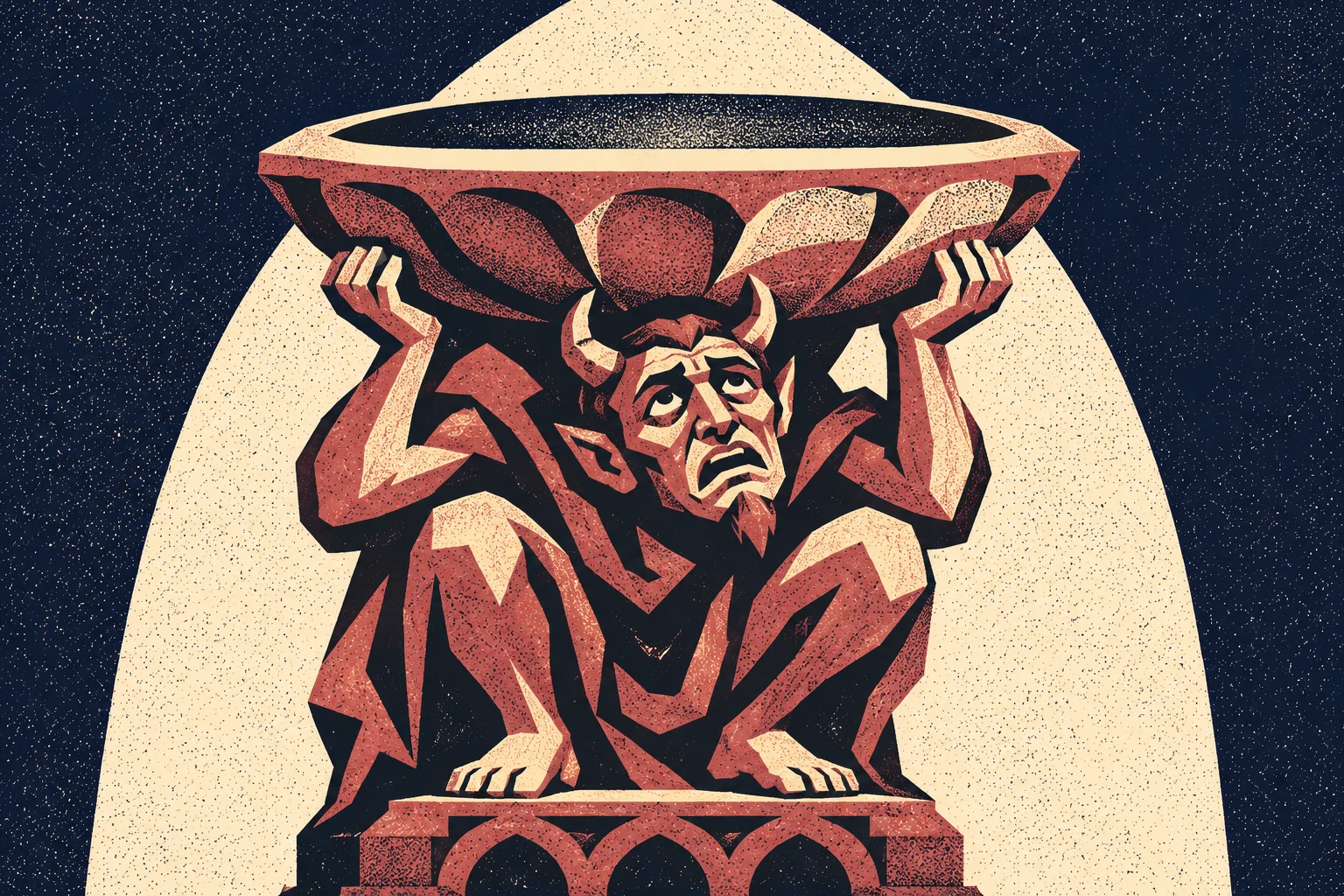
Just inside the door of the village church at Rennes-le-Château, a painted devil crouches beneath the holy-water stoup. Beyond the church stand a villa, gardens and a tower built by the parish priest more than a century ago. How he paid for them has been argued over ever since.12
The priest and the devil
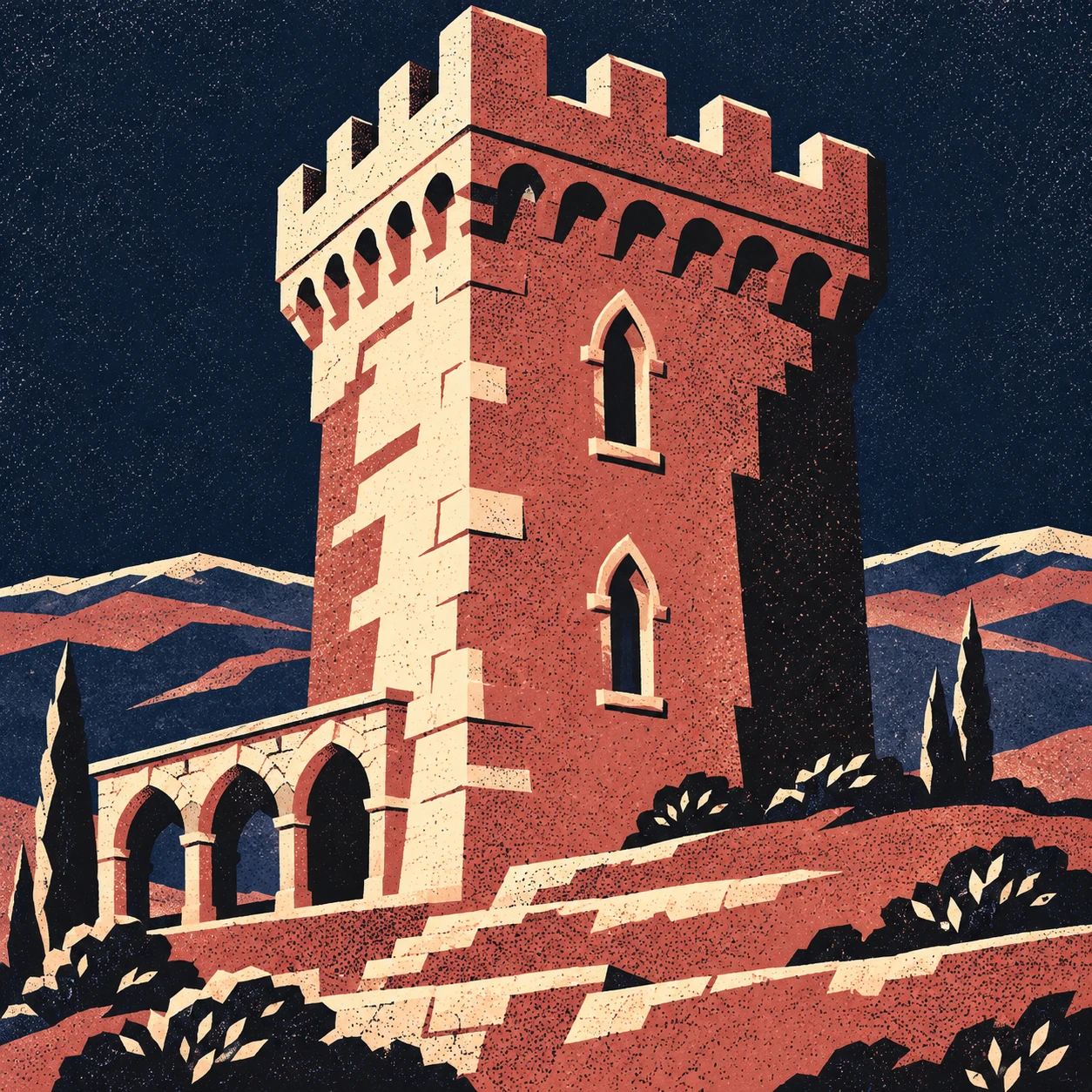
Bérenger Saunière arrived as parish priest in 1885. Over the following decades he renovated the church of Sainte-Marie-Madeleine and built an estate whose villa, gardens and tower still draw visitors to this hilltop in the Aude. The Tour Magdala was a library, complete with a battlemented viewing platform, and the winter garden and promenade looked out over the surrounding country. These were large ambitions for a village priest.1
For later investigators, the buildings were the visible end of a hidden transaction. Somewhere between his arrival and his death in 1917, they reasoned, Saunière must have come into something extraordinarily valuable. Coins would explain the money, but a document dangerous to the Church might explain far more: his apparent independence, his troubled relations with his superiors, even his choice of decoration.3
The church seemed happy to oblige. Its dedication to Mary Magdalene would become central to a theory about the descendants of Jesus. The creature at the door, usually called Asmodeus in the mystery literature, seemed to welcome visitors into something less comforting than a country church. And over the porch was a Latin sentence that read like a warning.3
Terribilis est locus iste.
The words mean “this is an awesome place”, or a fearful one. In Genesis, Jacob says them after dreaming of a ladder between earth and heaven, when he realises he has found the house of God and the gate of heaven. In that setting, the sentence announces a holy presence. It only looks sinister in a treasure story when the reader is shown a fragment of the passage.5
The devil deserves the same care. A carved demon holding up a holy vessel can stand for the defeat of evil, and it hardly means that the priest secretly worshipped the figure beneath it. But the statue’s expressive face makes it a splendid ambassador for the legend. One unsettling object does more to set a mood than pages of financial calculation.26
The mood matters because Rennes-le-Château won its international fame long after Saunière died. His lifetime, the growth of a local treasure story and the invention of a secret society spanning the world are often run together as one continuous account. Separating them leaves a more interesting question than whether the whole thing was a hoax: which parts belonged to the priest, and which were added by the people who came after him?3
Drawing that line also lets the place keep its strangeness. Someone commissioned this decoration, paid for these buildings and fought a church dispute over his affairs. There is a real life to recover beneath the stories. The danger is that the most colourful explanation starts to dictate what each surviving object is allowed to mean.
What came out of the altar?
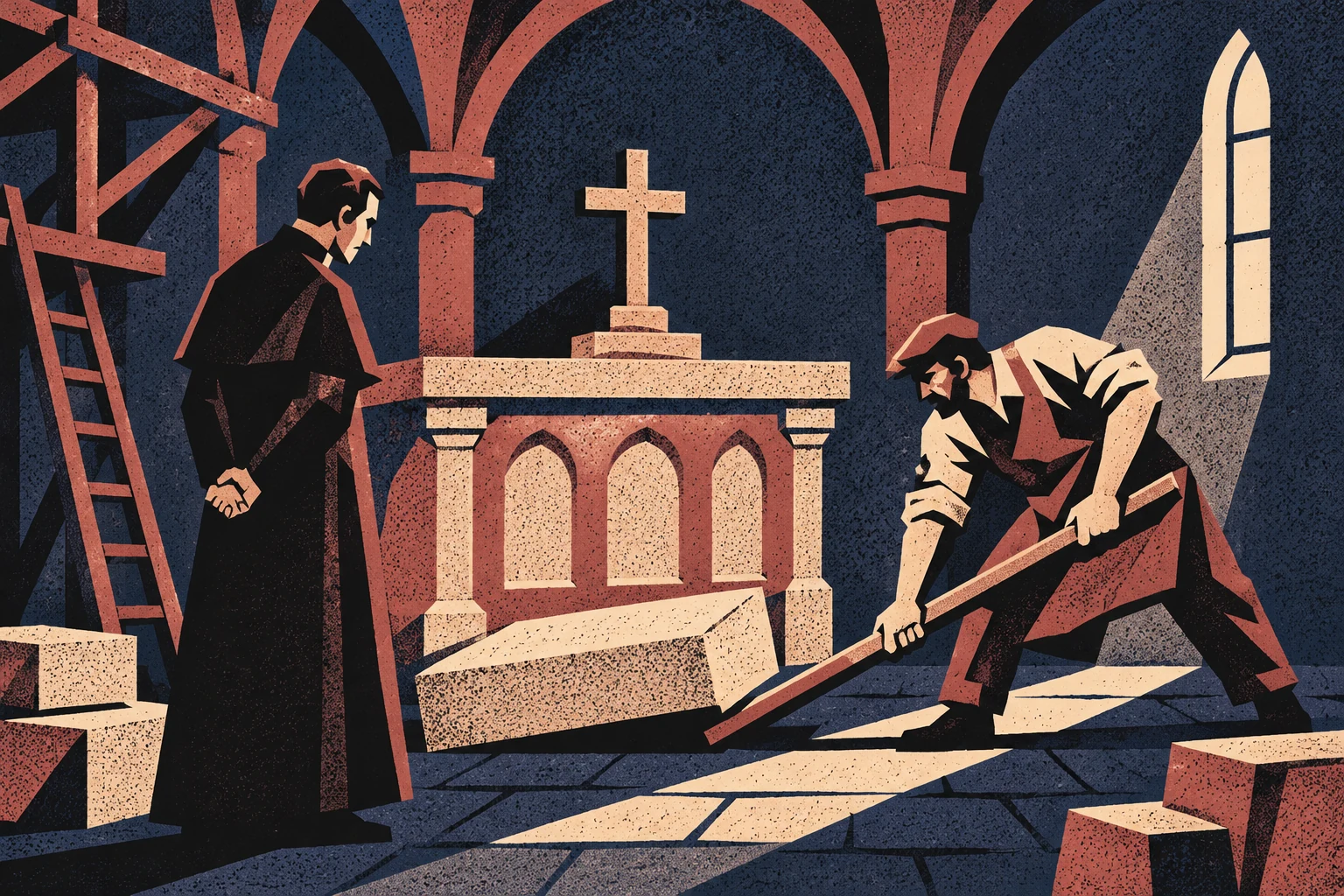
In the familiar version, everything changed during repairs to the church in 1887. Work on an old altar exposed hidden parchments, and Saunière recognised their importance, consulted others and pursued a secret that would pay for his estate. Some versions add coins, a skull, an underground chamber or discoveries among the graves. The details vary, but the plot is wonderfully efficient: a poor priest lifts a stone and his life changes.3
Two physical objects help make that account feel solid. The local museum displays a carved stone slab known as the Dalle des Chevaliers and an old altar pillar that Saunière later reused. Their existence is a separate matter from the claim that they hid a fortune, and even the village’s own description of them is careful to say what they would have contained. An old stone can be genuine while the story attached to its hollow is much younger.1
This matters most for the parchments. A text can contain a working cipher without being an ancient discovery. Someone has to show where the document was before it was published, who handled it and whether anyone recorded finding it at the time. Otherwise a clever modern puzzle can slip into the story disguised as the very thing it was invented to explain.
Our original article described testimony passed down through the family of a village bell-ringer, including an account of a container for documents. Memories like these belong in the history of the mystery, but how far they stand from the alleged discovery has to stay visible. A grandson’s later account cannot carry the weight of a dated photograph, an inventory or an original document kept from the restoration.3
The decoration offers firmer ground. A transcription of Saunière’s agreement with Giscard, a firm of religious sculptors in Toulouse, records an order dated 20 November 1896. For 2,500 francs, paid in instalments, the firm was to supply a relief, Stations of the Cross, a baptismal group, statues and fittings. Several items were to follow agreed models.7
The contract gives the church a supplier, a price and practical arrangements. Goods would arrive at the railway station, and the parish was responsible for hauling them uphill and lodging the workman. It brings into view the ordinary business of furnishing a church, with deliveries and bills, alongside the later image of a man laying out an elaborate secret message.7
The agreement does not answer every question about the interior. The devil is not on the transcribed list, so it would be careless to claim that this document proves that particular statue was bought from a catalogue. A surviving Giscard catalogue from 1914 is useful evidence of the firm’s products, but it postdates Saunière’s order.78
A sensible investigation starts with those distinctions. Which object was ordered, which model was supplied, and what was changed? Treating every unusual detail as a clue ignores the workshop that made it. Equally, finding that a supplier worked from models does not explain every choice the customer made. The records can narrow the possibilities without making the interior either ordinary or encrypted.
Who paid for the tower?
The question of money gave the treasure story its strongest foothold. Saunière’s modest stipend seemed far too small to pay for the works attributed to him. Later writers converted his spending into vast modern fortunes, then treated the gap as a sum only treasure or blackmail could fill. The calculations were persuasive because readers could see the tower, even though they could not inspect the accounts.3
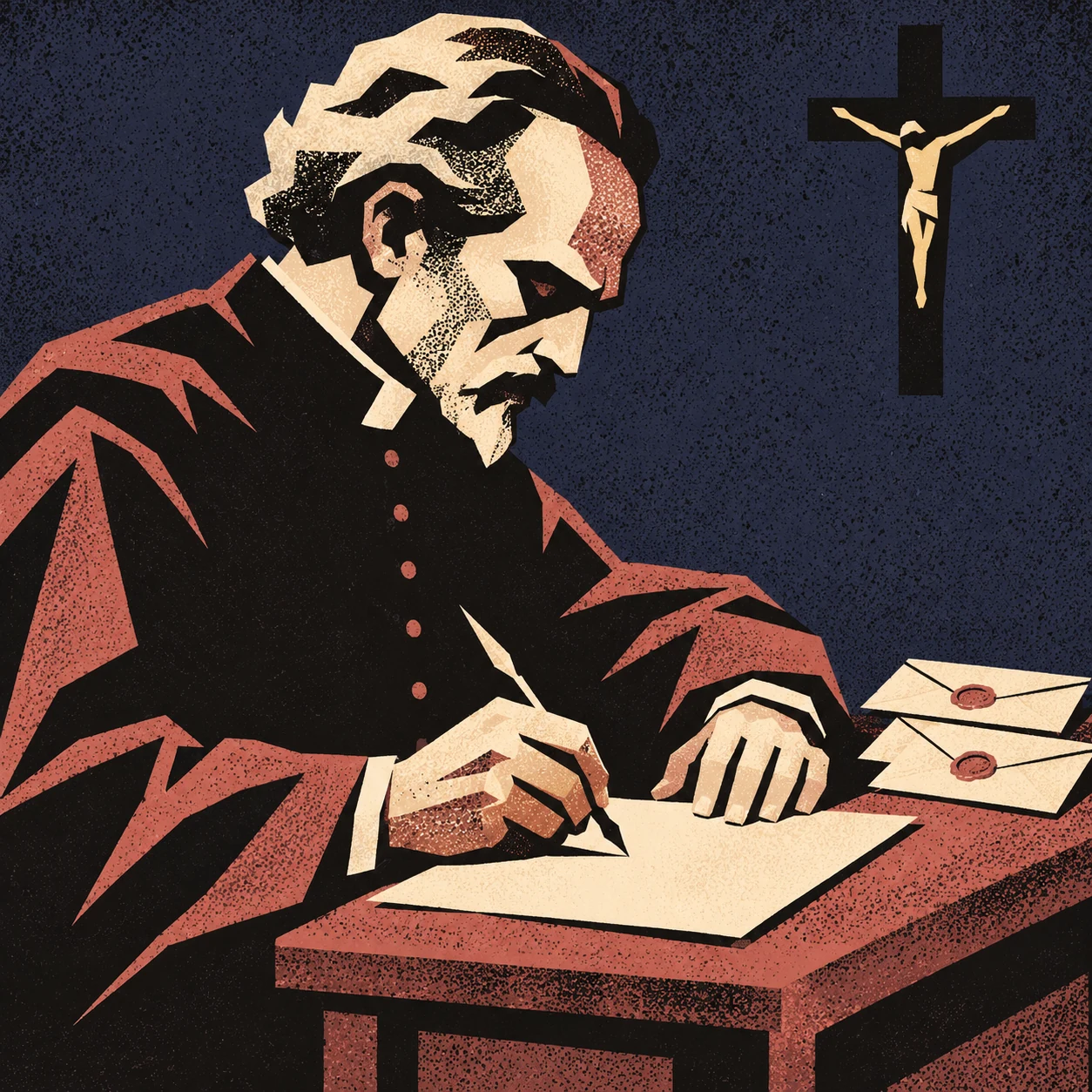
A more mundane source of income was already to hand: money sent for Masses. A believer could make an offering for a priest to say Mass for a particular intention, which was an ordinary religious practice. The trouble came when a priest asked for or accepted more of these obligations than he could fulfil, or failed to account properly for requests he passed on to other clergy.9
Saunière’s conflict with his bishop, Paul-Félix de Beauséjour, was therefore about something concrete. The church proceedings examined his requests for Masses, his finances and whether he had obeyed instructions. His supporters stress his defence that large sums came as donations and that other priests could say the Masses. But the dispute should not be flattened into the false claim that a criminal court convicted him of stealing a treasure.9
Our 2018 article argued that Mass money could not explain his spending. In Patrimoines du Sud in 2025, the archivist David Rossoni challenged that conclusion, finding that Mass offerings were the main income recorded in Saunière’s correspondence notebooks, topped up by other receipts.310
Rossoni concludes that this income covers the spending that can be identified. His reconstruction undermines the claim that the scale of the works demands a treasure. An estimate of unexplained millions is only as good as the costs and income fed into it.10
What did investigators have? The buildings show that money was spent, and the correspondence and church dispute offer evidence about where it came from and what was owed. None of it, by itself, points to an underground hoard.1910
Not every donor can be named, nor every payment traced. Private gifts are rarely recorded as clearly as a modern investigator would like. But a missing name leaves an unidentified donor, nothing more. Turning that person into a patron paying for silence would take further evidence, such as a letter describing the bargain or a payment tied to a particular secret.
The treasure theory has often worked the other way round. Start with a secret, then read privacy as discretion, spending as a reward and defiance of the bishop as the confidence of a man with powerful protectors. The same events can then support almost any hidden deal. The correspondence is more demanding: it can show that a request was sent, a sum received or an account challenged, and it gives the dispute dates and amounts that any explanation has to fit.
Saunière need not have been an ordinary or model priest for that explanation to work. Ambition, relentless fundraising and a poor record of obedience could produce both lavish building and serious trouble. Whether the estate was tasteful, eccentric or unsuitable for a priest is another question, and the answer says nothing about who paid for it.
The hotel that sold a treasure
After Saunière died, his housekeeper, Marie Dénarnaud, stayed at the centre of the estate’s story. In the later legend she was the keeper of his confidences, a woman who knew more than she would say. Promises of a secret, remembered gestures and tales of unexplained money gathered around her. Part of their appeal was the thought that she had outlived the only other person who could explain the place.3
The property eventually passed to Noël Corbu, who ran a hotel and restaurant there. By the mid-1950s, the treasure story had become an attraction in its own right. The estate supplied the setting and Saunière the mystery. Visitors could eat in the shadow of the priest’s buildings and hear why the signs of his wealth might hide an even greater discovery.3
A host did not need to invent the village, the tower or its former owner to make the story compelling. Those solid details encouraged the listener to take the next step: somewhere nearby lay the source of the money. A mystery told on the spot has an advantage over one met on the page. The guest can look up from the story and see something that seems to confirm it.
A 1948 report by the Belgian journalist Roger Crouquet complicates the timeline. Rossoni notes that the villagers he spoke to talked about donations and Mass money, not treasure. It cannot be assumed that the fully formed legend was already common knowledge among Saunière’s neighbours.10
That does not date the first whisper about buried money. Village gossip can leave little trace, and later writers have gathered up earlier hints. But it is a reason to be precise about what each witness or publication actually said. A vague rumour of wealth is not yet a story about coded parchments, Merovingian kings and a society guarding the descendants of Jesus.
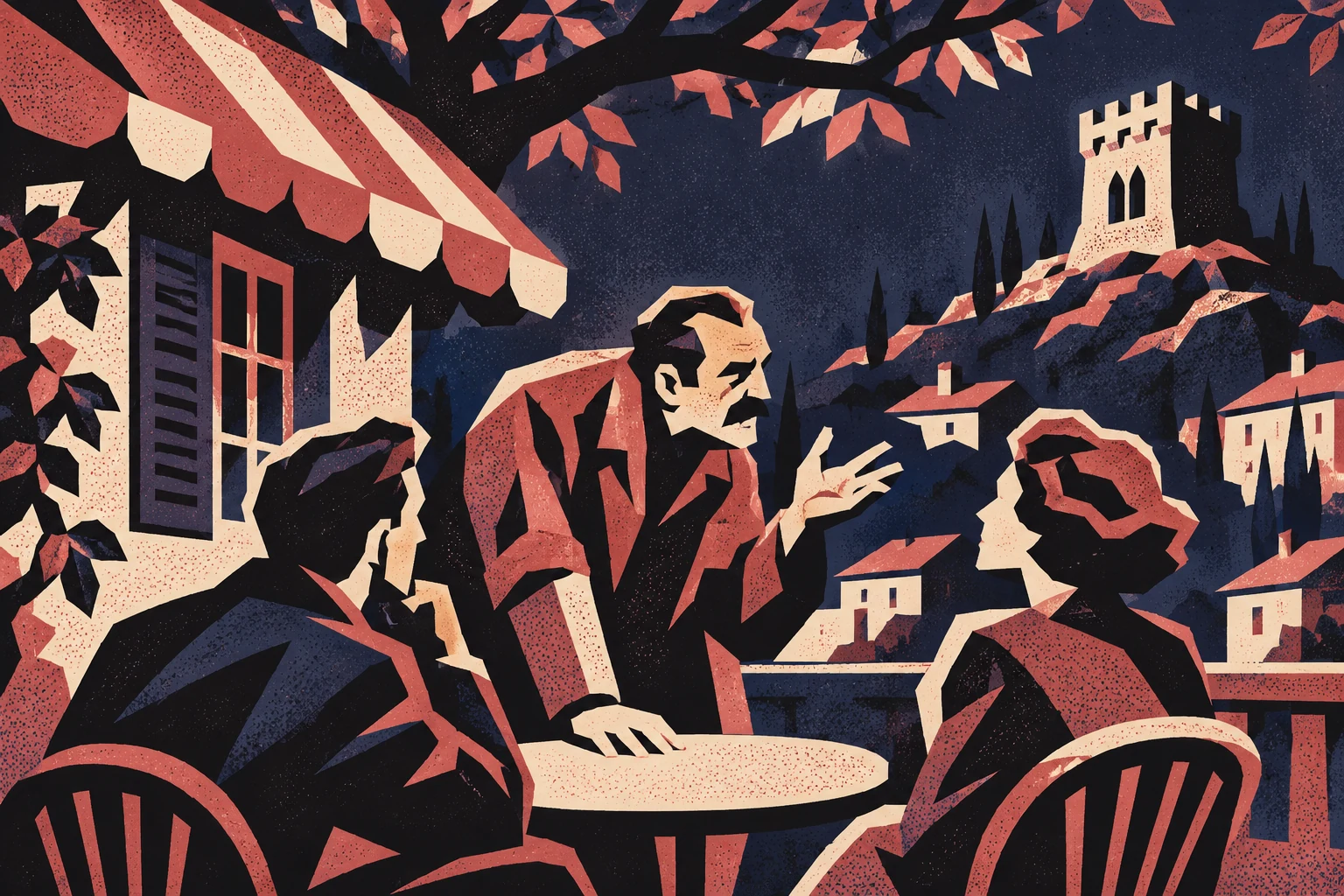
Gérard de Sède’s 1967 book brought a version of the affair to a much larger audience. The priest’s story now came with documents readers could study, hidden messages to decode and connections reaching far beyond his parish. Pierre Plantard and Philippe de Chérisey were central to the material behind this expansion, and the book dressed a local mystery in the trappings of historical research.3
Readers enjoyed taking part. Anyone who spotted an odd letter or teased out a hidden phrase could feel they were moving the inquiry forward themselves. Solving a puzzle is a real achievement even if the puzzle is not as old as it claims. That became one of the central traps of Rennes-le-Château: cracking a document’s code could seem to prove the document genuine.
Corbu’s restaurant and de Sède’s book also changed what counted as a clue. An old pillar no longer belonged only to the history of the church. It became a possible hiding place for a message whose publication had created a new audience of searchers. The estate had acquired a second history, made by visitors, authors and the things they hoped to find.
A secret society acquires a past
The Priory of Sion promised to tie the scattered clues together. Its supposed age supplied continuity across the centuries, and its supposed members supplied links to artists, rulers and scholars. Instead of a priest making an isolated discovery, Saunière could be placed on the edge of a long-running operation whose guardians understood why his find mattered.3
The real, documented organisation was far younger. The Bibliothèque nationale de France’s authority record for Plantard identifies him as the inventor of the Priory in 1956. A modern association did exist, but that could not establish the medieval history later claimed for it. Borrowing an evocative name does not give an organisation the age of every older body that might have used it.11
One especially effective source of authority was a set of papers called the Dossiers secrets, attributed to Henri Lobineau. The BnF catalogue records it as published in Paris in 1967, on 25 unnumbered sheets. A researcher could find a real item in a great national library, and its shelfmark made it feel solid and set it apart from mere rumour.12
But a library keeps material so that it can be studied, not to vouch for everything in it. The date in the catalogue tells us when these papers were published, not when a secret brotherhood began. A false family tree can be a perfectly genuine object in a collection, valuable as evidence of the time it was made.
The name on the papers is revealing too. The BnF’s separate record treats Henri Lobineau as a pen name. It notes a claim that he was the art dealer Leo R. Schidlof, which Schidlof’s family denied, and points instead to Plantard and de Chérisey as the authors. The apparently independent scholar leads straight back to the men already building the Rennes dossier.13
This is where counting references can mislead. A book may cite a dossier, another writer may cite the book, and an investigator may then find both in a library. Meeting the claim three times can feel like hearing three witnesses. If all three lead back to the same people, the corroboration is weaker than it looks.
Plantard’s interest in genealogy also had a political background. The BnF records his earlier involvement in antisemitic organisations. That history does not decide whether a stone in a village church is old or whether a priest received a payment. But it does make it unwise to treat the man putting together a story about rightful royal descent as a neutral keeper of inherited knowledge.11
The coded parchments are a particular problem. Our original feature already named de Chérisey as one of their creators, yet still entertained the idea of an older discovery behind them. What is missing is a secure trail taking these particular texts back before the men who promoted them. Without one, a message naming a king is more plausibly evidence of twentieth-century ingenuity.3
The medieval brotherhood had been brought in to explain how a dangerous secret survived. Once its own history needed explaining, the argument went round in a circle: the secret proved the society mattered, and the society explained why the secret had left so little ordinary evidence. The supposed solution had created a bigger mystery than the priest’s finances.

The shepherds and the hidden tomb
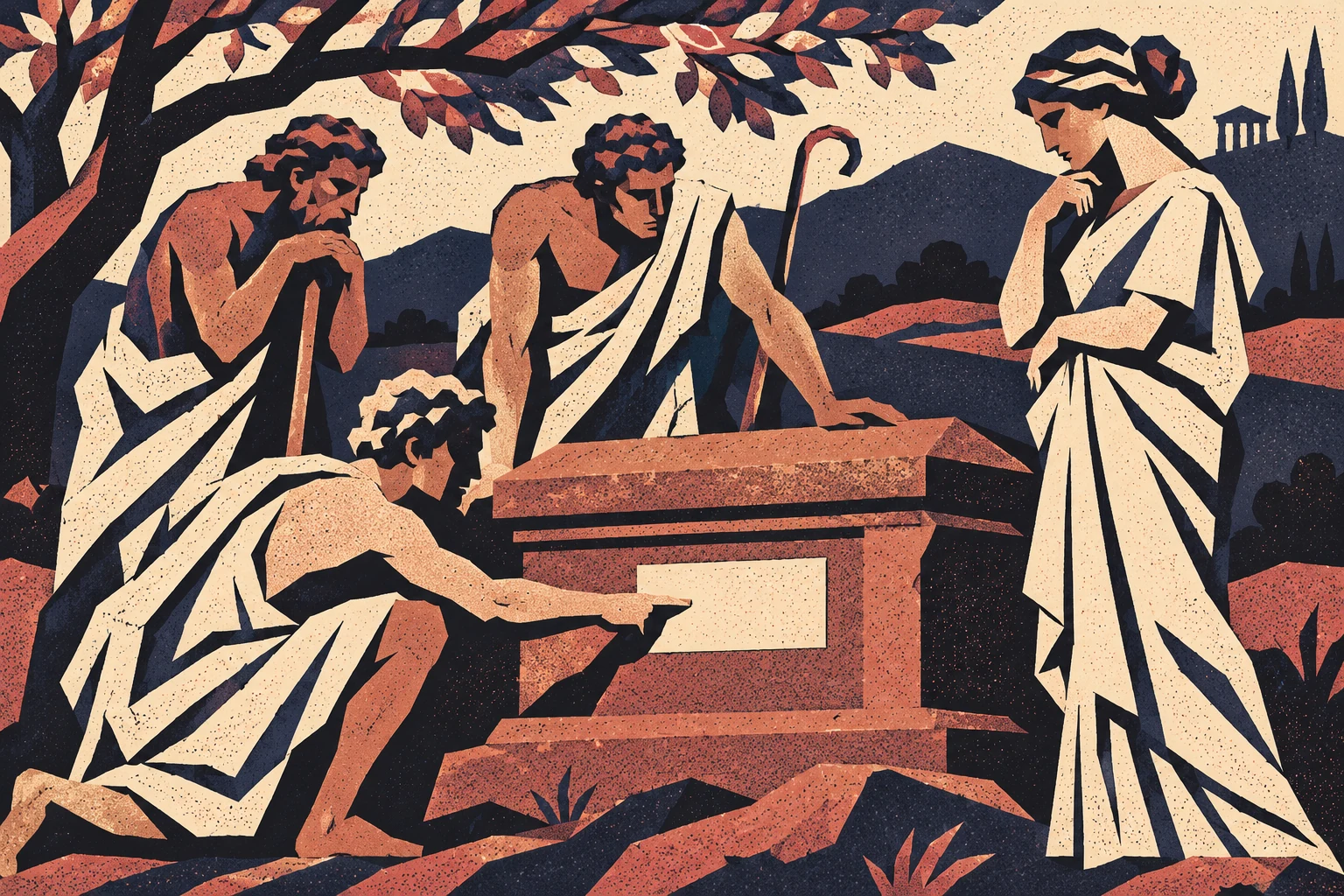
Nicolas Poussin’s Les Bergers d’Arcadie gave the inquiry one of its most memorable images. Shepherds gather round a tomb, studying an inscription while a woman stands beside them. To readers already hunting for hidden information, the figures seemed to be doing exactly what the investigation demanded: reading closely a message others might walk past.14
The Louvre dates the painting to about 1638 and records that it entered Louis XIV’s collection in 1685. Its inscription, Et in Arcadia ego, has been interpreted for centuries, and the museum discusses readings about death’s presence even in an ideal landscape and the memory of lost happiness. The painting has plenty to say before anyone links it to Rennes-le-Château.14
In the treasure literature, the landscape became a possible map and the tomb a possible destination. The coded parchments seemed to point towards Poussin, which made a likeness between a painted hill and a real one feel less like chance. A church document, an artist and the countryside could then be read as parts of one design.3
The order of events is crucial. If a modern author wrote a text that points towards a famous painting, finding a message about that painting proves only what the author built. It does not show that Saunière followed the same trail. The link becomes historically useful only if it can be traced without relying on the modern text that suggested it.
Comparing landscapes brings its own problems. A painter can move hills, trees and buildings around, and a viewer can pick a viewpoint, crop a reproduction or decide that one feature matters more than another. A likeness is a reasonable place to start, but an identification needs landmarks distinctive enough to beat other candidates. Search a large enough area and something suggestive will always turn up.
A map is useful here precisely because it need not pretend to solve the painting. Rennes-le-Château, nearby Couiza and Rennes-les-Bains are real, separate places south of Carcassonne. Showing where they lie helps readers follow the story without adding lines that seem to reveal a deliberate sacred plan. A line between two points shows a direction, but the decision to draw it is the modern investigator’s.15
The alternative approach gives every alignment a purpose. Choose enough churches, peaks, ruins and villages and a dense web soon appears. To judge a proposed design, we would need to know who chose those points, when, and what links that choice to Saunière. The map cannot supply an intention the historical record lacks.
There is a deeper reason the painting fitted so well. A tomb offers both a hiding place and the promise of knowledge about the dead. Its inscription invites reading, its setting invites travel and its age lends the search dignity. It can keep a treasure hunt going even after one location disappoints: perhaps the wrong viewpoint was chosen, or a word misread.
Poussin’s picture is still an extraordinary thing to look at. Its part in this affair shows that a work of art can inspire a convincing investigation without ever having been meant as a set of instructions. The shepherds have something to read, but that does not mean a French priest held the key to their landscape.
The bloodline beneath the Grail
Henry Lincoln helped bring the Rennes story to British television. The first of his BBC Chronicle programmes, The Lost Treasure of Jerusalem?, was broadcast in February 1972. More followed, and his collaboration with Michael Baigent and Richard Leigh eventually produced The Holy Blood and the Holy Grail in 1982. The book made a much larger claim.16
Now the treasure could be a living family. The authors proposed that Jesus and Mary Magdalene had children, that the line continued in southern France and that it married into the Merovingian dynasty, with a brotherhood guarding it through the centuries. The Grail became royal blood, not a physical cup, and genealogy became the secret at the heart of the whole affair.317
That gave familiar details new weight. Mary Magdalene’s name on the church could seem to identify the woman at the centre of the secret, and a royal name in a document could seem to point to heirs with a lost inheritance. The theory’s great strength was its reach: a question about a village priest’s building costs became an explanation for the behaviour of churches and kings across European history.3
The evidence it needed grew just as dramatically. Showing that Jesus was married would not show that he had a child, that the child went to France, or that the family later married into a royal house and left a documented line of descent. Each step needs its own evidence. A guess at one stage cannot safely be carried forward as the foundation for the next several centuries.
The biblical details also need reading accurately. Mark’s account of the visit to the tomb has Mary Magdalene, Mary the mother of James and Salome bringing spices and finding the tomb open. It does not describe Mary Magdalene washing Jesus’s naked body, a scene our earlier article mentioned when discussing intimacy between them. The argument had picked up a suggestive episode that the cited Gospel does not contain.318
Nor has the small Coptic fragment known as the Gospel of Jesus’s Wife rescued the genealogy. Our original article repeated early claims about its age. A 2016 update to Smithsonian magazine’s reporting records that Karen King changed her view after the fragment’s history was investigated, and now thought it more likely a forgery. Even the original scholarly case never made a late fragment an eyewitness biography of Jesus.19
The popularity of the bloodline theory is easier to prove than the bloodline. It offered a hidden family history with a recognisable human centre: a woman whose importance had supposedly been suppressed, and descendants whose identity might still matter. Readers did not need to care about the price of a stained-glass window to care about that.
Dan Brown’s The Da Vinci Code took related ideas to an even wider audience. The copyright case that followed ended in 2006, when Baigent and Leigh’s claim against Brown’s publisher was dismissed. The judgment was about whether literary material had been copied. It did not endorse the book’s version of Christian origins, the Priory’s medieval pedigree or Saunière’s discovery.16
By then the priest’s original puzzle had almost shrunk out of sight. A hidden royal family did not need to explain every receipt to feel significant. Yet the argument still ran through Rennes-le-Château, asking one unusual estate to bear the weight of a history reaching back to the first century.

What remains at Rennes?
Exposing the modern fabrications has not ended the debate. In 2024, Gil Galasso argued in Patrimoines du Sud that the older affair still deserved investigation. He weighed ordinary financial explanations alongside a treasure discovery and a possible religious network, and his preferred line of inquiry allowed for clergy funding a project whose purpose was kept private.20
That is a stronger position than accepting every Priory claim. A modern deception could easily attach itself to an older event, and private religious patrons do not always advertise their motives. Galasso points to episodes such as a 1903 visit described as an inspection, and asks whether they suggest more organisation behind Saunière’s work than the usual account allows.20
The difficulty is turning that possibility into a proven arrangement. An inspection can matter without proving a hidden network, and the existence of an older church says nothing about what lies in a buried chamber. Rossoni’s 2025 reply challenges both the financial argument and the habit of promoting guesses to facts. Their disagreement is useful because it pins down the points that actually need settling, instead of asking readers to decide whether the place feels mysterious.1020
A proper answer would rest on identifiable records. A newly found letter from a donor might change the financial picture, and an authenticated document recorded before the modern legend might change the parchment story. A properly excavated find could change the history of the site. None would prove the other claims along with it: a hoard beneath a church would not give Plantard’s association a medieval founding.
Reading the trace: The estate, the church furnishings and the financial dispute belong to Saunière’s history. The published ciphers, library dossiers and bloodline theory have later histories that must be traced separately.191216
That separation leaves room for curiosity about the priest himself. His taste, his persistence and his dealings with his superiors are worth recovering for their own sake. Marie Dénarnaud deserves more attention than the part of silent guardian the legend gave her. Neither of them becomes easier to understand when every ordinary act is read as a signal to future treasure hunters.
As of 7 November 2026, the sources examined here do not show that treasure lay behind the estate, or that the Priory of Sion preserved a bloodline from the first century. The famous documents still have no secure history reaching back to the restoration, and the documented modern Priory cannot fill the missing centuries in that genealogy.1112
The place itself has outlasted every argument. There is still a church to step into, a carved devil beneath its stoup and a tower from which to look out across the Aude. Visitors arrive with very different expectations and can find much of what they came for: religious art, an eccentric building project, a book they remember or the starting point of a search.1
The most elusive thing may be the moment when the priest’s own story ended and the treasure story began. It will not be found by drawing another line through the hills. It lies in dated letters, early accounts and the small practical records left by a man whose reputation grew far larger after his death.
Linked case files


Sources20
- Le Musée Domaine de l’Abbé Saunière et l’Eglise Mairie de Rennes-le-Château · undated · Accessed 2026-11-07
- Église Sainte-Marie-Madeleine: diable supportant le bénitier Ministère de la Culture / André Signoles · 1993 · Accessed 2026-11-07
- Rennes-le-Château: Lost Treasure of God The Unredacted · 2018-02-24 · Accessed 2026-11-07
- St. Madeleine Inschrift Hawobo / Wikimedia Commons · 2006 · Accessed 2026-11-07
- Genesis 28:16–17, King James Version Genesis / Bible Gateway · public-domain translation · Accessed 2026-11-07
- C’è un tesoro in quella chiesa? Mariano Tomatis / CICAP · 2005-04-20 · Accessed 2026-11-07
- Le contrat du statuaire entre Saunière et Giscard Rennes-le-Château Archive / Jean-Pierre Garcia · undated; contract 1896-11-20 · Accessed 2026-11-07
- Giscard et son catalogue 1914 Rennes-le-Château Archive / Jean-Pierre Garcia · undated; catalogue 1914 · Accessed 2026-11-07
- Saunière’s Trial Renneslechateau.nl · 2017-06-05 · Accessed 2026-11-07
- Réponse à « Rennes-le-Château, entre mystifications et réalités » de Gil Galasso David Rossoni · 2025-04-01 · Accessed 2026-11-07
- Plantard, Pierre (1920–2000) Bibliothèque nationale de France · undated · Accessed 2026-11-07
- Dossiers secrets / d’Henri Lobineau Bibliothèque nationale de France · 1967 · Accessed 2026-11-07
- Lobineau, Henri: authority record Bibliothèque nationale de France · undated · Accessed 2026-11-07
- Les Bergers d’Arcadie, INV 7300 Musée du Louvre · undated · Accessed 2026-11-07
- API Découpage administratif: commune centres French government geo.api.gouv.fr · accessed 2026-11-07 · Accessed 2026-11-07
- Baigent & Leigh v Random House [2006] EWHC 719 (Ch) Mr Justice Peter Smith; approved judgment mirrored by Binary Law · 2006-04-07 · Accessed 2026-11-07
- Holy Blood, Holy Grail Penguin Random House / Dell · 2004 edition · Accessed 2026-11-07
- Mark 16:1–8, King James Version Mark / Bible Gateway · public-domain translation · Accessed 2026-11-07
- The Inside Story of a Controversial New Text About Jesus Ariel Sabar / Smithsonian · 2012-09-17; updated 2016-06-20 · Accessed 2026-11-07
- Rennes-le-Château, entre mystifications et réalités Gil Galasso · 2024-10-01 · Accessed 2026-11-07