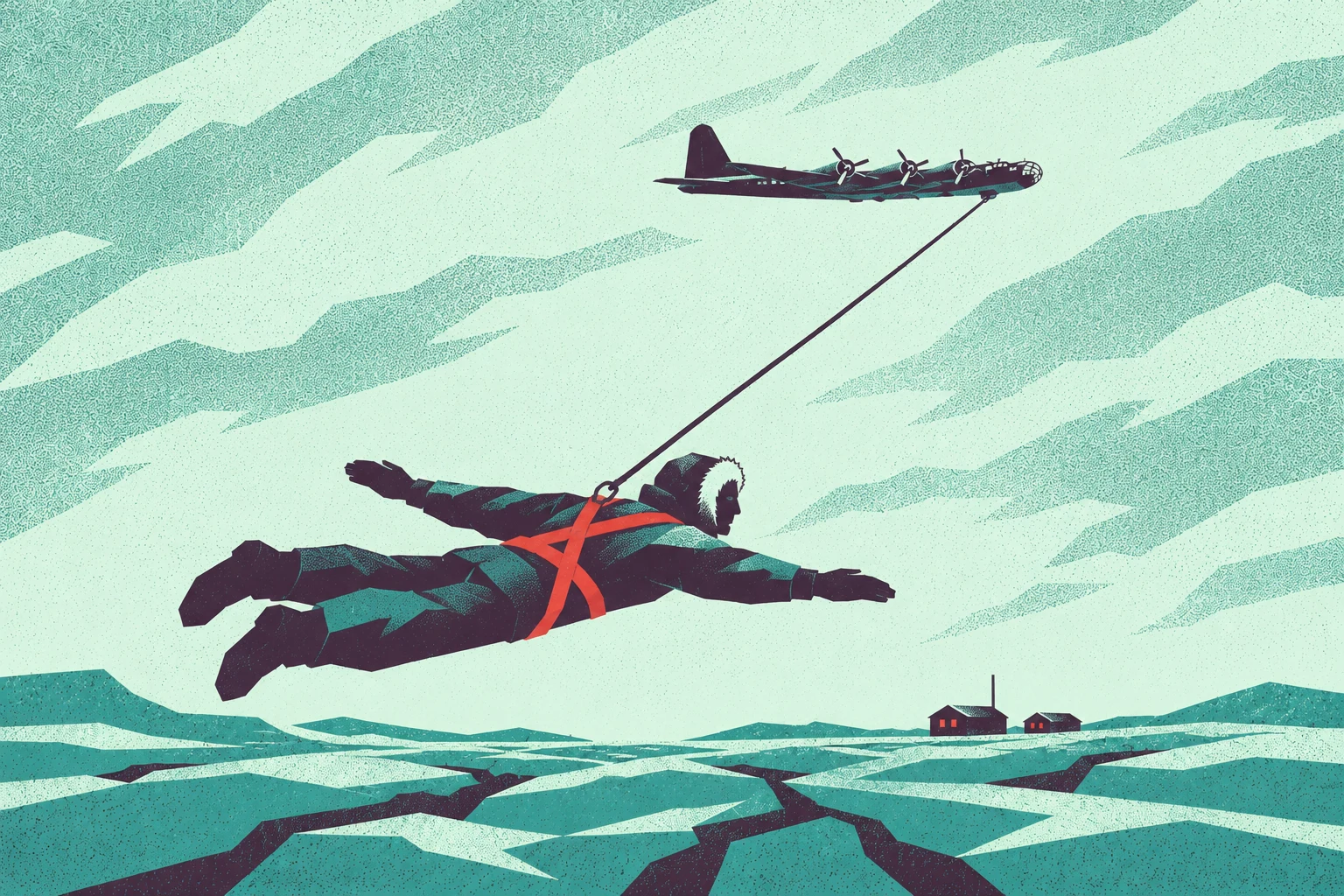
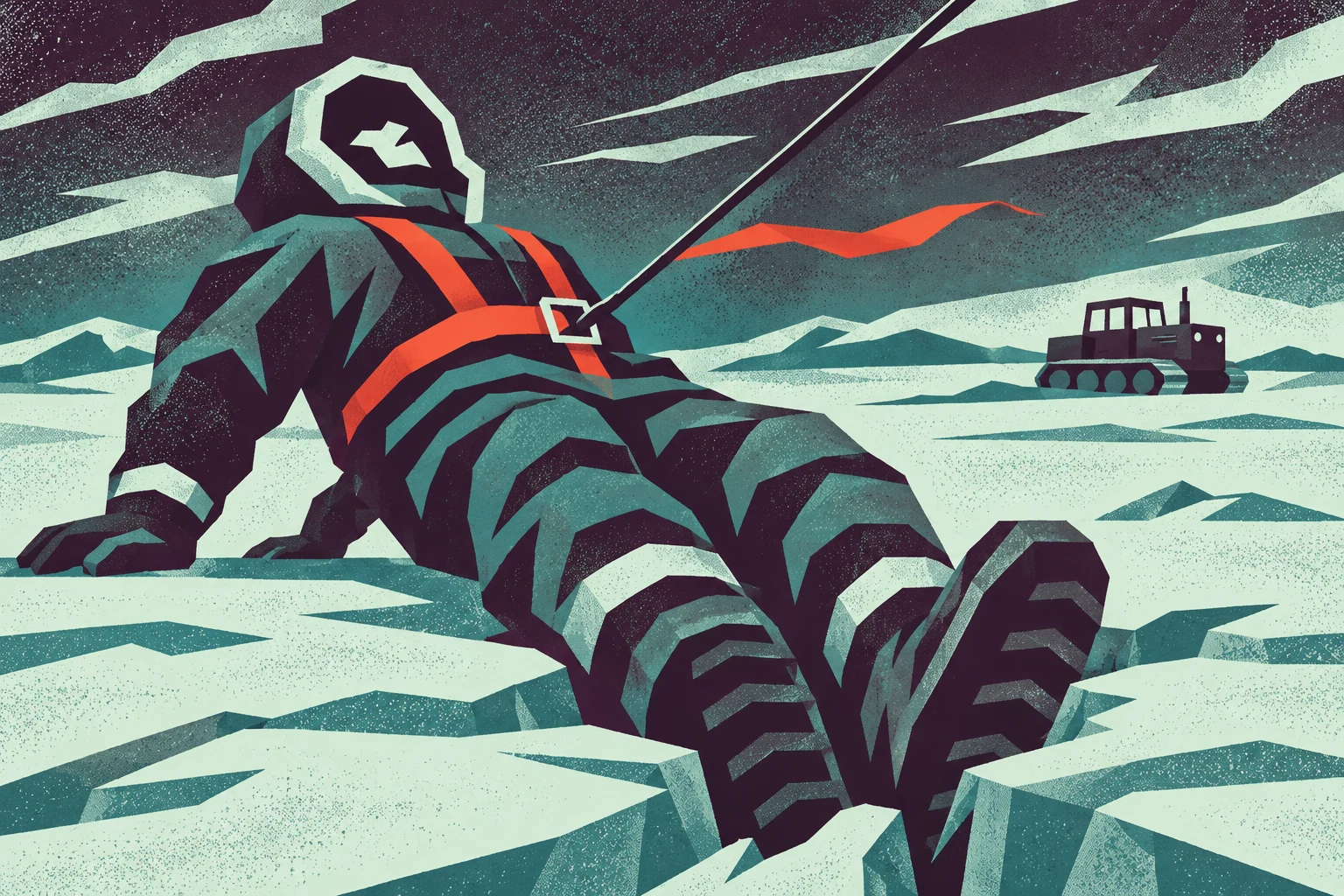
On 2 June 1962, in a hard wind over the Arctic Ocean, a helium balloon dragged Leonard LeSchack across the ice until a block of ice stopped him. Overhead, a converted B-17 bomber was lining up to catch the line tied to his harness and snatch him into the sky.1
An abandoned station on the ice
LeSchack and his partner had been on the ice for five days. On 28 May, the two Americans had parachuted onto an abandoned Soviet research station called NP8, drifting on the Arctic Ocean. Its crew had left when the ice around their camp became too dangerous, abandoning equipment and research material. Major James F. Smith of the US Air Force and Lieutenant LeSchack of the US Naval Reserve had come to see what remained. Both would get home alive, with a haul of documents, exposed film and equipment samples. Getting them off the ice proved far harder than getting them on.13
A drifting station offered an unusual intelligence opportunity. It was a rival’s workplace, and nobody had to break into an embassy or persuade a scientist to defect: the people who knew the equipment had simply left. What they had left behind could answer questions that aerial photography could not. The problem was reaching it before the conditions that had driven out the Soviet team made an American visit impossible.1
Both the United States and the Soviet Union ran research stations on the Arctic ice, where scientists could take observations far from land while the floe carried them across the ocean. The science was real. It also mattered to navies that wanted to operate beneath the ice, where understanding the environment could matter as much as understanding an enemy’s machinery. A research station could serve both purposes without every measurement being a military secret.15
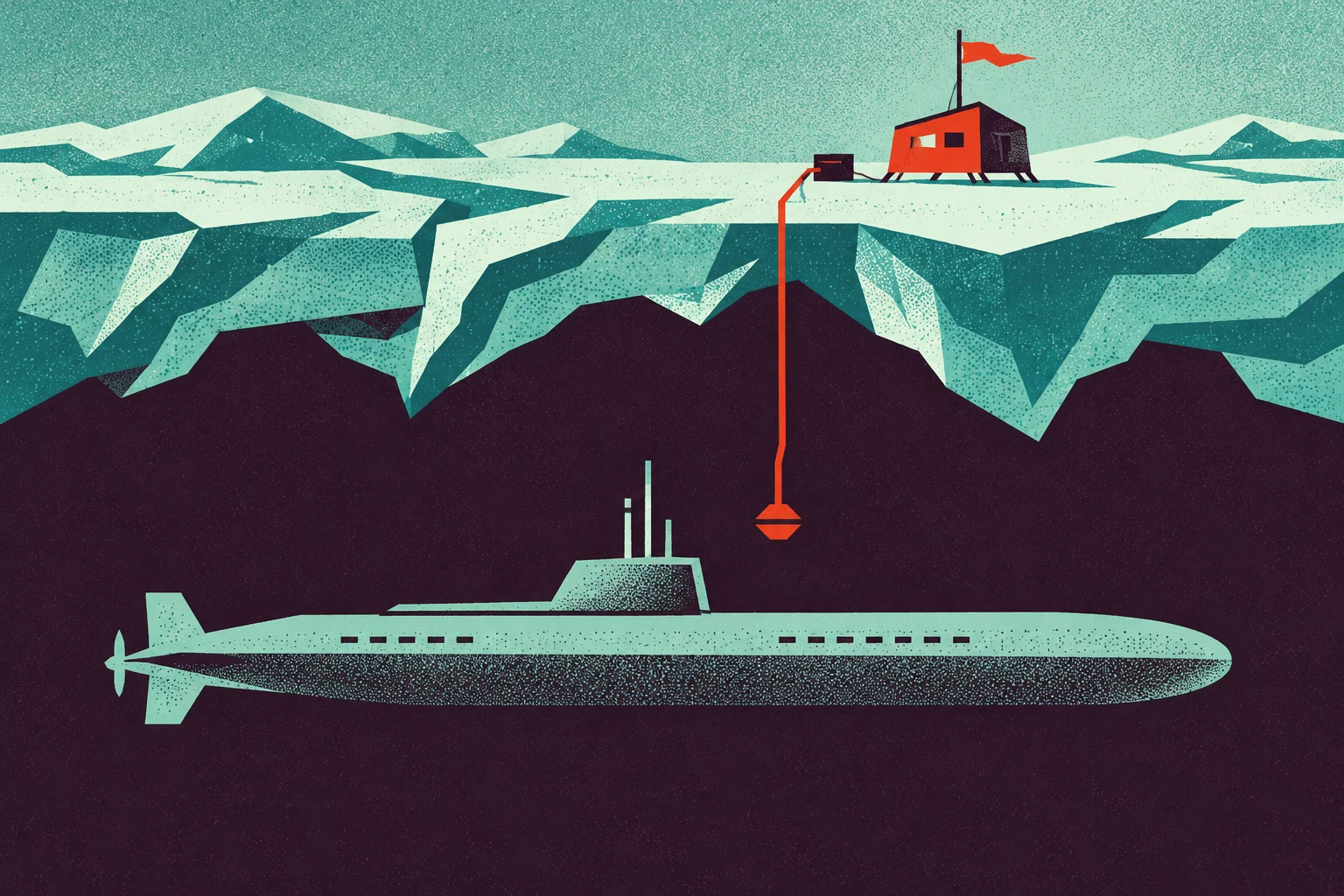
By the early 1960s, nuclear-powered submarines had made the polar ocean a practical place to operate. Ice that blocked a ship on the surface could hide a submarine beneath it, which raised an urgent question for the Americans: what could Soviet researchers hear? If a submerged boat could be detected by its sound, the ice became a platform from which an enemy could be watched. American planners wanted evidence of what the Soviets could do, not an assumption that Moscow had the same techniques.1
LeSchack knew the question from his own work. A geophysicist with polar experience, he had helped install surveillance equipment on the American ice station T-3 in 1960. In an interview published decades later, he recalled proposing a search of an abandoned Soviet camp to find out whether its equipment could track American submarines, exploiting whatever a departing expedition could not carry away. His memory fits the operation’s stated interest in acoustic research.14
Smith brought different skills: experience on American drift stations, Russian and parachuting. Anyone examining unfamiliar apparatus needed to recognise what it was, and anyone searching its paperwork needed to understand it. Both men also had to survive in an environment where staying alive might matter more than gathering intelligence. They were chosen as investigators, not just as passengers willing to try an extraordinary pickup.1
The mission was named Project COLDFEET, and its central gamble was simple to state: drop two specialists on the ice, give them time to search, then recover them without a runway. The Soviet evacuation had shown how dangerous an airstrip on ice could be, so the American plan avoided landing altogether, at the price that everything they collected, and both men, would have to leave on the end of a rope.1

An exit through the sky
The rope belonged to Robert Edison Fulton Jr.’s Skyhook. In its finished form, the person waiting on the ground wore a harness attached to a long nylon line, which a helium balloon lifted into the air. The approaching aircraft flew into the line, caught it in a fork mounted on its nose and locked it in place. The passenger was jerked off the ground while the crew hauled the trailing line into the aircraft and hooked it to a winch.1
That sequence explains both Skyhook’s appeal and its limits. An ordinary aircraft could reach a place with nowhere to land, and the people on the ground needed nothing more than a parachuted package of equipment. But catching the line was only the beginning. The passenger also had to be lifted safely, the line handled correctly and the person reeled in through the aircraft’s hatch without losing the connection.1
Earlier systems had snatched a line strung between two poles, borrowing a technique used to collect mail, to solve an old problem, because it was far easier to parachute someone into a remote place than to get them out again. Fulton replaced the low-slung line with one held aloft by a balloon and developed a catching mechanism for the aircraft, so the balloon held up the line and the aircraft did the lifting.1
Fulton’s experiments began in 1950. Making the idea work took more than a rope strong enough to carry a person. The line had to be caught reliably, held as the load came under strain and then released from the nose fork so the crew could finish the recovery. Jerry Thigpen’s history for Air University describes the locking device, known as the sky anchor, as crucial to making the system work. A catch that could not be handled afterwards would solve nothing.1
By 1958, the basic design was settled. The Navy’s modified P2V aircraft carried projecting steel forks, and the ground kit included a harness, a helium supply and a 500-foot line, with a marker below the balloon to give the pilot something to aim at. Tests moved from weights to instrumented dummies to live subjects. On 12 August 1958, Marine Staff Sergeant Levi W. Woods became the first person picked up by the Fulton system. Human pickups were an established test procedure well before COLDFEET was proposed.1
Arctic trials followed in 1960, including pickups from ice station T-3 and from the deck of the icebreaker USS *Burton Island*. Success in a convenient test area would not have proved the system could cope with polar conditions, so these trials mattered. They also showed that the load need not be a person: Skyhook could recover the equipment or records that made an intelligence visit worthwhile, as well as the people sent to find them.1
A working system still needed a trained team. The pilot had to approach the line correctly, the crew had to handle the shifting load and transfer it to the winch and the person below had to wear the harness properly and adopt the right position. LeSchack and Smith practised with the system at Patuxent River in Maryland, and LeSchack also learned to parachute, which he had never needed before. They were preparing for two very different journeys: leaving an aircraft in flight, and boarding one without it landing.1
COLDFEET would test the whole chain at once, with no friendly runway nearby and no guarantee that the weather over the station would match the weather at base. The invention removed one obstacle. It could not make the Arctic predictable, and before Smith and LeSchack ever reached NP8, the Arctic nearly ended the operation.1
A target that would not wait
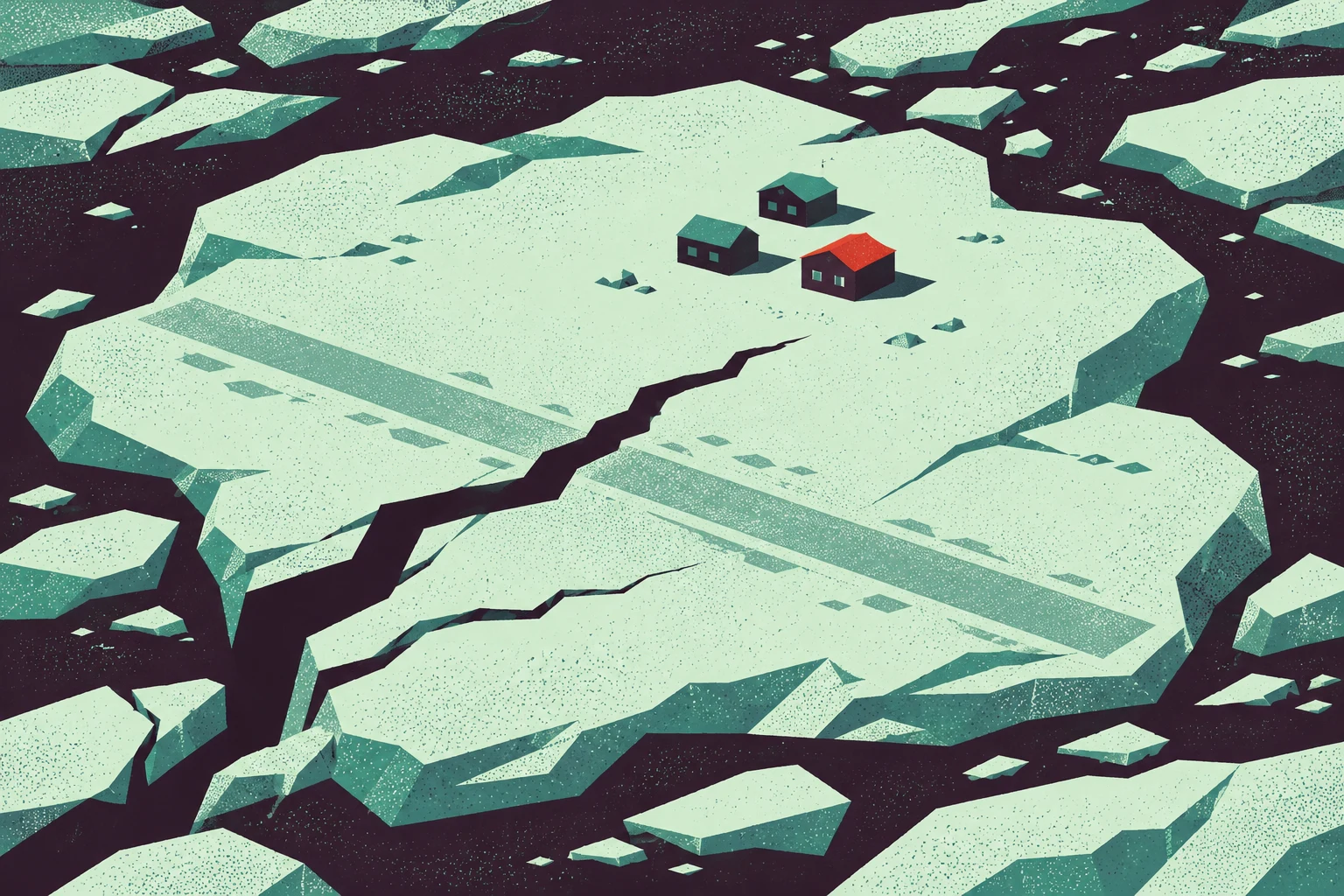
NP8 was not the first target. In 1961, the Americans became interested in another abandoned Soviet station, NP9, after a naval aircraft spotted it and word got out that the Soviets had left. The Office of Naval Research began planning a visit. The numbering is confusing: the operation first planned to visit Station Nine and ended up inspecting Station Eight, simply because it was the one available.1
The first plan called for an expedition in September 1961, flying from Thule in Greenland under the command of Captain John Cadwalader. Approval was slow. Senior officers questioned whether the mission could succeed and whether the risk to the investigators was acceptable, and by the time permission came through, the season was closing. An intelligence opportunity on drifting ice could float away while officials argued about it.1
Equipment caused more delays, as cold-weather testing at Eglin Air Force Base in Florida exposed problems that had to be fixed before the mission could go ahead. A successful demonstration was not proof that everything was ready, and the station went on drifting while the Americans worked through their problems, until winter pushed the attempt into the following year. NP9 did not stay put for its visitors.1
In March 1962, news that NP8 had been abandoned revived the plan with a new target. The Americans got permission to fly from the Royal Canadian Air Force base at Resolute Bay, and a Skyhook-equipped Navy P2V and a supporting C-130 went north in April. The C-130 would find the station and drop the investigators, and the P2V would bring them back. On paper, the operation now had a destination, a base and the right aircraft for both jobs.1
The station was not where the searchers expected. The C-130 flew to its last known position and searched outwards in a box pattern, then searched again with its tracks closer together. More flights followed, and still the camp did not appear. Clear weather was no help when the search was in the wrong part of a moving ice field. When the flying hours ran out, the expedition was cancelled without either man setting foot on the ice.1
Later reconnaissance found NP8 east of the area that had been searched. The station was still there, but the Office of Naval Research had run out of money. Fulton was already working with Intermountain Aviation, a company secretly owned by the CIA, which had fitted a B-17 with Skyhook equipment and practised aerial pickups. Its pilots, Connie Seigrist and Douglas Price, offered another way to reach the station, if anyone would pay for it.1
The Defense Intelligence Agency put up an initial $30,000, and Intermountain supplied the modified B-17 and a C-46 support aircraft. This time the mission would start from Point Barrow in Alaska. New aircraft and a new base did not change the basic problem: the Americans still had to find a small abandoned camp in an ocean of ice. On 26 May 1962, the aircraft reached Alaska and the search began again.1
Seventy-two hours
The first B-17 search failed too. On 27 May, Seigrist and Price spent about thirteen hours in the air without finding NP8, because unlike most intelligence targets, which are fixed buildings, airfields or shipyards, this one was moving. The searchers were looking for a camp whose last reported position was out of date before they took off, and poor visibility made it even harder to spot.1
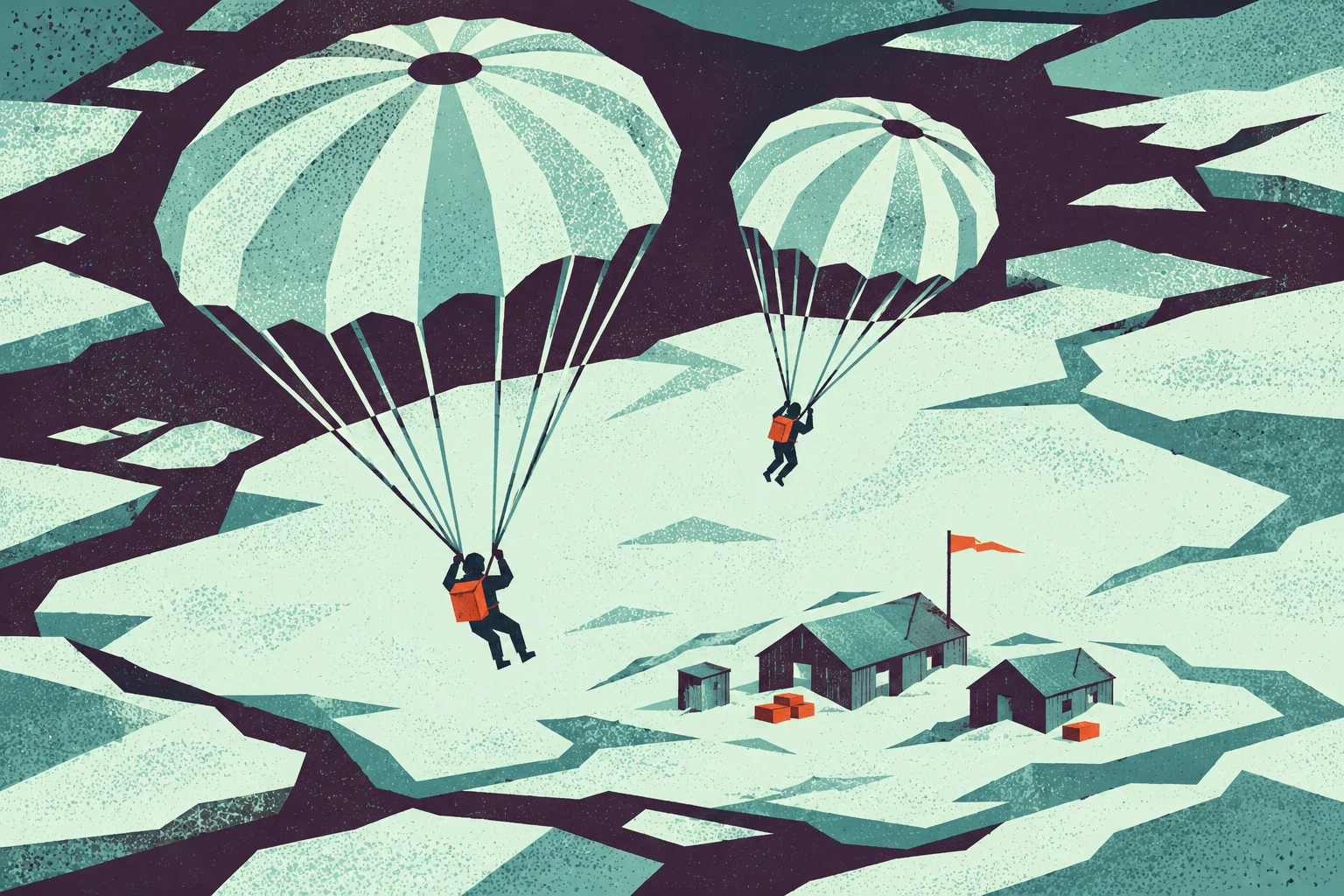
On 28 May, with help from a Navy P2V, the B-17 found the station, and Smith and LeSchack finally jumped, dropping through a hatch in the aircraft’s belly of the kind used for earlier secret parachute missions, with supplies following them down. Once they had reported by radio, the B-17 flew away, so the men had reached their target, but getting home depended on someone finding it again.1
The plan allowed seventy-two hours for the inspection, though delays would keep them on the ice until 2 June. They photographed the station and gathered material to be examined elsewhere. Equipment and working arrangements together would reveal more than either alone: an instrument showed how a measurement was taken, the records showed what its operators thought important, and photographs captured how things too large to remove fitted together. This was a technical inspection, not a hunt for one dramatic document.13
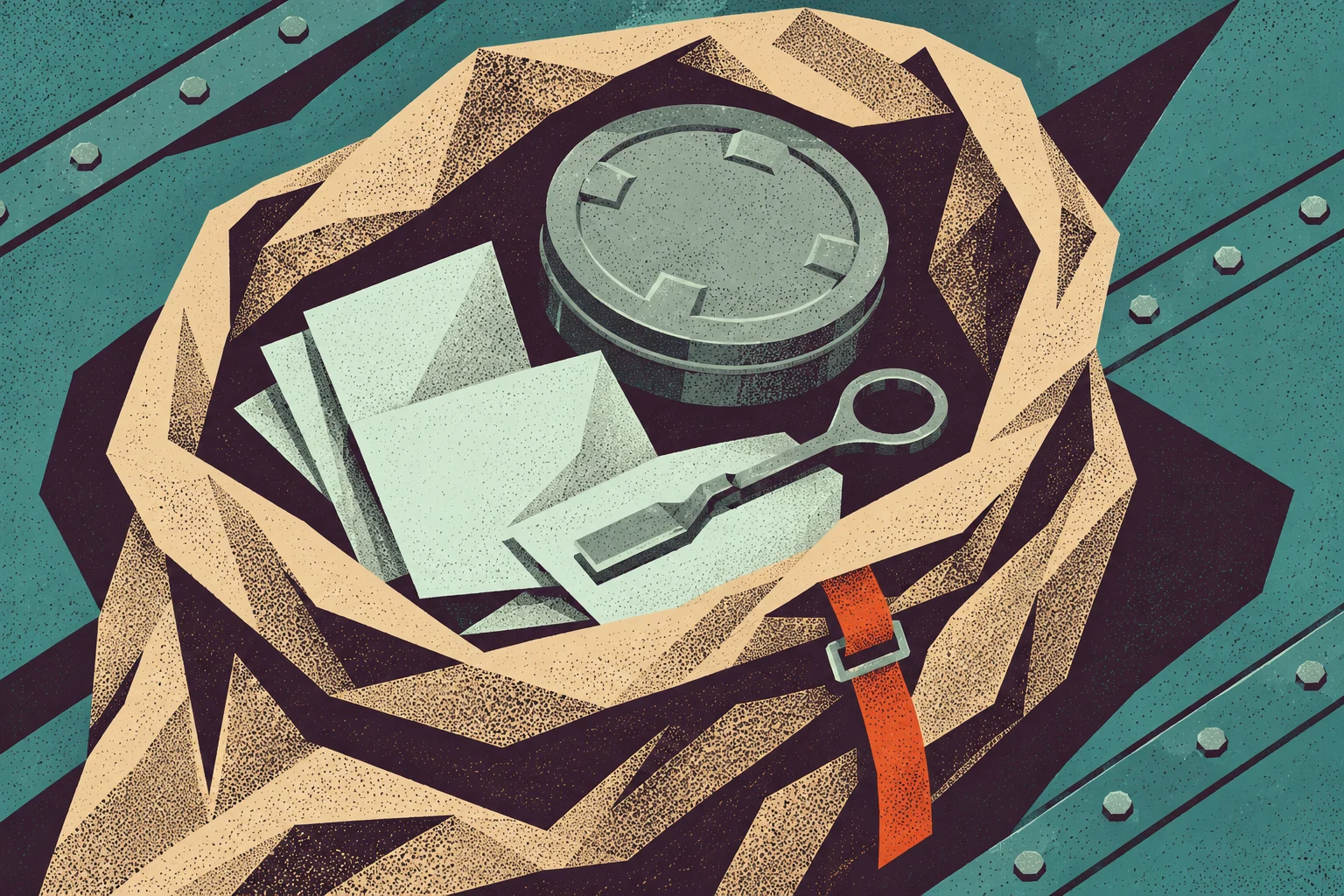
The published summaries describe the haul only broadly: exposed film, documents and equipment samples, weighing about 150 pounds. There is no full inventory, so no list of secret charts, codebooks or listening devices should be invented to fill the huts. The haul was heavy enough to need its own pickup, but its weight says nothing about how many discoveries the two men made.13
Their expertise shaped what the mission could achieve. Smith could read Russian documents on the spot instead of sending everything back for translation, and LeSchack could judge a polar station against his experience of American ones. The Americans had not simply found abandoned property. They had put people capable of asking informed questions right beside it, and success depended on choosing the right evidence in the time available, not on carrying everything away and hoping analysts would sort it out later.1
The station had a history before it became an American target. A catalogue entry in the Russian State Library records a substantial volume of scientific observations from NP8 and NP9 in 1960–61, published in 1964 under the editorship of K. A. Sychev. That volume has not been examined for this article, and its catalogue entry says nothing about what the Americans took. It does show that the stations produced a public scientific record as well as attracting secret attention.5
While Smith and LeSchack worked, Intermountain’s mechanics prepared the B-17 and tested its pickup gear at Point Barrow. The return trip was set for 31 May, three days after the drop. The aircraft would never need to touch the ice, but the crew would need to see the station and its pickup line well enough to approach safely. The weather was about to make that much harder.1
Lost in grey
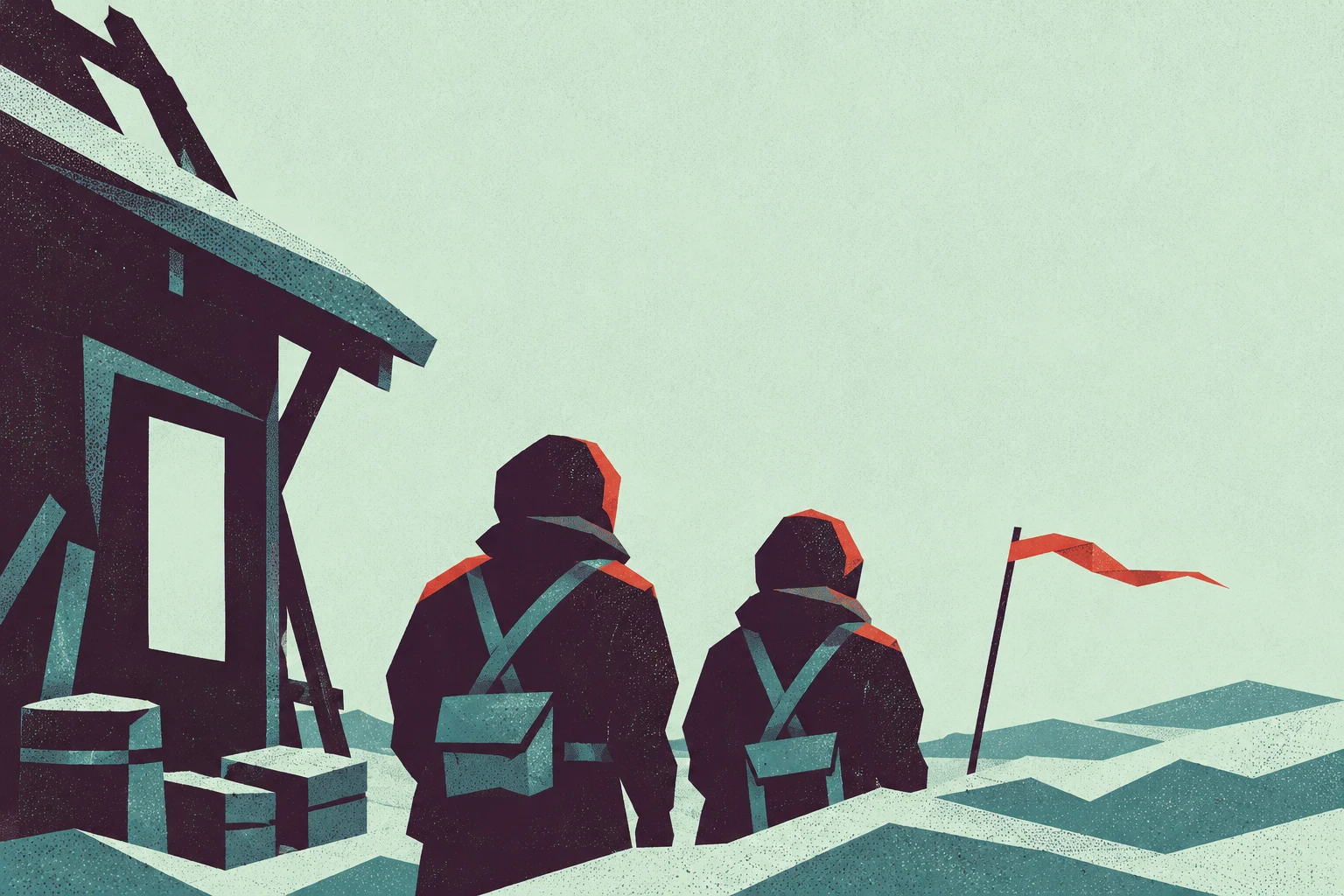
On 31 May, the B-17 could not find the station. Fog hid the camp, and the aircraft returned to Alaska without the men it had come for. Another attempt on 1 June also failed. The crew had already found the station once, to drop the two men; now they had to do it again in worse weather, carrying the equipment needed to bring them home.1
The delay did not mean the men had vanished or the station had broken up. The official history describes failed attempts to find it from the air, nothing more. No Soviet pursuit, no attack on the camp and no final distress call appear in these accounts. The danger lay in the known limits of the recovery plan and the difficulty of reaching the men waiting on the ice.1
A balloon could lift a line above the ice, but it could not make the surrounding terrain any easier to read. The pilot needed enough to see to control his approach and enough certainty about his position to avoid flying into the ice. Fog could hide the camp completely, and even when it was visible, a faint or missing horizon made it hard to keep the aircraft level by eye. Skyhook had done away with the runway, not with the need for precise flying.1
On 2 June, the Americans again sent a P2V to help, flying ahead of the B-17 so that it could search first. It found the station and guided the B-17 in. The famous recovery depended on help from a second aircraft, not on the B-17’s crew overcoming every obstacle alone.1
Conditions over the camp were still poor. Thigpen’s history records winds of about thirty knots and a horizon that was hard to make out. The men on the ice had to inflate and control the balloons in that wind while preparing the loads, and before any aircraft caught anything, a balloon could drag its cargo, or a man, across the ice. A device designed to lift a person had become hard to hold down.1
There would be three pickups: first the bag of material, then LeSchack, then Smith. Whoever went last would have to prepare his own pickup with nobody to help him. Both men had practised the procedure, but neither could count on a second pair of hands all the way through.1
Three loads for the aircraft
Seigrist flew the first approach. The canvas sack held everything that had justified the expedition, and its balloon was already pulling so hard the men could barely hold it, but the B-17 caught the line and the crew hauled the cargo aboard. The system had worked in the conditions over NP8, though the two human pickups were still to come.1
Price took the controls for LeSchack. As the balloon rose and caught the wind, Smith could not hold his partner down. LeSchack was pulled off his feet and dragged across the ice, about three hundred feet according to the official history, until he hit a block of ice. He was still being hauled along by the line when Price flew into it.1
LeSchack’s own memory adds an uncomfortable detail. His face mask slipped during the ordeal, blocking his vision, and he found himself facing the wrong way as he was lifted. Once airborne, he used his arms to turn himself until his back was to the wind. This is a participant’s memory recorded many years later, not a measurement made at the time, but it shows that getting into the air did not end the danger.4
The sources differ on some details of the wind and the sequence. LeSchack remembered lower wind speeds than the thirty knots in the official history, and the two figures should not be averaged or treated as the same observation. What they agree on matters more: the balloon dragged him across the ice, he went up in an awkward position and he had to right himself before he was pulled aboard.14
Now Smith was alone on the ice. He held on to a tractor while preparing his balloon, but the wind began dragging him too. He stopped himself by jamming his boot heels into a crack and lay on his back, waiting for the aircraft. The cracking ice that had made the station too dangerous for its Soviet crew now gave the last American just enough grip to stay put.1
Seigrist flew the final pickup, and when the aircraft caught Smith’s line, the crew hauled him aboard, so both men and their haul were off the ice. There had been no landing, and the aircraft had made three separate pickups in conditions well beyond the comfortable limits of the system, so if either human pickup had failed, this would be a very different story.1
Skyhook is often described as though the whole achievement lay in the moment the fork met the rope. The rest of the sequence mattered as much. The load had to stay attached while the line was transferred and wound in, and a person dangling behind an aircraft still had to be brought inside it. Pilot, ground crew and winch crew were one operation, and success at one stage counted for nothing if another failed.1
Nor did success prove the equipment was safe. Later versions included ground anchors, with fittings for ice and frozen soil, to hold the waiting load down in a high wind, and Thigpen explicitly links that improvement to lessons from COLDFEET. The mission proved a useful capability while exposing a danger its own participants had experienced first-hand.1
What the ice gave up
Was it worth the risk? The declassified American assessment describes a station set up for long periods of quiet operation. That mattered to anyone interested in listening beneath the ice, because machinery noise could drown out acoustic measurements. The inspection gave the Americans evidence of how Soviet researchers had organised the station, in place of a suspicion held from far away.1
The published assessment stops well short of proving that the station could detect American submarines. A station built to run quietly is one thing. The public accounts contain no detection trials, ranges, success rates or recorded submarine contacts. They show that the Americans judged Soviet acoustic work important, and say little about how well it performed.1
The Americans also rated Soviet work in polar meteorology and oceanography highly, describing parts of it as ahead of their own. That undercuts any picture of the camp as a military front. Useful intelligence included learning how a rival did science and kept an installation running in brutal conditions. A successful haul could reveal an advantage worth studying as well as a secret weapon.1
A research station can publish genuine science and still hold information a rival navy wants to see. The Russian catalogue record documents the first, and the American mission the second. Neither tells us the military status of every instrument or every person who worked there, and calling the whole camp fake science would claim far more than the evidence shows.15
The origins of the story matter too. Thigpen’s military history takes its account of COLDFEET from William M. Leary’s earlier work, and Leary drew on participants’ accounts and an operational report by Cadwalader. These are good sources, but retelling the same account in later histories does not make the retellings independent. Most of the familiar story travels along one documentary chain, supplemented by the memories of the people involved.12
Leary was frank about one limitation. In a note to his account, he explained that descriptions of the events of May and June differed in places and that he had used the sequence he considered most logical. That does not cast doubt on the operation or its success. It does mean that the minute-by-minute details of popular retellings do not all come from a single complete record made at the time.2
A full assessment would need the recovered material and the original technical analysis, compared with Soviet records of the station’s work. For a general history, what is known is remarkable enough. The Americans found equipment and arrangements they considered valuable, brought them out through a dangerous operation and gained a clearer view of Soviet polar research. What questions their analysts went on to ask, the public record does not say.12
A success with limits
COLDFEET gave Skyhook a real operational test beyond its controlled trials. It had taken people out of a place no aircraft could land. And the safe return gave American intelligence a story of ingenuity, cooperation and persistence through repeated setbacks, in which finding the camp, paying for the mission and flying the aircraft counted for as much as the invention itself.1
The technology did not guarantee safety. Thigpen records a fatal accident during a training pickup in 1963, when the person being recovered came loose before being safely secured inside the aircraft. That death was not part of COLDFEET and does not belong in its casualty count. It showed how much depended on the final stage, after a catch that seemed successful had already brought someone to the aircraft.1
Later military versions adapted the system to other aircraft and refined its equipment and procedures. The projecting forks make a striking photograph, but the less visible improvements mattered just as much: managing the line, keeping it clear of obstacles and holding the waiting load on the ground. COLDFEET was a demanding early use of the system, with lessons to carry forward. It was not the moment aerial extraction became easy.1
In 2008, participants were honoured at CIA headquarters at the unveiling of a painting of the operation by Keith Woodcock. Painted in 2007, it shows a B-17 making a pickup over the ice. The agency’s museum places the mission within its own tradition of resourcefulness and celebrates a success that many of the participants’ families had never heard about in detail.3
As of November 2026, the public sources support a clear operational success and a more limited technical one. Smith and LeSchack landed on NP8 on 28 May 1962 and were recovered on 2 June with material the Americans valued. The published summaries describe the broad intelligence findings, but list nothing they brought out and offer no measure of what it proved about detecting submarines under the ice.123
Linked case files


Sources5
- The Praetorian STARShip: The Untold Story of the Combat Talon Jerry L. Thigpen / Air University Press · 2001-12 · Accessed 2026-11-07
- Robert Fulton’s Skyhook and Operation Coldfeet William M. Leary / Studies in Intelligence · 1995 · Accessed 2026-11-07
- Seven Days in the Arctic CIA Museum · Accessed 2026-11-07
- Leonard LeSchack: Spy, scientist and Navy captain Don Otis / Sandpoint Magazine · 2015 · Accessed 2026-11-07
- Observations of drifting research stations North Pole 8 and North Pole 9, 1960/61: catalogue record Russian State Library / Arctic and Antarctic Research Institute · 1964 · Accessed 2026-11-07