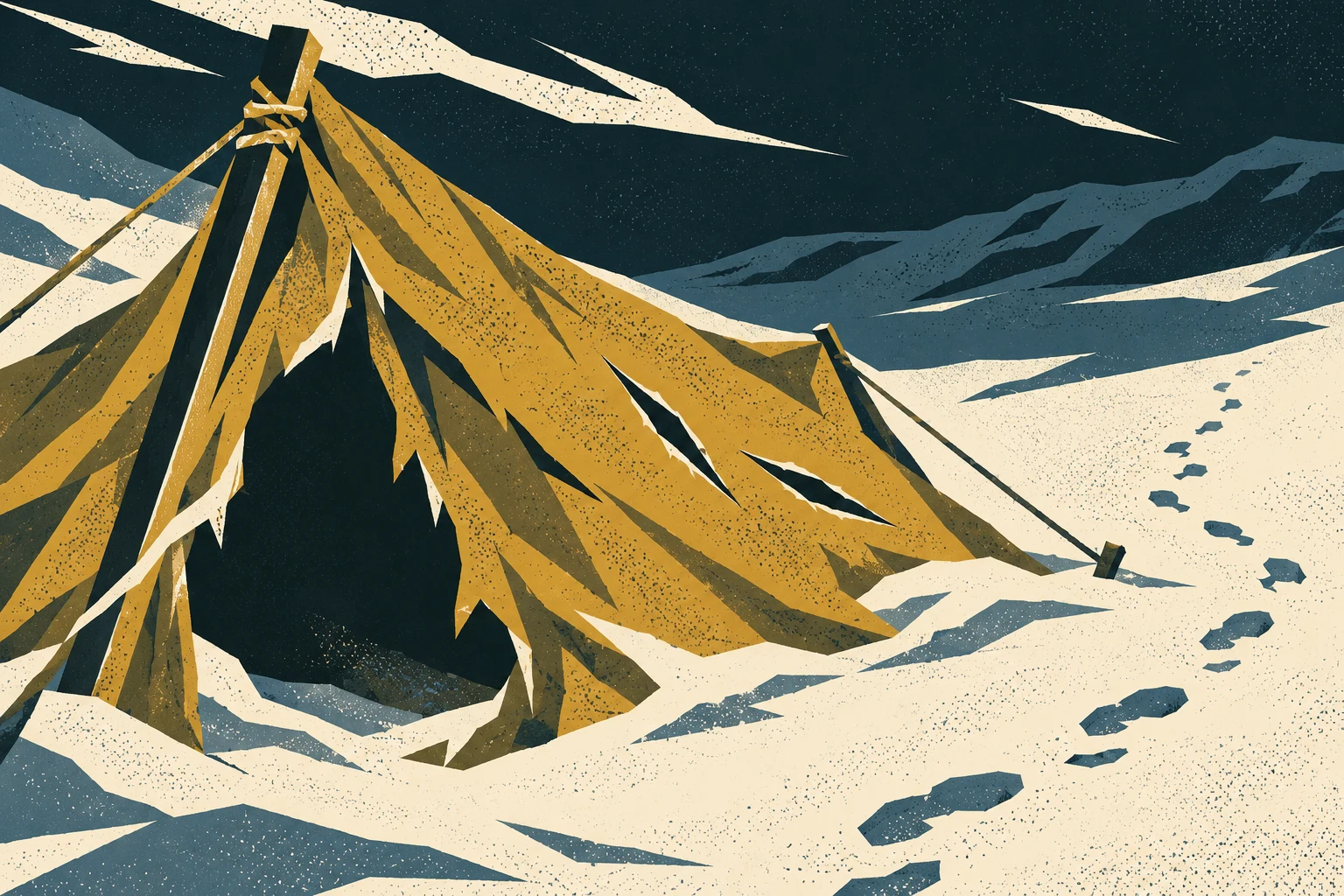
On 26 February 1959, student searchers found a tent half buried in snow on the eastern slope of a Ural mountain. Nobody was inside. The nine hikers who had pitched it had left behind the boots and clothing they needed to survive.4
The mountain was Kholat Syakhl, marked in the investigation as height 1079. Boris Slobtsov, who led the search party, later described a pocket torch lying on the canvas. When he switched it on, it worked.4
It is the kind of detail that has made the Dyatlov Pass incident one of the most retold mysteries of the Cold War. Nobody returned from the final camp to say what had happened there. The hikers left photographs and diaries but no account of the emergency itself, and what followed was pieced together by searchers, doctors and investigators. Their records describe a disaster that unfolded in stages, not a single scene of nine people struck down by something inexplicable.1324
The dead were Igor Dyatlov, Zinaida Kolmogorova, Lyudmila Dubinina, Yuri Doroshenko, Yuri Krivonischenko, Rustem Slobodin, Aleksander Kolevatov, Nikolay Thibeaux-Brignolle and Semyon Zolotaryov. They are usually remembered as students, but the group also included engineers and a tour-base instructor.3
They were found in different places, in different clothing, with different injuries. Some died of cold; three suffered fatal major trauma. Whatever drove them from the tent need not explain every death that followed, and a devastating injury need not have been suffered beside the tent.910111213
In July 2020, a Russian prosecutorial review announced that an avalanche was to blame. A scientific model published the following year showed how a small slab of snow could break away hours after a disturbance, and later expeditions found terrain and avalanche activity nearby that fitted parts of the argument. None of it amounts to a witnessed account of the night of 1–2 February 1959.192021
Much of what English-speaking readers know about the case comes through the archive assembled by the specialist researcher Teodora Hadjiyska, who reproduces translations of the Russian records alongside scans of the originals. The archive gives unusually close access to the investigation. Its own editorial theories are a separate matter from the documents it hosts.24
The heart of the case lies in the distance between the last camp and the forest below. Within it are an urgent departure, a descent without adequate protection and attempts to build another shelter. Whatever began the emergency, the nine still had to survive what came next.
There should have been ten. Yuri Yudin told investigators in April 1959 that his leg had begun to hurt and that he turned back at the Second Northern settlement on 28 January, while the other nine went on with their equipment, so Yudin survived because he left early.2
His statement describes an organised sporting expedition, whose members divided responsibilities, collected contributions and drew supplies and equipment through the institute’s hiking organisation. Zolotaryov had joined shortly before departure, and Yudin said he behaved well on the journey, so nothing in the evidence makes the newcomer a hidden cause of the deaths.2
A winter journey
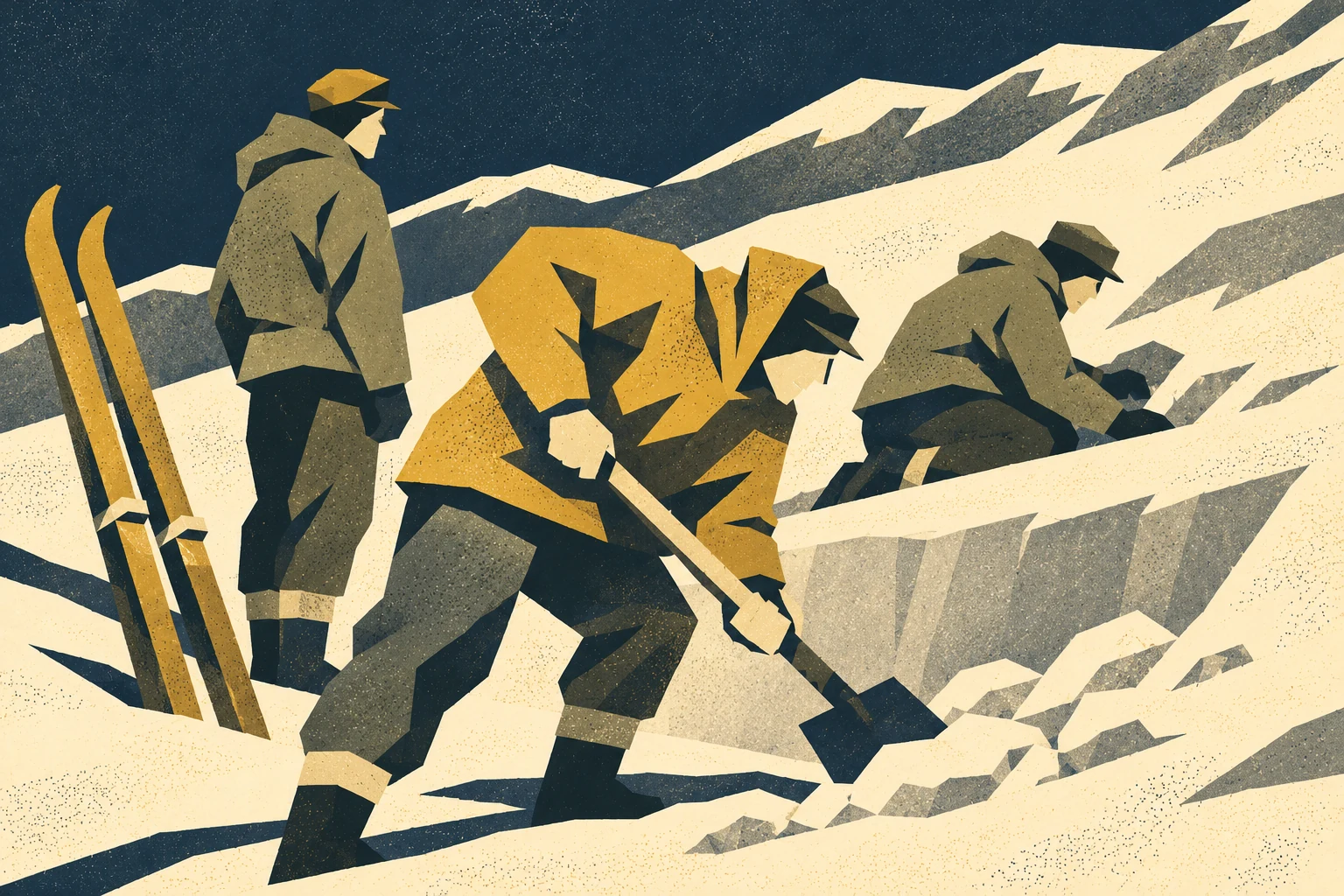
The party’s own diary records hard work. On 30 January the hikers struggled through deep snow, and the following day they tried a new system in which one skier, without a pack, broke trail ahead, rested and then rejoined the others while the next took over, a practical answer to the conditions.1
The 31 January entry describes a strong westerly wind as the forest gave way to open ground. The group dropped into the Auspiya valley to camp, finding shelter and warmth below the ridge. The entry tells us what the hikers felt that day. It cannot tell us how hard the wind blew on the slope the following night.1
The final photographs show the party working in snow on the mountainside. In the closure resolution, the investigator Lev Ivanov used the exposure settings and the appearance of one frame to estimate that the tent was going up at about five in the afternoon on 1 February.3
Ivanov’s resolution also criticised Dyatlov’s route and timing. It is tempting to let the choice of campsite explain the whole tragedy, but those judgements were made after the outcome was known. They show how the investigation apportioned responsibility, not what the hikers knew when they stopped.3
Experienced members of the Soviet hiking community considered the party qualified. Vladislav Karelin, who had recently travelled in the region himself, told investigators that the members he knew met the requirements for a third-category winter expedition, the most demanding grade. Slobtsov described them as prepared for that level of travel.416
Competence did not make them immune to danger, but it does rule out a party of helpless novices. These were people used to travelling, working and camping together in winter. If something forced them out, what they did next is best read as the work of an experienced group under growing pressure.
More than three weeks passed between the last photographs and the discovery of the tent, while snow and wind went on working on the site. Then the searchers arrived, dug, removed equipment and took the shelter down, so the record begins after all of that, not at the moment the hikers left.45
Slobtsov was careful to separate what he had seen from what he had heard. He saw the torch, the canvas, the snow and the tracks; he did not claim to have witnessed every object or mark later reported. His statement also says the contents were removed on 27 and 28 February, not catalogued all at once when the tent was found.4
Captain Aleksey Chernyshev described the middle of the tent weighed down with snow while its entrance remained standing. Inside were provisions, bedding, clothing and footwear, with the stove packed in its case, and it did not look like a camp that had been methodically struck for the next day’s march.5
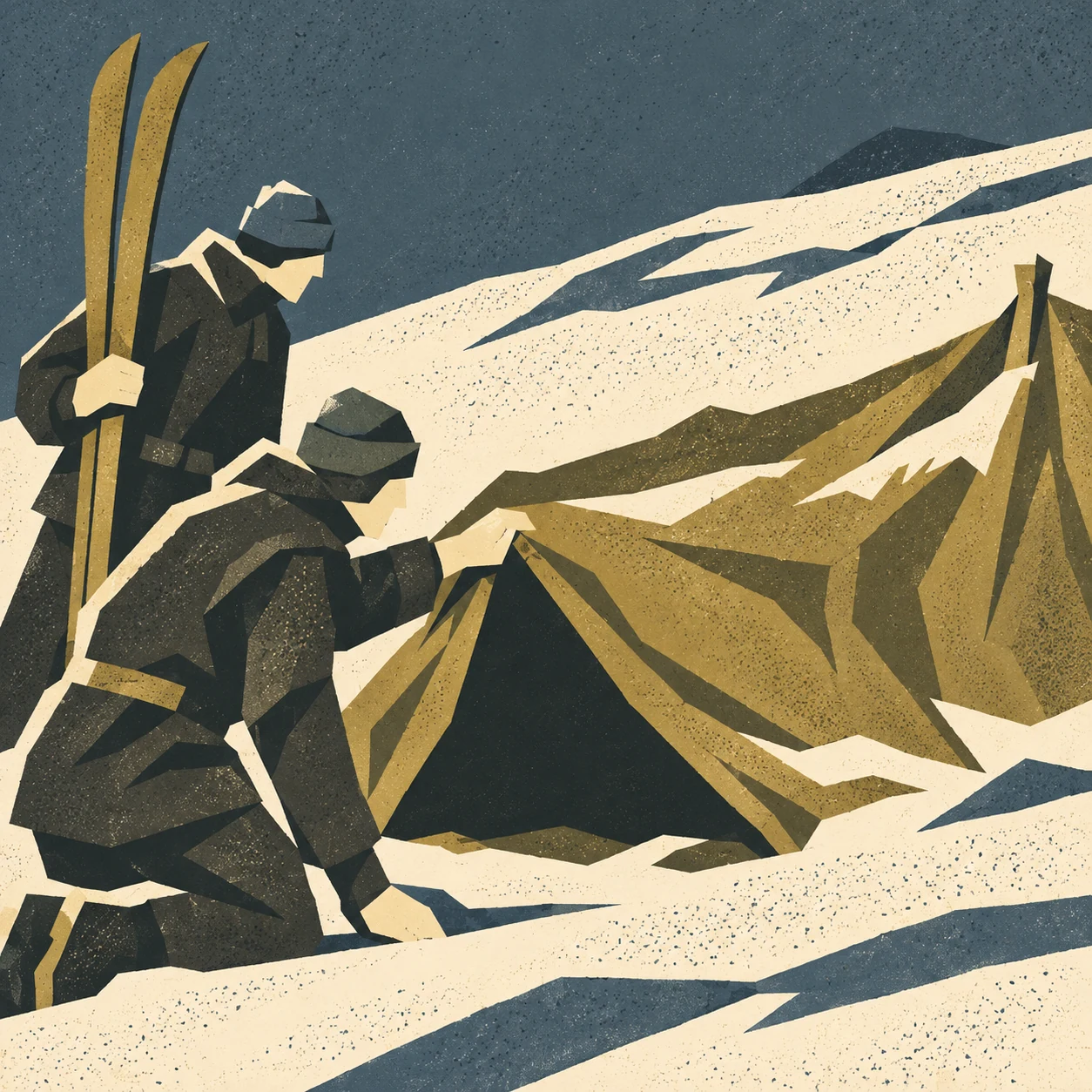
The canvas itself received one of the most important examinations in the file. In April, an expert named Churkina reconstructed the pitched tent with Yudin’s help and examined each damaged thread and edge to separate cuts from tears. Three openings, approximately 32, 89 and 42 centimetres long, were knife cuts.6
Cuts in the canvas
Under the microscope, Churkina found smaller scratches, punctures and incisions on the inner surface around those cuts, and concluded that all three had been made from inside, while the rest of the damage was tearing. It is a more precise finding than the familiar claim that the tent was simply slashed open.6
It tells us which way the knife went, but not who held it, in what order the cuts were made, or why, whether to clear a blocked exit, to escape a collapsing roof or to flee a danger that left no trace. Answering that requires other evidence.
The tracks offer the same mixture of information and silence. Chernyshev described several sets of prints, at first in two groups and then converging. He could make out the marks of feet in socks and at least one boot, and he read the pattern as people going down the slope together.5
Slobtsov remembered the tracks standing proud of the surrounding snow, where the wind had scoured away the looser material around the compressed prints. He did not give a confident headcount. Neither the popular image of a calm march nor that of a panicked flight can be read securely from those raised impressions.4
Search leader Evgeniy Maslennikov was more specific. In April he said that eight pairs of prints could be distinguished together only along a limited stretch; a ninth was uncertain because the tracks overlapped, and elsewhere fewer were visible. The tracks cannot prove that all nine walked down unaided.25
The 1959 closure found no sign of a struggle and no evidence of another party at the tent. That weighs heavily against an attack, though an incomplete search record could never guarantee that every movement on the mountain would have stayed visible.3
One consequence was plain. The descent took the party away from almost everything that protected them from the cold, so whatever drove that decision also created a second emergency. Escaping the tent and surviving outside it were separate problems, and any explanation has to solve both.
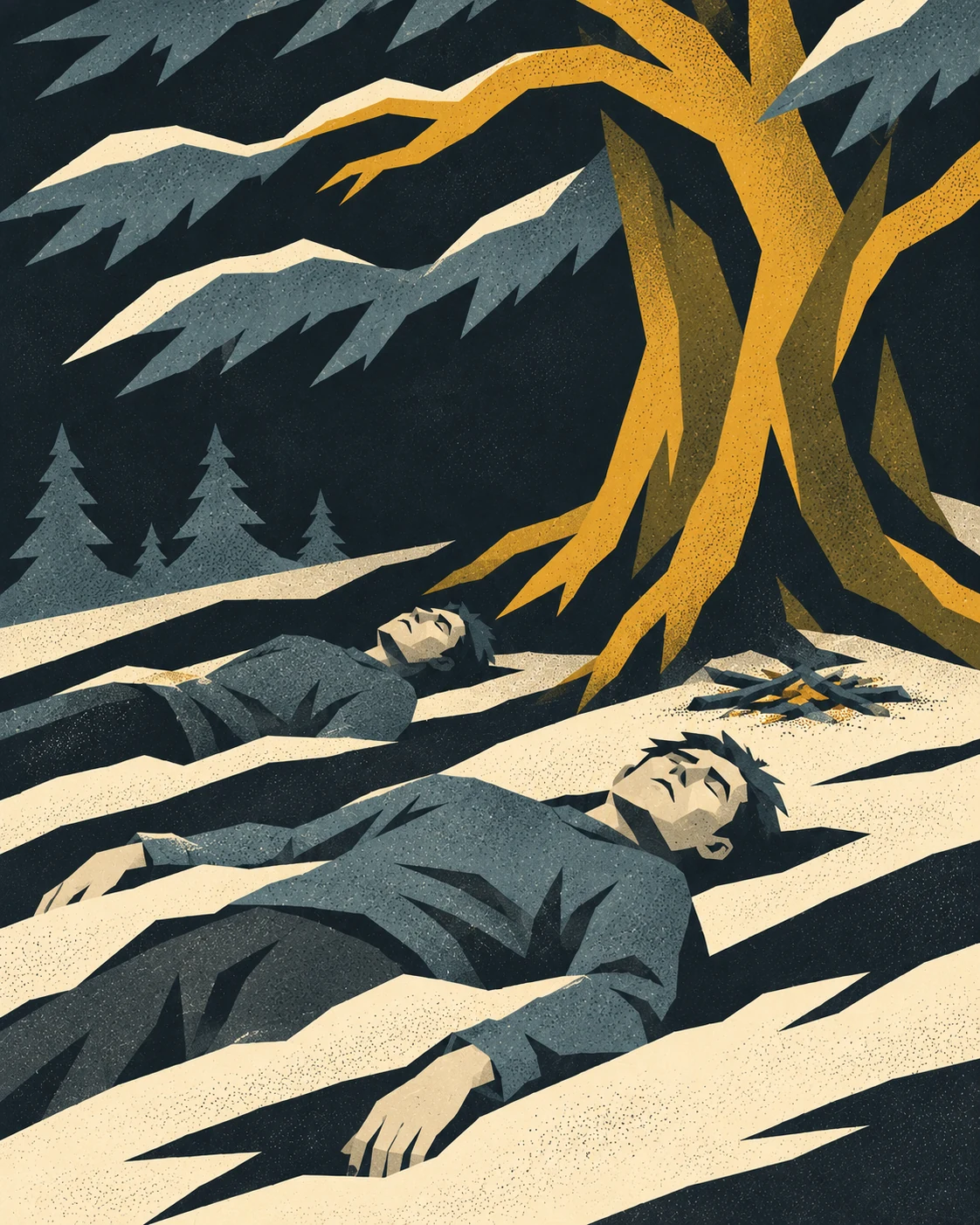
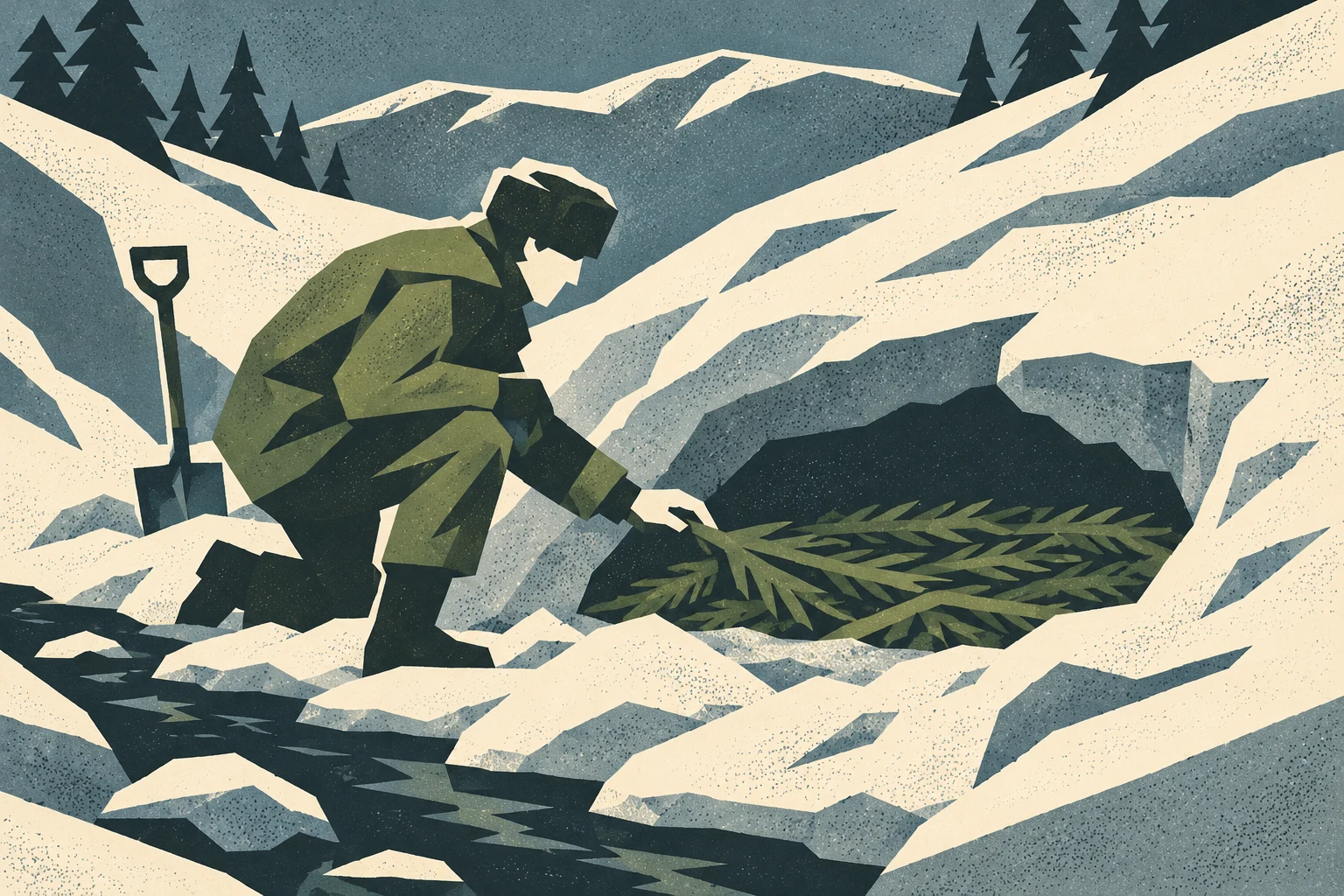
At the edge of the forest, beneath a cedar, searchers found the remains of a fire. Doroshenko and Krivonischenko lay nearby. The scene report records charred clothing and broken branches, some of them broken on the tree itself. Someone had been trying to keep a fire going; the report cannot say how long after the descent they died.7
The same report places Dyatlov and Kolmogorova farther up the slope. Slobodin was found as the search continued. Their positions between the forest and the tent suggested they had been trying to get back, a plausible reading of where and how they lay.716
The paperwork itself warns against false precision. The early scene report misidentifies Doroshenko before correcting itself, distances were amended, and the closure resolution and earlier testimony do not always agree on details or discovery dates, so a minute-by-minute route drawn from these documents would hide their unevenness.3716
The missing four
By May, four people were still missing. They were found under deep snow in a stream ravine close to the cedar. The inspection protocol dated 6 May describes bodies lying in running water and, a short distance away, a floor of branches made from the tops of firs and a birch. Fragments of clothing were recorded too.8
The branch floor shows the hikers working to build a shelter. It cannot show how the floor was used, who lay on it or whether the four died together. Finding bodies near a prepared refuge is not the same as finding them where they were injured.
The protocol describes decomposition and warns that the stream could carry the bodies away. That context matters for later claims about missing eyes and soft tissue: the bodies recovered in May had lain exposed far longer than those found earlier.8
Kolevatov died of cold. His autopsy described damage to the soft tissue of his head and changes to the skin of his hands and feet as post-mortem changes caused by his time in the water. He was found with the ravine four, but he did not share their most severe injuries.12
Dubinina’s autopsy recorded extensive fractures of the ribs on both sides, internal bleeding and damage to the heart, and attributed her death to major chest trauma suffered while she was alive. The same examiner treated the damage to the soft tissues of her head as post-mortem decay. That distinction was drawn in 1959, not by a later writer explaining away an awkward detail.9
It does not make the bodies less disturbing to imagine, but it does change the question. The fractures demand an explanation involving great force, while the missing soft tissue is no evidence of mutilation, and treating the two as a single unexplained assault throws away the examiner’s own separation of injury from decay.
The ravine also widens the story, because the tent was not the only place an accident could happen. The forest offered fuel and some shelter, but its stream channels, deep snow and darkness brought dangers of their own, so going downhill could remove one threat while exposing the party to others.
Zolotaryov’s autopsy found five broken ribs on the right side and bleeding into the chest. The examiner believed the injuries were suffered during life through a powerful impact, from a fall, compression or being thrown. He was describing the kind of force involved, not identifying a weapon.10
Zolotaryov was wearing several layers and felt boots. Thibeaux-Brignolle also had boots and substantial clothing. Not all of the group had fled half-dressed, and any estimate of how long they could have kept moving must allow for the different protection each had.1011
Thibeaux-Brignolle had an extensive depressed, fragmented fracture of the skull. His autopsy attributed his death to that injury in conditions of low temperature, and again classed the deterioration of soft tissue as post-mortem. “Broken skull” covers very different injuries: his was far worse than the fracture found in Slobodin.1113

Injuries and radiation
Slobodin’s autopsy recorded a crack in the skull about six centimetres long but concluded that he died of freezing. The examiner thought the head injury might have impaired him and contributed to a loss of consciousness. Unlike the injuries of the three in the ravine, it was not the direct cause of death.13
On 28 May, Ivanov questioned the forensic examiner, Boris Vozrozhdenniy, about the major injuries. His answers are among the most consequential in the file. He believed Thibeaux-Brignolle would have been unconscious and unable to move by himself after his injury. He might have shown signs of life for two or three hours, but someone would have had to carry or drag him.14
Vozrozhdenniy estimated that Dubinina died within ten to twenty minutes of her injuries and could have remained conscious. Zolotaryov, he thought, might have survived longer. These were medical estimates made after death, but any account that places all three injuries at the tent has to reckon with them.14
To convey the force involved, the examiner compared the injuries with those caused by a car crash or the shock wave of a bomb. The comparisons have taken on a life of their own. A doctor saying an injury resembles blast trauma has not said a bomb went off; he has set the problem any reconstruction must solve.14
Physical fitness cannot solve it for them. Endurance might help a person keep going, but it cannot make someone with a devastating head injury walk unaided. Where and when the trauma happened remains central, because the bodies were found well away from the tent.
A reconstruction can propose that the injured were helped along, that they fell later or that snow crushed them in the ravine, and each has different consequences. If they were helped, someone has to explain how, and if the accident came later, nobody had to be carried from the tent, though the first emergency still needs its own explanation. No version becomes true simply by telling a complete story.
The radioactivity was real, but narrower than the legend. A laboratory report in May examined samples from the four bodies in the ravine and their clothing. It found the solid tissue samples within natural levels, while selected areas of clothing carried additional beta contamination.15
The laboratory detected no alpha or gamma radiation. Washing reduced the clothing readings, and the expert concluded that the garments had been contaminated, not made radioactive by a neutron flux. The equipment available could not identify the substance responsible.15
That leaves two temptations to resist. The finding cannot conjure a nuclear weapon, reactor accident or secret test on the mountainside, and nobody knows where each garment picked up its contamination. Either way, contaminated clothing is not a cause of death.
Suspicions of a secret operation
Lights in the sky have a dating problem. Karelin told investigators about a bright phenomenon seen during his own expedition on 17 February, more than a fortnight after the night Dyatlov’s party is thought to have died. He described what he saw; he did not see anything attack the group.16
In 1990, more than thirty years after the deaths, Ivanov himself published an extraordinary account in the newspaper *Leninskiy Put*. He linked the deaths to fireballs and claimed that officials had restricted his inquiry. Coming from the man who had led the investigation, the claim lent later suspicions an authority they had not had before.17
Ivanov’s article records what he came to believe and allege. It does not verify the energy he imagined, the orders he said he received or any link between lights in the sky and the deaths. His role in 1959 gives the account historical weight, but he was no more an eyewitness to the final camp than anyone else.
The Soviet setting explains why suspicion persisted, because secrecy, incomplete records and distrust of official institutions are fertile ground for theories. But none of that identifies which secret operation occurred, who carried it out or how it produced the documented sequence of events, and a concealed explanation needs evidence of its own.
There is no basis for reviving accusations against the local Mansi people. The closure resolution found no evidence of another party and recorded local help and hospitality, Chernyshev rejected the idea of an attack in his testimony, and the investigation’s failure to explain everything was never evidence against the people who lived in the region.35
Popular accounts, including The Unredacted’s own 2016 version of this story, gave aliens a prominent place. Later research gives no reason to keep them there. The legend belongs in the history of the case, not as a rival to snow, terrain and cold.23
Natural explanations face a high bar of their own, since they must account for the sudden exit, the struggle to survive below the slope and the very different injuries. Nor is “avalanche” one answer, because there are different avalanche mechanisms, just as there are different ways in which wind could threaten a tent.
Richard Holmgren, who took part in a Swedish-Russian expedition to the pass in 2019, proposed a violent katabatic wind, a sudden flow of cold air down the slope, as the trigger. His party visited at the same time of year, and he argued that such a wind could threaten the canvas and force an emergency exit and retreat.18
Holmgren’s experience gave the theory a basis in the field, but it was not a measurement of February 1959, and his account of the hikers’ decisions remains a reconstruction. Its value lies in naming a physical danger that can be tested. It also leaves the timing of the severe injuries open.18
In July 2020, Andrey Kuryakov of the Russian Prosecutor General’s Office announced that the official review favoured an avalanche, cold and snow pressure. According to Interfax’s report of his statement, the reconstruction had the party losing sight of the tent and some victims later overwhelmed by snow near their refuge. The official account did not require every fatal injury to happen at the tent.19
The review’s conclusion is firmer than some of the precise movements it assigned to the hikers. An official finding can narrow the credible explanations while still relying on inference for much of the route.

A slab after midnight
In 2021, the scientists Johan Gaume and Alexander Puzrin supplied a more specific mechanism. Cutting into the slope to pitch the tent could weaken a slab of snow sitting above a buried weak layer. Wind-blown snow could then pile on extra weight until the slab gave way. Under the model’s assumptions, that could happen roughly 7.5 to 13.5 hours later.20
They also modelled what a slab could do to a person lying against a firm surface, and suggested that a fairly small block could cause serious chest injuries. They acknowledged that the result depended on the size of the block and the position of the body, and allowed that the chest injuries might instead have happened later in the ravine. The paper did not claim to solve the whole case.20
That distinction is the key to reading it. The model shows that the process is physically possible under stated conditions. It cannot show that the snowpack on Kholat Syakhl in 1959 had exactly those properties, or tell us the path, decisions and injuries of each hiker after they left the tent.
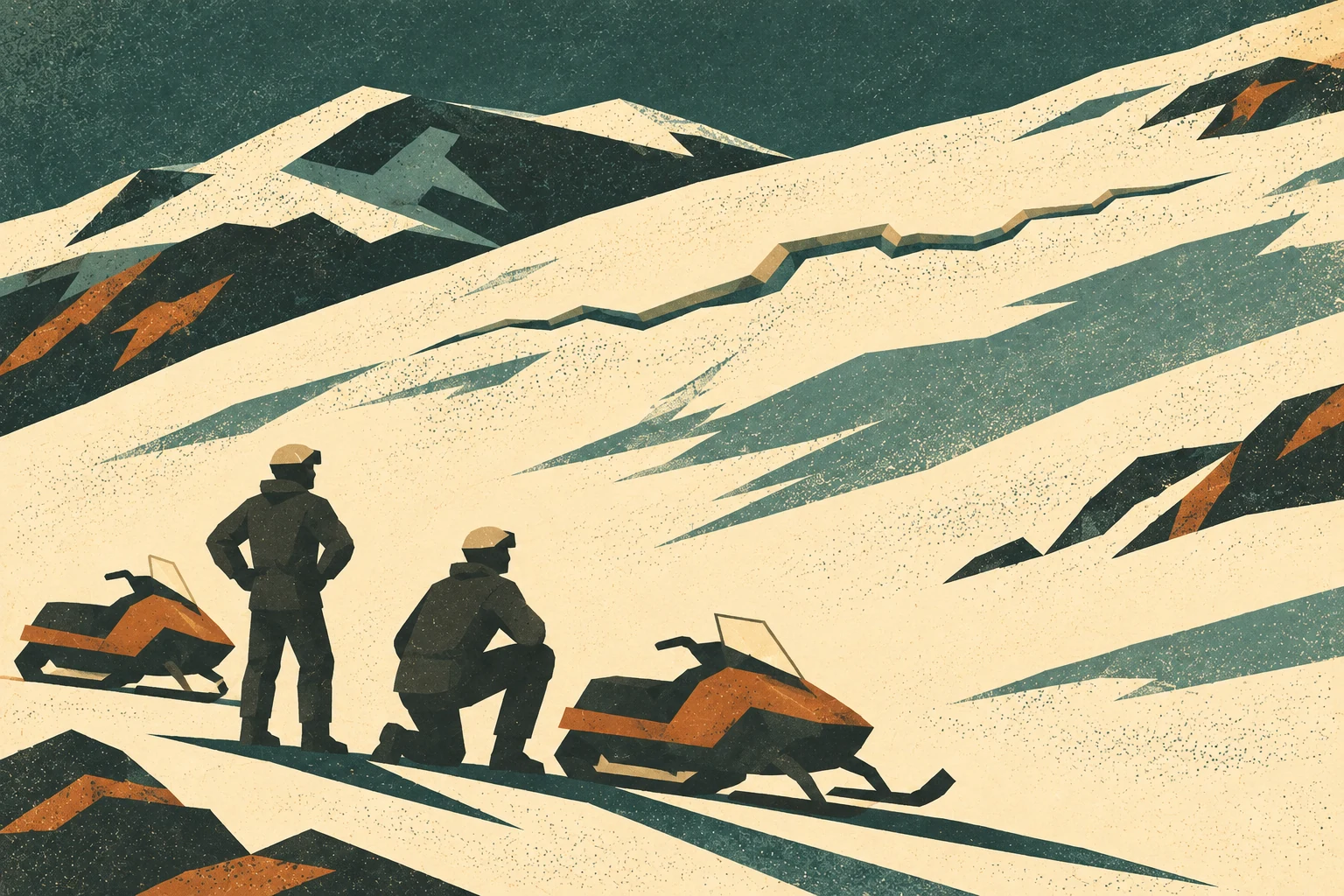
The familiar objection that the slope was too gentle for an avalanche is weaker than it sounds. An average angle does not describe every local step, and the surface of the snow need not run parallel to a buried layer. Cutting a level platform for a tent can remove the support beneath the snow directly above it. What matters is the shape and strength of the slope at the point of release.20
In 2022, Puzrin and Gaume reported field work and a drone survey that found steeper local terrain within the broadly shallow slope. Guides also recorded two small slab avalanches within about three kilometres of the proposed tent site in January 2022. Such avalanches, in other words, do happen there.21
The authors noted the differences, pointing out that the observed slabs were not copies of their 1959 model and that one seemed to be linked to a cornice, and they did not claim the final word. The modern avalanches show that the danger is real, but they cannot mark the fracture line of one night sixty-three years earlier.21
A further challenge arrived in February 2026, when the independent researcher Caroline Detry posted a preprint on Zenodo. Drawing on the 1959 examiner’s testimony and an estimated walking time, it argued that major injuries at the tent were hard to reconcile with the descent that followed. The paper is a preprint; its title, *Matters Arising*, does not mean it has been accepted by a journal or peer reviewed.22
The underlying question is fair even if every detail of the calculation is not. If a reconstruction gives someone an injury that would stop them walking, it has to explain how that person reached the place where the body was found. Calling an injury “severe but non-fatal” does not answer that.1422
Nor does the objection sink every avalanche theory. The 2021 paper left room for injuries later in the ravine, and the 2020 prosecutorial account placed a second snow event near the refuge. An argument against injury at the tent is not an argument against every reason for leaving it.192022
What remains
A walking-time calculation has its own limits. The snow surface, the help members gave one another and the order in which they moved were never recorded. The medical testimony sets important constraints, but its survival estimates are not stopwatch readings, however precise the number a model produces.1422
What the evidence does support can be set out in order of confidence. Exposure is firmly established in the medical findings, and so is major trauma in three of the victims. The efforts to survive at the cedar and near the ravine are documented. An avalanche as the trigger for the retreat has an official finding and a developed physical mechanism behind it. The sequence that joins those facts is less certain.789101112131920
That is a stronger position than calling the event unexplained, and a more modest one than claiming a simulation has recovered the last night. Natural processes can account for much of the disaster without every detail of one reconstruction being right.
In June 2026, the lawyer Yevgeny Chernousov told URA.RU that Dyatlov’s sister was seeking a new criminal investigation and exhumations. The report records a request; it does not say a new case has been opened or a different cause of death established.26
As of November 2026, the official explanation announced in 2020 remains an avalanche, cold and snow pressure. Published modelling and later field observations support parts of that account. The preprint and the family’s request show that the argument continues; neither replaces the official finding.1920212226
The most important unknown may still be the first few minutes. Why did an experienced party, equipped for a long winter journey, abandon so much of what it needed to get through the next hour? The cuts made from inside record an act and the tracks record a descent, while the fire and the branch floor record an effort to stay alive.
Those efforts are easily lost when the nine are reduced to a list of anomalies. Below the tent, someone gathered fuel, broke and cut branches and prepared a refuge, and the evidence describes people fighting a danger, not surrendering to an unexplained force.78
The mountain gave up its evidence unevenly: canvas examined months later, footprints reshaped by the wind, bodies recovered in different seasons and medical opinions written after death. Any final reconstruction has to bridge those gaps.
No last message survives to settle the order of events. There is the abandoned tent on the slope, the fire beneath the cedar and the floor of branches in the ravine. The hikers left no account of the distance between them.
Linked case files


Sources26
- Dyatlov group diary Dyatlov party; translation hosted by Teodora Hadjiyska · 1959-01 · Accessed 2026-11-06
- Yuri Yudin witness testimony Yuri Yudin / investigator Romanov · 1959-04-15 · Accessed 2026-11-06
- Resolution to close the case Lev Ivanov; approved Nikolay Klinov · 1959-05-28 · Accessed 2026-11-06
- Boris Slobtsov witness testimony Boris Slobtsov / investigator Romanov · 1959-04-15 · Accessed 2026-11-06
- Aleksey Chernyshev witness testimony Aleksey Chernyshev / Lev Ivanov · 1959-03-11 · Accessed 2026-11-06
- Forensic examination of the tent, Act199 Forensic expert Churkina · 1959-04-16 · Accessed 2026-11-06
- February scene inspection protocol Ivdel prosecutor and search witnesses · 1959-02-27 · Accessed 2026-11-06
- May ravine inspection protocol Prosecutor Tempalov and witnesses · 1959-05-06 · Accessed 2026-11-06
- Autopsy report of Lyudmila Dubinina Boris Vozrozhdenniy · 1959-05-09 · Accessed 2026-11-06
- Autopsy report of Semyon Zolotaryov Boris Vozrozhdenniy · 1959-05-09 · Accessed 2026-11-06
- Autopsy report of Nikolay Thibeaux-Brignolle Boris Vozrozhdenniy · 1959-05-09 · Accessed 2026-11-06
- Autopsy report of Aleksander Kolevatov Boris Vozrozhdenniy · 1959-05-09 · Accessed 2026-11-06
- Autopsy report of Rustem Slobodin Boris Vozrozhdenniy · 1959-03-08 · Accessed 2026-11-06
- Testimony of forensic expert Vozrozhdenniy Boris Vozrozhdenniy / Lev Ivanov · 1959-05-28 · Accessed 2026-11-06
- Radiological analysis and supplementary questions Radiologist Levashov · 1959-05-18/1959-05-29 · Accessed 2026-11-06
- Vladislav Karelin witness testimony Vladislav Karelin / investigator Romanov · 1959-04-15 · Accessed 2026-11-06
- Mystery of the fireballs Lev Ivanov / Leninskiy Put · 1990-11-22/1990-11-24 · Accessed 2026-11-06
- The Swedish-Russian Dyatlov Expedition2019 Richard Holmgren · 2019 · Accessed 2026-11-06
- Prosecutor General's Office announces cause of Dyatlov deaths Interfax, reporting Andrey Kuryakov's statement · 2020-07-11 · Accessed 2026-11-06
- Mechanisms of slab avalanche release and impact in the Dyatlov Pass incident in1959 Johan Gaume and Alexander M. Puzrin · 2021-01-28 · Accessed 2026-11-06
- Post-publication careers: follow-up expeditions reveal avalanches at Dyatlov Pass Alexander M. Puzrin and Johan Gaume · 2022-03-24 · Accessed 2026-11-06
- Forensic constraints on the tent-site trauma in the Dyatlov incident Caroline Detry · 2026-02-23 · Accessed 2026-11-06
- Dyatlov Pass Incident: Mountain of the Dead The Unredacted · 2016-03-10 · Accessed 2026-11-06
- Case-files archive and provenance Teodora Hadjiyska, specialist archive editor · undated · Accessed 2026-11-06
- Additional questioning of Evgeniy Maslennikov Evgeniy Maslennikov / investigator Romanov · 1959-04-15 · Accessed 2026-11-06
- Relatives of the Dyatlov hikers seek a new case and exhumations URA.RU, direct interview with lawyer Yevgeny Chernousov · 2026-06-02 · Accessed 2026-11-06