
On 20 June 1977, ITV viewers settled down to what looked like a documentary about Britain’s brain drain. By the end, its presenter was telling them that the missing scientists were bound for a secret colony on Mars. None of it was true, but the story has never gone away.12
The missing scientists
The investigation began with a familiar complaint. Britain was losing trained people to better jobs abroad, and a television team wanted to know where they were going, but in the programme’s account its attempts to follow these emigrants turned up something stranger. Addresses led nowhere and relatives could not explain what had happened, so a story about jobs was becoming a story about disappearance.3
That gradual change of scale was the trap. Viewers did not have to swallow a colony on Mars at the start. They could begin with what seemed an ordinary report and follow the journalists through one discovery after another, each presented as the reason the investigation had become more dangerous. The people on screen appeared to be uncovering the conspiracy as they went.
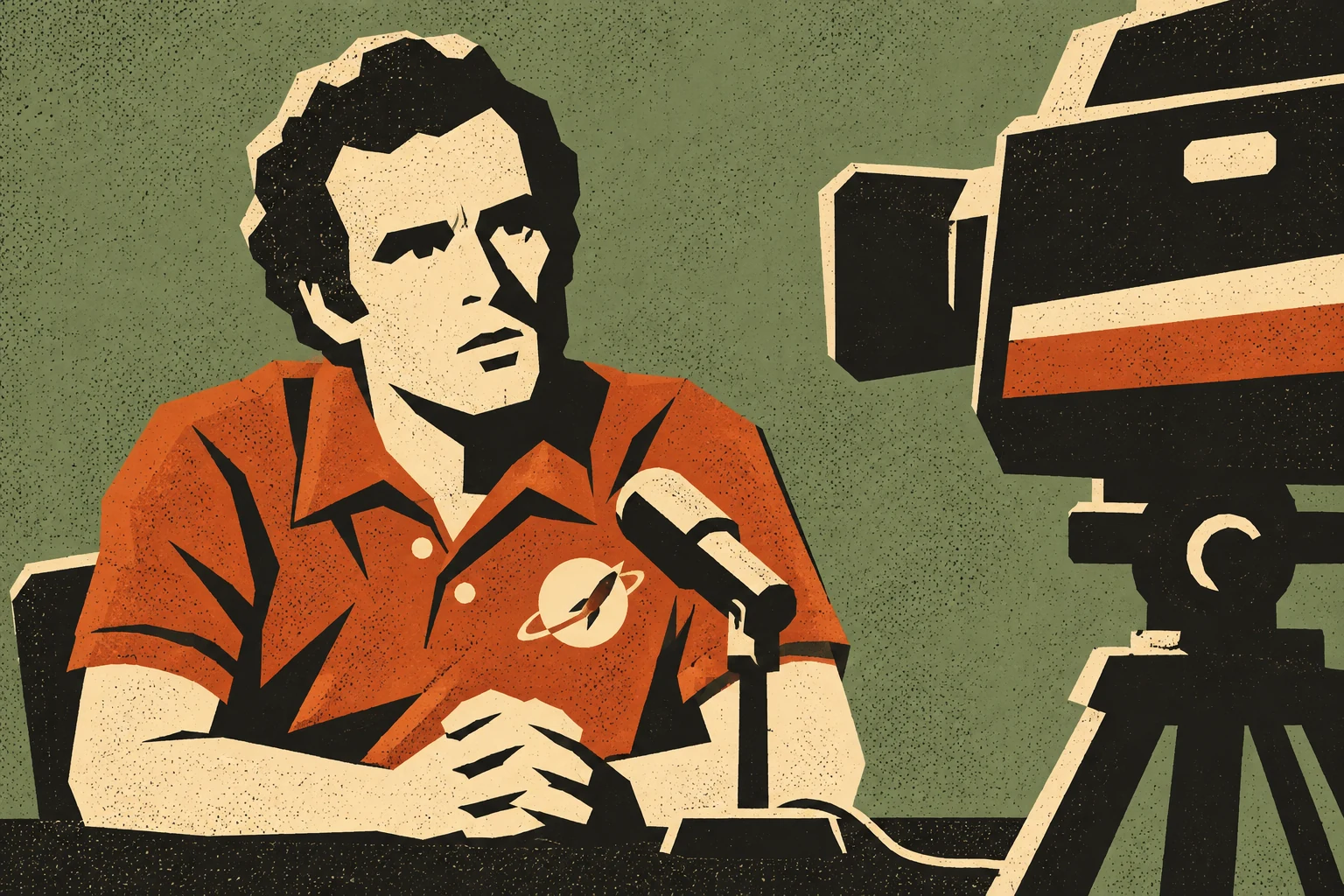
The programme went out under the banner of Science Report, an invented series with a sober, official sound. Tim Brinton, a former newsreader, lent it the authority of a familiar television face and presented the extraordinary material with the composure of someone reading the evening news. Other performers played the people whose expertise or frightened testimony seemed to justify his concern. The programme borrowed the manner of an investigation before asking the audience to accept where it led.4
Where it led was human survival. The fictional inquiry revealed that a worsening environment would make Earth uninhabitable, and that governments had considered three responses: tampering with the atmosphere, moving a chosen population underground, or taking a selected group off the planet, using the Moon as a staging post for a settlement on Mars. Most people would never be invited.5
The scandal was more personal than an alien invasion. The authorities knew what was coming and had decided who deserved to live. A missing scientist might be a recruit, and a death might silence someone who knew too much. The public space race became a cover story, distracting attention from the real programme supposedly running behind it.1
It was a good premise for a thriller. Its menace lay as much in who would be chosen as in the technology. A rocket leaving a dying world would save somebody, but the viewer was left on the wrong side of the decision. Scientific expertise, political connections and the ability to keep a secret could buy a ticket out, while ordinary citizenship offered no protection.
The film’s most audacious evidence came as moving pictures. A recording, once decoded, appeared to show an American-Soviet landing on Mars in 1962, with something stirring the ground, so the supposedly dead planet contained life and the audience was being shown a discovery that official history had somehow missed.5
NASA’s real chronology puts the fictional achievement in perspective. Mariner 4 flew past Mars in July 1965 and sent back the first close-up photographs of another planet. They were a small set of transmitted still images, not television pictures from the surface. Alternative 3 moved a far greater feat three years earlier and made its concealment the explanation for the difference.6
The programme had not found any vanished people or secret landing. David Ambrose wrote the screenplay and Christopher Miles directed it, and the cast was listed in the closing credits, which also carried an April date. Those clues were part of the same broadcast as the alarming interviews, so exposing the hoax never depended on finding a confession in a private archive.25
But closing credits could not control what every viewer took away, and the screen had already offered a memorable image of a place, somewhere beyond the Moon, prepared for the people who would be leaving first.
The men who built the illusion
The most useful surviving evidence shows how that image was made. A catalogue of Miles’s production archive describes an original contract with Anglia Television dated 1 August 1976, when the project was called The Split. It also lists character outlines, casting and audition arrangements, shot lists, call sheets and a voiceover script. These are the working papers of a television production.2
The catalogue quotes letters asking people involved to keep quiet, in case advance knowledge spoiled the effect:
the fun and hoax element could be spoilt.
There was real secrecy, then, but its purpose was to protect a television surprise. The contract and production records explain why actors and technicians might have been asked not to talk about their work, and they give that discretion a date and an ordinary professional motive. Treating it as evidence for the plot means ignoring the production it was hiding.2
Miles and Ambrose used the conventions that make factual television persuasive. A reluctant interviewee, a reporter chasing an address and a damaged recording all suggest that the outside world is resisting the programme. In a drama, each can simply be written in. Showing how hard the evidence was to get makes the final revelation feel earned, even when the difficulty and the revelation come from the same script.
The cast gave viewers more identities they could check. Shane Rimmer played Bob Grodin, the supposed astronaut, Richard Marner played the scientist Carl Gerstein, and Gregory Munroe played the investigating reporter Colin Benson. They were actors playing parts, not officials who had later been tracked down and pressured into denying what they knew.57
Rimmer was hardly unknown. He had voiced Scott Tracy in Thunderbirds and appeared in other film and television work. Recognising him could break the spell, but an audience does not need to know every actor to understand that it is watching a drama. Alternative 3 left it to viewers to rethink the serious manner in which the material had just been delivered.3
The intended April Fool’s date mattered too. The programme was meant for 1 April but reached the screen in June, which removed an obvious warning sign. Accounts differ over exactly what went wrong with the schedule, so the delay should not be dressed up as one confidently reconstructed dispute.35
Reports of the aftermath describe calls from disturbed or angry viewers and newspaper accusations of irresponsible broadcasting. The film critic Devin McKinney, discussing Steve Marshall’s earlier research on the production, notes that the show went out in a drama slot and had been trailed beforehand. Its documentary look worked inside a setting that also gave viewers reasons to recognise fiction.4
No reliable audience figures show how many people believed in a Mars colony, how many simply disliked being deceived and how many enjoyed the joke. A busy switchboard can hold all three. The later legend has every reason to paint the first night as nationwide panic, because mass belief becomes part of the story’s importance.
The makers’ explanation was circulating long before the internet found the programme a new audience. In March 1989, the British journal UFO Brigantia reproduced letters between the Canadian researcher Les Cherni and Miles. In a reply dated 13 October 1980, Miles said he and Ambrose had devised the idea together and called the central story a hoax.8
UFO Brigantia was a journal for people investigating UFO reports, not a broadcaster protecting its reputation. Its editors wanted the letters to settle an argument that was still taking up a great deal of attention in their own field. The surviving issue is a reminder that curiosity about strange phenomena has never meant believing every dramatic story told about them.8

A paperback with a second life
Television gave people a shared experience, but a book could be kept, annotated and passed to someone who had missed the broadcast. Leslie Watkins’s Alternative 3 was published by Sphere in 1978, followed by an American Avon edition in 1979, which library records classify as fiction. The names attached to the television project travelled with it into print.9
Watkins greatly expanded the story. The book’s existence is well documented, but its author’s later comments added a complication that believers would find useful. He could admit to inventing a thriller while suggesting that its premise had brought him uncomfortably close to the truth.10
A letter attributed to Watkins, preserved in the Windwords newsletter and a 1989 Vangard Sciences archive text, describes the book as a leap into fiction. It also says that letters from readers had convinced him he had stumbled on real secrets. He said much of this material went missing when he moved house, and that he suspected his telephone had been tapped.10
a HIGH DIVE INTO FICTION.
The same letter plainly says the astronaut, the reporter and the scientist were invented. His later suspicions do not undo that. They describe what Watkins came to think about material sent to him after publication, not how Ambrose could have obtained secret information before writing the film. None of the alleged revelations survives with the reproduced letter.10
In a short retelling, this distinction tends to vanish, because “the author admitted it was fiction” and “the author believed it was true” sound like rival accounts of one event. In fact they describe two different stages, writing an invented story and then making sense of the responses it provoked, and a novel that attracts claims from its readers has gained a postbag, not proof.
The letter survives online as a transcription, and this article has not examined a signed original. Its admission and its later suspicions travelled together, leaving readers free to remember whichever part they preferred.10
By the 2010s, the argument had gathered material far beyond the film. Cancelled military projects, a puzzling line in a presidential diary and a hacker’s memories seemed to supply the machinery the original drama had lacked.1
Each of those leads deserves to be examined on its own terms, and none of them is made stronger by resembling a scene already written for television. A real record of a military spacecraft tells us about that spacecraft. It would take more evidence to establish an evacuation plan, a settlement on Mars or an agreement about who would be left behind.
The paperback gave this argument room to grow. A viewer could accept that Brinton’s broadcast was staged while treating the surrounding world of classified technology as the real story. The supposed revelation no longer depended on mistaking an actor for an astronaut. It depended on the belief that fiction had said something its authors could not fully control.
That is the version worth testing. The credits settle who played the television characters, but they do not settle every question about military activity in space, and for that there are real programmes, documents and people to follow.

There really was a secret space programme
Military spaceflight was not something Ambrose dreamed up. The United States developed spy satellites and considered putting crews into orbit for military purposes. Among the most serious plans was the Manned Orbiting Laboratory, or MOL, a joint project of the Air Force and the National Reconnaissance Office whose central photographic mission was classified.11
The proposed station was small and had a specific job. Two crew members would live and work in low Earth orbit for about thirty days, then return in a modified Gemini capsule. Its camera would take detailed pictures of the countries the United States wanted to watch. It was a plan to look down at Earth, not to set up a self-sufficient community beyond it.11
MOL helps explain why the wider suspicion lasts, because here was a secret purpose behind an acknowledged space project, with pilots selected, hardware built and a launch site prepared. Any account that treated NASA’s exploration programme as the whole of American space activity would leave out an important part of the history.11
It also shows why the details matter. MOL was cancelled on 10 June 1969, not halfway through the decade, and NASA’s history describes rising costs, delays and improvements in uncrewed reconnaissance that weakened the case for sending people up to operate the camera. Those circumstances give the cancellation a technical and financial explanation.11
The people did not vanish with the project. On 14 August 1969, NASA announced that seven astronauts were transferring from the cancelled programme, and their later careers are part of the public history of the shuttle, including Robert Crippen’s flight on its first mission, so the transfer can be followed through named people and flights.12
Dyna-Soar, another project invoked in the original article, took a different course. NASA’s documentary chronology records the Defense Secretary, Robert McNamara, announcing the cancellation of the X-20 on 10 December 1963. He said the money would go into a wider study of military operations in space, particularly MOL. One cancelled programme was helping pay for another proposed one.13
The same record includes Project Horizon, an Army study for an outpost on the Moon. Plans like these show how ambitiously military organisations thought about space. A proposal can establish an intention, an engineering study or a bid for funding. Showing that the outpost was built and occupied would take later evidence, not a reading of the proposal’s drawings as photographs of finished facilities.13
It is tempting to treat every cancellation as another reason for disbelief, on the grounds that so much work could not simply stop. The surviving record shows projects competing with one another and changing as technology improved. A crew became less useful once an uncrewed machine could do the same job better. Money already spent did not guarantee a vehicle worth finishing.1113
What did investigators have? A classified reconnaissance mission, selected pilots and developed equipment establish that MOL was a serious military project. Its cancellation and the transfer of its pilots are documented too. No record examined here connects it to a survival colony on Mars.1112
Reagan’s diary offers a smaller, stranger piece of the argument. On 11 June 1985, he recorded a lunch with five space scientists and wrote that American shuttle capacity could put 300 people in orbit. The sentence is genuine and appears in the published diary. The entry gives no calculation, timetable or description of any secret vehicle.14
That makes it more ambiguous than the usual comparison with the seats in a single shuttle suggests. The sentence does not say that 300 people would go up on one flight, or that they were already in space. It could refer to a total over many launches, a proposal or a misunderstanding. The entry alone cannot settle which, and saying so is more accurate than handing Reagan a secret fleet.14
Secrecy did sometimes keep orbiting objects out of public records. A French account of the GRAVES surveillance radar described tracking sensitive satellites missing from the published lists, and ONERA’s own 2007 summary referred to about twenty objects absent from the American catalogue. They were being detected from the ground, which is awkward for a theory that needs everything in a hidden programme to stay unseen.1516
A missing catalogue entry concerns what a government chooses to publish about an object, not whether the object can be tracked or whether it carries people. The French findings support the existence of undisclosed satellites, but they offer no route from an orbit round Earth to an inhabited outpost on another planet.15

The hacker and the missing photograph
Gary McKinnon brought the secret programme a different kind of witness. He had broken into American government and military computer systems while searching for evidence of suppressed technology. His story felt less like reading old proposals and more like breaking into a live operation. He said he had reached the computers where the secrets were kept.17
In a June 2006 interview with Project Camelot, McKinnon described a spreadsheet headed “Non-Terrestrial Officers”. He remembered names and ranks, and information about transfers between ships or fleets, and he took this as possible evidence of a force operating away from Earth. But he could not reliably recall the names, or even which organisation’s computer had held the file.17
The spreadsheet itself would offer names, dates and ships to investigate. What survives publicly is McKinnon’s memory of it, including his uncertainty about where he found it. No copy accompanies his account.17
McKinnon also described seeing an image that he took to be an unusual craft above Earth. He was working over a slow connection through a remote desktop. In a 2006 interview with WIRED, he said the object looked cigar-shaped, and accepted that a hypothetical military game might explain what he had found in the spreadsheets.18
Without the image, even its most basic features are out of reach: what produced it, whether it showed a physical object, and whether the shape he saw was a spacecraft at all. His account of how he got in cannot answer those questions.
His long legal battle gave the story emotional force, but it concerned something else. In October 2012, the Home Secretary, Theresa May, withdrew his extradition order on human-rights grounds after considering medical evidence, and her statement dealt with the grave risk extradition posed to him, making no finding about spacecraft or officers.19
The case can be serious without proving everything McKinnon believed. His open interest in UFOs explains why he went looking for certain kinds of material, and the charges explain why the American authorities wanted to try him, but neither supplies the missing image or tells us what a particular heading meant.
What did investigators have? McKinnon’s interviews preserve his account, including the gaps in his memory. They do not provide an authenticated photograph of a spacecraft or a list of officers that anyone can check.1718
His claim also differs from the plot of Alternative 3. Even a real undisclosed vehicle in Earth orbit would leave the central allegation untouched: a settlement prepared for chosen survivors of an environmental disaster. Someone could believe McKinnon saw something important and still have no evidence for that destination, its inhabitants or its purpose.
In the original drama, a recording gave up its secret once someone found a decoder. In the later story, the decisive file is always out of reach. The resemblance is powerful, but it is the missing material that now has to do most of the work.

What was on the Moon?
Photographic claims were already part of the world McKinnon was searching. The Disclosure Project’s 2001 executive summary includes accounts from Karl Wolfe and Donna Hare, presented as people whose jobs had exposed them to hidden information. These were memories collected decades after the events they describe, not a release of the photographs themselves.20
Wolfe said he had been shown Lunar Orbiter images containing artificial structures. A later account reproduced by UFO Casebook describes a visit to repair photographic equipment and a conversation with a technician. It also records his explanation that he had muddled the initials NSA and NASA when remembering the facility. That uncertainty belongs in the story alongside the memorable claim of buildings on the Moon.21
The date of 1965 used in this site’s original article creates a direct problem, because NASA’s first Lunar Orbiter was launched on 10 August 1966 and reached lunar orbit four days later. Wolfe could not have been shown its photographs in 1965, so either the date or the identification of the pictures would have to change.122
That conflict does not tell us what happened in the room, but it gives an investigator something specific to test. Service records, work assignments or an identifiable image might show when and where a visit took place. Repeating that Wolfe had technical experience does nothing to resolve the clash between the claimed year and the spacecraft’s launch.2022
Hare described a photograph from which she believed a UFO had been removed, and what a colleague reportedly told her about such alterations. The Disclosure Project’s summary also includes things she said she had heard about astronauts. Seeing an image and passing on someone else’s description of a wider practice are different kinds of testimony, and the second cannot confirm the first.20
Gathered together, these accounts seem to gain weight, but grouping them hides how much they depend on missing material. Wolfe’s lunar structures, Hare’s altered picture and McKinnon’s screen are not three independent sightings of one spacecraft or settlement. They concern different images, different places and different memories. Putting the stories side by side does not reveal a common object.172021
The technology that really did photograph the Moon is interesting enough without a base. Lunar Orbiter exposed film on board the spacecraft, developed it and scanned the results for transmission to Earth. NASA’s history describes camera faults, blurred pictures and the later recovery of the original recordings. The archive is the product of a complicated photographic and radio process, with a history that can be studied.22
That history shows how a new claim could be tested. A frame number, a mission and an original recording would let other researchers find a disputed feature for themselves. A drawing of what somebody remembers cannot stand in for the missing negative. And a claim that the crucial frame was removed would need evidence that it once existed and of who had held it.
The Moon base survives most comfortably in the gap between a memory vivid enough to describe and an image nobody else can inspect. Alternative 3 understood the dramatic value of that gap. Its frightened experts held the answer just out of the reporter’s reach, until the film decided it was time to show it.

Missing scientists again
In 2026 the programme’s premise seemed to step off the screen. After William Neil McCasland, a retired US Air Force major general and former head of the Air Force Research Laboratory, disappeared from his home in Albuquerque in February, online writers and then newspapers began compiling lists of American scientists and laboratory staff who had died or gone missing since 2022. By late April the White House had been asked about it, the FBI said it was looking for connections and the House Oversight Committee had announced an inquiry.2425
Commentators heard the echo of 1977 almost at once. In June, the Guardian’s Phil Tinline set the American lists beside the programme’s fictional roll of vanished experts, and David Ambrose told him how he had invented it.23 Nearly fifty years on, a programme first scheduled for April Fool’s Day was being used to make sense of real deaths.
The American cases are as varied as the Marconi deaths of the 1980s. They include a shooting that the FBI said was the work of a lone gunman, a carjacking for which a man was charged, a drowning with no sign of foul play and several disappearances of people who have not been found. McCasland’s wife wrote that his clearances were commonly held, which made it unlikely that anyone had taken him for his secrets, and statisticians pointed out that a large technical workforce will always produce clusters like these. As of November 2026, no public finding has linked the cases.242526
What Alternative 3 supplied was the shape of the story rather than any fact in it. A list of missing experts, a hint of secret space or nuclear work and an official denial are enough to suggest a plan, and the programme showed in 1977 how readily an audience would fill in the rest.
The escape that never ended
There are two histories here, and the evidence for them is very different. One includes a script, actors, production contracts, casting arrangements and a book. The other proposes a hidden evacuation, but offers no comparable record of the colony, its transport or its occupants. The documented production cannot fill those gaps just because it imagined them so persuasively.29
Real military secrecy gives the story lasting material. MOL’s mission was hidden, the public satellite catalogue was incomplete and military planners did consider far more ambitious uses of space. Each of these facts can make a blanket dismissal of all secret space activity look foolish. Alternative 3 benefits whenever that careless dismissal is mistaken for the only alternative to believing its plot.111315
The better question is what each document actually shows. A cancelled station tells us about a proposed station, and an unlisted satellite tells us about an object missing from a list. Piling them up does not make a settlement on Mars. The evidence has to connect each step, including some reason to think people travelled, arrived and stayed.
A settlement needs transport, shelter, supplies and a way to keep people alive. A camera circling Earth does a different job. The records of one project cannot quietly be made to stand for all the others.
The fictional emergency made that gap easy to jump. If survival was at stake and governments already knew the public would be left behind, they had every reason to hide what they were doing. Their denials could then be written into the plot. The story became hard to shift because the lack of the evidence it predicted was itself taken as proof of how far the cover-up reached.
The makers’ continued willingness to talk about the production fits that story badly. In June 2026, Ambrose told Phil Tinline that he had made it up.23 Miles had said much the same in letters that were circulating among UFO researchers by 1989.8 These are separate accounts by the people who created the programme, backed by a production history.
As of 7 November 2026, the sources examined for this article establish Alternative 3 as a fictional television production with a long conspiracy afterlife. They also establish genuine classified space work. They do not connect that work to an evacuation colony on Mars, and the photographs and records described in later testimony are not available for anyone to authenticate.
The remaining historical questions are about how the programme was received and passed on: which audiences saw which version, what readers sent Watkins, and how particular claims came to carry the authority of a secret already revealed. The full production correspondence, press files from the time and the original letters from readers, if they survive, would sharpen that picture. They would be worth finding, without expecting them to contain a departure timetable.
On television, the reporters eventually got their impossible pictures. Outside the story, everything that can be examined leads back to people making a film, publishing a book and trying to explain what they had made. The colony remains on the other side of the screen.
Linked case files




Sources26
- Alternative 3: Secret Space Program The Unredacted · 2018-02-23 · Accessed 2026-11-07
- Alternative 3: The Director’s Archive Carter Rare Books · undated · Accessed 2026-11-07
- Alternative 3 Television Heaven · undated · Accessed 2026-11-07
- Neglected Gem #88: Alternative 3 (1977) Devin McKinney · 2016-01-20 · Accessed 2026-11-07
- Alternative 3 David Langford / The Encyclopedia of Science Fiction · 2021-07-12 · Accessed 2026-11-07
- Mariner 4 NASA Science · undated · Accessed 2026-11-07
- Alternative 3: Cast & Crew Rotten Tomatoes · undated · Accessed 2026-11-07
- No Alternative! UFO Brigantia / information supplied by Mark James · 1989-03 · Accessed 2026-11-07
- Alternative 3 Open Library · 1979 · Accessed 2026-11-07
- The Truth about Alternative 3 Leslie Watkins, letter reproduced by Windwords / Vangard Sciences · 1989-10-28 · Accessed 2026-11-07
- 55 Years Ago: Manned Orbiting Laboratory Cancellation John Uri / NASA · 2024-06-11 · Accessed 2026-11-07
- 55 Years Ago: NASA Group 7 Astronaut Selection John Uri / NASA · 2024-08-14 · Accessed 2026-11-07
- Documents: Early Space Station Activities Roland W. Newkirk, Ivan D. Ertel and Courtney G. Brooks / NASA · undated · Accessed 2026-11-07
- Diary Entry: 11 June 1985 Ronald Reagan / Ronald Reagan Presidential Foundation & Institute · 1985-06-11 · Accessed 2026-11-07
- GRAVES: Une perspective européenne European Security · 2007 · Accessed 2026-11-07
- Return on Innovation ONERA · 2007 · Accessed 2026-11-07
- Gary McKinnon: Interview transcript Gary McKinnon interviewed by Kerry Cassidy and Bill Ryan · 2006-06 · Accessed 2026-11-07
- ‘UFO Hacker’ Tells What He Found WIRED News interview with Gary McKinnon · 2006-06-21 · Accessed 2026-11-07
- Theresa May statement on Gary McKinnon extradition Theresa May / Home Office · 2012-10-16 · Accessed 2026-11-07
- Executive Summary of the Disclosure Project Briefing Document Steven M. Greer / Disclosure Project · 2001-04 · Accessed 2026-11-07
- I Saw Structures on the Moon UFO Casebook, reproducing a Wolfe interview account · undated · Accessed 2026-11-07
- 55 Years Ago: Lunar Orbiter 1 Launches to Survey the Moon John Uri / NASA · 2021-08-10 · Accessed 2026-11-07
- Wow, it really worked!: Alternative 3’s enduring afterlife Phil Tinline interviewing David Ambrose · 2026-06-16 · Accessed 2026-11-07
- Missing scientists conspiracy theory Wikipedia · Accessed 2026-11-08
- How a speculative story about dead and missing scientists went from the fringe to the White House T. M. Brown, CNN (syndicated copy) · 2026-04-30 · Accessed 2026-11-08
- Math and statistics help explain the FBI’s ‘missing scientists’ cases Faye Flam, Scientific American · 2026-05 · Accessed 2026-11-08