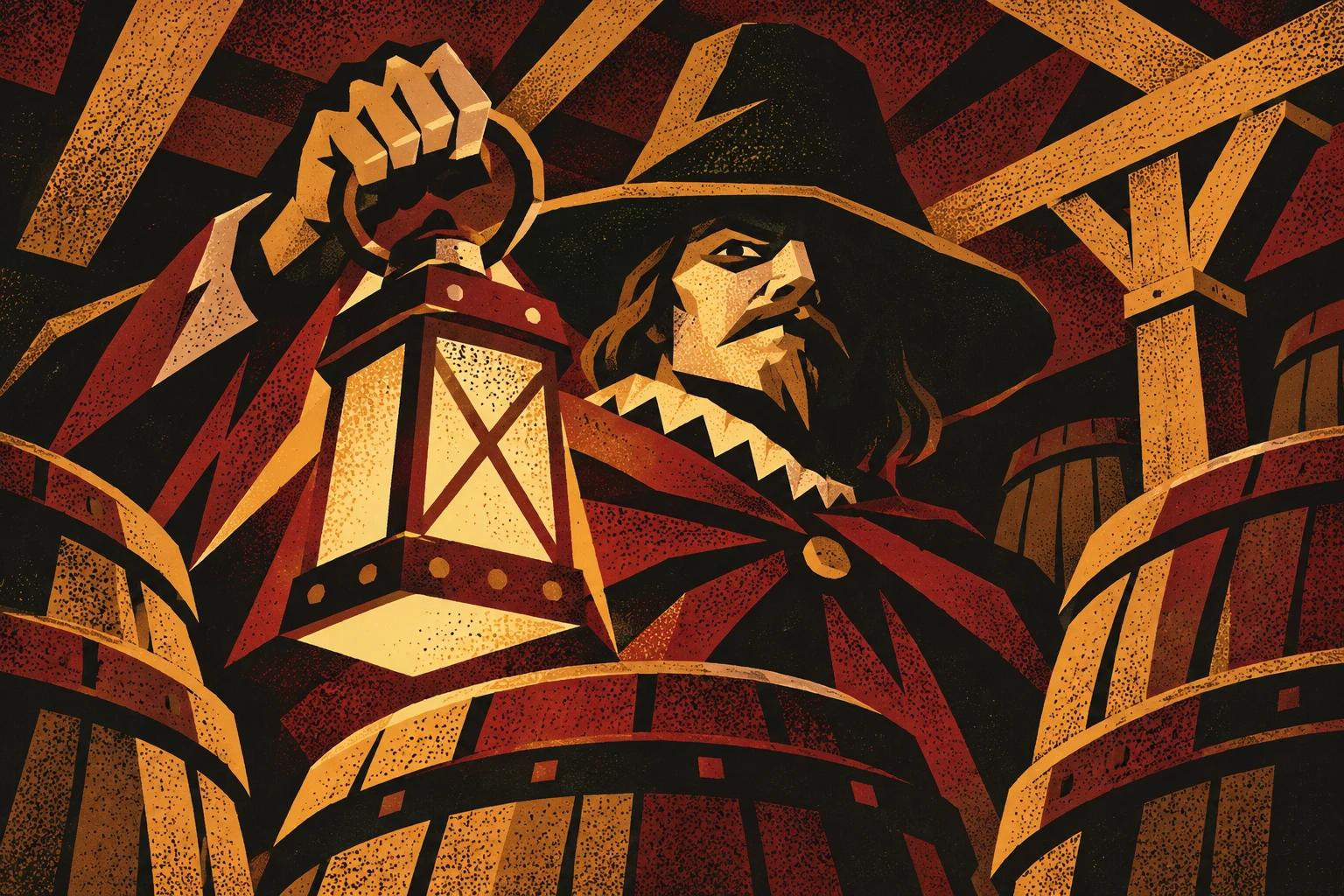
In the early hours of 5 November 1605, men searching beneath the House of Lords found thirty-six barrels of gunpowder and the man guarding them. He said his name was John Johnson. That day, a clerk noted the discovery in the margin of the Commons Journal.1810
A king above the powder
The clerk’s entry is a compact record of an enormous intended crime. Johnson was described as the servant of Thomas Percy. The powder lay beneath the chamber where James I was due to open Parliament, and the clerk understood it as an attempt to destroy the King and everyone gathered with him. The prisoner was Guy Fawkes. The false name hid who he was, not what the powder was for.13
His purpose is set out in his examination the same day. Asked what he had intended, he admitted planning to blow up the upper house while the King was there. Asked about the Queen and the royal children, he indicated that their presence would not have stopped him. No comforting reading turns the barrels into stage props or the intended victims into people who merely had a fright. The planned assassination would have killed everyone in the chamber with its royal target.3
Yet the most famous conspirator was not its leader. Robert Catesby had gathered the first group around a plan to wipe out the government in a single explosion. Parliament’s own history dates the plan to May 1604, with Thomas Wintour, John Wright, Thomas Percy and Fawkes among the original members, and later recruits widened the circle. Fawkes’s job at Westminster won him a lasting fame that his place in the conspiracy does not justify.7
The plotters had thought about what would come next. With the political leadership destroyed, a rising in the Midlands was to follow, and the conspirators planned to seize the King’s young daughter, Elizabeth, and make her the figurehead of a new regime through whom others would rule. Destroying a government was a far simpler proposition than controlling the country afterwards.67
James had succeeded Elizabeth I in 1603, raising Catholic hopes that a new king might ease their position. The historian Samuel Rawson Gardiner traced the disappointment that followed: renewed action against priests and the enforcement of fines for religious nonconformity, including a proclamation in February 1604 ordering priests out of the country. That background explains the conspirators’ hostility. It did not make their choice inevitable, and other Catholics under the same pressure chose otherwise.13
This was a Catholic conspiracy, but England’s Catholics had not authorised it. The distinction was politically urgent in 1605 and still matters. A small group could act in the name of a persecuted faith without its community’s consent or any realistic prospect of freeing it. Their readiness to kill Catholic members of Parliament alongside Protestant ones exposed the gulf between their cause and the people it claimed to serve.3
The explosion never happened. Instead, the government gained a prisoner, a trail to his accomplices and a story of national deliverance, gains that have fuelled a second interpretation in which the state knew about the plot beforehand, or even helped create it. It is a serious accusation that can mean several different things, because a minister who receives a warning, one who secretly watches a plot develop and one who organises it are doing very different things.
Telling them apart means going back to what survives: the powder recorded at Westminster, an anonymous letter, statements taken from prisoners and the official account prepared for the public. None of it answers every question. Together, it lets the government’s role be investigated without first assuming either its innocence or its omnipotence.
The room beneath Parliament
Thomas Wintour’s account, reproduced by Gardiner, describes five men meeting near St Clement’s and swearing an oath of secrecy before hearing Mass in another room. Fawkes later said under examination that the priest, John Gerard, did not know their purpose. That mattered, in a statement that would later be available to a government looking for a wider religious conspiracy: being close to the plotters was not the same as knowing what they planned.13
Access was the conspiracy’s great advantage. Percy’s connections to the Earl of Northumberland, and his place in the King’s bodyguard, put him close to the court and to Westminster. The plotters had no fortress to storm. They needed only a plausible reason to rent space near a chamber that would be used on a predictable ceremonial occasion. It was a security failure of an everyday kind, rooted in the ordinary business of renting rooms and storing goods.7
The traditional account includes an attempt to tunnel towards Parliament before the conspirators found a more convenient room. By March 1605, they had leased a cellar directly beneath the House of Lords. Popular illustrations often merge the alleged tunnel and the powder store into a single underground maze, but they are separate claims, and the reality of the store does not confirm every detail later told about the tunnel.7
That distinction later became part of the historical argument. A poorly documented tunnel can weaken one part of the official story without removing the barrels from the other, and a real store of powder does not vouch for every earlier episode. The question is always which part of the account an objection actually reaches. One discrepancy cannot make the whole conspiracy vanish.
The opening of Parliament was postponed until 5 November. The ceremony that gathered royal and political power in one room made the attack attractive, and it also fixed the deadline. Once the warning reached the government, the time left was measured in days.710
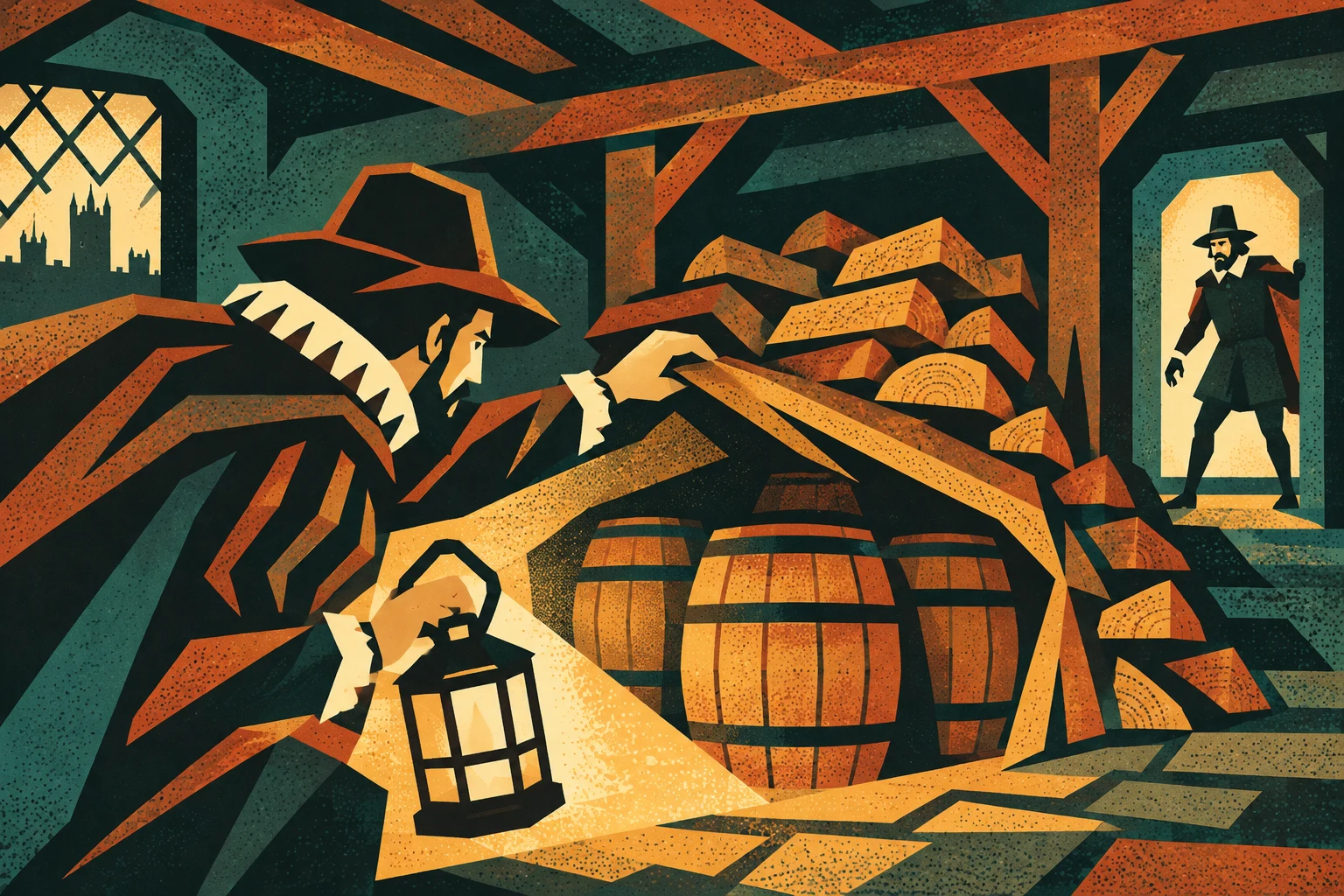
The first search, on 4 November, did not end the affair. A second search that night found Fawkes and the hidden powder. The familiar picture of a single inspired discovery compresses a sequence of warning, consultation, inspection and return. Even in the standard account, officials had more than one chance to grasp what the rented cellar and its contents meant.810
A lantern in the Ashmolean Museum gives the arrest a tangible afterlife. Made of iron and horn, it is said to have been Fawkes’s, and was given to the University of Oxford in 1641 by Robert Heywood, whose brother Peter was associated with the search; it passed to the Ashmolean in 1887. Its history is worth preserving, but an attributed object cannot testify to everything that happened that night.14
The cellar itself is gone, destroyed in the fire that gutted the old Palace of Westminster in 1834. There is no room left to enter and measure against the claims made about it, only records, descriptions and later reconstructions. Losing the room makes those sources more important, but their disagreements are not evidence that it never existed.25
The hunt moved beyond Fawkes before he gave his fuller account of his accomplices, and a royal proclamation dated 5 November named Percy and described him for the searchers. Out of context, that early identification can look suspicious, but Percy had rented the premises and the prisoner claimed to be his servant, so his name did not need to wait for a confession.14
A warning without a name
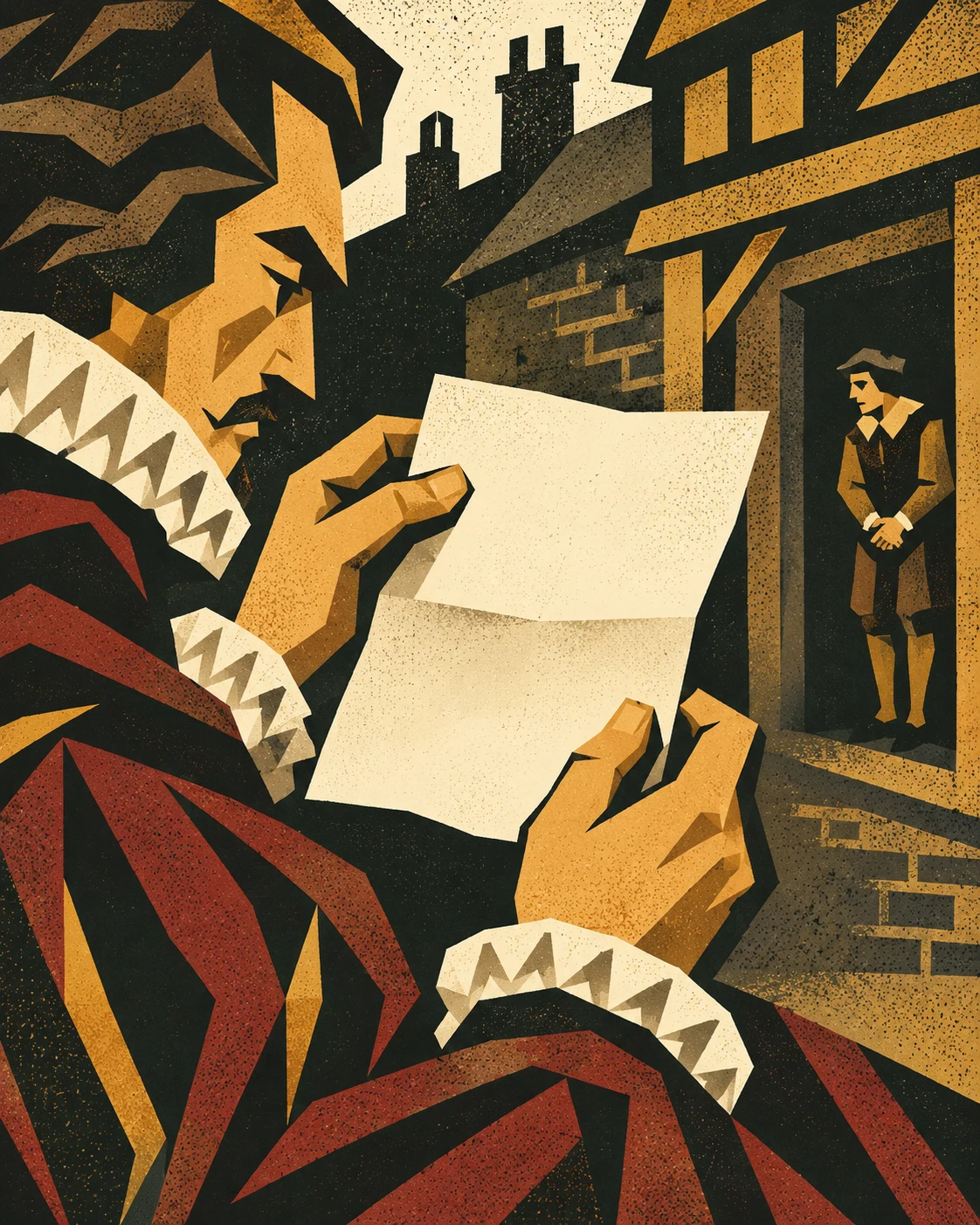
The letter at the heart of the discovery survives. On 26 October, Lord Monteagle received an anonymous warning at his house in Hoxton, urging him to stay away from Parliament and retire to the country, because those assembled would receive “a terrible blow”. It named neither Catesby nor Fawkes and said nothing about gunpowder, conveying danger while hiding both its source and its author.28
Monteagle passed it to Robert Cecil, Earl of Salisbury, the King’s chief minister, so the government now had something definite to act on, though the strange wording left room for interpretation. The anonymity could protect a frightened conspirator, a sympathetic relative or an informer, or conceal something more complicated, and the text itself does not say which.8
The usual suspect is Francis Tresham, a relative of Monteagle and a late recruit to the conspiracy, who had every reason to fear the deaths of people he knew. Parliament’s biography describes him as appalled by the scheme and later claiming to have tried to stop it. That makes a warning from him understandable. But there is no signature, no admission and no proven link between his hand and Monteagle’s letter.9
The plotters suspected him too, and their confrontation with Tresham at the start of November shows they knew they might have been betrayed before Fawkes was arrested, yet they carried on regardless. It is one of the grimmest features of the story, because the warning had reached the government, word of the warning had reached the conspirators, and still the preparations continued.910
Tresham’s motives need not be a simple choice between loyalty and betrayal. A man might want to save a relative, prevent a massacre and still avoid handing his friends to the authorities, and a warning could serve one purpose while disastrously undermining another. That is why historians find the letter persuasive evidence of a split within the plot. But they are interpreting circumstances, and no statement by its author has ever been found.
There are other possibilities. Monteagle may have known more than he admitted, someone in the government’s network may have helped shape the warning or how it was presented, and Cecil may have had intelligence the public account never acknowledged. Each would change the history of the discovery, but none would show that Cecil invented Catesby’s plot or told Fawkes to guard the powder.
The gap between 26 October and the final search is often made to carry that bigger accusation, prompting the questions of why the cellar was not searched at once and whether the government waited for maximum political effect. The delay deserves scrutiny, but it does not explain itself, because a vague warning needed investigating, a minister might manage the timing and officials might disagree about what it meant. Without the missing intelligence trail, the delay supports several explanations equally.
What makes the letter powerful also limits it. It was written before the arrest, not invented afterwards, but it is deliberately incomplete, because its author wanted the recipient to act without knowing, or at least without recording, everything. Four centuries of argument have not turned that calculated silence into a name.
What the Tower could extract
After the arrest, the records become far more plentiful, and far more obviously compromised. On 6 November, James authorised torture, starting with the gentler methods and increasing them if necessary. Historic Royal Palaces considers use of the rack highly likely, while treating its exact location with caution. Confident pictures of a particular torture chamber, or a precise timetable of every session, go beyond the evidence.11
The first examination, on 5 November, came before that warrant, which matters when tracing how the government’s information developed. That does not make the prisoner comfortable or the questioning neutral. A man arrested for trying to kill the King was inside an overwhelmingly coercive process long before any formally authorised instrument was used.311
Later documents are often illustrated with two signatures side by side, a firm hand beside a painfully shaky “Guido”. The comparison is powerful, but it cannot reconstruct the whole interrogation. The Institute of Historical Research’s guide distinguishes successive examinations, a statement of 8 November and its acknowledgement before the commissioners on 10 November. Writing, signing and acknowledging a statement were different events.24
Torture creates two problems at once. It can produce information an investigator later confirms, and it can produce whatever a broken prisoner thinks will make the pain stop. Corroborated details do not make every accusation reliable, and the brutality of the process does not mean every admission was invented. Each important statement has to be tested against what was already known and what can be confirmed elsewhere.
One surviving examination concerns the planned seizure of Elizabeth and the proclamation that was to follow the explosion. A passage about opposing the union of the kingdoms and foreign influence, while leaving religion alone, has been crossed out. The deletion is visible proof that the record was shaped, and it complicates the public story of a plot aimed only at the Protestant religion. Who ordered the deletion, and why, the document cannot tell us.6
Thomas Wintour’s confession brings another problem. Gardiner acknowledged that its date had been changed, from 23 to 25 November, in a different hand. He suggested the first date might record when it was written and the second when it was formally acknowledged, but offered that as an explanation, not a proven sequence. Accepting the visible alteration requires accepting neither Gardiner’s defence nor the idea that the whole statement was faked.13
Wintour’s account of the end at Holbeach House is far messier than a tidy march from discovery to execution. The fugitives were cornered there on 8 November. Catesby, Percy and the Wright brothers were killed; Wintour described being shot in the shoulder and losing the use of his right arm before he was captured. Others survived to be questioned, and Robert Wintour stayed on the run until January. The conspiracy was not rounded up in one neat sweep.510
Nor does the government’s surviving instruction suggest any order to silence every suspect. The proclamation for Percy specifically wanted him taken alive, so that others could be found. That does not excuse the violence or make the later questioning trustworthy. It does rule out one tempting shortcut: deaths during the pursuit cannot be treated as proof that the government wanted every witness dead.4
In Salisbury’s shadow
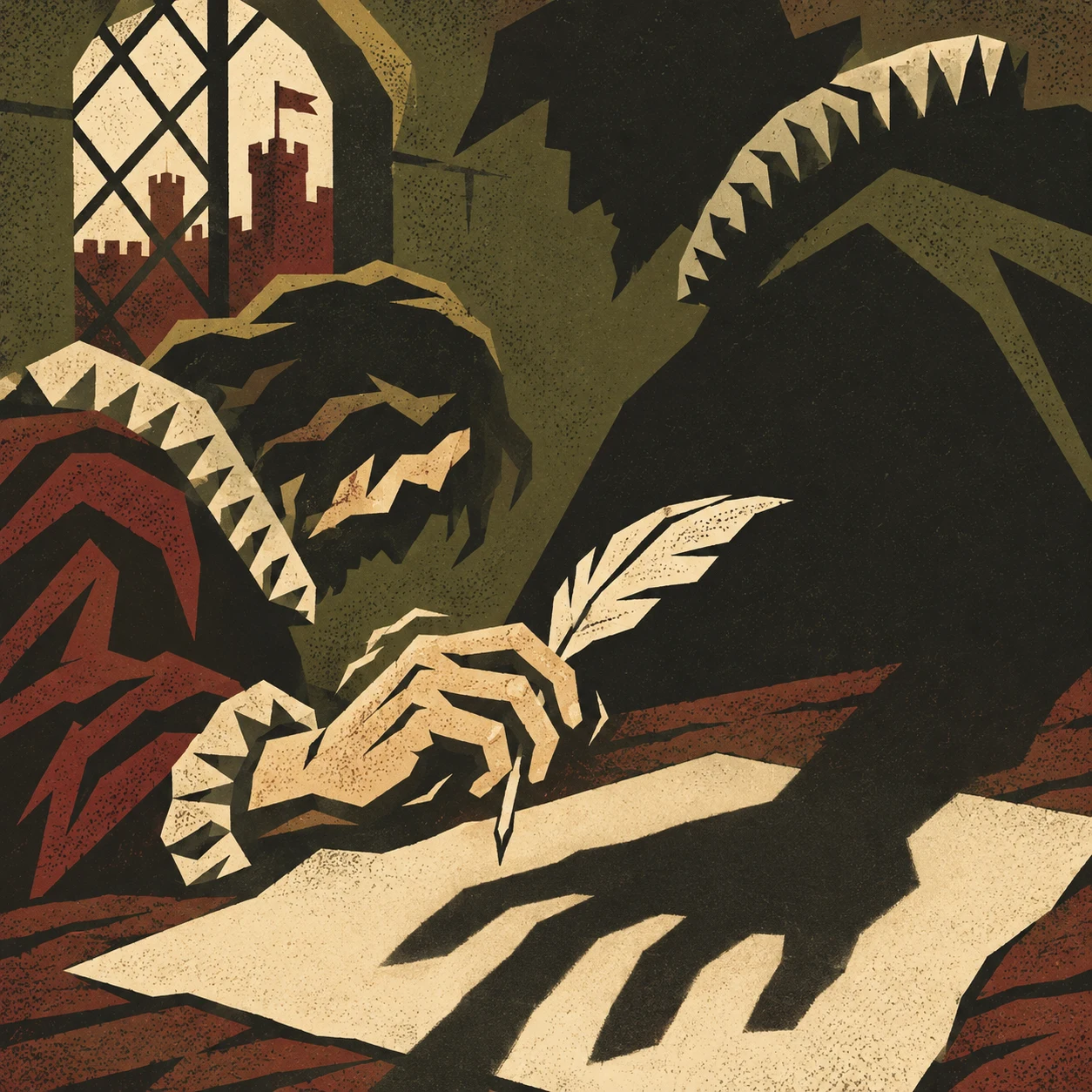
Cecil is the figure around whom the alternative history gathers. He received Monteagle’s warning, helped direct the response and held a position from which information could be controlled, and an exposed Catholic plot also strengthened the case for the vigilance his government preached. He had access, opportunity and a political motive, which are reasons to investigate his role, not evidence of what that role was.
The Unredacted’s 2018 article cast Fawkes as a possible fall guy and gave considerable space to doubts about the official story of the discovery. The question is still worth asking, but it has to move beyond the observation that a powerful minister benefited. Governments can benefit from crimes they expose, crimes they mishandle and crimes they secretly encourage. The outcome does not reveal which it was.20
The strongest version of the suspicion concerns intelligence. Spying depends on contacts whose names are hidden, payments that go unexplained and sources with reasons to tell different people different things. An official story can leave those relationships out without being a fantasy. If Cecil already had a source close to the plot, the warning letter may have been one step in a longer process, not his first real clue.
That remains a hypothesis. Proving it would require a reliable link between a particular source, particular information and the minister at a particular time. A spy network is no proof that it had penetrated this group. And knowing that some Catholics were talking about rebellion is a long way from knowing that powder was stored beneath the Lords and that Fawkes would be guarding it on the night of 4 November.
The more ambitious accusation is that the authorities nurtured or manufactured the plot, which could mean an agent encouraging men who already wanted to strike, a deliberate decision to leave the preparations in place or direct authorship of the scheme. Each would need evidence beyond the later handling of confessions, and without it, Cecil was clearly well placed to exploit the discovery, but that he created the plot remains unproven.
The firmer ground is that the Crown shaped the story afterwards. A publication of 1605, catalogued by the Morgan Library, combined James’s speech, an account of the discovery and the examinations of Fawkes and Wintour. Readers received a connected interpretation, not an unedited archive, with the King’s deliverance and its explanation bound in the same volume as the statements meant to prove it.23
That publication was itself a move in the crisis. The government had to explain an extraordinary breach of security, show the danger had been defeated and decide how far guilt should spread. A narrative could serve all those purposes while keeping a real assassination attempt at its centre. What it chose to publish, omit or credit to royal insight is evidence about presentation. It is not evidence about who devised the plot.
Cecil’s shadow falls across many of the records, and it is darkest where a missing intelligence history meets an obviously managed public account. But gaps in the surviving papers do not turn it into a documented hand directing the conspirators, and while the missing link limits the accusation, it is no reason to stop examining the minister.
The historians’ counterplot
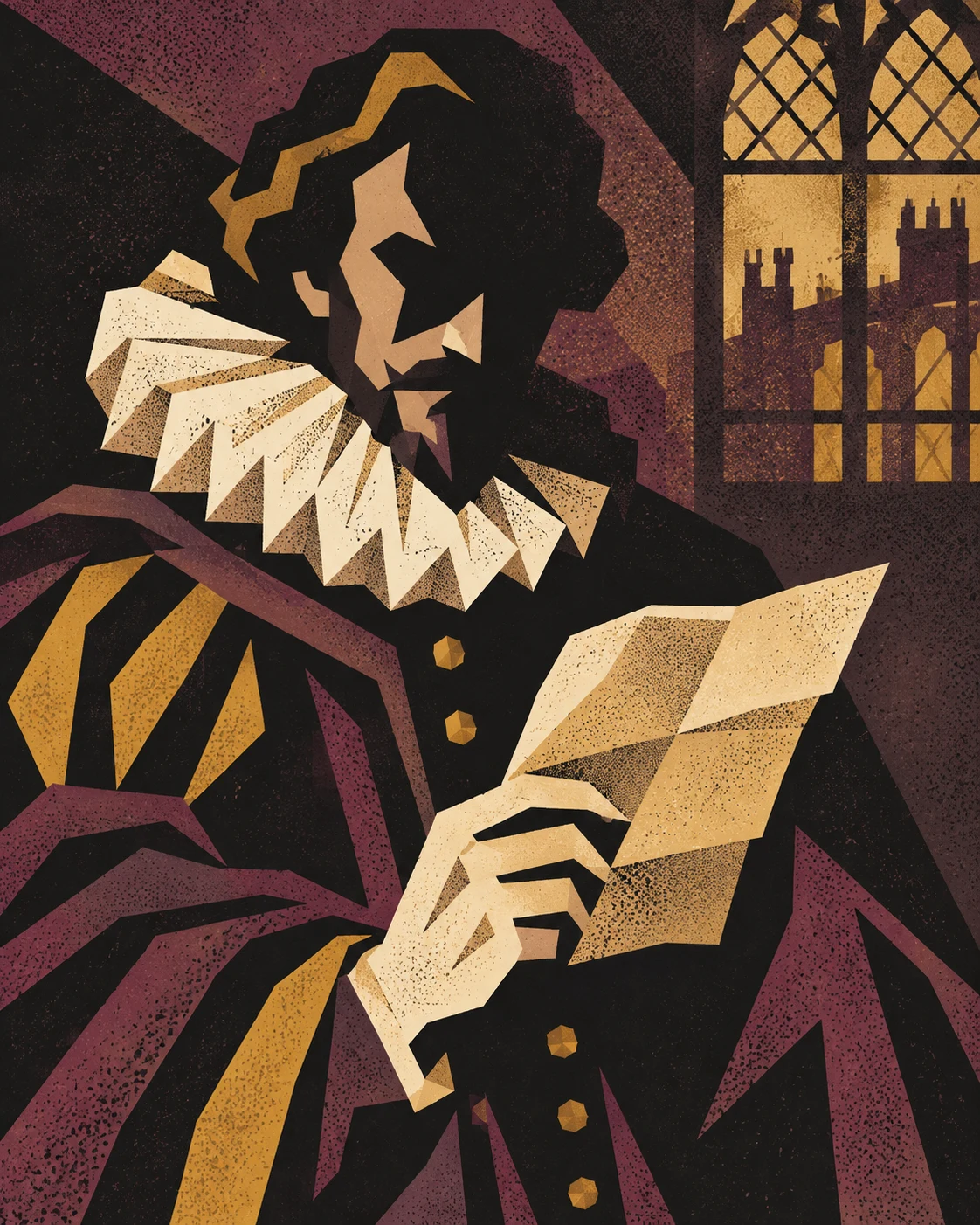
The argument became a full documentary battle in 1897. John Gerard, a nineteenth-century Jesuit historian, challenged the traditional account in *What Was the Gunpowder Plot?*, and Samuel Rawson Gardiner replied with *What Gunpowder Plot Was*. Gerard questioned the discovery, the handling of statements and the reliability of a prosecution story assembled by the government. Gardiner defended the reality of the conspiracy without putting every official detail beyond criticism.1213
Gerard was at his strongest when he forced attention onto evidence too easily smoothed into a familiar story. Confessions passed through many hands; published versions did not always reproduce the manuscripts; and accounts of the discovery needed comparing, not blending together. Those objections stand even for readers who reject his conclusions about the government. They turn the official story into something to investigate, not a standard every objection has to fail.12
Gardiner’s reply shows why admitting manipulation does not prove invention. He accepted problems in the documents, including alterations and suppressed material, while disputing what Gerard concluded from them. The two historians were not simply deciding whether to believe one confession. They were arguing over how far particular faults could carry an explanation of the whole affair.13
The boldest modern version of the accusation is Francis Edwards’s *The Enigma of Gunpowder Plot, 1605: The Third Solution*. According to its publisher, Edwards considered three possibilities: a plot discovered, a plot allowed to develop and a plot invented by the government, and argued for the third. That is the book’s stated thesis, though a publisher’s summary is no substitute for examining every document behind it.15
Pauline Croft’s review tests that claim. While recognising Edwards’s archival labour, it challenges his picture of an all-seeing government spy network. An intelligence service can be extensive and still fail to know what particular men are doing, and evidence that an official ought to have known something is far weaker than a record showing that he did.16
There is also a danger in making the conspirators seem so impractical that they must have needed an outside author. The historian Mark Nicholls argues for treating the plan as calculated political action against long odds, not dismissing its members as an irrational fringe. Failure and a murderous objective are not evidence of a lack of strategy, and the planned seizure of Elizabeth belongs in any account of what they hoped to achieve.17
These arguments can be tested at different levels. The captured man, the powder and the target make a strong case for a real attack. The letter and the handling of the discovery leave questions about information and timing. The statements produced by the state, and the selective publication that followed, raise further questions about how responsibility was presented. A weakness found at the second or third level should change the judgement there, not wipe out the first.
The fullest version of the counterplot needs the strongest evidence, because it has to show how the government’s hand got into the operation, not merely into the archive, and the sources do not show that. They leave room for a hidden informer or a less than candid account of the discovery, but they do not turn Fawkes into an innocent bystander guarding somebody else’s harmless barrels.

A treason made public
On 27 January 1606, eight surviving conspirators were tried in Westminster Hall. The building is often confused with their target, but the trial took place in the great hall, while the powder had been beneath the House of Lords. The familiar line about men tried in the very room they meant to destroy gives the proceedings a symmetry they never had.25
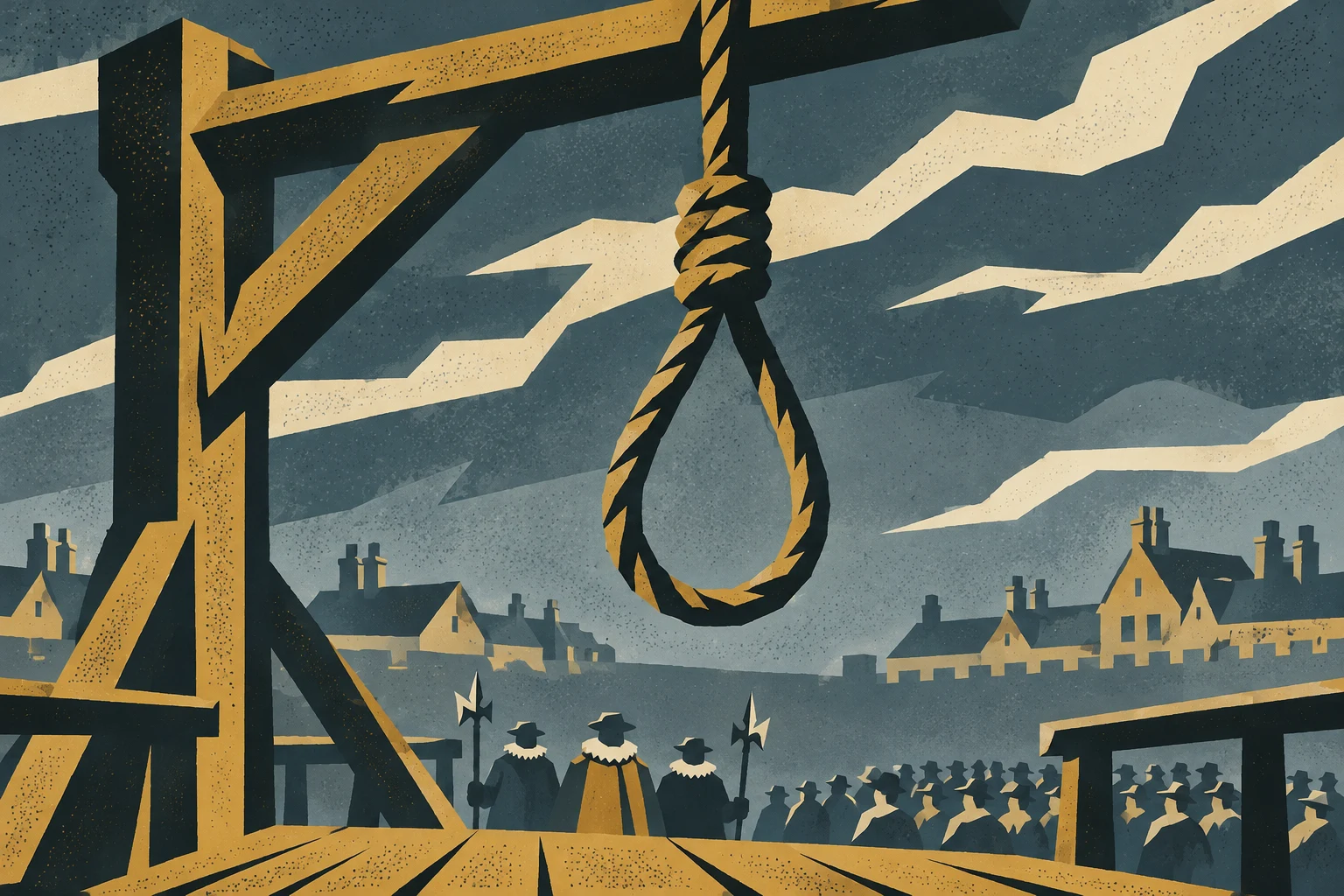
The convictions led to executions on 30 and 31 January; Fawkes died on the second day. The punishment for treason was hanging, drawing and quartering, and parts of the condemned men’s bodies were put on display. It removed a threat and made the power to punish visible across the capital, turning the bodies of the defeated into public warnings.25
Gardiner identified a specific example of manipulation involving the priest John Gerard. Fawkes had said Gerard did not know the purpose of the Mass he celebrated for the plotters, but the prosecutor, Sir Edward Coke, marked that passage for omission. Later, at the trial of the Jesuit Henry Garnet, Coke claimed that Gerard had known the conspirators’ plans. Gardiner condemned the substitution of a prosecutor’s conviction for evidence. It is a far more specific reason to distrust the presentation than any general assumption that every government document was forged.13
The plot also gave the authorities a case against a wider religious threat. An allegation about particular plotters could become an allegation about Catholic loyalty in general, and a prisoner’s contacts could be used to draw others into the story. That was where the reliability and selection of statements mattered most. Proving that Fawkes meant to cause an explosion did not prove the guilt of every priest, relative or fellow Catholic connected with him.
James did not declare all Catholics traitors, and Parliament’s own history of the aftermath notes his insistence that many Catholics were loyal, even as some members urged severe measures. That did not lift the pressure. It made loyalty the central political question, which was what the Crown could require Catholics to swear, and what a refusal would be taken to mean.18
The new Oath of Allegiance demanded loyalty to the King and a denial of the Pope’s power to depose him. It placed a dispute about spiritual and temporal authority inside a test administered by the state. For Catholics who rejected the plot, condemning Catesby was not enough. They faced demands shaped by a crime committed without their consent, in a climate where any qualification could sound like hidden sympathy.18
That was one of the government’s most consequential uses of the discovery. It did not need to have ordered the attack to dictate the response. Officials controlled the interrogations, the prosecution and much of the publication through which the public met the evidence. The result could be a real conspiracy followed by a self-serving explanation, with injustice flowing from how far that explanation reached, not from any invention of the barrels.
Inside the Tower, Sir William Waad later installed a marble memorial to the deliverance, dated 1608, in a building associated with the prisoners’ confinement. Names, punishment and divine rescue were all part of the same commemoration. The stone is a different kind of source: a record of what an official wanted to make permanent once the danger had passed, and no neutral account of how the plot was uncovered.26
The argument over the plot outlived everyone who could have answered questions about it. Some of the leaders were dead before any trial. The surviving testimony had been extracted under conditions that demand scrutiny, and the official publications gave the country a coherent story while leaving readers dependent on choices made by interested officials. That explains why suspicion has lasted, though not every accusation made in its name.
How the plot is remembered
Parliament made remembrance an annual duty. The Thanksgiving Act of January 1606 established services and sermons every 5 November, while bells, bonfires and fireworks supplied celebrations of their own. It was an organised interpretation of survival: the nation had been delivered from a particular enemy, and the calendar would keep that deliverance in public view.19
The figure on the fire changed over time. Parliament’s history dates the rise of effigies of the Pope and the devil to the reign of Charles I, and their greatest popularity to later anti-Catholic crises; Fawkes himself became the main figure later still. Modern Bonfire Night does not recreate what London did after his arrest. Each generation took its own enemies and meanings from the same November story.19
That process has helped cut Fawkes loose from the plot’s intended victims and political aims. A lone man with a lantern is easier to recognise than a group planning an explosion, a rising and the kidnapping of a princess. He can stand for treason, for rebellion or simply for a night of fireworks. Each version simplifies him, sometimes until the question of what he meant to do almost disappears.
Recent work has returned to the Catholic world the conspirators came from. A 2026 exhibition at the Bar Convent in York explores the city’s connections with the plot, and research discussed by the historian Hannah Thomas examines material associated with the Clitherow and Middleton families and possible links to Fawkes’s circle. This work recovers a social and religious setting instead of replaying the scene in the cellar.2122
Possible school friendships are not the same as a surviving register proving them, and the suggestion that Fawkes may have witnessed or known about the execution of Margaret Clitherow in 1586 is not an eyewitness record placing him there. Such connections can help make his motives understandable. They reveal nothing new about what Cecil knew in October 1605.22
The evidence supports a real assassination attempt, whose discovery and official presentation remain less fully understood than the annual ritual suggests. The anonymous warning shows that someone intervened before the arrest, and torture and editing are reasons to distrust easy readings of the later record, but neither shows that the minister who benefited commissioned the crime.
A document identifying the author of the warning, an earlier intelligence report with a secure link to Salisbury or an instruction to an agent would change parts of that judgement. A newly noticed inconsistency in a published confession would have to be weighed against whatever it contradicted. The story remains open to new evidence, but not equally open to every conclusion.
What survives most clearly is the gap between the catastrophe that was planned and the story told about how it was prevented. Fawkes stood beneath a chamber that was to hold the King. Afterwards, the Crown stood over the records through which the country would come to know him, and the story of the plot’s discovery has never quite belonged to anyone else.
Linked case files


Sources26
- House of Commons Journal: Gunpowder Plot entry Ralph Ewens / Parliamentary Archives · 1605-11-05 · Accessed 2026-11-07
- The warning letter to Lord Monteagle Anonymous / The National Archives · 1605-10-26 · Accessed 2026-11-07
- First examination of Guy Fawkes Guy Fawkes, examined as John Johnson / The National Archives · 1605-11-05 · Accessed 2026-11-07
- Proclamation for the apprehension of Thomas Percy James I / The National Archives · 1605-11-05 · Accessed 2026-11-07
- Confession concerning the last stand at Holbeach Thomas Wintour / The National Archives · 1605-11-23 · Accessed 2026-11-07
- Examination concerning Elizabeth and the intended proclamation Guy Fawkes / The National Archives · 1605-11 · Accessed 2026-11-07
- The Plot UK Parliament · undated · Accessed 2026-11-07
- Parliament receives a tip-off UK Parliament · undated · Accessed 2026-11-07
- Francis Tresham UK Parliament · undated · Accessed 2026-11-07
- Timeline: October 1605–1606 UK Parliament · undated · Accessed 2026-11-07
- Guy Fawkes and the Gunpowder Plot Historic Royal Palaces · undated · Accessed 2026-11-07
- What Was the Gunpowder Plot? The Traditional Story Tested by Original Evidence John Gerard SJ · 1897 · Accessed 2026-11-07
- What Gunpowder Plot Was Samuel Rawson Gardiner · 1897 · Accessed 2026-11-07
- Guy Fawkes’s Lantern Ashmolean Museum · undated · Accessed 2026-11-07
- The Enigma of Gunpowder Plot, 1605: The Third Solution Francis Edwards / Four Courts Press · 2008 · Accessed 2026-11-07
- The Enigma of Gunpowder Plot, 1605: The Third Solution (review) Pauline Croft · 2010 · Accessed 2026-11-07
- Strategy and Motivation in the Gunpowder Plot Mark Nicholls · 2007 · Accessed 2026-11-07
- From retribution to toleration UK Parliament · undated · Accessed 2026-11-07
- Commemoration of the Gunpowder Plot UK Parliament · undated · Accessed 2026-11-07
- Gunpowder Plot: The Fall Guy The Unredacted · 2018-02-22 · Accessed 2026-11-07
- The Gunpowder Plot: The York Connection Toni Wainwright / The Bar Convent · 2026-09-16 · Accessed 2026-11-07
- Research uncovers new Guy Fawkes evidence Diocese of Middlesbrough, reporting Dr Hannah Thomas · 2026-11-02 · Accessed 2026-11-07
- His Maiesties Speach ... Together with a Discourse of the Maner of the Discovery of this Late Intended Treason James I / The Morgan Library & Museum · 1605 · Accessed 2026-11-07
- The examination and torture of Guy Fawkes IHR Digital / Institute of Historical Research · 2011-11-04 · Accessed 2026-11-07
- Frequently Asked Questions: The Gunpowder Plot UK Parliament · undated · Accessed 2026-11-07
- The Gunpowder Plot and Guy Fawkes: learning resources Historic Royal Palaces · undated · Accessed 2026-11-07