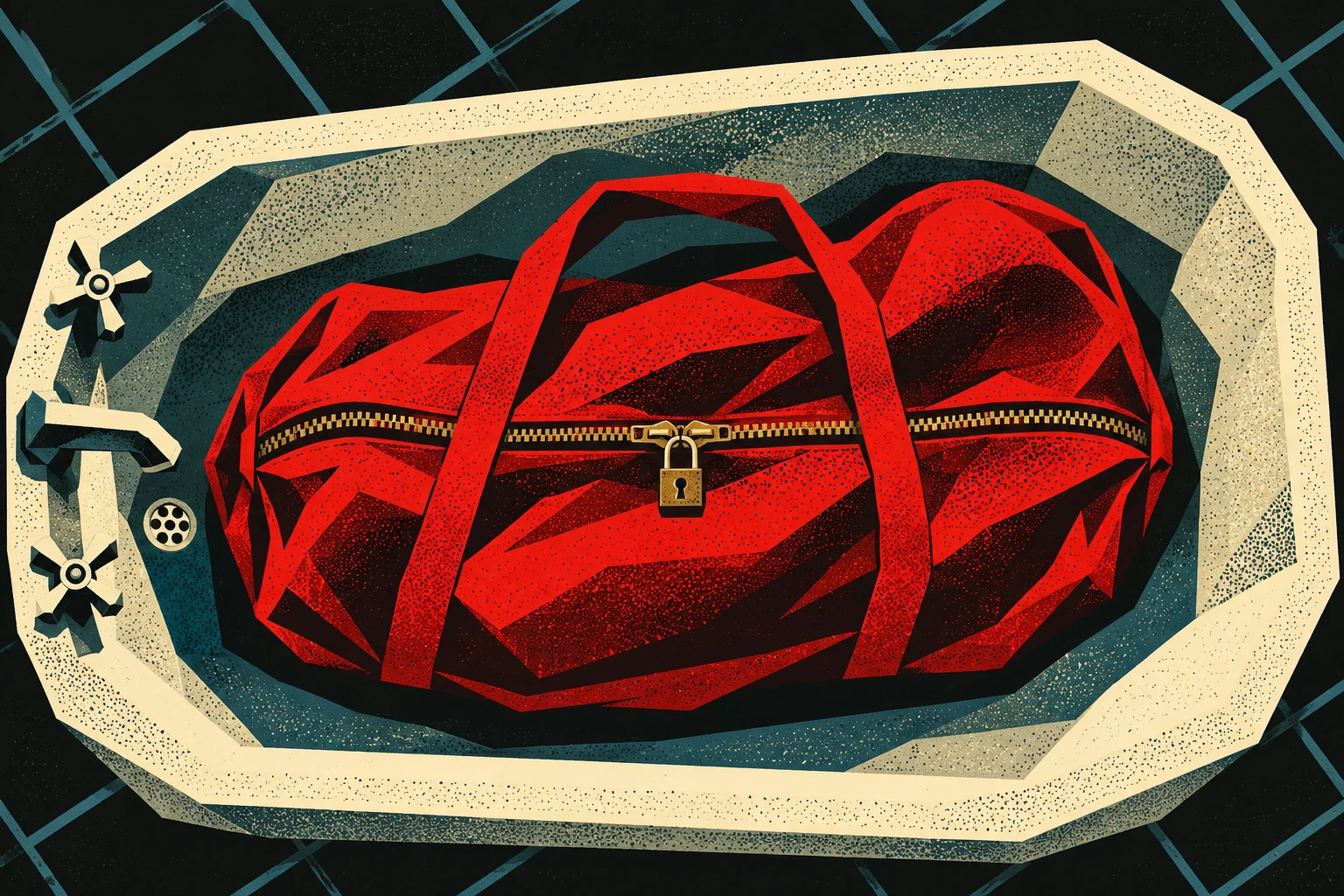
On 23 August 2010, police entered a flat in Pimlico, central London, and found a red holdall in the empty bath. It was zipped shut and padlocked. Inside was the body of Gareth Williams, who lived there, and the keys to the padlock were in the bag with him.12
The week nobody checked
Williams had last been seen alive eight days earlier. He was 31, a mathematician from Anglesey who worked for GCHQ, the government’s communications intelligence agency. At the time of his death he was on secondment to the Secret Intelligence Service, better known as MI6. His flat was across the Thames from the service’s headquarters at Vauxhall Cross.12
His absence from work should have brought someone to his door much sooner. He failed to turn up on Monday 16 August, yet a week passed before police found his body, a delay that his family, the coroner and the intelligence agencies’ own watchdogs would all later agree had failed him.3
The holdall was a red North Face bag, and Williams’s naked body was curled up inside it with the zip closed and secured by the padlock. There was no obvious damage to suggest he had struggled to tear his way out, so an ordinary soft bag seemed to have become a locked room.2
The flat offered no easy way back to the moment of death. The radiators had been left on in midsummer and the body had decomposed, so pathologists could not establish an exact medical cause. They considered suffocation and poisoning the main possibilities, but no poison was identified and no decisive injury was found.45
His job made the discovery international news, because a codebreaker dead in a locked bag seemed to promise an assassin, a covert operation or a message written into the manner of the killing. Detectives at first believed someone else had been involved, and at the 2012 inquest the coroner, Fiona Wilcox, concluded that Williams had probably been unlawfully killed. In 2013, however, the Metropolitan Police announced that he had most probably died alone, in an accident.36
Those conclusions still stand side by side, since the police assessment did not replace the coroner’s recorded finding and the inquest did not identify a killer. A later forensic review, whose outcome was announced in February 2024, found no new DNA evidence and no further line of inquiry. The bag remains at the centre of the case because one physical question has survived every change in the official account: how did it come to be locked with Williams inside?1

A life outside the headlines
The tabloid label, “spy in the bag”, reduced Williams’s life to his employer and the object he was found in. His family and friends described a far less theatrical everyday life. He cycled, climbed and ran in the hills. He had worked in Cheltenham, where GCHQ is based, and was planning to go back there. His sister, Ceri Subbe, told the inquest he disliked parts of the London office culture.7
The work was real and sensitive, but the operations Williams supported have never been made public. Reports at the time described his mathematical and technical skill, and the intelligence watchdog’s records confirm his job and his secondment. None of that shows he was running agents, carrying a particular state secret or planning to defect. His work explained why his security was taken seriously, and left plenty of room for others to fill with their own theories.38
The outline of his career is firmer. The Intelligence and Security Committee reported that Williams first received Developed Vetting clearance in 1999, while finishing his doctorate at Manchester. A review after his first year at GCHQ rated his security risk as very low. Another full review followed after five years, and a further one was due in 2011. Before the secondment, MI6 examined his vetting file and accepted that assessment.3
The committee went through those checks because his death had set off so much speculation about his private life. Its account revealed no hidden disciplinary crisis. It set out the agencies’ understanding of an employee who had passed their procedures. The same report pointed out that personal lifestyle choices did not automatically disqualify someone from security clearance, a useful corrective to stories that treated every unusual possession as a professional weakness.3
In his flat, police found women’s clothes, shoes, a wig and make-up. The discovery gave Williams a second public identity after his death. A friend, Sian Jones, told the inquest that he had bought her expensive clothes in the past and suggested the items might have been presents. Other witnesses offered their own impressions of a private man. None of them could turn a wardrobe into a reliable account of his last evening.27
There was also a more relevant story about restraint. His former landlady, Jennifer Elliot, described an occasion in Cheltenham when she and her husband heard him calling for help. They found his hands tied to his bed and freed him. According to her statement, he said he had been trying to see whether he could get himself free. She read the incident differently. The episode gave investigators a reason to look at an interest in escape or confinement, but it could not tell them what happened years later in Pimlico.7
Much of the coverage blurred those two kinds of evidence. The restraint incident might bear on whether Williams would attempt a dangerous experiment, but the clothes could not show that he had, and even when police later favoured an accident they said the clothing had nothing to do with how he died. There was no need to solve every part of his private life in order to investigate a locked bag.9
Four hundred failed attempts
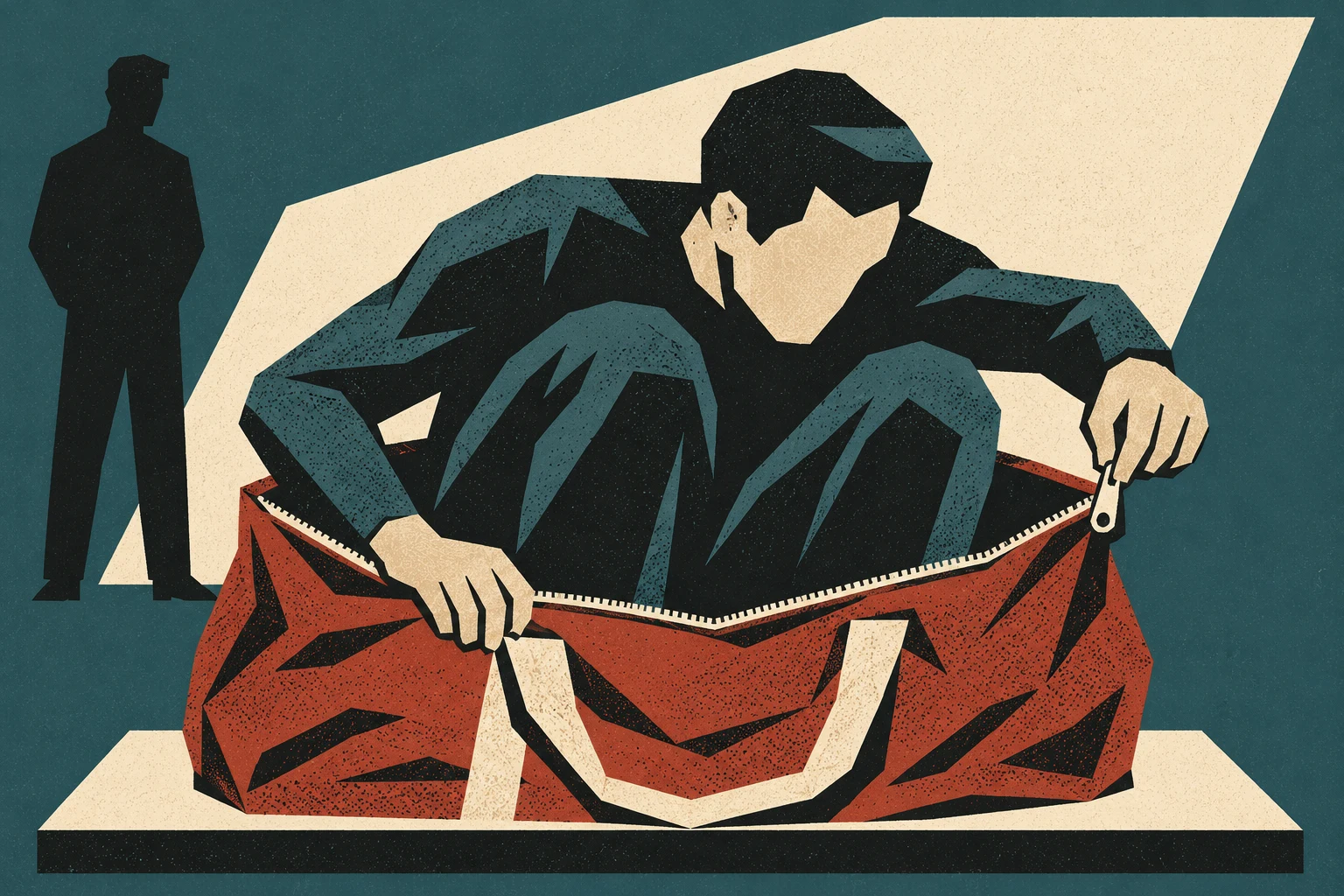
The holdall was about 81 centimetres long and 48 centimetres wide, and a man of Williams’s build could fit inside it. But getting in was only the start. Someone acting alone would also have to pull the zip into place, fasten its fittings with the padlock and leave the bag in the bath as it was found. Every movement got harder as the space around him disappeared.1011
Police asked two specialists to try it for themselves. William Mackay, who had military experience and expertise in confined spaces, made more than a hundred attempts, while Peter Faulding, who rescues people from confined spaces, made about three hundred. The inquest watched recordings of their efforts, which showed that both men could get into a similar bag but neither could close and lock himself inside in the way required.1011
Mackay was about the same size as Williams. He used a similar bag and key, with the bag in a bath, and someone was present for safety. It was a test of a possible method, with time to stop and try again. It could not recreate the fear, heat or failing air of the real event. The repeated failures were strong evidence of how difficult it was, though the experimenters did not claim to have tested every possible movement.10
Faulding went further. He believed Williams had been put inside while unconscious or already dead, and his practical experience gave that opinion weight. Asked whether it was impossible, he added a qualification that was often lost in the headlines:
“I couldn’t say it’s impossible, but I think even Houdini would have struggled with this one.” >
A later demonstration complicated things. Sky News reported in 2013 that an army sergeant had shown how someone could get into a similar holdall and lock it. Mackay objected that the eyelets had not been brought together as they were in Williams’s case. A demonstration can show a method that works for one arrangement while leaving open whether it explains the one the detectives found.612
The popular question, whether a person can lock himself inside a bag, was therefore too broad. The case needed the right bag, closure and lock, worked without help, and then the bag and body ending up as they were found. Proving the general possibility would weaken any claim that it was impossible, but investigators would still need a plausible sequence for this death. In 2013, police called self-locking theoretically possible. They did not claim to have reconstructed every movement.9
The other sequence needed explaining too. If someone else closed the bag, how had Williams been unable to resist? Why use his own holdall, and why put it in the bath? Faulding’s view answered the first question, but the medical evidence could not show that Williams was already dead, and Wilcox believed he had climbed into the bag alive. Two people could agree that someone else was involved and still disagree about what that person had done.51113
What the body could not say
The pathologists were dealing with a body altered by time and heat, and decomposition limited what they could learn about injuries, drugs or alcohol, or about what happened just before death. The radiators drew obvious suspicion, because heating left on in August seemed out of place and had badly damaged the evidence. No public finding established who turned it on, when, or why it stayed on.45
Suffocation offered a cause consistent with being shut in, since a person inside a closed bag might be overcome before making any sustained effort to escape. Court reports described expert evidence about carbon dioxide building up in the small space. That also weakened the argument from the undamaged fabric, because an intact bag could not show that the person inside had stayed conscious and able to fight for long.45
Witnesses gave different estimates of how long someone might survive, depending on what they were describing and what they assumed about conditions inside the holdall. A precise countdown has become one of the case’s misleading certainties. The important medical point was that the enclosed space could kill, perhaps with little time to react. It was not a record of Williams’s breathing or a timed account of his last minutes.411
Poisoning was the other possibility discussed at the inquest, and it could explain why he did not resist, or why he collapsed before the bag was closed. No poison was identified as the cause of death, but so little can be ruled out in decomposed remains that the possibility stayed open, without a substance, a means of giving it or anyone who gave it. The body could not decide between the competing accounts.45
The forensic traces were just as easy to oversimplify. There was no palmprint on the rim of the bath and none of Williams’s DNA on the padlock, points that troubled the coroner and that the police account never explained. But the flat had not been wiped of all human traces. Small amounts of another person’s DNA were reported on the bag, and whether that DNA meant anything was a separate question.28
One supposed lead collapsed for a very specific reason. DNA recovered from Williams’s hand at first seemed to belong to an unknown person. It was later traced to a scientist working on the investigation. A mistake in entering the numerical profile had stopped the match being spotted, and the laboratory, LGC, apologised. A laboratory error had given the case a phantom suspect while the family waited for the trace to lead somewhere.14
Police said in 2013 that they had found no evidence that the flat had been cleaned to remove traces. That did not explain the gaps in the forensic record. It meant only that the idea of a clean-up had no positive evidence behind it. The missing prints, the heating and the damaged body could be woven into a sinister story, but they could not identify its author or show that all three came from a single plan.9
The coroner’s locked door
The inquest opened at Westminster Coroner’s Court on 23 April 2012 and ended on 2 May. It brought the bag tests, the medical evidence, colleagues’ accounts and the agencies’ handling of Williams’s disappearance into one public hearing. By the end, Wilcox believed another person had closed the bag and put it in the bath. She thought Williams had probably been alive when he got into it.313
She recorded a narrative conclusion, whose key words the Intelligence and Security Committee later reproduced: the death was unnatural and likely to have been criminally mediated, and on the balance of probabilities Williams had been unlawfully killed. It was her judgement of what was most likely after hearing the evidence, and it named no killer and gave no full account of how the killing was done.3
The form of the finding matters, because the case is often told as if a murder verdict had been returned and then overturned by detectives. Wilcox did not record a short-form verdict of unlawful killing. She gave a narrative conclusion, on the civil standard of the balance of probabilities. The later police statement was an investigative assessment, made by a different body after further work. Their disagreement was real, but a court’s judgement was not being overturned at a press conference.36
Wilcox’s reasoning was rooted in the physical facts. The bag had been closed around a man, attempts to repeat that unaided had failed, and his own traces were missing from surfaces he would have been expected to touch. She also believed the bath had been chosen to contain the fluids of decomposition. That last point was her interpretation of why the bag was there, not a witness’s account of anyone choosing the spot.813
Her criticism went well beyond a suspected unknown visitor, because the inquest exposed mistakes by MI6, the police, the forensic scientists and the coroner’s own office. Poor communication affected the handling of the investigation, including the arrangements for a second post-mortem, and the DNA error had wasted a line of inquiry. This was not a flawless official process obstructed from outside, but one in which several of the organisations responsible had fallen short.5
The family’s anger focused most of all on the delay. An employee had failed to turn up, and nobody had made the checks that could have brought help or preserved fresher evidence. The head of MI6, Sir John Sawers, apologised through the service’s lawyer. An apology could acknowledge what was lost, but not recover the days that had passed. Nor could it tell the family whether a prompt visit would have found Williams alive.5
The committee’s later report set that failure in a wider context. People doing intelligence work could face risks because of their jobs, so their employers had every reason to take unexplained absences seriously. The report rejected any comfortable assumption that a man doing secret work could vanish from his desk for a week without a proper response. Whatever had happened inside the flat, this part of the story demanded change outside it.3
Between two investigations
The institutions had made the inquiry harder in another way. At first, the detectives investigating the death did not deal directly with MI6 on every matter. Counter-terrorism officers from SO15 acted as go-betweens. Sensitive material passed through a system designed to protect national security, while the murder detectives needed evidence that would explain a death. The arrangement left room for each team to assume the other had already checked something.36
Near the end of the inquest, Detective Chief Inspector Jackie Sebire learnt that memory sticks and another holdall had been among Williams’s belongings at work, and said she would have expected to be told about them. MI6 had examined electronic material without her knowing how far that work went, which meant the officer leading the investigation had never had a full account of potentially relevant items.15
SO15 witnesses said they had taken what they judged relevant. The contents of Williams’s office cabinet had not been listed in the normal way because the documents were sensitive. That left an awkward decision about relevance with the people holding the material, not the detective responsible for the case. An item might be routine to an intelligence officer but still matter to someone trying to reconstruct its owner’s movements.16
The agencies rejected the wider accusation that they had refused to co-operate. The committee recorded MI6’s position that it had worked fully with SO15. It also recorded a practical change: MI6 would now deal directly with the investigating team, cutting out the middle step. Together, those two points describe the dispute more accurately than either a claim of total obstruction or a claim that the system had worked well all along.3
The procedures for absences changed too. MI6 told the committee that its policies had been correct but poorly communicated and carried out. Staff were reminded of their duties, and managers were made explicitly responsible for acting when a colleague failed to turn up. GCHQ revised its own rules, including who was responsible for staff on secondment. Being employed by two agencies could no longer blur the question of who should act.3
The bureaucratic language describes a personal failure. Williams belonged to one agency and worked at another, and the fact that his original employer still existed did not relieve the agency he was working for of the duty to check on him. The committee concluded that the delay had made it harder to establish how he died. That was a documented consequence of the response to his disappearance, whatever caused his death.3
Why police changed their mind
On 13 November 2013, Deputy Assistant Commissioner Martin Hewitt announced the result of the continued investigation. Police now thought it more likely that nobody else had been present when Williams died, and Hewitt said his own preferred explanation was an accident. That contradicted both the coroner and the view the original investigating team had given at the inquest.68
The argument rested partly on what the investigation had not found. No one with a proven motive had emerged. There was no evidence of a break-in, no substantiated clean-up and no established link between the death and Williams’s intelligence work. The police had been unable to build the case for a third person that the state of the bag had at first seemed to demand.69
Access had changed as well. Hewitt admitted that the original go-between system had been cumbersome and had hampered the detectives. He said officers had since been given full access to information about Williams’s work, and the investigation had included interviews with 27 members of staff from GCHQ and MI6. By the end of 2013, the claim that his colleagues could never be questioned no longer described the police investigation.68
Hewitt was not offering new evidence of what had happened in the flat. Nobody had seen Williams lock the bag, and the missing DNA on the padlock and prints on the bath were still troubling. Police judged that an accident of this kind could happen and that a long inquiry had produced no convincing evidence of anyone else. Their conclusion rested on weighing incomplete explanations against each other, not on a new witness to the death.89
The family were not persuaded. They said the coroner’s conclusion best reflected the circumstances, and they returned to the failure to check on Williams when he stopped coming to work. In their eyes, the police had moved towards an accident while admitting that central questions remained unanswered. Being unable to identify a killer is not the same as showing exactly how a solitary accident happened.6
Neither account removes every difficulty. A second person would explain how the bag was closed, but brings in an unknown visitor, an unknown motive and an unproved way of overpowering Williams. An accident needs no unknown participants, but it depends on a difficult feat that the specialists brought in by the police had failed to repeat. The evidence gives reasons to take each account seriously and reasons not to treat either as a fully reconstructed event.3910
The wilder theories go much further. A professional assassination followed by a staged sexual death would explain why a clever killer might want the scene to look embarrassing, but it still needs evidence of an operation, a target and the people involved. A theatrical suicide, set as a final puzzle for others to solve, supplies a personality and intention that nobody saw. Neither story gains support from the fact that Williams worked with secrets or was exceptionally good at mathematics.12

The review that found no answer
In January 2021, an independent forensic review began. New techniques offered a reason to go back to old exhibits, since a sample that had once yielded too little information might now say more, but the promise was narrower than a full reinvestigation of Williams’s last days. It was a search for a fresh scientific lead in material that already existed.1
The Met received the findings in November 2023. When the result was announced on 5 February 2024, Detective Chief Inspector Neil John said no new DNA evidence had been found and no further lines of inquiry identified. Williams’s family had been told. The force said detectives would look at any new information or evidence that came to light. It did not claim that every trace had been identified, or that the closing of the bag had finally been reproduced beyond dispute.1
The family rejected the police’s 2013 assessment and stood by the coroner’s conclusion, and the review announced in 2024 offered nothing to settle the disagreement. A locked bag had produced two official explanations, and exactly what happened inside the Pimlico flat is still unknown.16
Linked case files
Sources16
- Gareth Williams: Review into death of MI6 worker found in bag reveals no new evidence Tomos Evans / Sky News · 2024-02-05 · Accessed 2026-11-07
- Mystery DNA found on dead spy’s bag Reuters via ABC News · 2012-04-25 · Accessed 2026-11-07
- Intelligence and Security Committee Annual Report 2011–2012, Cm8403 Intelligence and Security Committee · 2012-07 · Accessed 2026-11-07
- Mystery Deepens Into British Spy’s Death Jean-Nicholas Fievet / ABC News US · 2012-04-30 · Accessed 2026-11-07
- Coroner concludes MI6 agent probably killed unlawfully ITV News · 2012-05-02 · Accessed 2026-11-07
- Spy In Bag: MI6 Man Probably Locked Himself In Martin Brunt / Sky News · 2013-11-13 · Accessed 2026-11-07
- Dead spy once found tied to bed, inquest told Reuters via ABC News · 2012-04-26 · Accessed 2026-11-07
- Police defend MI6 spy death findings ITV News · 2013-11-13 · Accessed 2026-11-07
- Police: MI6 spy death remains a mystery Lucy Manning / ITV News · 2013-11-13 · Accessed 2026-11-07
- Houdini would have struggled to escape from spy bag ITV News · 2012-04-27 · Accessed 2026-11-07
- Body in bag theory ruled out Sky News · 2012-04-27 · Accessed 2026-11-07
- Gareth Williams: The Spy in the Bag The Unredacted · 2018-02-26 · Accessed 2026-11-07
- Coroner’s conclusions: Gareth was unlawfully killed ITV Wales · 2012-05-02 · Accessed 2026-11-07
- New inquest to shine light on MI6 spy death ITV News · 2012-03-30 · Accessed 2026-11-07
- MI6 held back spy’s belongings ITV London · 2012-05-01 · Accessed 2026-11-07
- MI6 kept evidence related to dead spy Reuters via ABC News · 2012-05-02 · Accessed 2026-11-07