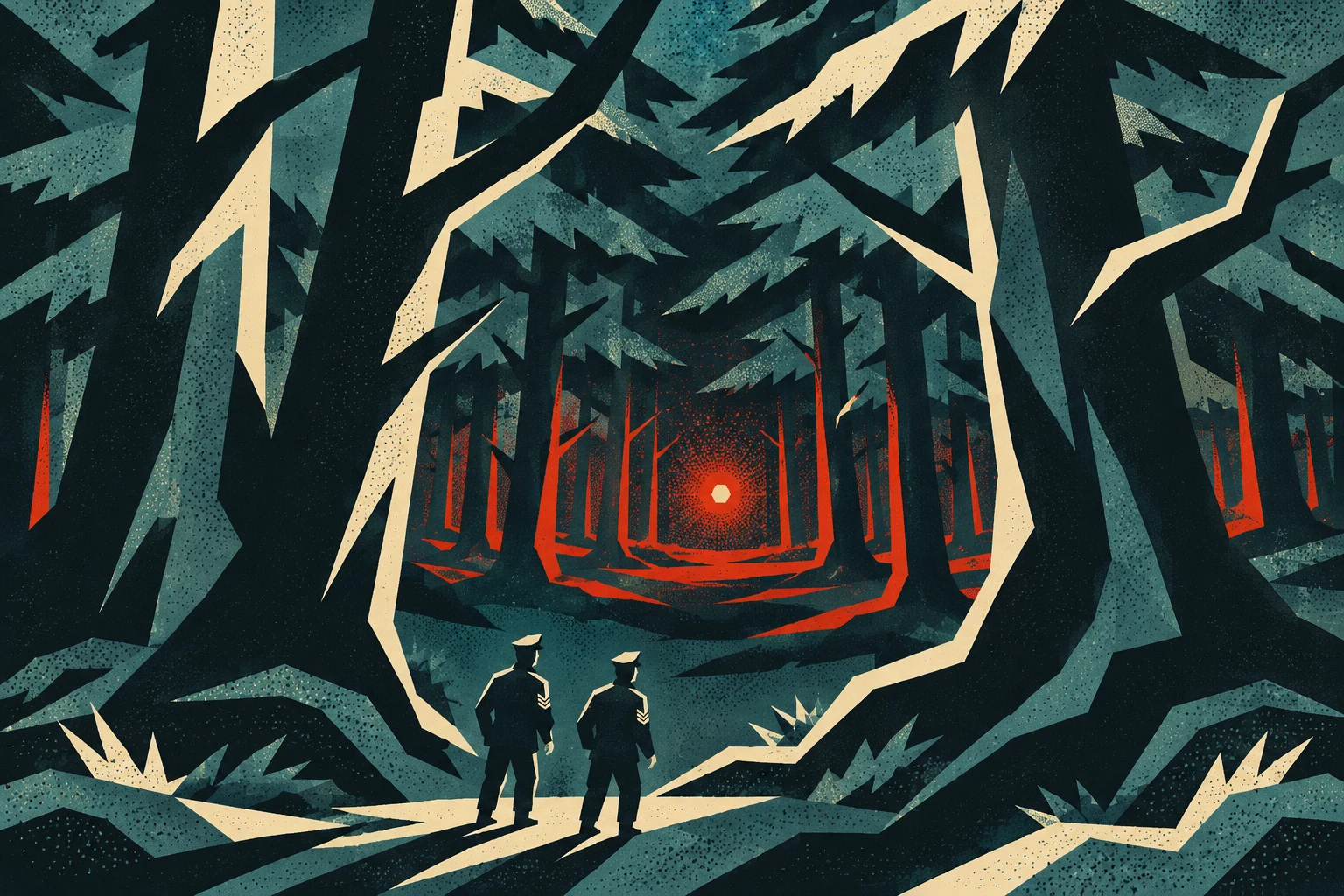
In the early hours of 26 December 1980, American security police at RAF Woodbridge in Suffolk saw lights moving among the trees of Rendlesham Forest. Fearing a plane had crashed, they sent three men out to look. What they reported would become Britain’s most famous UFO case.123
Beyond the east gate
The patrol’s walk into the forest became the first act of what would be called Britain’s Roswell. The surviving accounts describe something more complicated than that convenient label suggests.123
Woodbridge and nearby RAF Bentwaters were British bases used by the United States Air Force. Rendlesham Forest lay right beside them, close enough for an unfamiliar light to become the guards’ business. That setting gave the story much of its force. These were men paid to notice trouble, reporting to officers who had better things to do than entertain tales of flying saucers.2
Airman First Class John Burroughs described red and blue lights, with a white light shining on the trees, and the colours seemed to move as he and his colleagues approached. Staff Sergeant Jim Penniston and Airman Edward Cabansag joined the search, driving part of the way and then going on foot, while at Central Security Control Lieutenant Fred Buran followed their progress over the radio and Master Sergeant J. D. Chandler helped relay messages.3
Burroughs’s early account is an uneasy document. He reported noises like a woman screaming, movement among the trees and lights that seemed to retreat across open ground, and the men threw themselves to the ground before going on. At a fence they could see lights near a farmhouse, then lost them, so it reads as a disorientating search, full of pauses and shifting impressions.3
One passage gives the search a recognisable end point, when Burroughs wrote that they followed a rotating beacon for about two miles before realising it was a lighthouse. Cabansag also described chasing a distant beacon, and found that another glow came from a lit farmhouse, though both men also mentioned other lights they could not identify, so their statements put an ordinary identification alongside things they still found strange.3
Penniston was more definite about an object. In an early typed account attributed to him, he described getting within about 50 metres of something giving off red and blue light, and judging it to be mechanical. The reproduced document is unsigned and undated, which limits what can be said about how it was produced. Chandler’s statement, dated 2 January 1981, separately records Penniston reporting a mechanical object at about that distance over the radio.3
Buran remembered asking whether the lights might be markers, and Penniston insisting he would know the difference if he had seen them. Buran eventually called off the search and sent the men back to their posts, and his later statement expressed confidence in Penniston’s maturity and reliability while admitting the limits of his own account, because he had taken no notes at the time and was writing after the event.3
So what had they approached? The documents describe men trying to make sense of lights, a reported mechanical object and a beacon recognised during the search. They do not give three matching descriptions of a spacecraft examined at close quarters. That distinction would grow harder to see as later versions added the shape of a craft, markings on its surface and a much closer encounter.23

Halt takes a recorder
Two nights later, Lieutenant Colonel Charles Halt, the deputy base commander, went into the forest with a group of servicemen. He took a small tape recorder of the kind he used for spoken notes. His recording, made in bursts, lasts a little over eighteen minutes and covers parts of an outing that went on for several hours. It is the most intimate record of the affair, and the easiest to mistake for a complete one.24
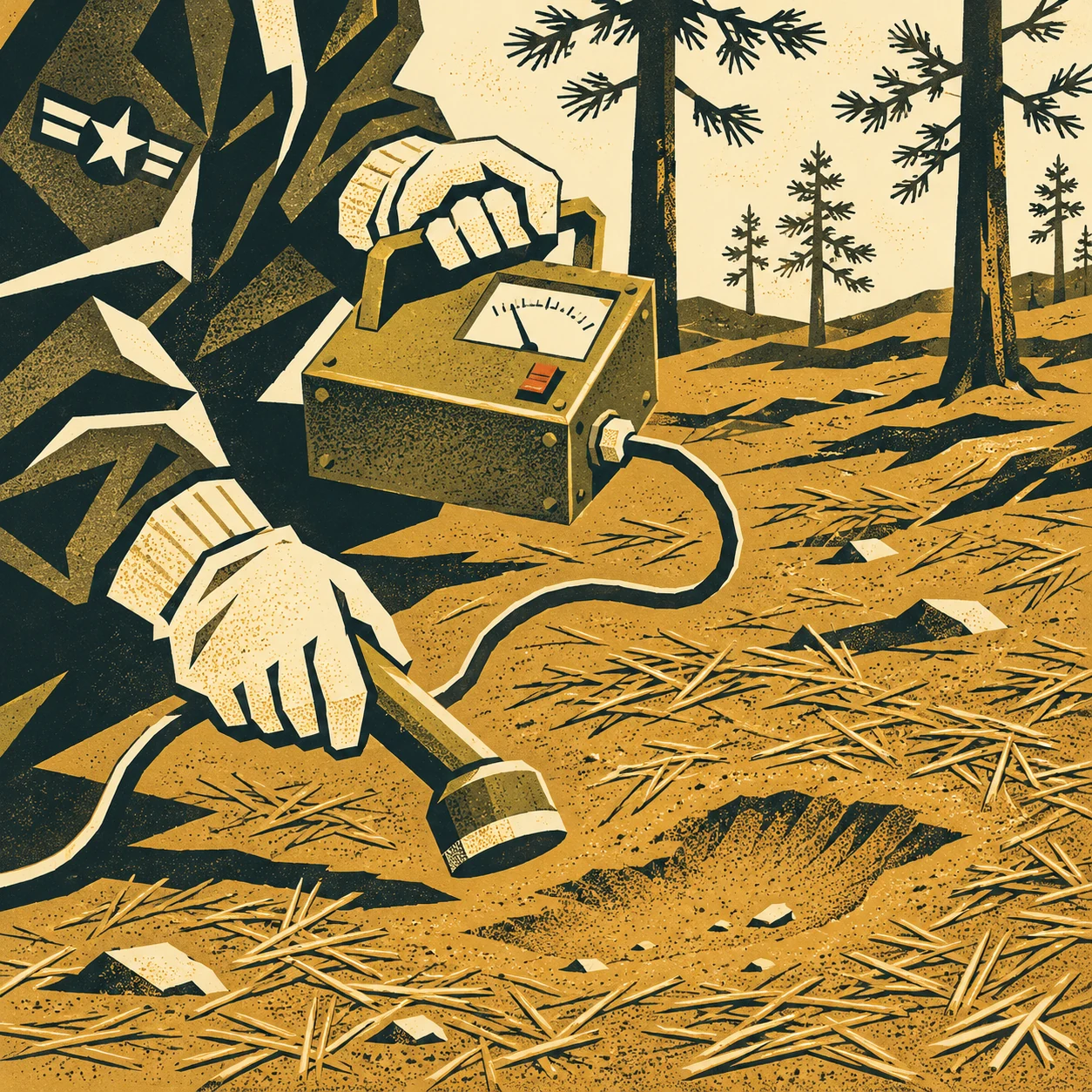
At first the group concentrated on the ground. Three small hollows had been found at the supposed landing site. Halt and his companions examined them, looked at damage to nearby trees and took radiation readings. Sergeant Monroe Nevels operated the meter, and Lieutenant Bruce Englund was among those showing Halt around. Their talk moved between what they could see, what the instruments might mean and what a landing might have done.4
A portable floodlight would not work, and on the tape Halt wonders about a mechanical fault and sends for another while radio traffic carries on around the inspection. Those mundane fragments matter because later accounts describe mysterious interference with equipment, but the tape records a lamp that failed, not what made it fail, and the search party had ordinary trouble with its equipment long before anyone showed an extraordinary cause.24
Halt’s report later described three hollows about an inch and a half deep and seven inches across, and gave a radiation reading of 0.1 milliroentgens at the marks and their centre, with lower figures on a tree facing the site. The precision has helped the case look scientific, but it also raises the question of what comparison would show that these readings came from a visiting object.1
Later, attention moved from the soil and trees to a flashing light. The voices on the tape grow more excited. Men call out colours and movements, and Halt describes a small red light and tries to judge how far away it is. The group heads for the edge of the wood to get a better view. The listener hears the investigation change direction, from a possible landing site to something visible beyond it.4
In the memo he wrote afterwards, Halt described a red, sun-like light shedding particles and then splitting into five white objects. He went on to report star-like lights to the north and south. Some stayed visible for hours and seemed to change shape through an optical instrument, and the one to the south appeared to send a beam of light down to the ground. Halt explicitly said he had witnessed this later activity and the ground inspection himself.1
That was a different kind of encounter from the first patrol’s. Halt had not been there when Burroughs, Penniston and Cabansag first went out. What he saw himself were distant lights and the marks that others had already linked to the earlier sighting. Running the two nights together creates a seamless story in which a machine lands, leaves marks, returns and is watched by a senior officer. The evidence was gathered on separate occasions.134
Three paragraphs reach Whitehall
On 13 January 1981, Halt signed a memorandum headed ‘Unexplained Lights’. In three paragraphs, it summarised the first patrol, the ground marks and radiation readings, and his own later sighting. The document’s survival is one reason Rendlesham has lasted. An officer put an extraordinary report into official correspondence, and anyone can still read the words he chose.1
The first paragraph begins with the patrolmen’s report of a glowing object, describing something metallic and triangular, two to three metres across the base and about two metres high, with a pulsing red light on top and blue lights underneath. It was said to light up the forest, move off through the trees as the men approached and vanish, and even how it stood was uncertain, since it might have been hovering or resting on legs.1
Halt was passing on what others had told him. The measurements came from their account, and the triangular shape was more specific than the descriptions in some of the individual statements. The memo is built so that his first-person declaration near the end covers only his later observations, keeping the patrol’s encounter separate from his own.13
The object was hovering or on legs.
The dates raise another problem. Halt put the first incident on 27 December and his inspection on 29 December. The earlier patrol statements place the first outing on 26 December, and the accepted timeline puts his own expedition in the early hours of 28 December. A slip of a day is easy to make in a summary written weeks later, but it matters when investigators try to match the report against air traffic, weather or astronomical records.134
Halt’s memo found its way into the British Ministry of Defence’s files. When the News of the World published it in October 1983, an incident known mainly to researchers became a national story. A named military author gave the report a standing that an anonymous sighting could rarely achieve. The public now had an official document to read, alongside the far more elusive object it described.2
The National Archives’ research guide points readers to Halt’s report, the correspondence that followed and parliamentary material. A dedicated Rendlesham file was opened years after the events. It contains briefings written after the 1983 publicity, followed by letters from members of the public. The report had taken on a second life as a question officials kept having to answer.5
The surviving centre: A memorandum, early patrol statements and a recording preserve reports of unusual lights. None of them provides an authenticated image of a landed craft or a recovered component.134
Marks on the forest floor
Physical traces promised a way past competing memories, because a craft resting on three legs might leave three impressions, and if it gave off unusual energy, the ground or nearby trees might hold something measurable. The forest offered small features that could be fitted into that story, but fitting them was the disputed part.12
Suffolk police received a report on the first morning and went to the area. Their log, reproduced by the researcher David Clarke from the released records, says the lights the officers could see came from Orford lighthouse and that a search found nothing. A later visit recorded three shallow marks in no set pattern, and an officer thought an animal could have made them.6
The police account deserves a place beside the Air Force report, since it describes a less impressive site and a more ordinary light. It has its limits too, because the officers were not with the original patrol, and their failure to find a craft does not tell us exactly what each airman had seen earlier. But it does show that the marks did not force the same interpretation on everyone who looked at them.136
Penniston objected that the ground was frozen, which made animal disturbance unlikely, and supporters also described the marks as forming an exact equilateral triangle. Neither claim can be checked from the memo’s brief description, because that would take reliable measurements, a securely identified patch of ground and a record of its condition at the time, and a remembered pattern is no substitute for a survey.12
The radiation readings have a similar appeal, because numbers seem to offer an independent witness, immune to excitement or expectation. But the figure in Halt’s memo is a summary, without the full measurement procedure needed to interpret it, and the tape’s talk about scales and a flickering needle records an attempt to measure, not a laboratory finding of an unusual substance.14
The memo includes no calibration record and no full set of background readings. A single figure cannot show where the radiation came from or how much anyone in the forest was exposed to.1
The party also talked about apparent heat on the trees. Ridpath’s transcript identifies their Starlight scope as a night-vision device, which amplifies available light. A bright patch seen through it is not, on its own, a measurement of leftover heat. The men’s conversation shows them trying to make sense of what the instrument showed them.4
A beacon beyond the trees
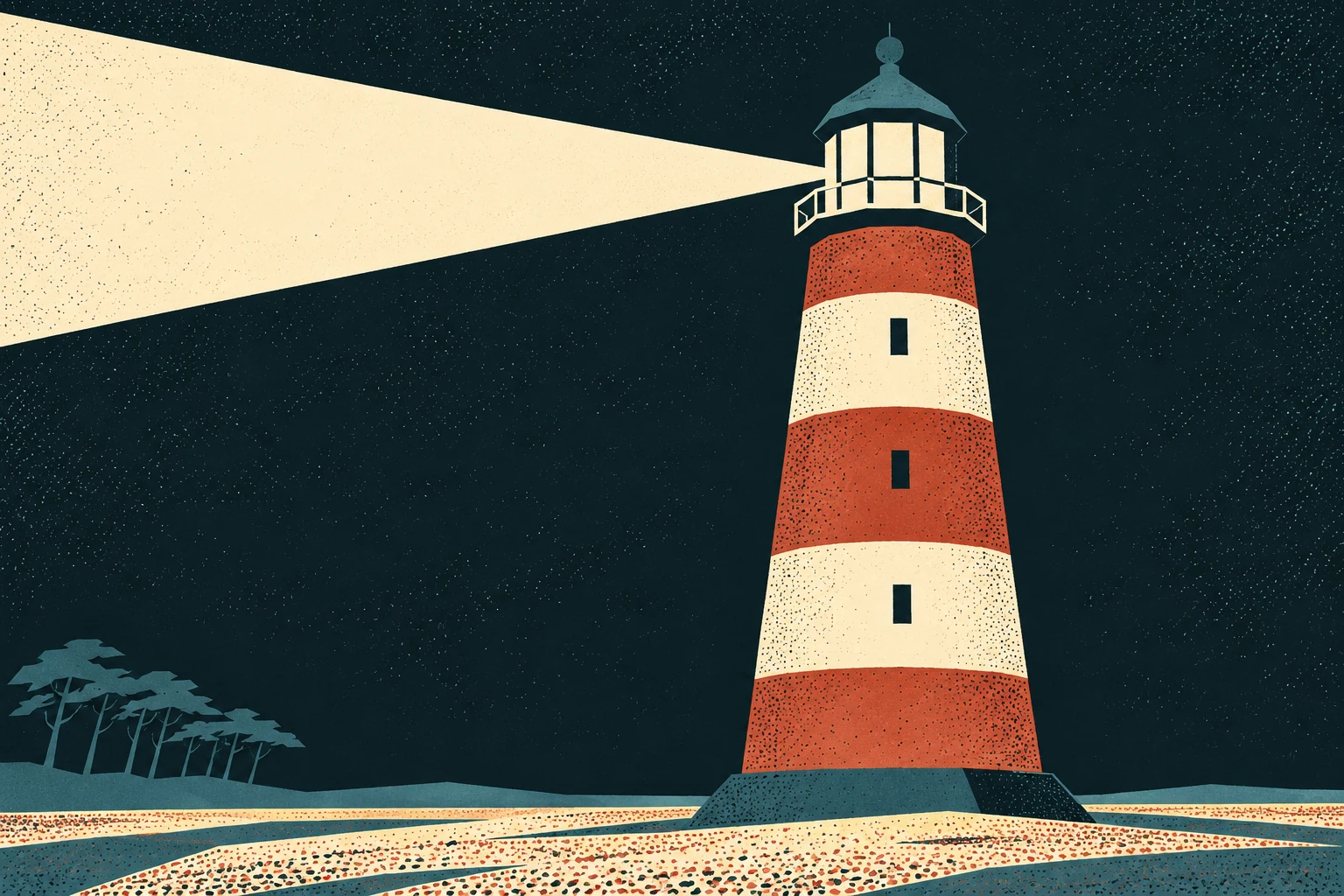
The strongest ordinary explanation starts with a light the first patrol did identify. Burroughs wrote that the beacon was a lighthouse, and Cabansag described a chase that ended at a spot from which the distant source became clear, which shows one of the practical hazards of the search, because a light that seems to be just beyond the trees can stay far away however long you walk towards it.3
The astronomer and science writer Ian Ridpath developed the lighthouse explanation after the story reached the press. He links the flashing light towards the coast in Halt’s recording to the Orford Ness lighthouse. In his annotated transcript, he points to five-second gaps between the calls marking each flash, which match the beacon’s cycle. That is a specific identification with a timing that can be tested, not a vague appeal to unreliable witnesses.4
A dark wood also makes distance hard to judge. A light glimpsed between tree trunks gives few reliable clues about whether it sits in the next clearing or beyond the forest, and as the observer moves, branches hide and reveal it. Those conditions deserve thought before apparent movement is turned into the measured flight of a solid object. No camera or rangefinder in the record supplies the missing distance.13
Halt rejected the lighthouse, arguing that it could not account for the movements, changing shapes, splitting lights and downward beams he described, and Nick Pope, who had worked on the Ministry of Defence’s UFO desk, also defended the case against a simple lighthouse dismissal. Their objection asks a fair question, which is whether the explanation covers what was actually reported.2
The answer depends on which report is being tested. A coastal beacon could explain a repeating flash in one direction without explaining every earlier colour, every later star-like light or every impression of a beam. Rendlesham involves several observers and a series of episodes. Treating all their reports as one phenomenon makes any ordinary explanation look inadequate before the individual observations have even been compared.134
The same point cuts against the craft theory. If one light was a beacon, another an unidentified coloured light and a third a distant point in the sky, seeing them on the same night does not prove a single vehicle changing its shape. The familiar story ties the episodes together with the idea that something came back. Showing that it came back takes an identification, not just a resemblance.13
Other suggestions include a meteor and bright stars, each proposed for different stages of the sightings.2
Military experience gives the testimony weight, but it cannot turn an estimated distance into a measured one. Buran’s own questions show that the first patrol was already considering marker lights and an air crash. He told the controller to check with the control tower. When the patrol reported reaching a beacon, he asked whether the earlier lights might have been the same thing. Penniston rejected the suggestion, and Buran called off the search at about 03.54.3
Hoaxes have been suggested too. A prank could explain a particular light if its source, timing and participants could be identified, but a vague suggestion that servicemen were amusing themselves over Christmas explains very little without that. The memo does not make a prank impossible, but the holiday is not evidence that one took place, and a convincing hoax explanation needs more than a possible motive.12
The lighthouse remains a serious candidate because it is there in the earliest statements. Its role can be investigated without pretending that everyone saw the same thing, or that an honest observer could never be wrong. The unresolved details lie in the gaps between specific reports. They do not erase the part of the walk for which the airmen themselves named an ordinary source.3
A craft comes into focus
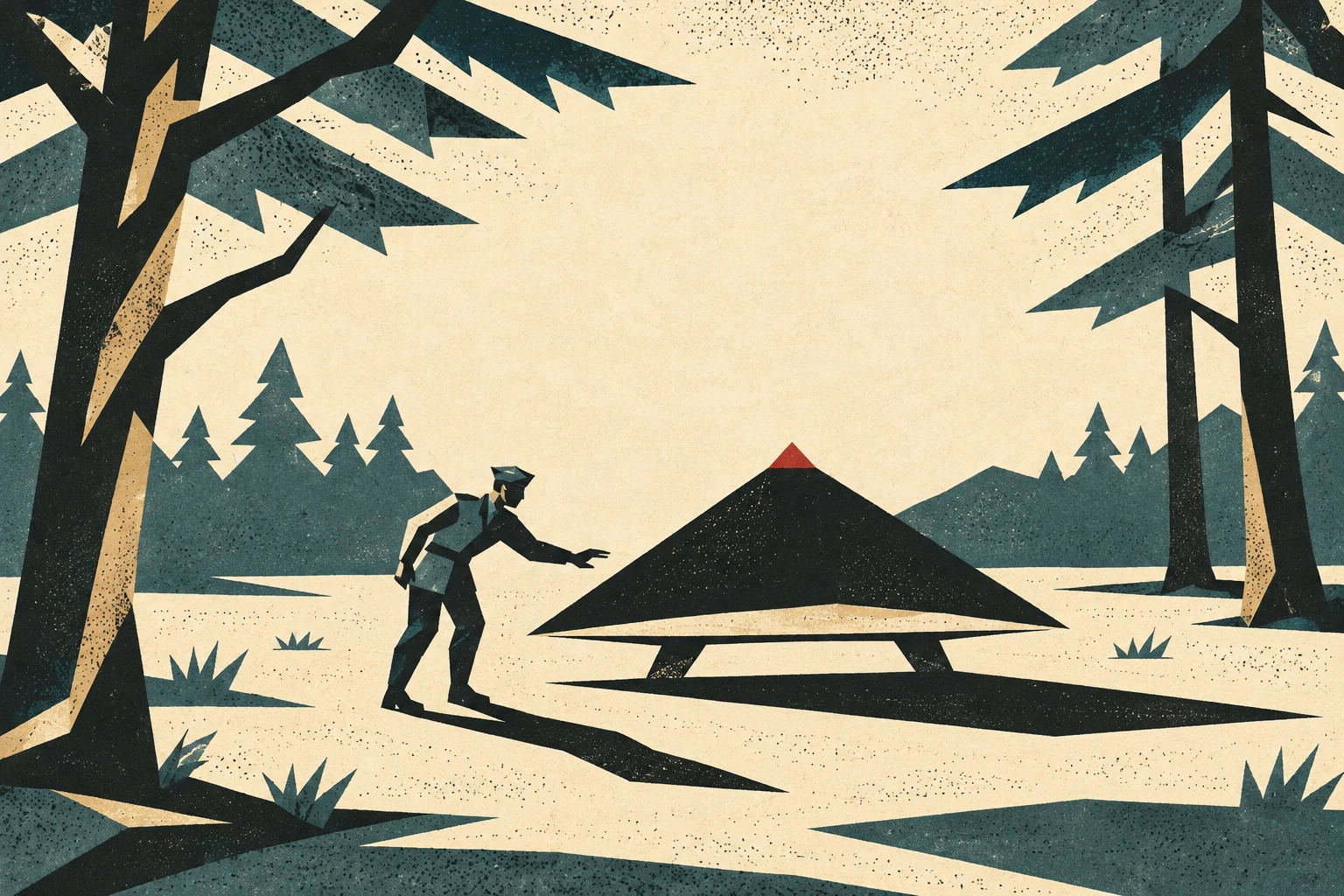
The later story is much easier to picture. In Penniston’s expanded account, a small triangular craft stood in a clearing, covered in unfamiliar symbols, and he walked right up to it, recorded details in a notebook and watched it leave. The notebook promised to make a fleeting encounter solid, because it suggested a witness had stopped to document the object while it was still in front of him.2
Beside that, the early typed Penniston statement is strikingly restrained, reporting a mechanical object giving off red and blue light and saying that about 50 metres was as close as he came. Chandler’s radio account from the time supports that distance, and neither describes the long, hands-on inspection that later made the story so distinctive.3
The typed statement is not a dated notebook page shown to have been written in the clearing. Georgina Bruni, who reproduced it, noted that Penniston questioned its typed form while accepting that its contents seemed original. A transcription or summary can lose detail. That leaves room for doubt, but it cannot supply all the details the document lacks.3
The notebook was shown in a 2003 television documentary. Penniston’s project later answered criticism of its date: in a 2022 account, he said the number read as 27 was really a 29, written as a reminder about a planned exercise before the encounter, and that he then used the same page for notes on the night. That is his explanation of the disputed entry, not independent dating of the ink. Burroughs said he did not remember Penniston taking notes or carrying out a long inspection.27
The later story also grew through hypnosis. A transcript published by Penniston’s project dates one session to 10 September 1994. In it, he describes visitors from a distant human future, looking for material connected with reproduction, and says government agents knew about them and wanted conflicting accounts put about. The questions repeatedly introduce ideas of their own, including symbols, a repair programme and breeding stock. These exchanges are part of how the story developed, not a second sighting in the forest.8
The message in the notebook
In 2010, the encounter acquired a message. Penniston said that touching a symbol on the craft had sent a stream of ones and zeroes into his mind, which he later wrote in his notebook. His co-author, Gary Osborn, describes sixteen pages that were eventually decoded into text and seven sets of map coordinates. The first pages reached television through Ancient Aliens. One published transcription ends with “ORIGIN YEAR 8100”, inviting readers to conclude that the sender came from thousands of years in the future. A search for the meaning of some lights had become a search for the purpose of whoever sent the code.910
Osborn and Penniston published The Rendlesham Enigma in 2019. In a January 2023 essay, Osborn went further. He said the coordinates led him to a latitude at Giza which, combined with selected pyramid measurements, anticipated a later measurement of the inverse fine-structure constant, a number that describes the strength of electromagnetism. He suggested an intelligence able to send information back through time, perhaps a future human or an artificial-intelligence descendant.9
His proof depends on a series of choices: which coordinates to follow, how to adjust ancient sites for continental drift and which measurements to multiply. It also depends on the notebook pages having been written before the later measurements were known, and the calculation cannot date them. Neither binary code nor a reference to a physical constant shows who wrote a message or where it came from.9
Larry Warren took the story in a different direction: beings near a landed object, followed by claims of pressure and tampering with memory. His version divided opinion and is hard to square with the better-known witnesses. It remains his own claim, with no independent physical evidence in the material examined here. Merging it with Halt’s observations would create a new encounter out of accounts that do not agree.2
Supporters have understandably stressed how many servicemen were involved. Patrick Gross’s compilation of the case presents it as an exceptionally strong incident with several kinds of evidence. But a list of names is not a list of people who independently saw the same close encounter. A radio operator hearing a report, a man inspecting marks later and a patrolman approaching lights each have different evidence to offer.311
That is why the early roles matter. Chandler said he saw nothing himself after reaching Woodbridge, even though he relayed Penniston’s report and believed the men had met something unusual. Buran’s support for Penniston was a judgement of a colleague and of the account he heard. Both deserve to be recorded accurately. Turning either man into another witness to a landed craft would inflate the case at the expense of its witnesses.3

Who wanted it forgotten?
For those convinced that something extraordinary had happened, the official response became part of the mystery, since a senior officer had reported strange lights near military bases and attracted so little interest. The gap between the importance the witnesses gave their experience and the thin investigation that followed invited another explanation, that someone already knew what the lights were and wanted the matter closed.2
The Ministry of Defence concluded that the incident had no defence significance. The National Archives’ summary of the released files says the ministry had no evidence of unidentified radar contacts, and that it could not explain the incident. Both positions can be true at once. An office deciding whether there was a threat to British airspace did not need to identify every light to conclude that no military problem had been shown.12
It was a narrow institutional answer that could hardly satisfy anyone hoping for a full reconstruction of the night, and it left plenty of room to ask whether officials had investigated properly. But a poor investigation and a cover-up are different claims, and each needs its own evidence, so while the surviving correspondence shows an official response, it does not reveal an order to hide a recovered craft.1512
The claims of pressure on witnesses are more serious. Penniston described repeated interrogation and the use of a drug, and Cabansag said he had been ordered to sign a false statement. Other accounts said senior personnel had removed evidence. This article found no order, interrogation record or documented transfer of evidence from the time that would confirm such an operation. Claims made later cannot, by themselves, explain every discrepancy in the earlier documents.2
Colonel Ted Conrad, Halt’s superior at the time, gave David Clarke a conflicting account in 2010. He said people watching from Woodbridge could not see what Halt reported, and he dismissed the idea of a secret operation. His account also got the timeline and the police response wrong. It is a later counter-account, useful against claims that everyone agreed, but with the limits of any memory.6
Halt, for his part, has publicly maintained that the objects were extraterrestrial and accused British and American security services of spreading disinformation. The disagreement cannot be settled by siding with the higher-ranking officer or the more dramatic statement. A later sworn declaration can leave no doubt about a witness’s conviction. It cannot produce the missing photographs, measurements or independent sightings needed to test what it says.26
Some witnesses linked the lights to possible interest in the weapons stored at the bases. That idea offers a reason why a visiting intelligence might have chosen this spot, but it is an interpretation of the reports. Neither the fear of an air crash that sent the first patrol out nor the published memo shows a nuclear mission.12
What the official answer means: ‘Unexplained’ records that no identification was settled. ‘No defence significance’ records the ministry’s view of the threat. Neither phrase identifies an extraterrestrial vehicle.512
A battlefield in Suffolk
Nick Redfern offered a different explanation for the contradictions. In his 2020 book The Rendlesham Forest UFO Conspiracy, the encounter became a psychological-warfare experiment carried out on military personnel. In an interview on 17 May, he described holographic displays combined with mind-altering drugs, meant to test how people reacted to shocking battlefield experiences. Secrecy would protect a human weapons programme.13
Redfern was clear about one ingredient that is often misreported. On his own blog on 20 May 2020, he denied claiming that LSD had been used at Rendlesham. He said his interviewees described an airborne mind-altering substance and an operation run by Porton Down. He had mentioned a 1964 LSD test elsewhere as a precedent for military experiments, not as the agent supposedly used in Suffolk.14
He also dealt with reports of radar contacts by pointing to electronic deception. In an extract from the book posted online, he drew on the CIA engineer S. Eugene Poteat’s account of creating false radar targets. He suggested that radar operators could have been fooled along with the men in the forest, but offered no operational record linking that capability to these nights.14
The theory was a change of course for its author. In a June 2020 reply on Kevin Randle’s blog, Redfern said he had still favoured a UFO explanation when he wrote A Covert Agenda in the 1990s. Randle reported that Burroughs had separately discussed a military-experiment explanation, though Redfern said he had not interviewed him for the new book. The two had reached similar conclusions without the collaboration Randle had assumed.15
Tony Eccles’s review for the British UFO Research Association was sympathetic to exploring the idea. Its main criticism was specific: the book did not show how the supposed operation had been planned and carried out. The material examined here contains no tasking order, named operational team or tested equipment for such an experiment. Redfern’s idea explains how the men might sincerely report a staged deception, but it does not show that the deception took place.16
Burroughs went on developing a technological explanation. His 2025 book with Toby Martinez, Rendlesham Signals from the Threshold, described a wider race involving technology linked to unidentified anomalous phenomena, or UAP, and weapons that act on the brain. Their project website ties the Suffolk case to that argument. The book shows where his later research has gone, but its claims are not the findings of an official inquiry.1718
The written notes for an Earthfiles interview dated 11 June 2025 attribute an even stranger idea to Burroughs: “The light is the life form”. They also attribute to him a claim that nuclear capabilities were shut down. Those are later claims by a participant, preserved in the programme’s summary. They do not appear in the patrol statements or Halt’s memo, and the notes offer no operational evidence of any shutdown.19
Back among the pines
Rendlesham is now a place people can walk through on a marked route. Forestry England advertises a UFO trail through woodland, heath and wetland, taking visitors through some of the areas linked to the 1980 sightings.20
As of 7 November 2026, the documents examined for this article support a clear outline. American servicemen investigated unusual lights after Christmas. The first patrol’s records include a belief that they had seen a mechanical object and the recognition of a distant beacon. Halt later inspected the alleged marks, watched lights and made a broken recording, and his memo carried both episodes into official correspondence. What the men actually experienced is still disputed.134
Visitors now follow purple waymarkers along the three-mile trail. Away from the path, the central written record is still Halt’s single page, setting out the first patrol’s reported object, the marks examined afterwards and the lights he watched himself, and its last paragraph places his own observations beside the reports that brought him into the woods.120
Linked case files



Sources20
- Unexplained Lights: memorandum, 13 January 1981 Charles I. Halt / USAF, released through FOIA 97-F-1677 · 1981-01-13 · Accessed 2026-11-07
- Rendlesham Forest UFO: The Christmas Invasion The Unredacted · 2017-03-19 · Accessed 2026-11-07
- USAF patrol statements reproduced in You Can’t Tell the People Fred Buran, J. D. Chandler, John Burroughs, Jim Penniston and Edward Cabansag / reproduced by Georgina Bruni · 1981; book 2000 · Accessed 2026-11-07
- Transcript of Colonel Halt’s tape, annotated by Ian Ridpath Charles Halt and party; transcription and commentary Ian Ridpath · 1980-12-28; transcription undated · Accessed 2026-11-07
- Unidentified Flying Objects: National Archives research guide The National Archives / David Clarke · 2011-08 · Accessed 2026-11-07
- Rendlesham Forest UFOs: police logs and Ted Conrad’s account David Clarke, with Suffolk Constabulary log extracts and Ted Conrad testimony · Police logs1980-12-26; Conrad2010-01-15; report subsequently updated · Accessed 2026-11-07
- Jim Penniston’s Notebook Jim Penniston / participant project blog · 2022-03 · Accessed 2026-11-07
- Jim Penniston Hypnosis September10,1994 Jim Penniston; transcript reproduced by participant project, from Linda Moulton Howe · session dated1994-09-10; posting2022-04 · Accessed 2026-11-07
- How the Rendlesham Binary Code Message AUTHENTICATES itself Gary Osborn · 2023-01 · Accessed 2026-11-07
- Origin Year8100: An Alien Message from the Future? Rob Schwarz / Stranger Dimensions · 2020-05-19;updated2026-04-07 · Accessed 2026-11-07
- The Woodbridge / Rendlesham incidents,UK,1980 Patrick Gross · undated · Accessed 2026-11-07
- 2009 UFO files release transcript: Rendlesham The National Archives · 2009-08 · Accessed 2026-11-07
- Rendlesham UFO Conspiracy / Consciousness & Remote Viewing Coast to Coast AM; George Knapp interviews Nick Redfern · 2020-05-17 · Accessed 2026-11-07
- The Latest on Rendlesham Forest: author’s clarifications Nick Redfern · post2020-05-12;authorcomments2020-05-20 · Accessed 2026-11-07
- X-Zone Broadcast Network: Nick Redfern Kevin Randle; authorcomment Nick Redfern · 2020-05-28;reply2020-06-08 · Accessed 2026-11-07
- New book explores military activity at Rendlesham Forest Tony Eccles / BUFORA · page2025-02-16; reviews2020book · Accessed 2026-11-07
- Rendlesham Signals from the Threshold: project website John Burroughs and Toby Martinez project · undated;2025book corroborated by29July2025show notes · Accessed 2026-11-07
- Show682 Notes: John Burroughs & Toby Martinez Podcast UFO · 2025-07-29 · Accessed 2026-11-07
- Ep138: UFO/UAPs not only watch us, but are tuning us? Earthfiles / Linda Moulton Howe; John Burroughs interview · episode2025-06-11 · Accessed 2026-11-07
- UFO trail at Rendlesham Forest Forestry England · undated · Accessed 2026-11-07